By Piranha Profits Team
Last updated on February 06, 2026
Microsoft (MSFT) reported earnings on 29th January 2026, with GAAP net income and EPS both growing 60% Year on Year. Following the earnings release, stock price was down roughly 12%, as investor attention appeared to shift towards future obligations tied to OpenAI.
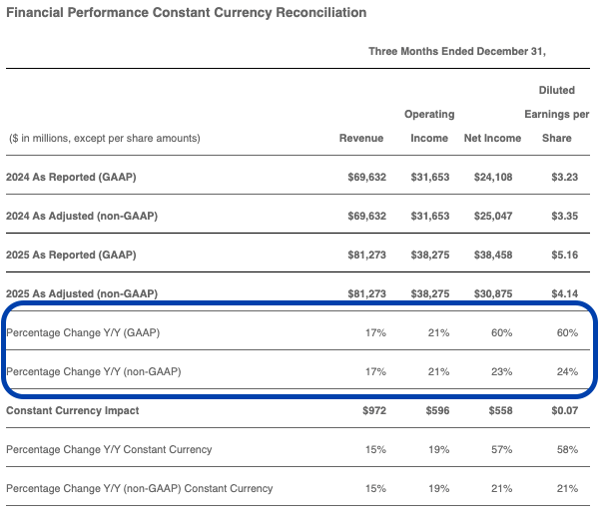
Source :https://www.microsoft.com/en-us/investor/earnings/fy-2026-q2/press-release-webcast
In Microsoft’s press release it was disclosed that OpenAI-related investments lowered GAAP earnings by approximately $7.6 billion in 2025.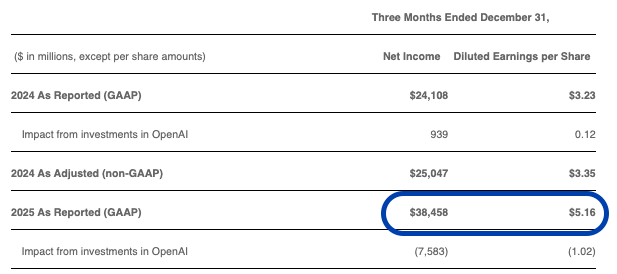
Source: https://www.microsoft.com/en-us/investor/earnings/fy-2026-q2/press-release-webcast
For a mega-cap stock like Microsoft, the market reaction seems to reflect a growing concern with revenue tied to OpenAI. Continued investment in OpenAI, has yet to translate into proportional financial returns, prompting investors to reassess the quality and visibility of near-term cloud revenues rather than the company’s long-term direction.
With pressure on OpenAI. CFO Amy Hood revealed that roughly 45% of Microsoft’s future contracted revenue is from OpenAI, a clear signal that future performance is increasingly reliant on their AI investments.
However, it’s still important to take into consideration that Microsoft’s Cloud segment, which contributes over 30% of total revenue, continues to be the company’s main growth engine. CEO Satya Nadella highlighted that “Microsoft Cloud surpassed $50 billion in revenue for the first time, up 26% year over year,” pointing to sustained enterprise demand across its cloud and AI stack.
Microsoft(MSFT) Stock Analysis with StockOracle™
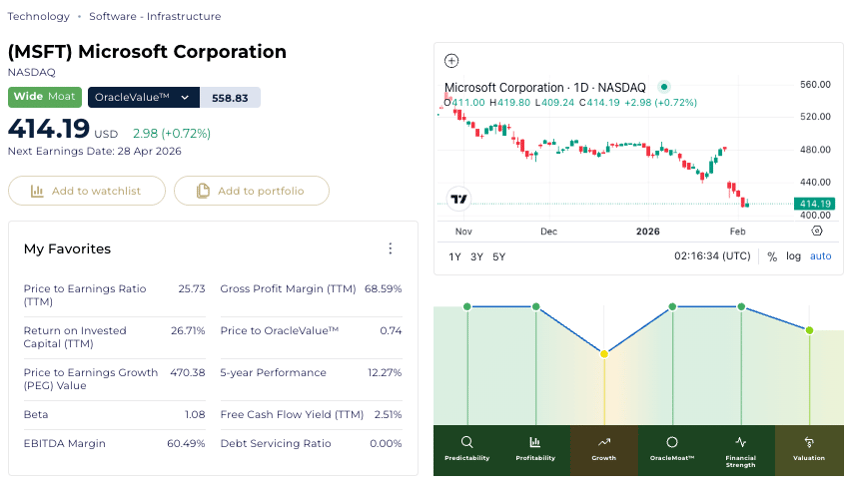
Microsoft (MSFT) powered by StockOracle™ - 5th Feb 2026
MSFT is currently trading at a Price/OracleValue™ estimate of 0.74 on 5th February 2026, indicating the stock’s OracleValue™ is estimated to be priced attractively based on OracleValue™’s model.
StockOracle’s OracleIQ™ Analysis on Microsoft (MSFT)
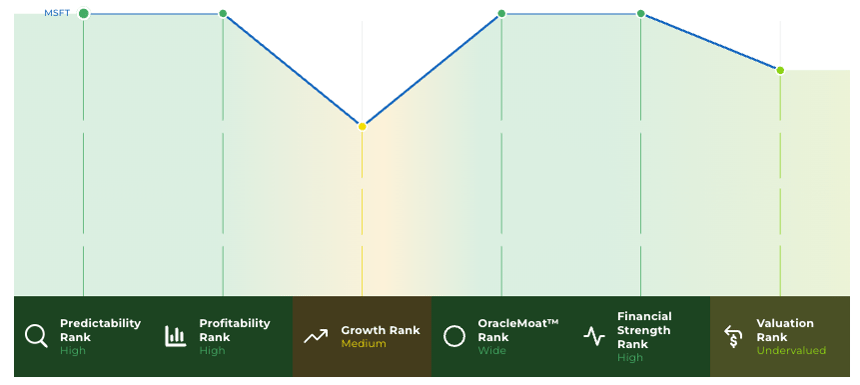 Microsoft (MSFT) OracleIQ™ powered by StockOracle™ - 5th Feb 2026
MSFT’s OracleIQ™’s profile reads like a classic hyperscaler in its “grown-up” phase: high predictability, high profitability, wide moat, strong financial strength, and medium growth.
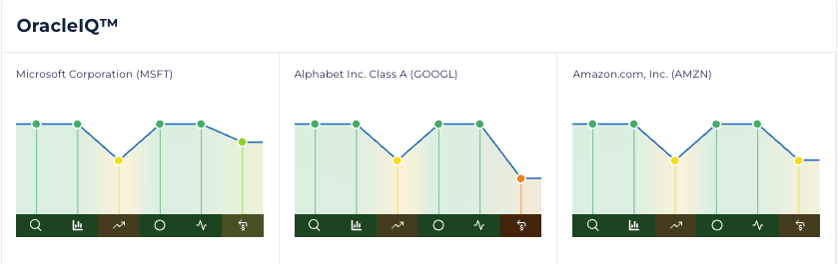
Microsoft(MSFT) , Alphabet(GOOGL), Amazon(AMZN) OracleIQ™ comparison powered by StockOracle™ - 5th Feb 2026
Find out other hyperscalers like Meta, Apple , Tencent and Alibaba OracleIQ for Free.
When compared with other hyperscalers such as Alphabet and Amazon, clear similarities emerge in how these large-scale platforms profiles are :
- GOOGL looks similar in quality: strong margins, strong balance sheet, and a wide moat, but growth usually sits in the medium zone because the base is already considerably huge.
- AMZN also shares the “scale makes growth harder” trajectory: more reinvestment-heavy, typically with medium growth expectations.
In conclusion, MSFT shows “medium growth” because that’s basically the hyperscaler template once you’re already gigantic: growth normalises, durability remains.
Calculating Intrinsic Value of Microsoft(MSFT) with StockOracle™ Intrinsic Value Calculator
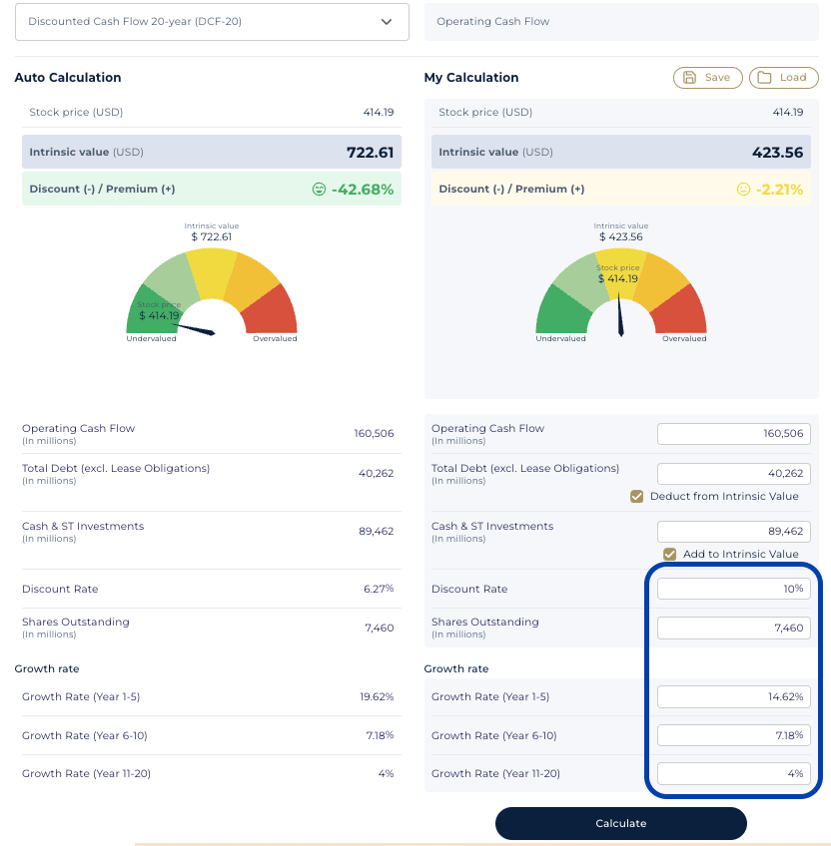
Valuation Calculation of Microsoft (MSFT) powered by StockOracle™ - 5th Feb 2026
All growth rates and valuation outputs shown are hypothetical model inputs and not in any way a representation of forecasts or future performance.
Don’t borrow Wall Street’s assumptions. Calculate MSFT’s intrinsic value your way. 7-day free trial.
The intrinsic calculator shows how sensitive Microsoft’s valuation is to changes in assumptions using the 20-year discounted cash flow model. By adjusting the discount rate and 1-5 years growth rate, the model attempts to reflect current investor concerns around OpenAI’s ability to deliver meaningful performance in the short term.
Microsoft’s near-term growth rate is reduced to 14.62% from an optimistic 19.62%, the discount rate is also widened from 6.27% to 10%. These changes reduce the intrinsic value closer to the current market price, shifting the stock closer to fair value using the DCF-20 model.
The point isn’t whether the assumptions are perfectly conservative, but how exposed Microsoft’s valuation is to shifting expectations. StockOracle™ lets investors stress-test that valuation by adjusting growth assumptions across different valuation models.

This analysis is shared for educational purposes to illustrate how markets and valuation models react to new information. It is not intended as financial advice or a recommendation on any investment.
Related

For most of its 24-year life, the company was private. The figures floating around came from leaks, ...

A business that still earns a 22.8% return on invested capital, carries no interest-bearing debt, ...

Home Depot trades at 21.95 times trailing earnings, a multiple that assumes the growth engine ...