By Piranha Profits Team
Last updated on September 24, 2026
Boeing and Airbus both want to build more single-aisle jets faster, and both are waiting on the same bottleneck: CFM International, GE Aerospace's joint venture with Safran, which lifted LEAP engine deliveries 41% in the first half of 2026 but still can't clear a backlog where spare-parts delinquencies grew 20% even as orders for those same parts grew 34%.
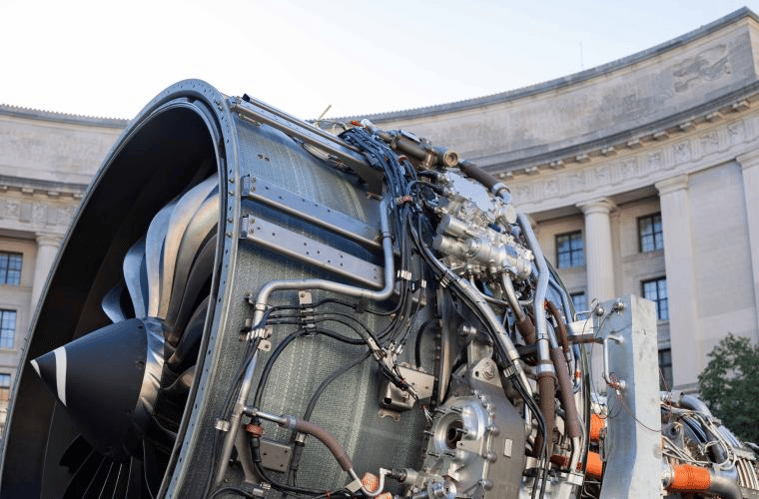
The constraint isn't whether airlines want GE's engines. It's whether GE can ship parts and engines fast enough to convert a $210 billion backlog into cash before the market finishes deciding what GE Aerospace is actually worth.
GE Aerospace is what's left of General Electric after the conglomerate spun off GE HealthCare in January 2023 and GE Vernova in April 2024, leaving a standalone jet engine and defense propulsion business. That matters for how this analysis should be read: GE Aerospace's revenue base, at $50.64 billion trailing twelve months, is the standalone aerospace unit's own figure.
It runs on a razor-and-blade model, selling engines near cost, then collecting decades of high-margin service and spare-parts revenue afterward, which makes GE stock valuation harder than a typical industrial: most of the value sits in cash flows the backlog hasn't delivered yet.
What is GE Aerospace's intrinsic value?
Intrinsic value is an estimate of what a business is actually worth based on the cash it can realistically generate over time, not whatever multiple the market happens to be paying today. For an annuity-style aftermarket business like GE Aerospace, that estimate depends heavily on how fast the current engine-delivery and spare-parts backlog actually converts into recognized cash flow.
GE Aerospace's Fair Value: What StockOracle's Models Say
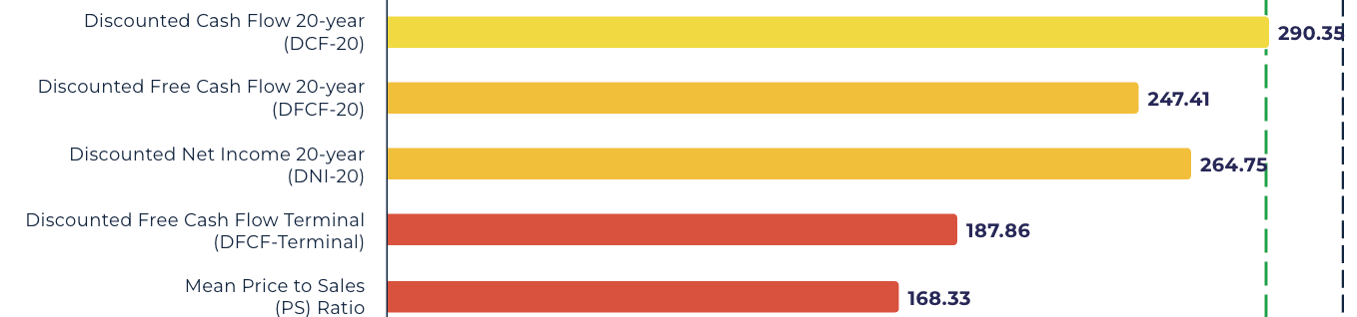
StockOracle's 20-year discounted cash flow model (DCF-20) puts GE Aerospace's fair value near $290.35 per share, built on the company's trailing free cash flow, its projected long-term EPS growth of 15.21%, and StockOracle's current weighted average cost of capital for GE of 12.57%.
Every cash-flow and earnings-based model StockOracle runs, from $141.81 to $290.35, sits below where GE Aerospace trades today, a gap wide enough across every lens to require an explanation.
The bull case for closing that gap: roughly 81% of the $210 billion total backlog, about $170 billion, is commercial services, an unusually large, already-booked revenue base for a cash-flow model to lean on, and GE has raised full-year guidance in back-to-back quarters.
The bear case: GE Aerospace trades at 39.48 times trailing earnings against a 36.77 forward P/E, and its enterprise value runs to 157.56 times EBIT and 140.36 times EBITDA, those multiples usually only make sense if the backlog conversion beats expectations for years.
Because GE Aerospace runs on an annuity-like services model, the backlog itself is worth reading as a second, supplementary lens alongside these models.
The $170 billion commercial services backlog, StockOracle's Rule of 40 score of 40.82% for GE (combining projected revenue growth and free cash flow margin), and a projected 3-5 year EPS growth rate of 15.31% all point the same direction: a business whose near-term growth math is unusually strong for an industrial, only if the delivery ramp holds.
GE Aerospace (GE) Financial Performance
Revenue Growth: A Standalone Entity, Or a Shrinking Conglomerate?
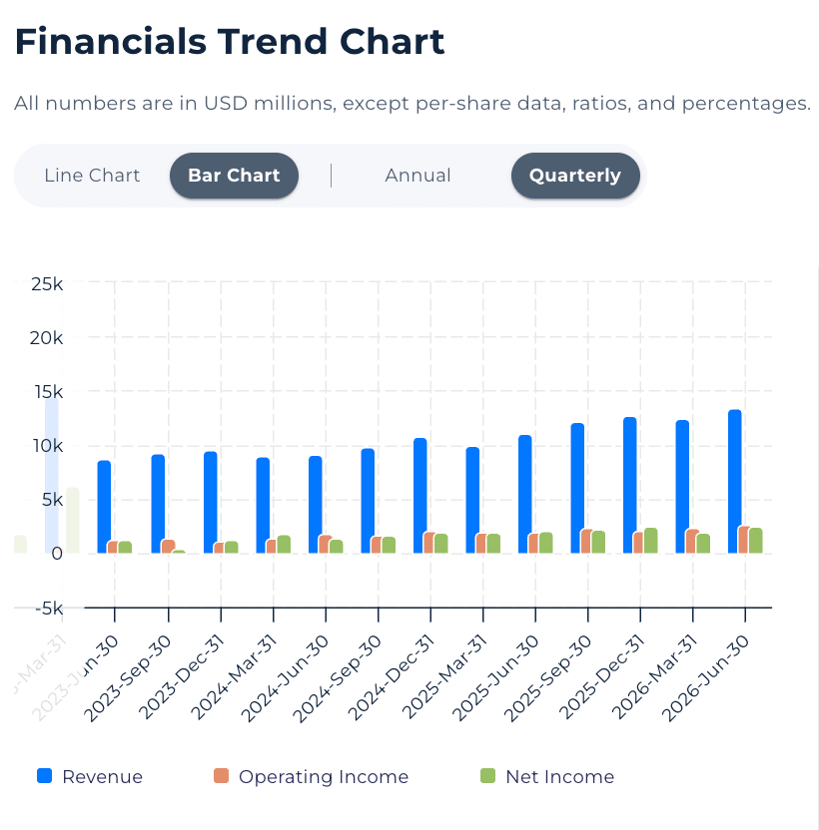
GE Aerospace's trailing twelve-month revenue reached $50.64 billion, up from $45.86 billion in fiscal 2025 and $38.70 billion in fiscal 2024, roughly an 18% step up from FY2024 to FY2025 alone.
Longer-window revenue growth figures, -9.57% over five years and -8.86% over ten, look like decline on the surface, but they're measuring a company that no longer exists in that form: GE HealthCare left the consolidated financials in January 2023 and GE Vernova left in April 2024, so those windows compare today's standalone aerospace unit against a multi-segment conglomerate's historical revenue base.
Read from the point the standalone entity actually started reporting, the trend runs the other way. Forward estimate of 10.72% projected revenue growth reflects that trajectory rather than the historical spinoff distortion.
Free Cash Flow: The Line the Fair-Value Estimate Leans On
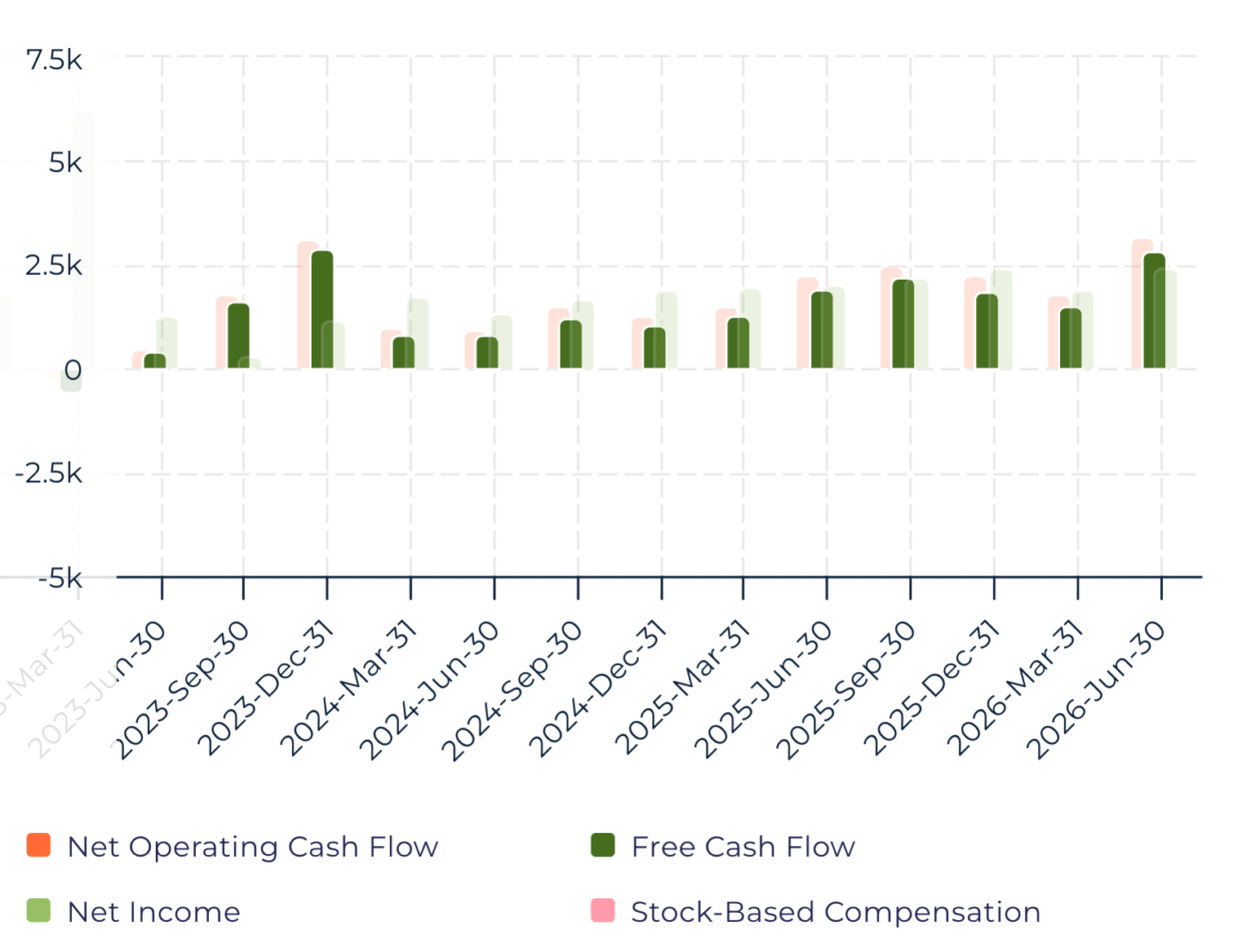
A discounted cash flow model is ultimately a bet on one number: how much cash the business will throw off, year after year. GE Aerospace's trailing free cash flow sits at $8.40 billion, up from $7.26 billion in fiscal 2025, a margin of 16.58%, meaning roughly 17 cents of every revenue dollar comes home as real cash after operations and capital spending. That's the line StockOracle's $290.35 DCF-20 estimate is built on, and its direction, expanding faster than the underlying revenue base, is what gives that estimate its near-term support.
Installed Base and Backlog: The Razor-and-Blade Math Behind the Numbers
GE Aerospace supports roughly 80,000 engines already flying, and that installed base is the actual annuity behind the intrinsic value question. Total backlog exceeds $210 billion, of which about $170 billion is commercial services, meaning the overwhelming majority of what's already booked is future aftermarket revenue rather than new-engine cash.
The razor-and-blade logic is straightforward: GE and CFM sell engines at thin or near-zero margins to win the aircraft platform, then spend the next 20 to 30 years selling the spare parts and shop visits that engine requires, at far higher margins than the original sale ever carried. The rule of 40 read (40.82%), a combined growth-and-cash-conversion score more commonly applied to software businesses, says that aftermarket mix could already be contributing to real operating leverage.
Returns on Capital: A Signal the Mix Shift Is Already Paying Off
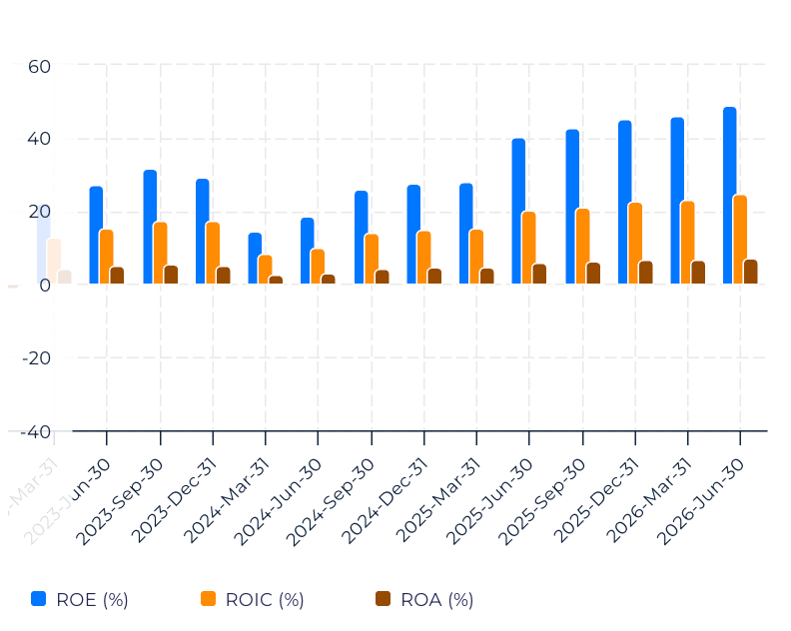
Return on equity (TTM) sits at 48.75%, well above its own five-year average of 18.72%, and return on invested capital (TTM) sits at 24.71%, more than double its five-year average of 10.28%. Both figures running that far above their own trailing averages points to operating leverage from the services mix, though it's also a reminder of how much the post-spinoff transition has distorted the longer-run comparison.
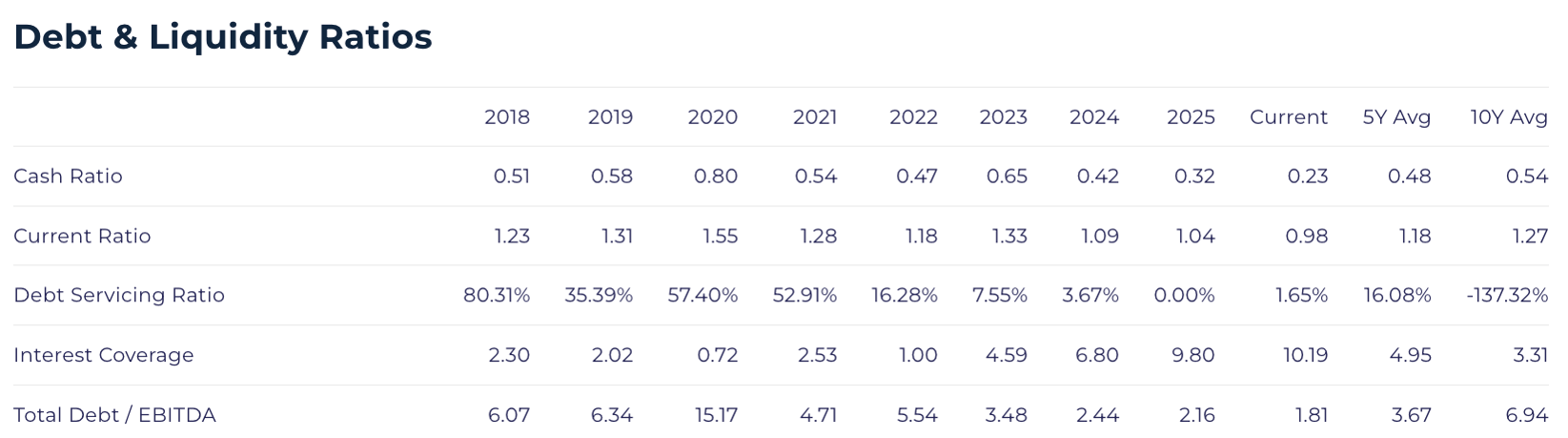
The balance sheet backs that read. Debt-to-EBITDA has fallen to 1.81x, with interest coverage at 10.19x, a stronger capital structure than the entity carried through most of its pre-spinoff history.
Shareholder Returns: Buybacks Funded By, Not Ahead Of, Cash Generation
GE Aerospace's dividend yield sits at 0.50%, with trailing dividends per share of $1.66 and a payout ratio of just 19.57% of earnings, leaving the large majority of free cash flow available for reinvestment or buybacks.
GE Aerospace has also reported repurchasing 4.2 billion of stock in the first half of 2026. Each dollar returned this way, rather than borrowed against, means existing shareholders keep a larger claim on the aftermarket cash flows the fair-value models above are actually pricing.
Growth Catalysts
LEAP engine deliveries rose 41% in the first half of 2026, with spare-parts orders growing 34% even as delinquencies on those same parts grew 20%. Defense & Propulsion Technologies orders grew 12% to $4.1 billion, with segment revenue up 16% to $3.4 billion.
Management also raised full-year operating profit guidance to $10.55 billion to $10.75 billion, up from a prior $9.85 billion to $10.25 billion.
GE9X, the exclusive powerplant on Boeing's 777X, reportedly carries more than 600 orders and targets first delivery to Lufthansa in early 2027, a program still a near-term margin headwind but one management expects to normalize as production costs come down.
Lastly, projected 3-5 year EPS growth of 15.31% and projected 3-5 year cash-flow-per-share growth of 15.28% track close to each other, a sign the earnings growth priced into consensus estimates is expected to show up in cash.
Economic Moat: Why GE Aerospace's Engine Business Is Hard to Dislodge
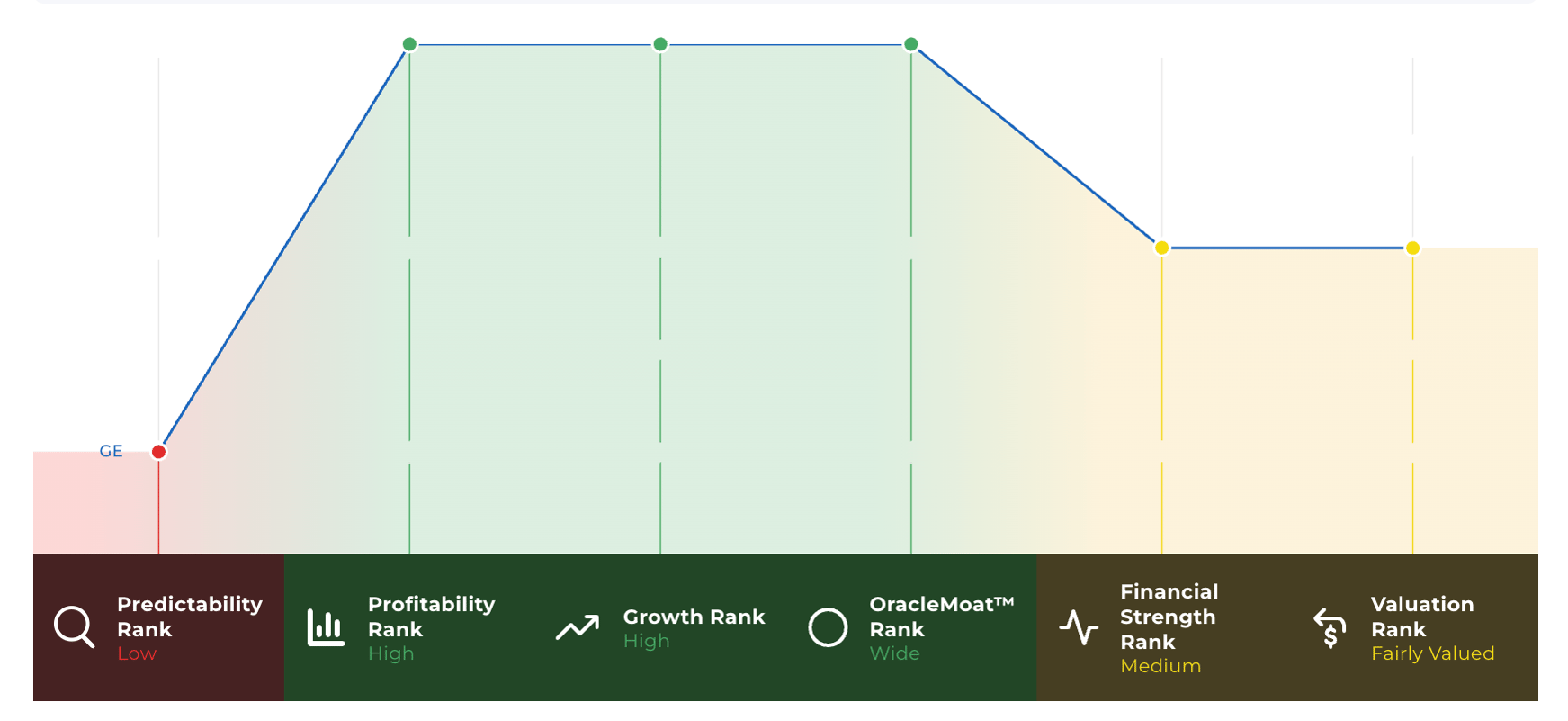
GE Aerospace is rated a Wide Moat business. That rating rests less on any single piece of engine technology and more on a stack of structural barriers competitors have to work around rather than replicate.
 FAA and EASA type certification for a new commercial engine program can take a decade and billions of dollars, which keeps new entrants out entirely. Commercial engine sales come bundled with decades-long service agreements, so an airline that chooses GE, CFM, or GEnx power for a fleet is effectively locked into that engine family's parts and shop-visit ecosystem for the aircraft's operating life.
GE also controls the proprietary technical data and certified repair processes behind its own parts, which limits how much aftermarket work independent repair shops can perform without GE's involvement. Scale adds a further layer and it gives GE room to keep investing in that installed base rather than defending it defensively.
Rivals carry their own specific advantages, not a generic ability to copy GE's engines. RTX's Pratt & Whitney competes directly on the narrowbody engine GE and Safran build through CFM, with its geared turbofan technology on the PW1100G offering a real fuel-burn advantage on the Airbus A320neo family. Rolls-Royce holds an exclusive or near-exclusive position on several Airbus widebody programs through its Trent engine family, giving it deep OEM relationships GE has to compete for on future platforms rather than inherit.
Choosing an engine platform functions like a subscription an airline can't cancel: once a carrier standardizes pilot training, maintenance tooling, and spare-parts inventory around one engine family across its fleet, switching suppliers means re-certifying crews and rebuilding a parts supply chain from scratch.
Building Your Own GE Aerospace DCF
The $290.35 DCF-20 estimate leans on GE Aerospace's projected long-term EPS growth of 15.21%. A more conservative investor might reasonably trim that growth assumption toward GE's own five-year average ROIC of 10.28%, given the spare-parts delinquencies already noted above, or assume the durability-kit retrofit campaign, which management has said could run into the early 2030s, absorbs more cash than the base case assumes.
Explore GE Aerospace's valuation with a free StockOracle™ trial to run your own growth and discount-rate assumptions through the same 20-year structure.

Final Thoughts on GE Aerospace's Intrinsic Value
Trailing revenue of $50.64 billion grew from $45.86 billion in fiscal 2025 and $38.70 billion in fiscal 2024, a standalone-entity trajectory the headline five- and ten-year growth figures obscure because of the 2023 and 2024 spinoffs.
Free cash flow of $8.40 billion (a 16.58% margin) is growing faster than the top line, the number the fair-value estimate is actually built on.
GE Aerospace also scored a Wide Moat business, anchored in certification barriers, a roughly 80,000-engine installed base, and decades-long service lock-in once an airline standardises on an engine family.
The market's skepticism about GE Aerospace isn't really a question about sales. The $210 billion backlog already answers that. It's a question about how much of a still-unfolding, multi-year backlog conversion the market has already paid for at nearly 40 times trailing earnings.