By Piranha Profits Team
Last updated on September 18, 2026
For most of its 24-year life, the company was private. The figures floating around came from leaks, investor decks, estimates and pure rumours.
That changed on 12 June 2026, when SpaceX listed on the Nasdaq under the ticker $SPCX. The largest IPO in history. Roughly US$75 billion raised and it came with something far more useful to investors than a share price: audited financials, segment reporting, and a quarterly filing obligation.
So investors can finally stop guessing.
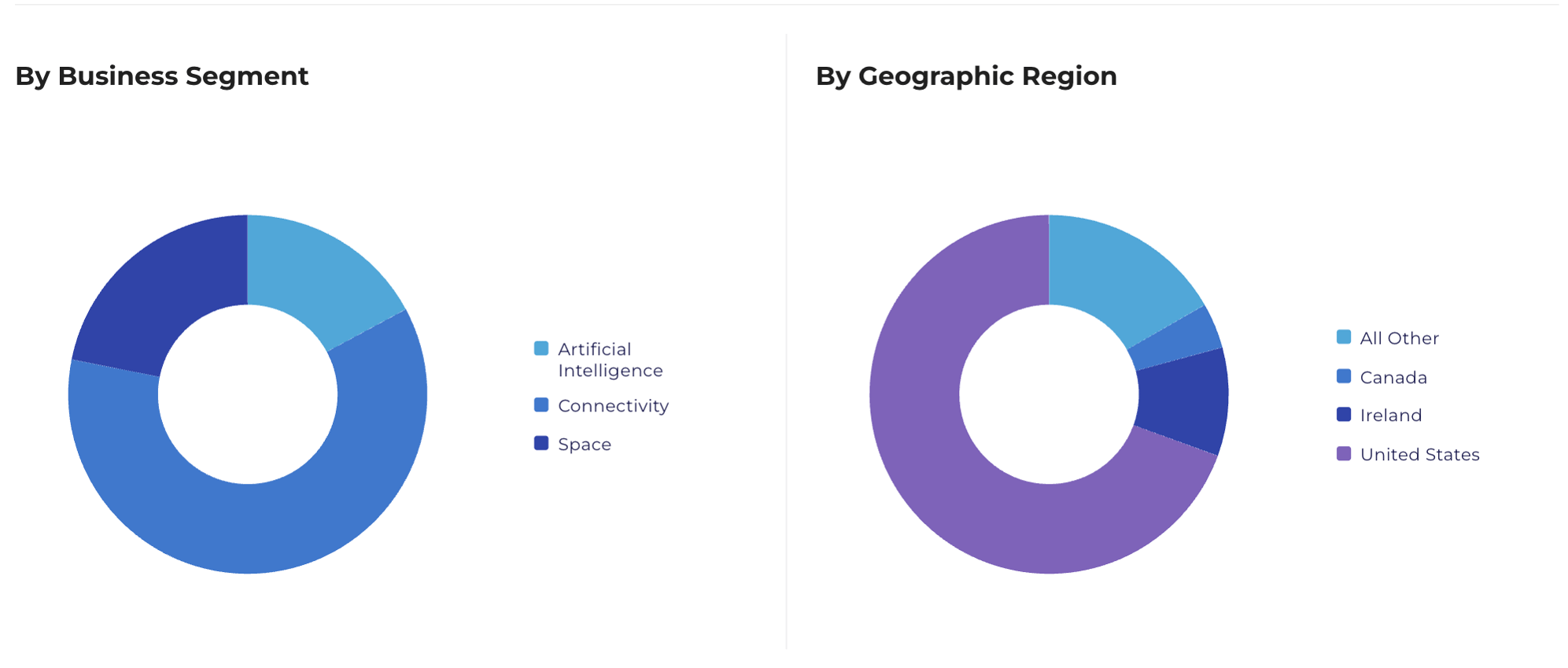
Now, here's the short version. SpaceX makes money from three reported business segments: Connectivity (Starlink), Space (rocket launches and government contracts), and AI (the xAI business it absorbed in February 2026).
In the most recent quarter, Connectivity did the heavy lifting. And it was the only segment that made an operating profit.
Let's break down each one, then look at what StockOracle™ shows about the business today.
The 30-second answer on how SpaceX makes money.
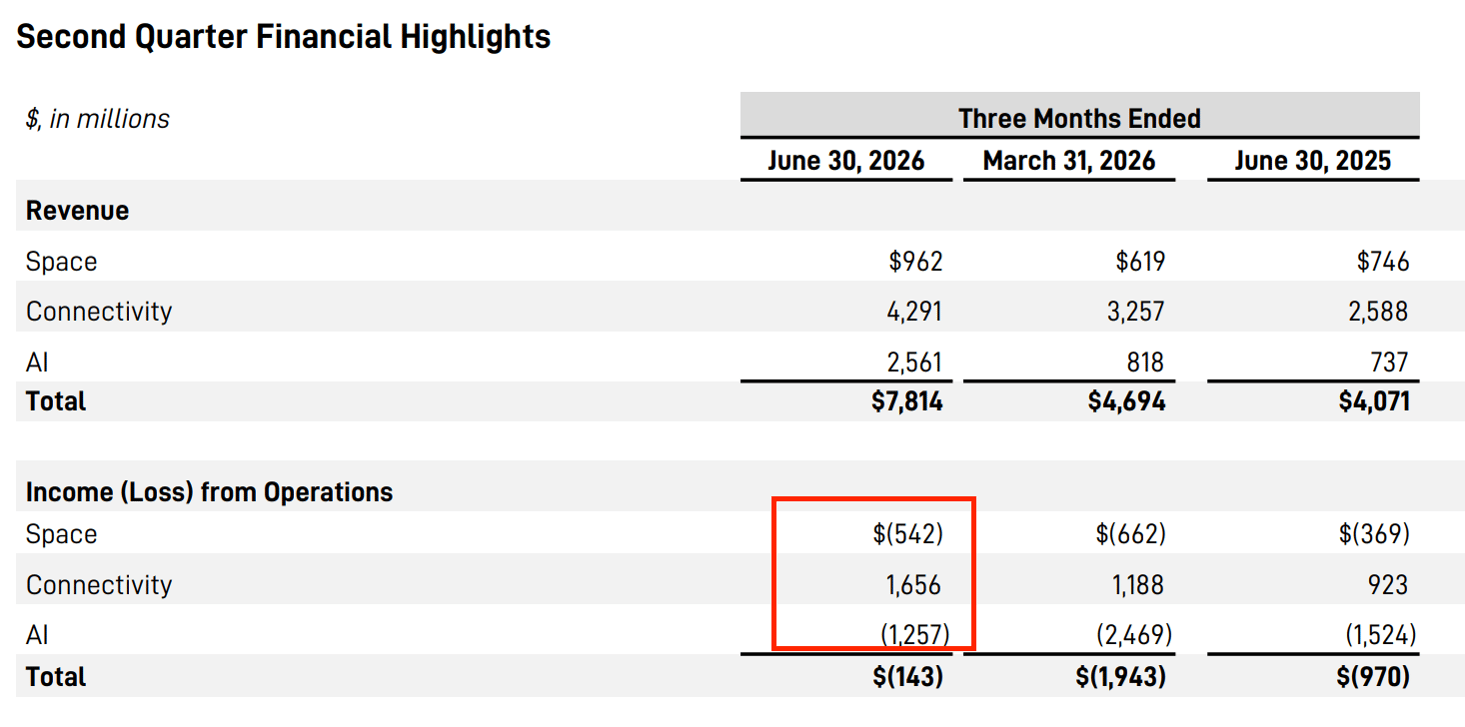
Based on SpaceX's Q2 2026 results, filed with the SEC on 4 August 2026:
|
Segment |
Q2 2026 revenue |
YoY growth |
Segment operating income |
|
Connectivity (Starlink) |
US$4.291B |
+66% |
+US$1.656B |
|
AI (xAI / Grok) |
US$2.561B |
+247% |
–US$1.257B |
|
Space (launch) |
US$962M |
+29% |
–US$542M |
|
Total |
US$7.814B |
+92% |
–US$143M |
Starlink is the cash engine. AI is the supposed growth engine. Rockets, the thing most people tend to associate with SpaceX.. are the smallest line and currently still lose money.
SpaceX ($SPCX) Revenue engine #1: Connectivity (Starlink)
Starlink is satellite broadband. Customers buy a dish, then pay a monthly subscription. It is the closest thing SpaceX has to a recurring-revenue software business, and it behaves almost like one.
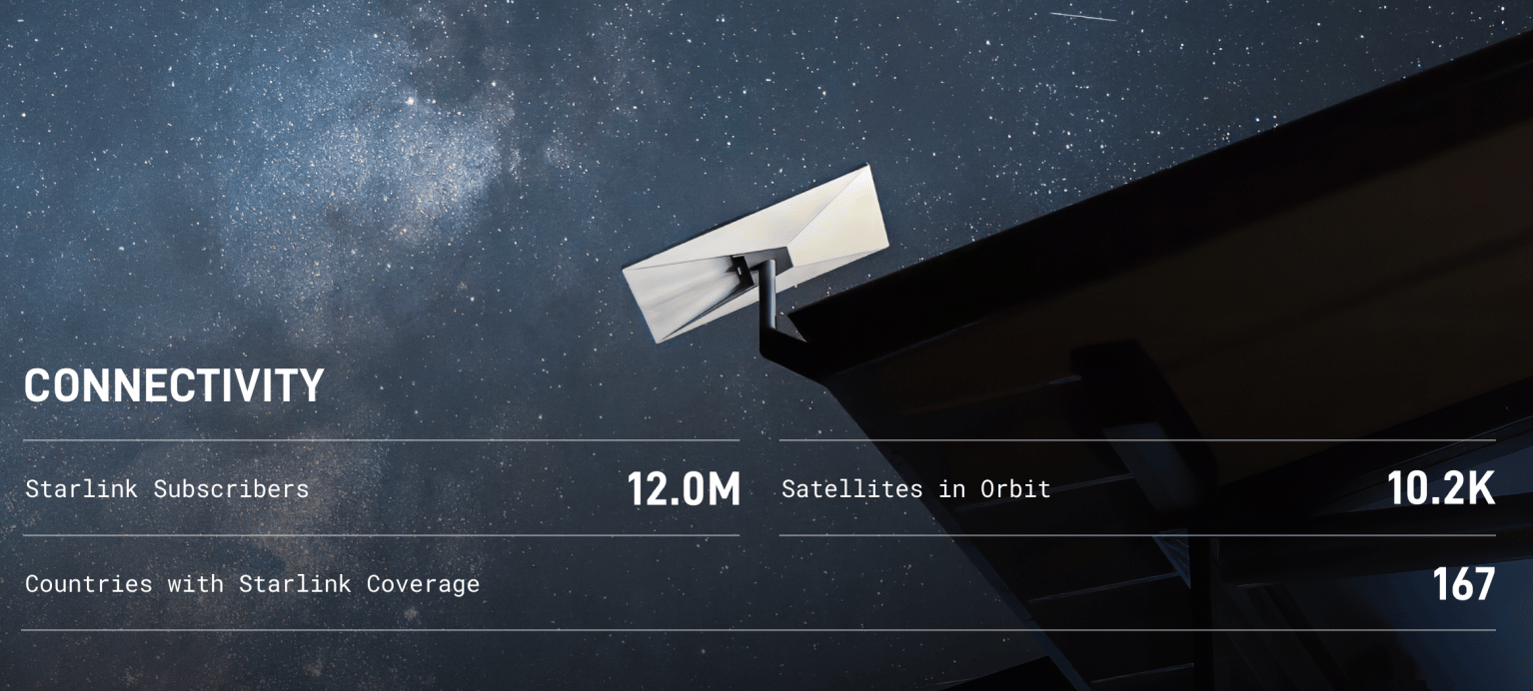
At the end of Q2 2026, SpaceX reported 12.0 million Starlink subscribers. That is double the 6.0 million a year earlier, at an average revenue per user of US$66 per month.
The segment splits into two halves that are closer in size than most people assume:
- Consumer: US$2.485B in the quarter. Households, RVs, boats, rural users in places terrestrial broadband never reached.
- Enterprise and government: US$1.806B. Airlines, maritime fleets, telcos buying backhaul, and defence agencies an area where switching costs tend to be higher.
The enterprise and government half matters more because those contracts are larger, stickier, and priced very differently from a US$66 home plan. Margins also vary for that segment of the business.
Connectivity is also the only segment producing actual operating profit: US$1.656 billion in Q2 2026, up from US$923 million a year earlier. Put another way, Starlink is currently funding the ambitions of the other two segments.
SpaceX ($SPCX) Revenue engine #2: Space (launches and government contracts)
This is the business most people picture when they hear "SpaceX". Falcon 9, Dragon, Starship, NASA astronauts, Space Force payloads.
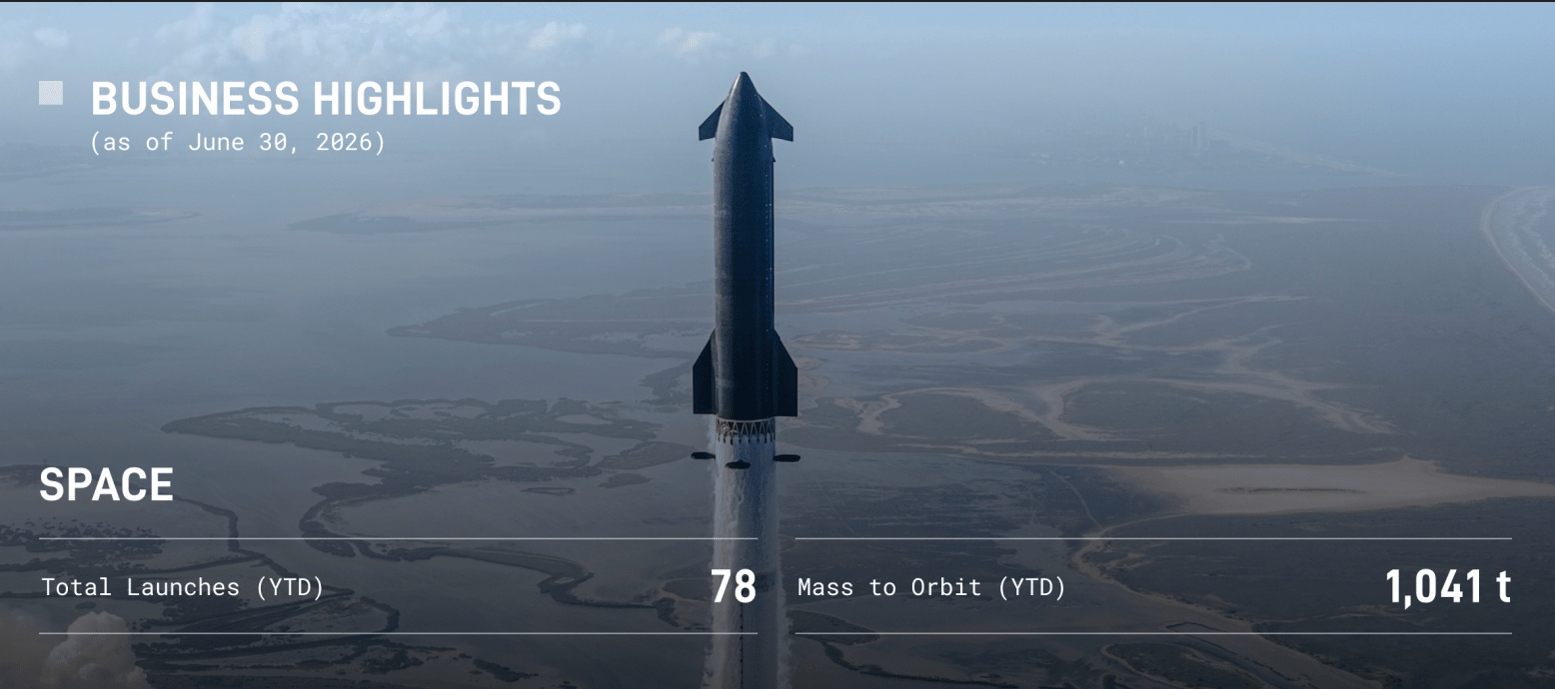
Space is the smallest of the three, at US$962 million in Q2 2026 (launch services US$648M, launch and development US$314M), growing a relatively modest 29%.
And it lost US$542 million at the operating line.
How can a launch business with a near-monopoly on Western orbital access lose money? Two reasons show up in the numbers:
- Starship development is expensed against this segment. Building a fully reusable super-heavy vehicle is enormously capital-intensive, and the spending lands before the revenue does.
- Launch is, structurally, a low-margin manufacturing business. Every Falcon 9 flight consumes hardware, propellant, range time and labour. Although reusability improved the economics dramatically, it did not turn rockets into software.
There is a strategic logic here that the income statement doesn't capture and is worth exploring. A large share of SpaceX's launch capacity flies its own Starlink satellites. Internal launch is a cost centre that makes the Connectivity segment possible at a price no competitor can match. That vertical integration is one of SpaceX’s real competitive advantages. But it just doesn't show up as segment profit just yet.
SpaceX also disclosed a US$47.5 billion backlog, which gives some visibility into contracted future work across the group.
SpaceX ($SPCX) Revenue engine #3: AI (xAI)
In February 2026, SpaceX combined with Elon Musk's AI company xAI in a deal valuing the merged entity at roughly US$1.25 trillion. Reported at the time as the largest merger ever announced. xAI's Grok models and cloud compute business now report inside SpaceX as the AI segment.
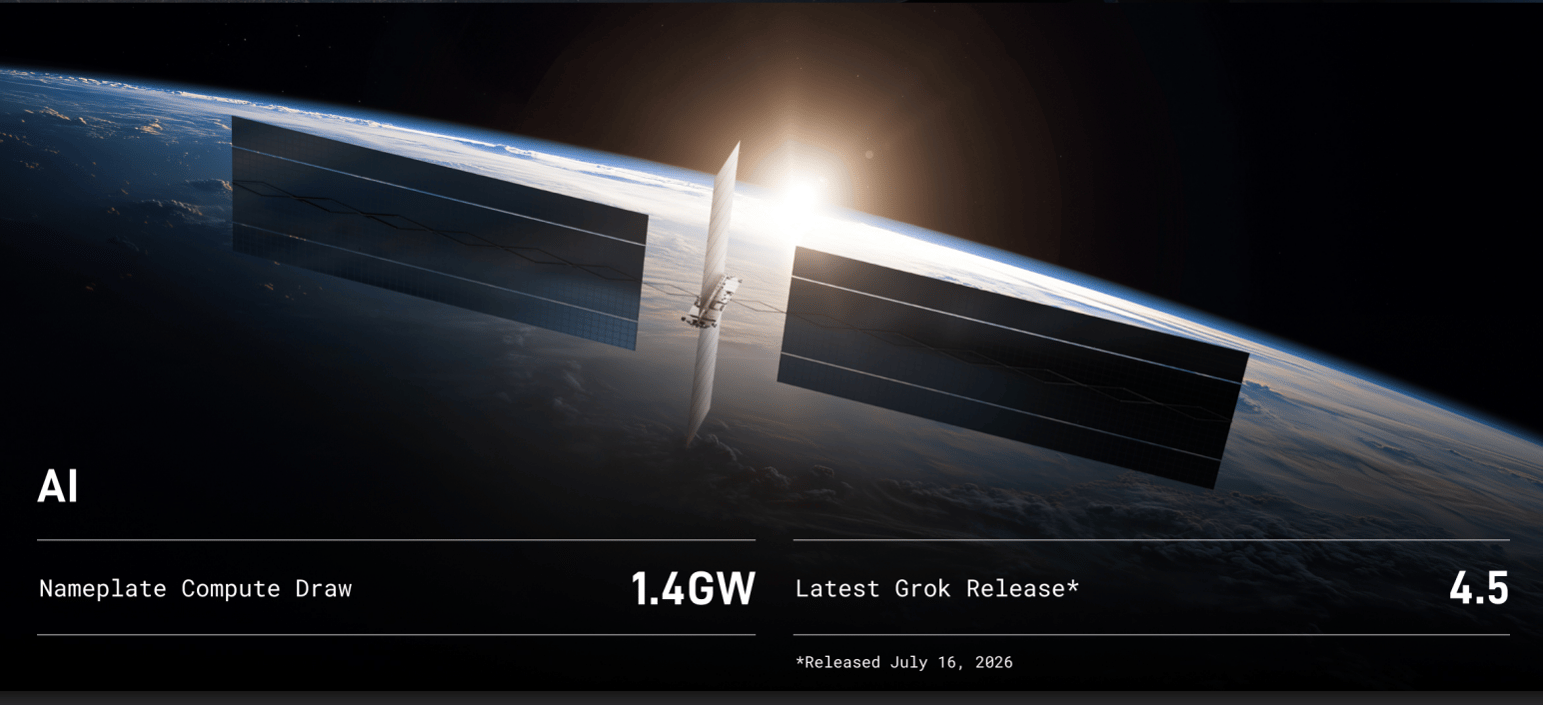
It is growing faster than anything else in the group: US$2.561 billion in Q2 2026, up 247% year on year, supported by what the company described as US$14.1 billion of contracted cloud sales.
It is also burning the most cash which many investors would argue that so does many of the other frontier models: an operating loss of US$1.257 billion in the quarter, and more significantly US$15.828 billion of the group's US$18.369 billion quarterly capital expenditure.
The AI segment is where the company is placing its largest bet, and it is being funded by Starlink's cash flow plus the enormous war chest the IPO provided. This could also be the largest factor when estimating SpaceX’s intrinsic value and where most investors will vary from another.
Revenue is not profit
SpaceX grew revenue from US$10.4 billion in 2023 to US$14.0 billion in 2024 to US$18.7 billion in 2025. Impressive by any standard.
Over the same period, the bottom line went the other way:
|
US$ millions |
FY2023 |
FY2024 |
FY2025 |
|
Revenue |
10,387 |
14,015 |
18,674 |
|
Gross profit |
4,277 |
6,019 |
9,223 |
|
R&D expense |
2,105 |
3,464 |
8,643 |
|
Operating income |
507 |
742 |
–2,064 |
|
Net income |
–4,628 |
98 |
–4,937 |
Source: StockOracle™
Looking at the R&D expense line, it went from US$2.1 billion to US$8.6 billion in two years, a bigger jump than the entire gross profit improvement. Starship, next-generation Starlink satellites and AI model training all sit in there.
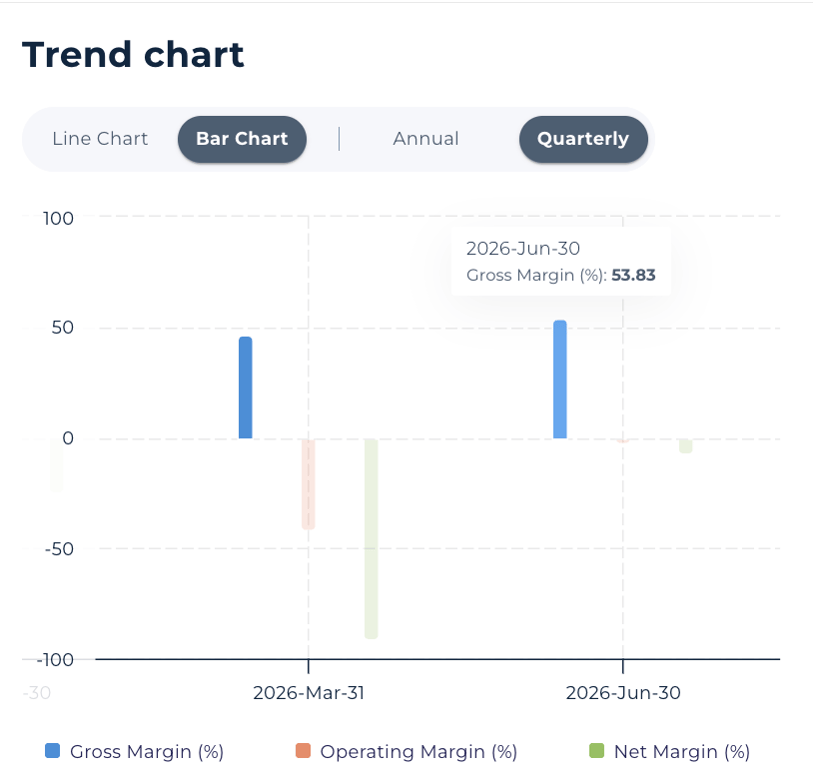
Gross margin was relatively healthy at 49.4% in FY2025. And it has been getting better since. Whether that spending eventually earns a return is the entire investment question, and it is genuinely unresolved and unpredictable.
The first half of 2026 remains to show the same pattern at greater scale: US$28.5 billion of capital expenditure against US$3.5 billion of operating cash flow, funded by US$100.3 billion of financing inflows from the IPO and bond issuance.
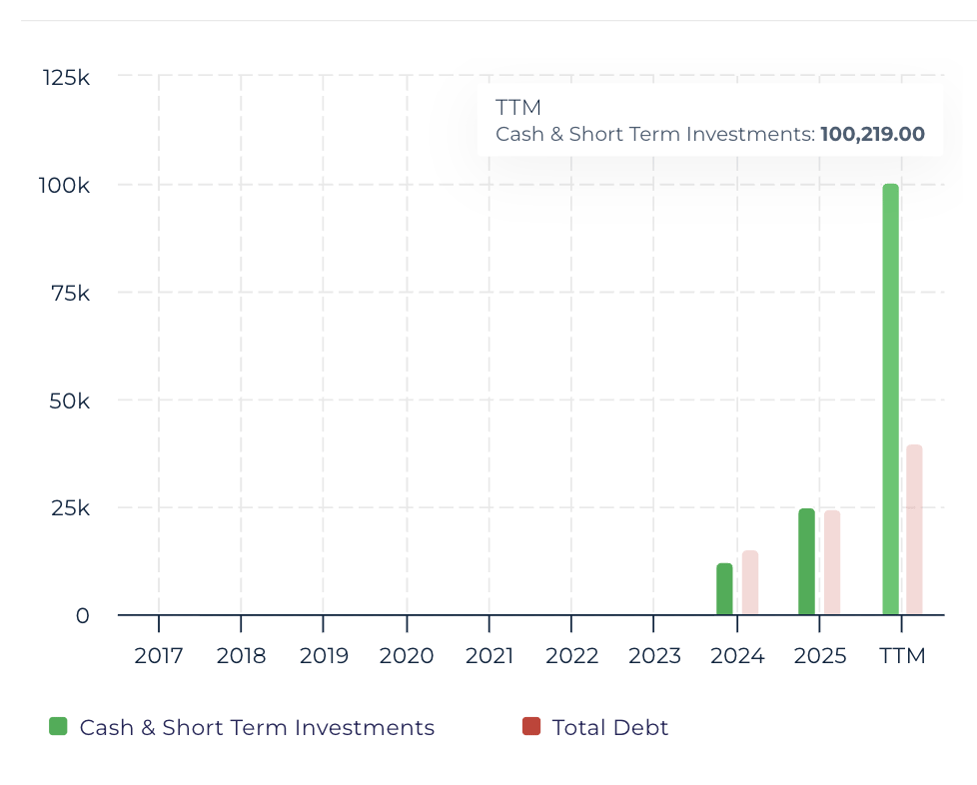
Cash and equivalents stood around US$100 billion at 30 June 2026.
What StockOracle™ shows about SPCX right now
Knowing how a company makes money is step one. Knowing what you're being asked to pay for those earnings is step two, and that's where valuation helps.
Here's SPCX in StockOracle™ as of the 17 September 2026 close:
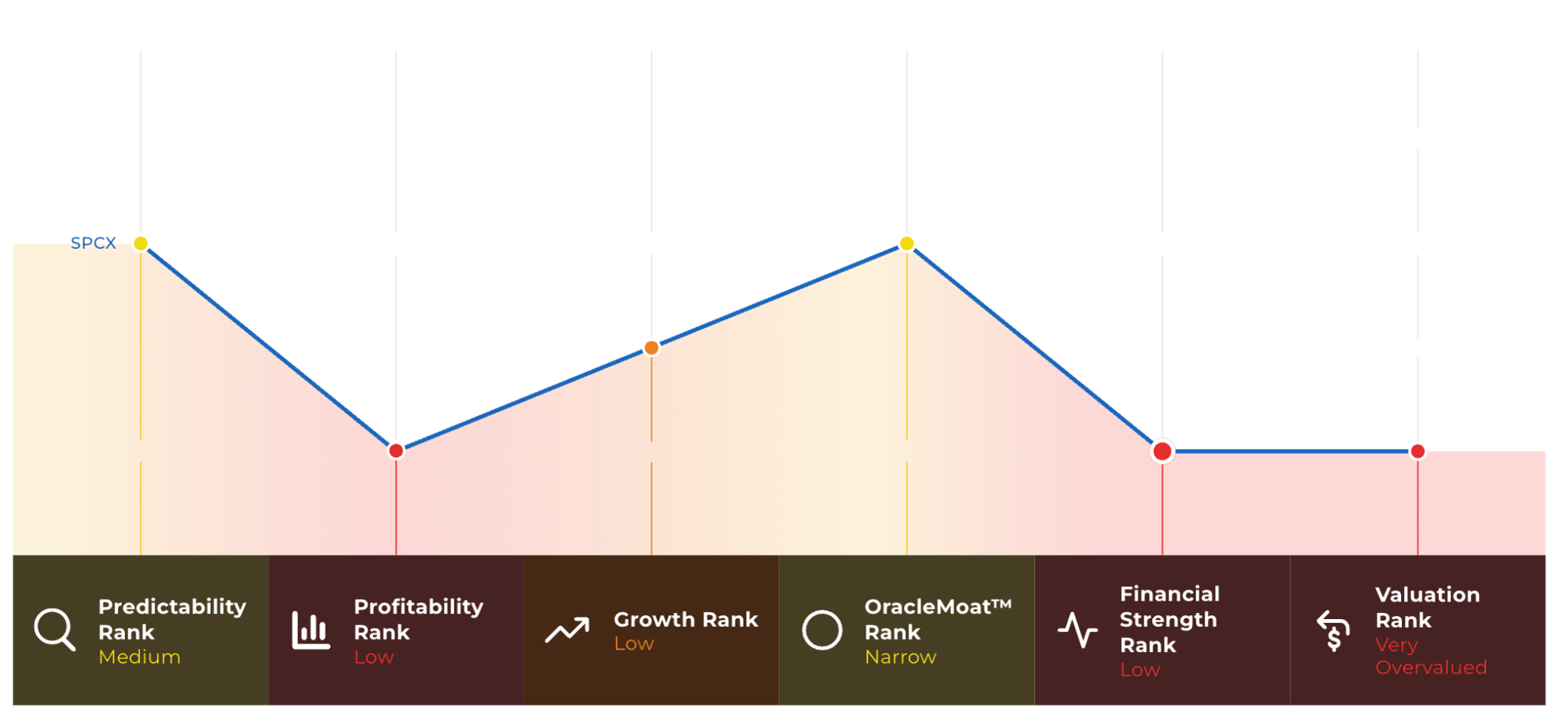
Some of those ranks deserve context rather than acceptance at face value. "Growth: Low" looks odd next to 92% revenue growth, but these ranks are built on multi-year track records, and SPCX has only a few reported periods as a public company. Systems need history and SPCX doesn't have much yet.

Why price-to-sales-growth and not discounted cash flow for SpaceX?
A DCF discounts the cash a business throws off today and grows it forward. SpaceX generated US$3.5 billion of operating cash flow in the first half of 2026 and spent US$28.5 billion of capex against it. Its current cash generation simply isn't the thing investors are buying, which is why StockOracle™'s 20-year DCF returns an intrinsic value of US$11.80 a share.
Arithmetically fine. Analytically beside the point.
The Price-to-Sales-Growth (PSG) ratio is a better lens for a business at this stage. It is the sales equivalent of the PEG ratio: take the price-to-sales multiple, divide it by the growth rate. It asks a simpler question, how much are you being asked to pay per unit of sales, relative to how fast those sales are growing?
Here is SPCX run through it on StockOracle™:
The left panel is StockOracle™'s automatic calculation. Sales per share of US$1.43, a growth rate of 74.58%, and a price-to-sales multiple of 105.65 produce a PSG ratio of 1.42. Applied against a conservative fair PSG of 0.2, that gives an intrinsic value of US$21.33. A 607% premium to the US$150.88 market price.
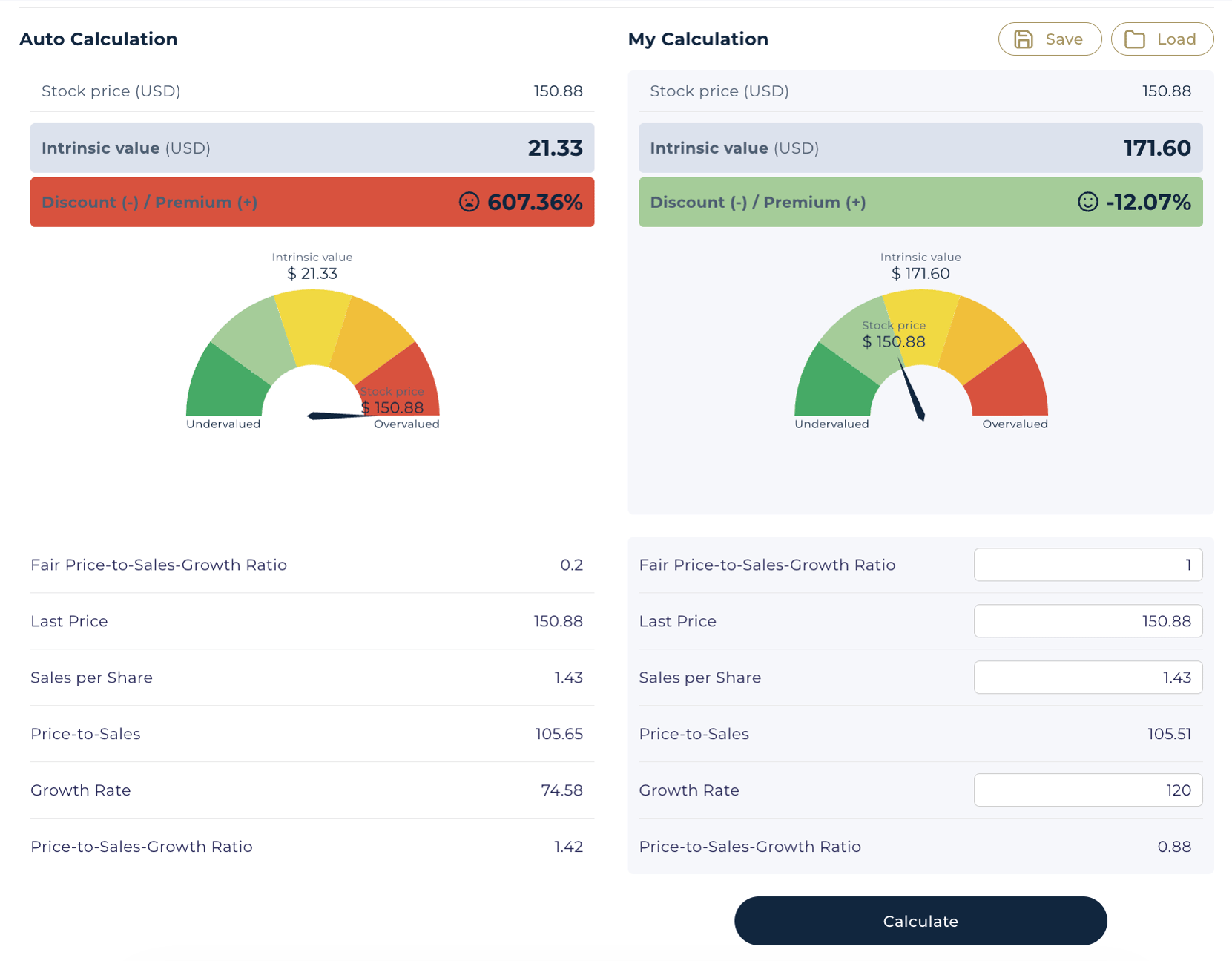
The right panel is the same stock with two inputs changed. Set the fair PSG ratio to 1.0, the conventional "priced in line with its growth" benchmark, and raise the growth rate to 120%. The same formula now produces US$171.60.
Same company. Same day. Same method. US$21 or US$172, depending on two very wide ranges of assumptions.
This is the investment question itself, written out in numbers. Everything hangs on whether SpaceX can sustain sales growth well north of 100% a year. But it is a forecast, not a fact, and if the growth rate you plug in is wrong, everything downstream of it is wrong too.
The risks of SpaceX (SPCX) worth naming
Three stand out from their financials:
Concentration in one profitable segment. Connectivity is carrying the group. If Starlink subscriber growth slows, ARPU compresses under competition from Amazon's Kuiper and regional operators, or regulatory access tightens in key markets, the whole structure is exposed.

Capital intensity. US$28.5 billion of capex in six months is funded by IPO proceeds and debt. It requires the AI and Starship bets to eventually generate extraordinary returns.
Governance. The IPO used a dual-class share structure. This means that class A shares sold to the public carry one vote; Class B shares held by insiders carry ten. Public shareholders own economics, not control.
Valuation. At roughly 106x sales, a great deal of future execution is already priced in. Historical performance, including the stock's 19% first-day gain and its subsequent range between US$104.83 and US$225.64 should not be a guide to guaranteed future results.
What this means for how you look at the business
The useful shift, now that SPCX is public, is that "how does SpaceX make money?" has moved from a fun question to a checkable one.
Three segments. One of them is profitable. A rocket business that is strategically essential and financially loss-making. An AI business consuming most of the capital. And a market price that assumes a lot of this works out.
Whether that price is reasonable is a judgement each investor has to make with their own assumptions . Through StockOracle™ investors can adjust the fair PSG ratio, growth rate and sales-per-share inputs on the Intrinsic Value tab and calculate your own number rather than accepting ours.
That's a habit worth building. Understand the business model first. Then decide what it's worth to you.
This article is for educational purposes only. Nothing here is a recommendation to buy, sell or hold any security.