Lam Research stock has surged more than 90% this year, outrunning nearly every semiconductor peer, on the promise that AI chip factories need more of its etch and deposition tools than ever.

CEO Tim Archer is calling 2027 "extraordinary." Now let’s dive into what Lam Research really does to make money.
What Does Lam Research Actually Do?
Lam Research doesn't design chips or manufacture them for other companies. It builds the highly specialized wafer fabrication equipment, primarily etch and deposition systems, that chipmakers like TSMC, Samsung, and Micron use to physically build integrated circuits.
That positions Lam close to a picks-and-shovels supplier to the semiconductor industry as opposed to a bet on a single chip designer, which is exactly why the current AI buildout shows up in its numbers indirectly, through capital equipment orders, rather than directly through chip sales.
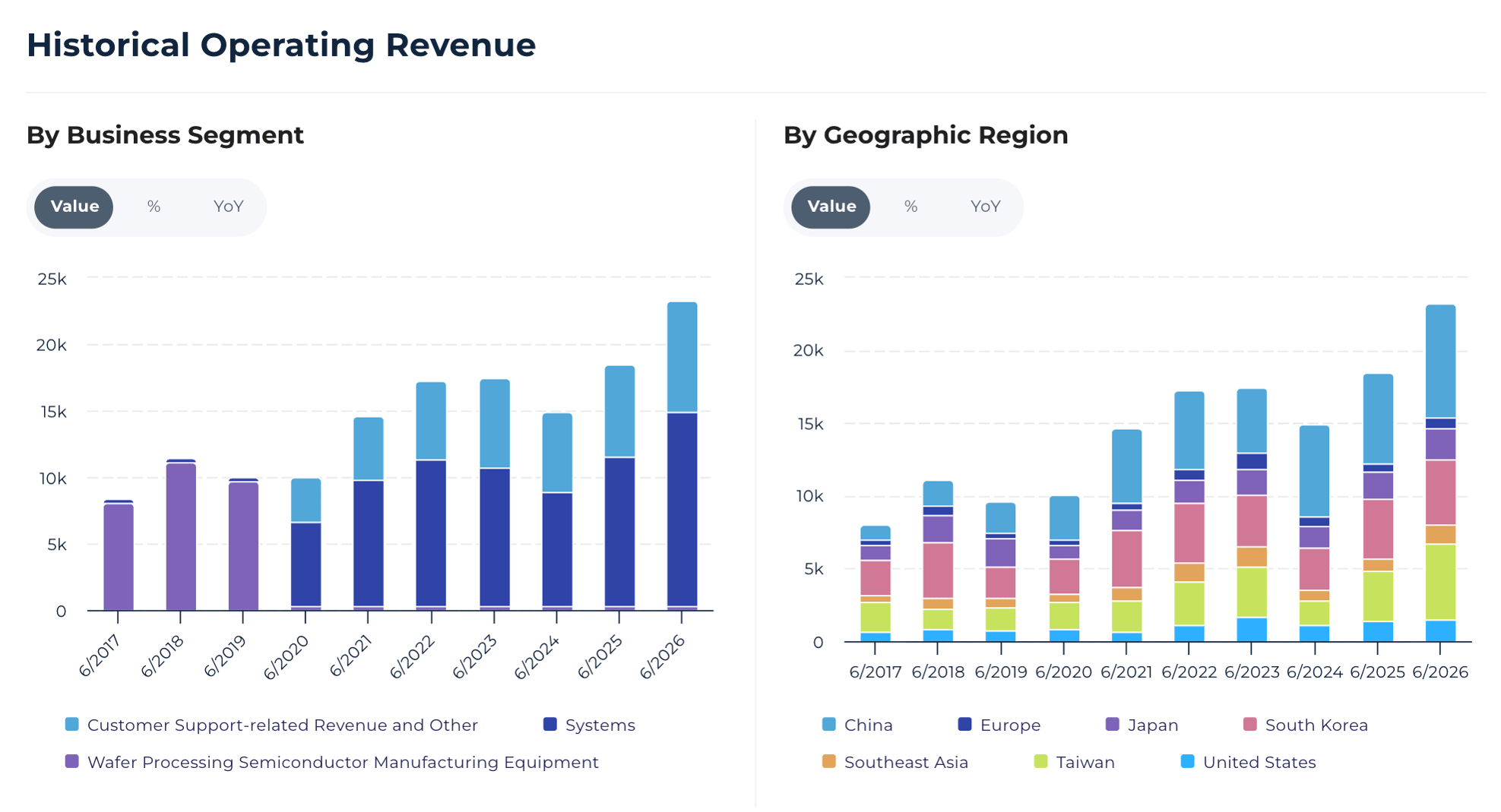
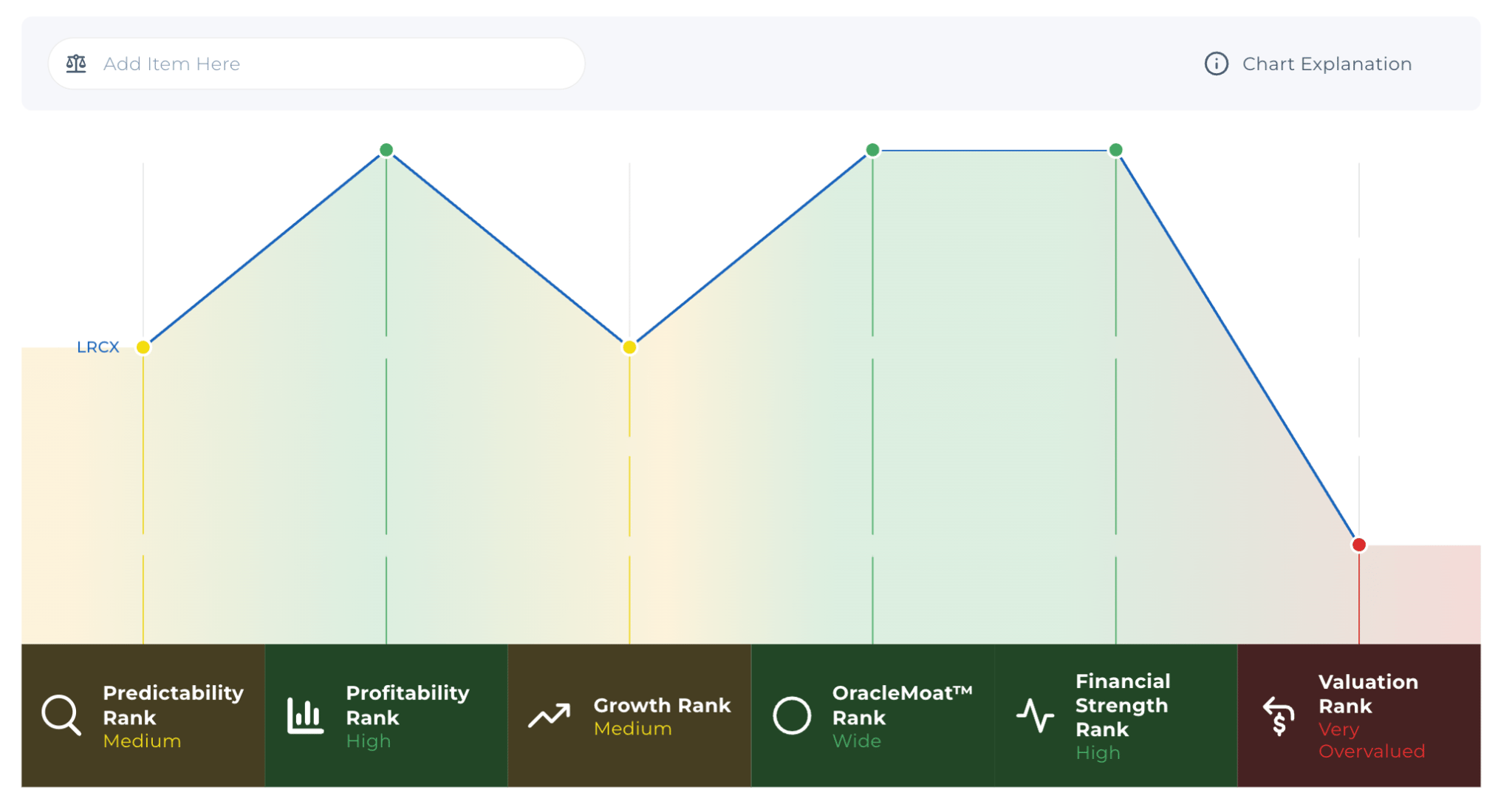
Additionally, unlike many other "picks and shovels" plays whose fortunes are tied heavily to a few customer's spending cycle, Lam's customer base is genuinely global, spanning Taiwan, South Korea, Japan, and the US, which spreads the cyclicality risk across multiple countries' semiconductor investment cycles rather than one. As shown in the StockOracle™ chart above.
What Is Lam Research's Intrinsic Value?
Intrinsic value is an estimate of what a business is actually worth based on the cash it can realistically generate over time, not whatever the market happens to pay for it during a sector-wide AI rally. For a cyclical, capital-equipment business like Lam Research, that distinction matters more than usual, because near-term growth rates can look extraordinary in one direction just as easily as the other.

Lam Research's Fair Value: A Split Between the Growth Case and the History Case
Run Lam Research's numbers through a 20-year discounted cash flow model using its 24.34% projected 3-5 year EPS growth rate and fair value lands at $302.89 per share, close to the current $310.53 share price.
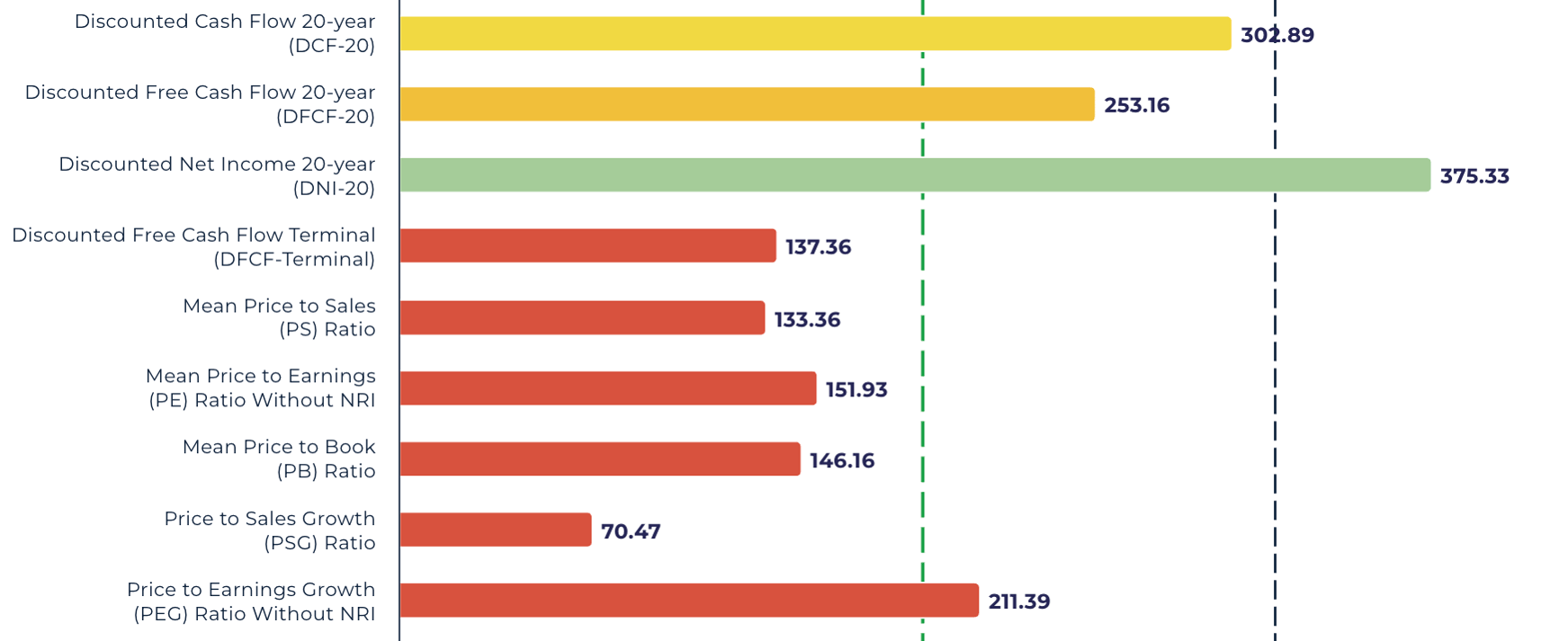
Lam Research (LRCX) Valuation Chart — Model Breakdown — Powered by StockOracle™ · Accurate as of 21 August 2026
Looking at the history-anchored methods instead: Mean Price-to-Earnings puts fair value at just $151.18, Mean Price-to-Book at $145.46, Mean Price-to-Sales at $132.44. That's less than half of today's price. The gap between these two groups of models is a bet on cyclicality: the growth-trusting methods assume Lam's current pace of AI-driven demand is closer to a new normal, while the history-anchored methods assume the semiconductor equipment cycle eventually reverts toward its own long-run average, the way it always has before.
Lam Research (LRCX) Financial Performance
Revenue and Margins: A Genuine Record, Driven by Hyperscalers’ AI Capex
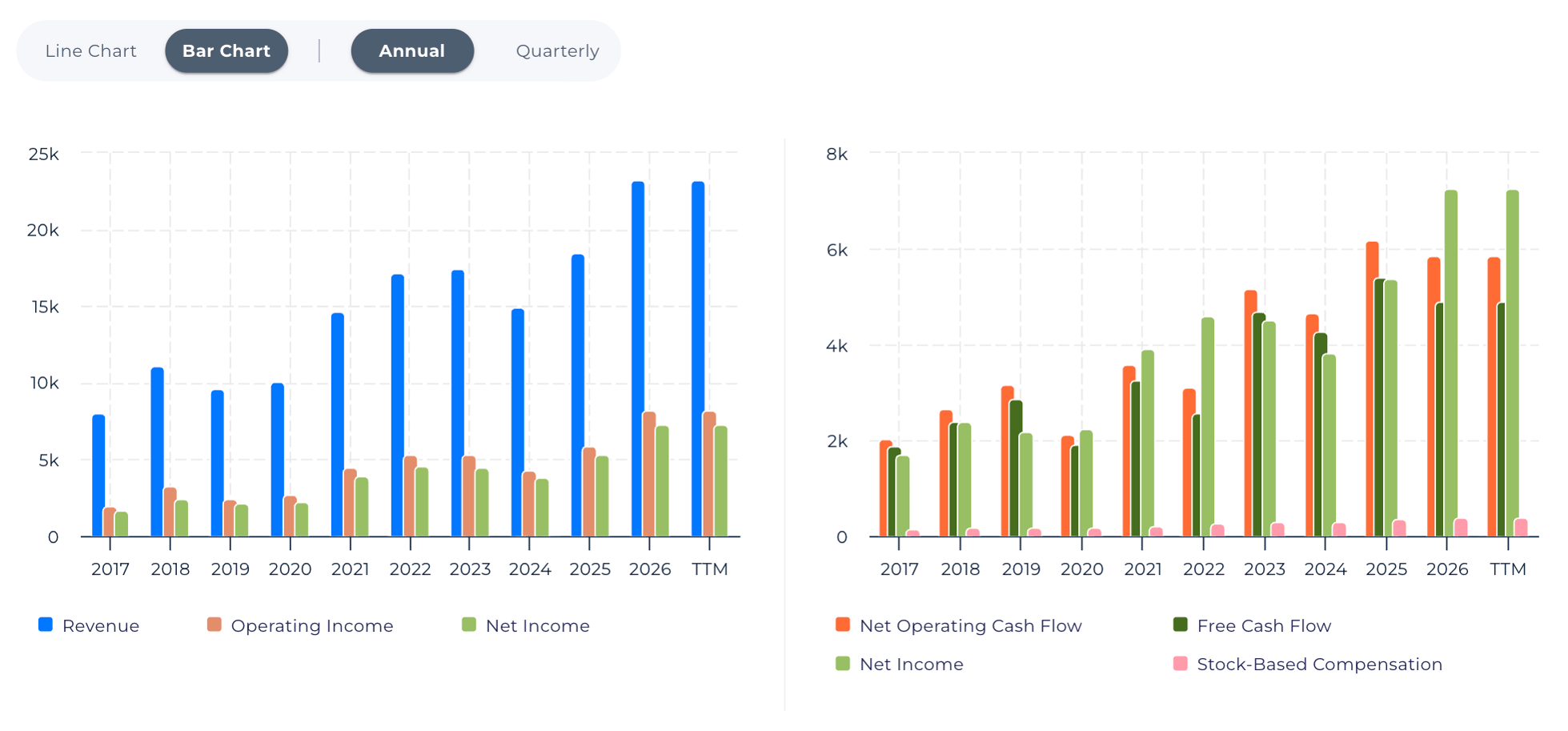
Lam Research (LRCX) Revenue, Operating Income and Net Income Trend — Powered by StockOracle™
The quarter ended June 28, 2026 delivered record revenue of $6.72 billion, with non-GAAP gross margin of 52.0% and non-GAAP diluted EPS of $1.82. As CEO Tim Archer put it, "Lam delivered record revenue, operating margin and earnings per share in the June quarter as AI-driven demand continues to reshape the semiconductor industry." Lam Research's Q4 FY2026 earnings release has the full detail.
Full fiscal-year revenue reached $23.23 billion, and the momentum is guided to continue: management expects the September 2026 quarter to bring revenue of $8.10 billion and operating margin of 39.5%, an acceleration from the June quarter's already-record pace.
Free Cash Flow: Strong in Absolute Terms, Thin Relative to the Stock's Price
Free cash flow reached $1.27 billion in the June quarter alone (operating cash flow of $1.46 billion less $188.8 million of capital expenditure), and $4,891 million on a trailing twelve-month basis, a healthy 21.05% margin on revenue. The FCF yield relative to the stock's market capitalization, however, sits at just 1.27%. That's the mechanical reason the multiples-based valuation methods above sit so far below the growth-trusting ones.
Returns on Capital: Pretty Decent
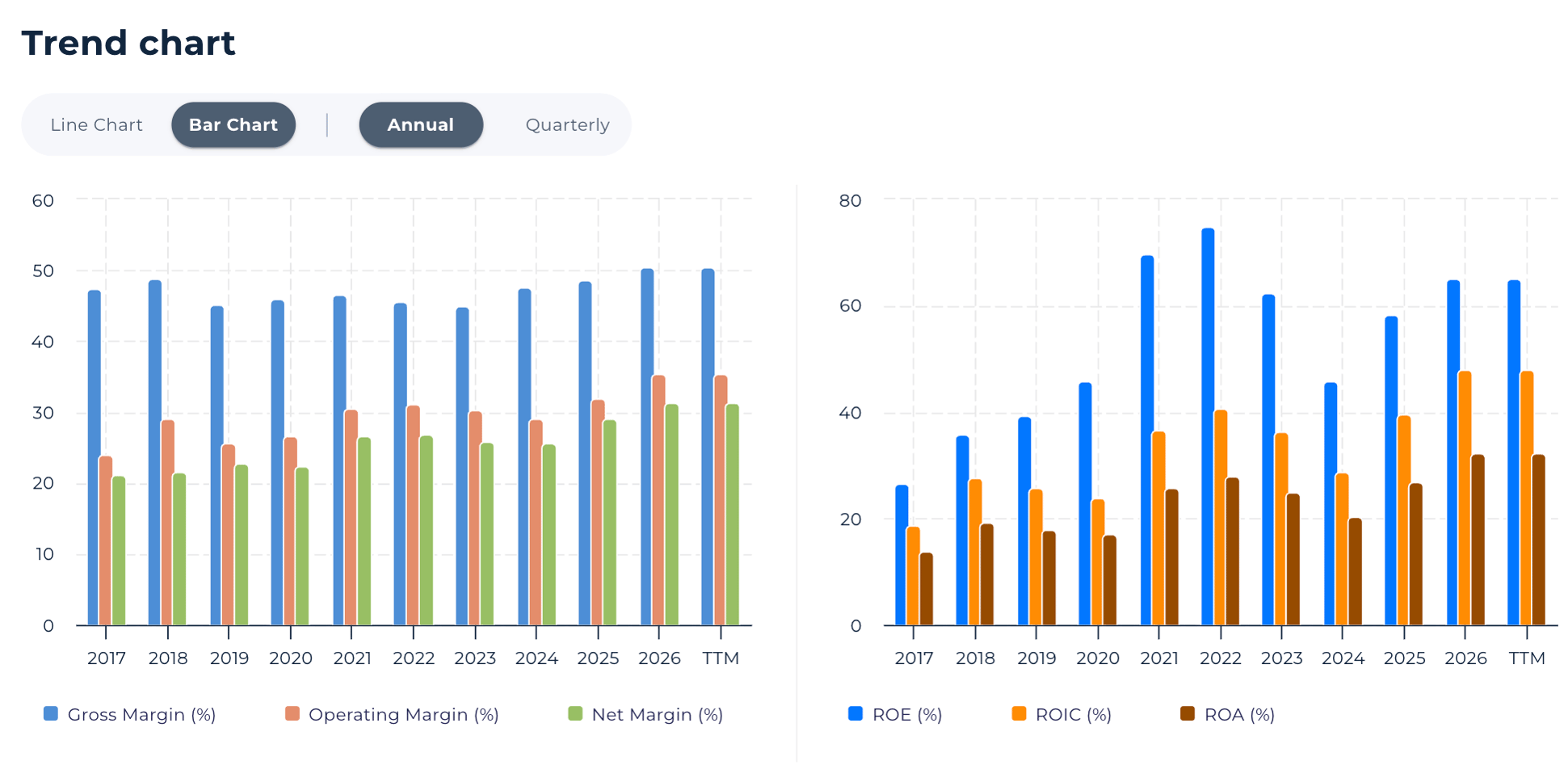
Lam Research (LRCX) Margins and Returns Trend — Powered by StockOracle™
Return on equity (TTM) reads 65.07% and return on invested capital 47.98%, both extraordinary even relative to other high-margin technology businesses. That capital efficiency is real and durable evidence behind Lam's business model, though it doesn't, on its own, resolve whether today's price has already fully credited it.
Shareholder Returns
Lam returned $246.6 million in buybacks and $325.3 million in dividends during the June quarter alone, and $3.85 billion in total buybacks over the full fiscal year, funded comfortably out of the business's strong free cash flow generation even during a period of heavy AI-driven capital investment by its own customers.
Growth Catalysts
The AI and Advanced Packaging Buildout
- Management guides advanced packaging revenue growth exceeding 50% in 2026, driven by high-bandwidth memory (HBM) demand for AI processors and next-generation chip architectures.
- Backside power distribution and dry-resist processing represent newer process opportunities tied directly to the most advanced chip nodes.
- Lam's stock has outperformed most semiconductor peers this year, up roughly 90% year-to-date versus ASML's 68.5% and KLA's 80%, though it has trailed Applied Materials' 123.9% gain, evidence the entire equipment sector is being re-rated on the same AI capex thesis rather than Lam alone.
- One industry comparison put Lam's forward P/E at a premium to the broader semiconductor equipment industry average, reflecting how much of this growth story the market has already priced in.
Why it matters for valuation: these catalysts are the real evidence behind the platform's 24.34% growth assumption. They're also, by definition, tied to a capital spending cycle among chipmakers that has historically run in booms and busts, which is exactly the risk the history-anchored valuation methods above are pricing in.
Economic Moat: Why StockOracle™ Rates Lam Research a Wide Moat
StockOracle™ rates Lam Research a Wide Moat business. The case rests on genuine switching costs: once a chipmaker qualifies Lam's etch and deposition tools into a specific manufacturing process node, replacing that equipment mid-process is expensive and risky enough that customers rarely do it without a compelling reason.
The competitive set carries different, specific strengths, and Lam has to defend against each rather than simply outspend it.
Applied Materials competes across a broader swath of the fabrication toolchain, giving it more cross-selling reach even where Lam holds a technical edge in etch.
Tokyo Electron holds a comparably strong position in Japan and parts of Asia, backed by deep relationships with regional chipmakers.
ASML occupies a different, even more concentrated niche in lithography, the one step Lam doesn't compete in directly, but its dominance there shapes the overall capital spending pattern Lam depends on. None of these rivals fully replicate Lam's specific combination of etch and deposition leadership at the most advanced process nodes, which is the core of the wide-moat case, though it's a moat that protects market share more durably than it protects against the industry's own cyclicality.
A More Conservative Look at Lam Research's Fair Value
The $302.89 to $375.33 range above leans on the 24.34% growth assumption holding for five to ten years. If we put on a conservative lens to roughly where the semiconductor equipment industry's growth has averaged across full cycles, and the output compresses toward the mean price-to-earnings readings in the $145–$151 range.
Turn the exercise ask what has to be true for the higher end of the range to hold, and the answer is specific and checkable: advanced packaging revenue needs to keep growing north of 50% annually well beyond 2026, and HBM-driven memory capex from AI infrastructure buildouts needs to keep expanding rather than pause once the current spending cycle matures to meet investors current expectations.
Readers can run their own growth assumptions through StockOracle's DCF calculator.
Final Thoughts on Lam Research's Intrinsic Value
- Record quarterly revenue of $6.72 billion and non-GAAP operating margin guidance of 39.5% for the next quarter both reflect genuine, current AI-driven demand, not just market enthusiasm.
- Growth-trusting valuation methods (DCF-20 at $302.89, DNI-20 at $375.33) sit at or above today's price, while history-anchored methods (mean P/E, P/B, P/S, and the DFCF-terminal variant) all sit in the $132–$151 range, less than half the current price.
- The most recent quarter's 62.54% EPS growth implies a doubling time of just 1.4 years if it held, a pace unlikely to be sustainable; the platform's 24.34% multi-year assumption is a more grounded number, closer to next year's cooler 22.17% consensus estimate.
- Return on equity (65.07%) and return on invested capital (47.98%) are both exceptional, even by semiconductor industry standards, and are real evidence behind the premium the stock commands.
- Advanced packaging revenue growth above 50% and continued HBM-driven memory capex are the specific, checkable catalysts the current valuation depends on.
- The wide-moat rating reflects genuine switching costs in qualified fabrication processes, but that moat protects market share more than it protects against the equipment industry's own boom-and-bust cycle.
Lam Research's business is executing about as well as a capital equipment supplier can right now. The open question the valuation split makes explicit is whether the current AI-driven capex cycle represents a durable step-change in demand or the strong phase of a cycle that, in this industry, has always eventually turned.
This analysis is shared for educational purposes only and is not intended as financial advice or a recommendation to buy, sell, or hold any security. The valuation figures above are model outputs built on stated, adjustable assumptions, not a fixed or guaranteed price target, and should not be treated as a standalone signal. Past performance, including any figures referenced above, is historical and is not indicative of future results.