Oracle Has Fallen 55% From Its Peak. Is That a Buying Opportunity or a Warning Sign?
|
Key Points
|
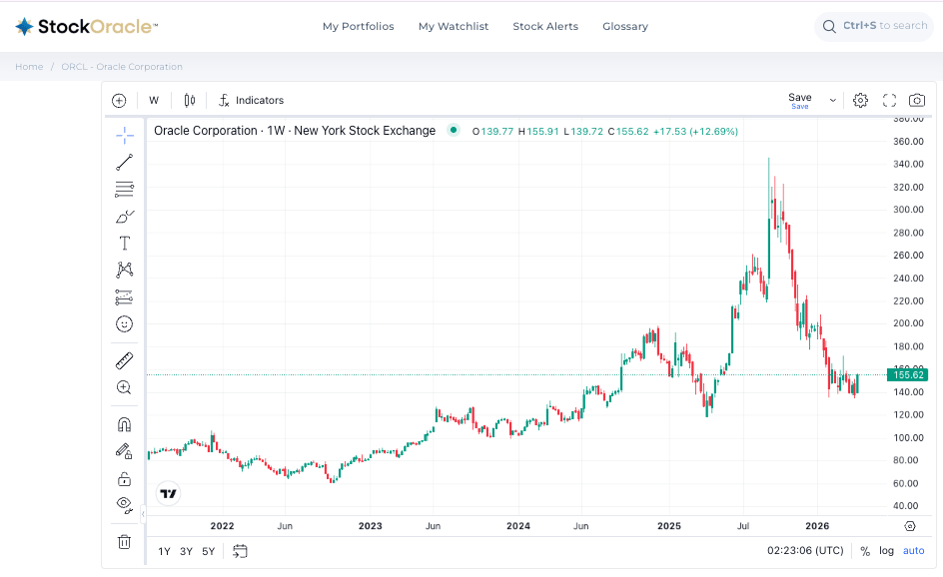
Oracle Corporation (ORCL) was one of the defining AI stocks of 2025 capturing headlines and attention. From May 2024, the stock more than doubled, riding a wave of cloud infrastructure euphoria and a landmark partnership with OpenAI to reach an all-time high near $345 in September 2025. Then it reversed, sharply. By April 2026, Oracle was trading near $155, representing a drawdown of around 55% from the peak.
For investors sitting on the sidelines, the natural question is whether this decline is the market correcting an overhyped valuation.
What Does Oracle Actually Do? A StockOracle™ Look
Oracle Corporation (ORCL) is one of the oldest and largest enterprise technology companies in the world, founded in 1977 by Larry Ellison. For most of its history, Oracle was synonymous with enterprise databases and software licensing. Today, it is undergoing the most significant transformation in its history: a pivot toward cloud infrastructure, particularly AI-ready data centers through Oracle Cloud Infrastructure (OCI).
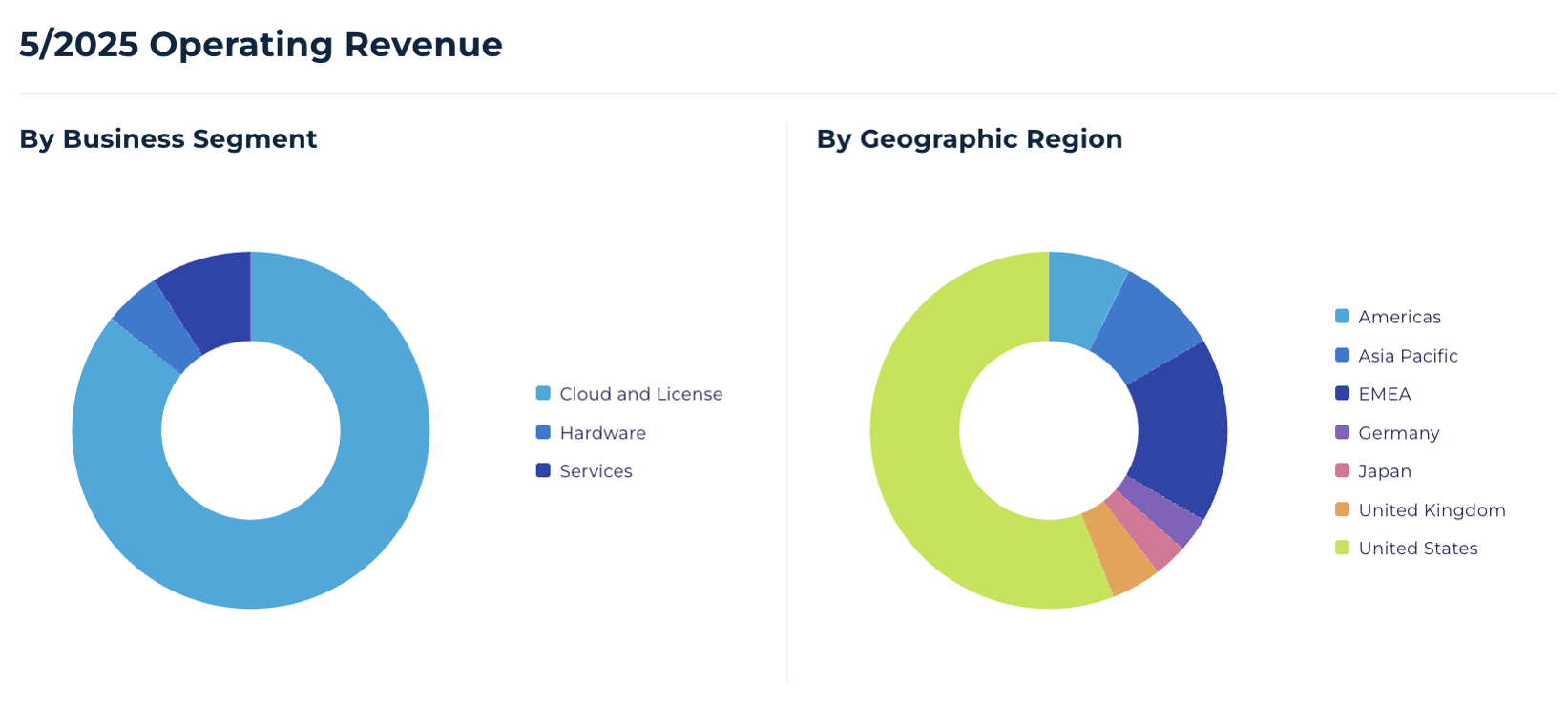
Oracle Corporation (ORCL) Revenue Breakdown powered by StockOracle™ - May 2025
Oracle's business runs across three main segments. Cloud and License is the dominant revenue driver, encompassing cloud services (SaaS and IaaS) and on-premise software licenses. Services cover support, consulting, and advanced customer support. Hardware is a smaller, legacy segment covering Oracle Engineered Systems.
As the revenue breakdown above shows, Cloud and License accounts for the overwhelming majority of Oracle's operating revenue, with the United States and EMEA representing the largest geographic contributors. This concentration is worth noting: Oracle's growth story lives and dies on how quickly its cloud business scales.
Oracle's Financial Snapshot: What the Numbers Show
Before getting into the bull and bear case of ORCL, it helps to understand the financial foundation these arguments are built on. The charts below, drawn from StockOracle™ data, highlight the key trends.
Revenue, Margins, and Returns
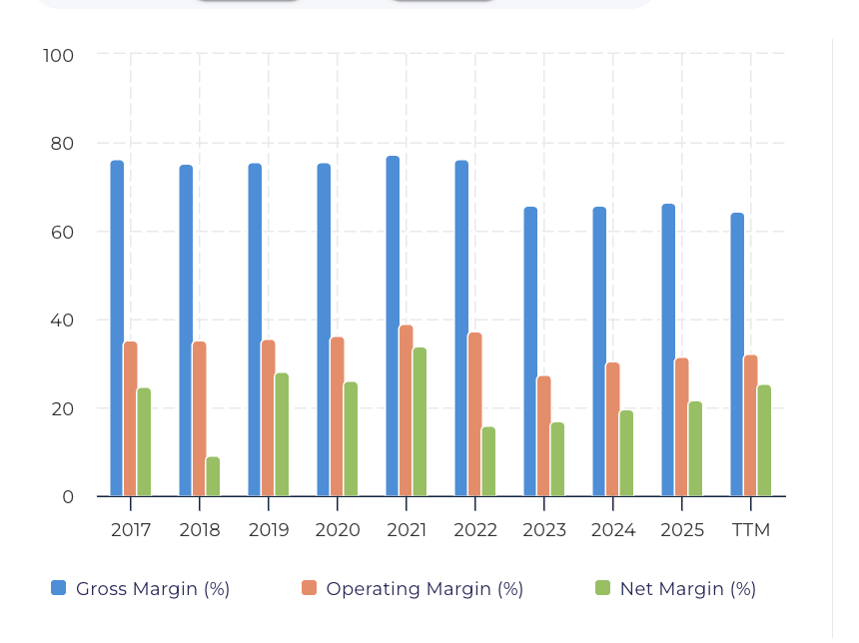
Oracle Corporation (ORCL) Margins Trend Chart powered by StockOracle™ - 14th April 2026
Oracle's Gross Margin has remained above 60% with an obvious dip in 2023 from high 70% to the lows 60%. These are ok numbers for a technology company and reflect the high-margin nature of its software and cloud licensing business.
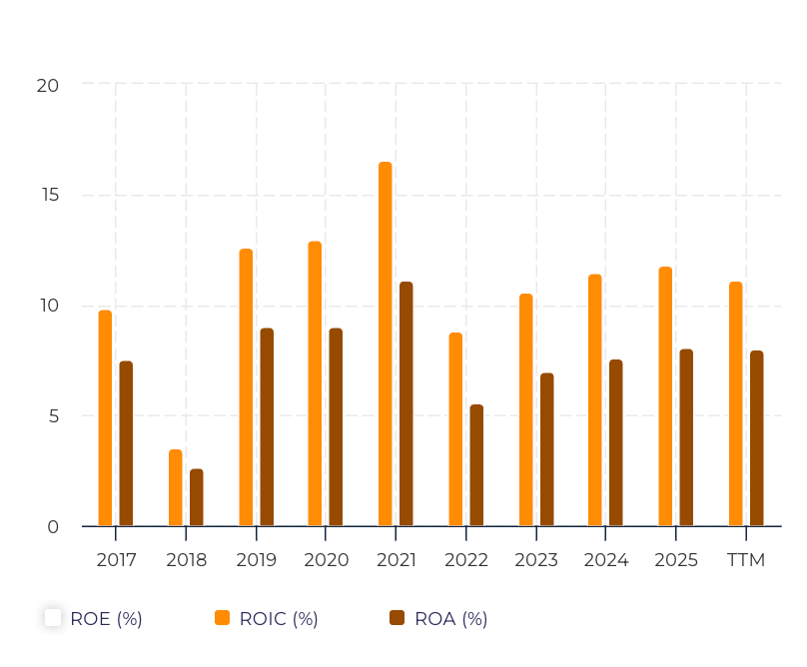
Oracle Corporation (ORCL) Returns Trend Chart powered by StockOracle™ - 14th April 2026
Return on Equity (ROE) appears elevated at roughly 57%, though this figure is significantly amplified by Oracle's negative book equity, a result of aggressive buybacks and debt-financed capital spending. ROIC of approximately 11% is a more grounded measure of capital efficiency.
Valuation Ratios in Context
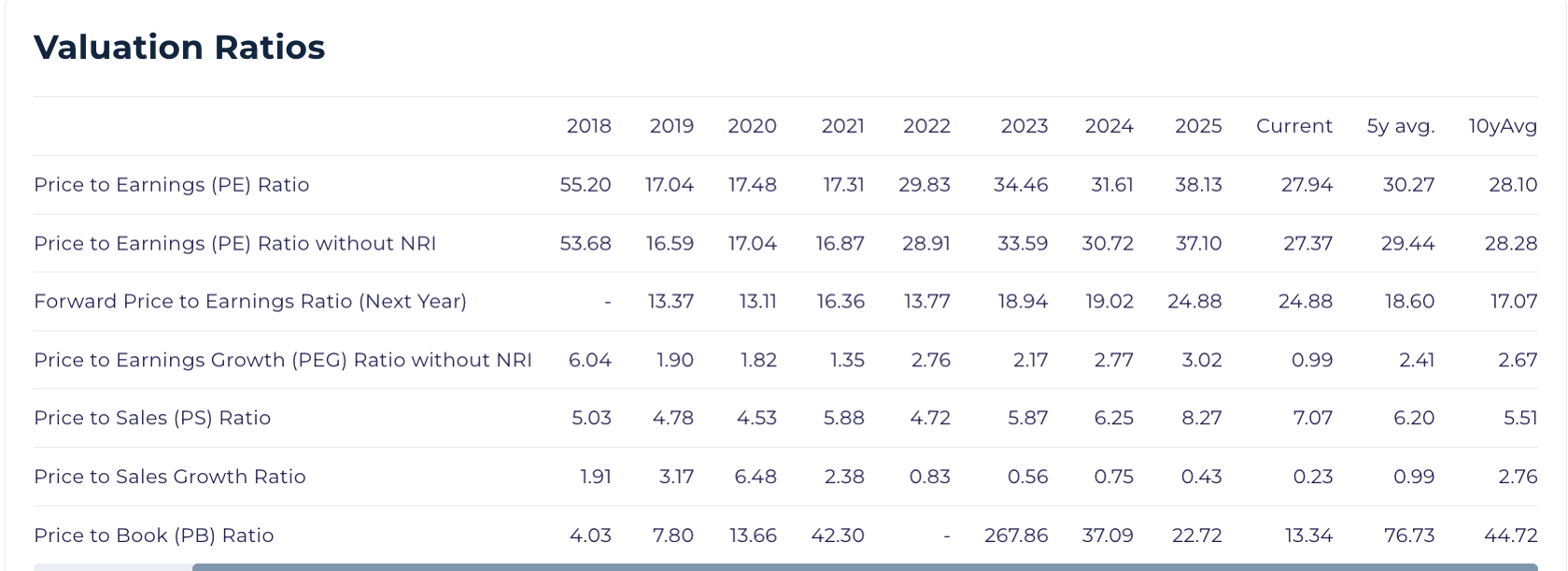
Oracle Corporation (ORCL) Valuation Ratios powered by StockOracle™ - 14 April 2026
Oracle's current trailing PE of 27.94 is broadly in line with both its 5-year average of 30.27 and its 10-year average of 28.10, suggesting the stock is priced reasonably on a historical earnings basis. The PEG ratio is estimated at 0.99 implies the market is pricing Oracle's growth at roughly one times its earnings growth rate.
The Debt and Cash Flow Challenge
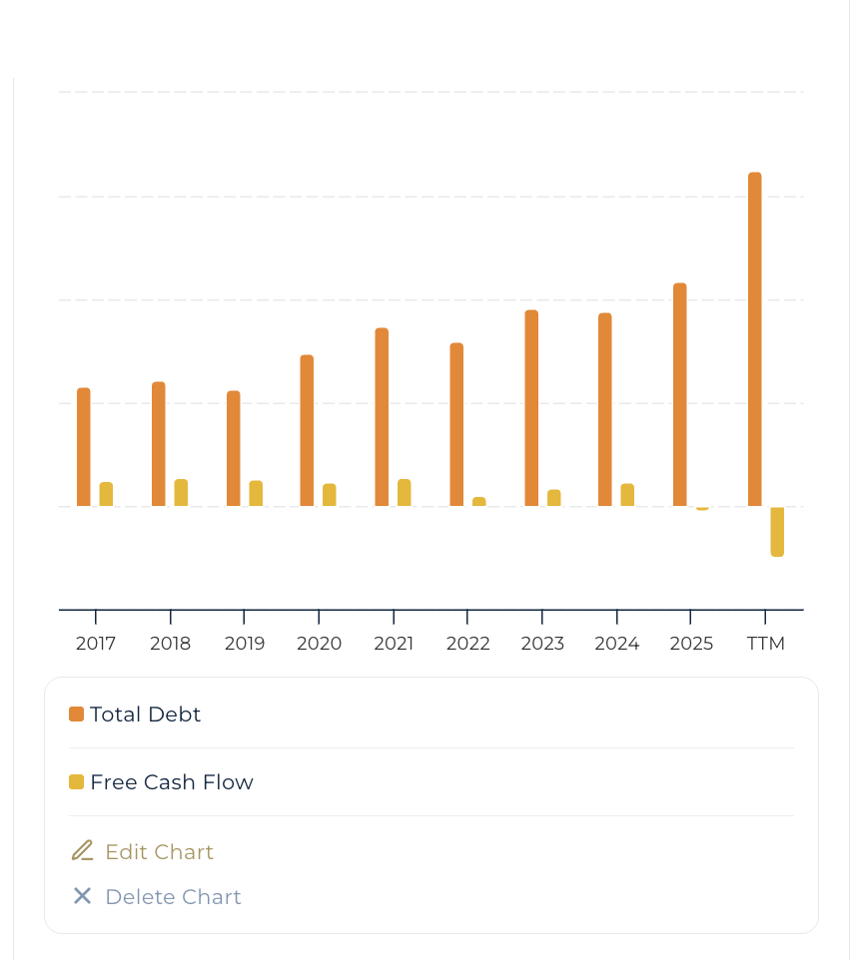
Oracle Corporation (ORCL) Total Debt and Free Cash Flow powered by StockOracle™ - 14 April 2026
This is where the financial picture becomes more complicated. Oracle's Total Debt has climbed to record levels, and for the first time in its recent history, Free Cash Flow has turned negative on a trailing twelve-month basis. Net Operating Cash Flow remains positive, but the gap between operating cash generation and capital expenditure is widening.
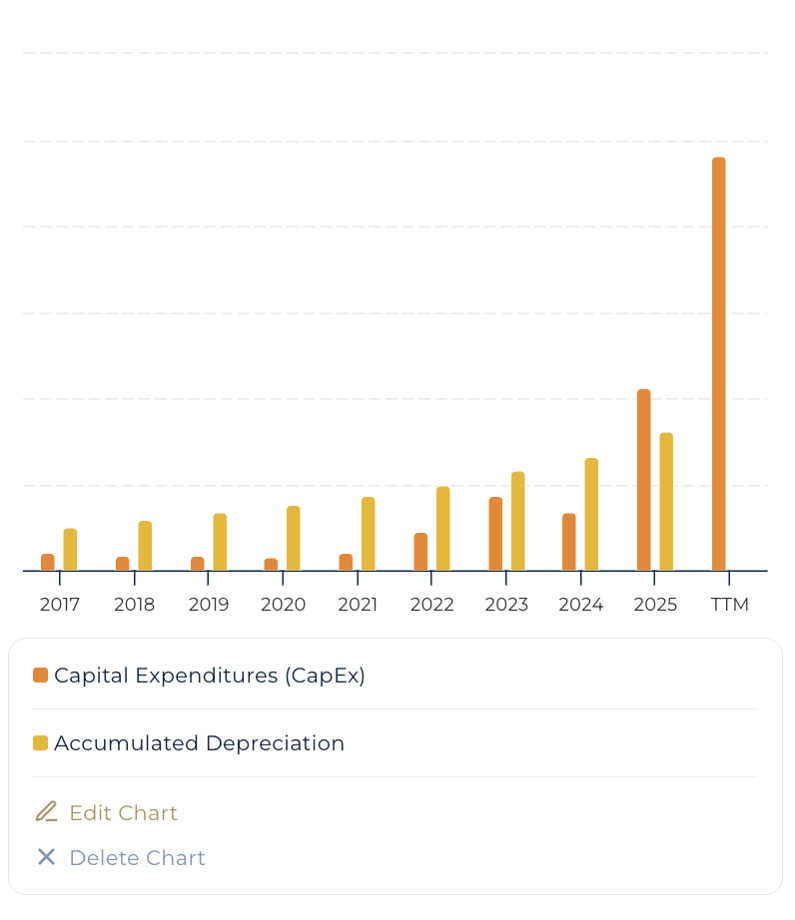
Oracle Corporation (ORCL) CapEx Chart powered by StockOracle™ - 14 April 2026
Oracle is spending at a pace that its current operating cash flows cannot fully absorb, which is precisely why it has been raising capital through debt and equity markets.
Compare ORCL Against Other AI Infrastructure Stocks on StockOracle™ -- Try it Free
The Bull Case for ORCL
Oracle’s organic revenue and non-GAAP EPS both growing above 20% YoY. Total revenue hit $17.2 billion, up 22%, with cloud infrastructure revenue surging 84% to $4.9 billion. Multicloud database revenue grew 531% and AI infrastructure revenue jumped 243%.
But the growth rate isn't the story. The structural positioning is.
Oracle has done something none of the hyperscalers would do for themselves: it embedded its database layer directly inside AWS, Azure, and Google Cloud data centres, with microsecond-latency colocation. This effectively turned rivals into distribution channels. Every enterprise running Oracle databases across multiple clouds now has Oracle infrastructure physically sitting inside their hyperscaler's facility. That is not commodity cloud compute. That is a neutral data layer across competing ecosystems, a role no hyperscaler is incentivised to fill.
The $553 billion RPO (up 325% YoY) also changes Oracle's risk profile in a way most coverage misses. Management stated that most large-scale AI contracts are funded through customer prepayments or customer-supplied GPUs, meaning Oracle does not expect to raise incremental capital to support them.
The Bear Case for ORCL
The bear case centres on the financial strain of Oracle's ambitions outpacing its current cash generation. Total debt exceeds $162 billion and Free Cash Flow has turned negative.
The $553 billion backlog, within the bull narrative, carries meaningful concentration risk, with reports suggesting roughly $300 billion tied to a single customer (OpenAI) that itself operates at a loss. Beyond the balance sheet, Oracle must execute a data centre build-out with no precedent in its history, while simultaneously defending its cloud niche against Amazon Web Services, Microsoft Azure, and Google Cloud, competitors with deeper capital reserves and years of infrastructure operating experience.
Final Thoughts
Oracle in 2026 is a divided investment case. The business has real, measurable momentum: OCI is growing at an exceptional rate, the SaaS layer is steady, the backlog is enormous, and the strategic partnerships are credible. At the same time, the financial risks are not trivial. A debt load of $124 billion, negative free cash flow, and significant customer concentration in a business that is betting its future on AI demand materialising at the projected scale, these are serious considerations.
The 55% drawdown from Oracle's all-time high has changed the risk/reward calculus compared to where the stock was in September 2025. Whether that repricing is sufficient depends on one's view of Oracle's ability to convert its contracted backlog into sustainable, cash-generative revenue over the next three to five years. That is the central question investors need to form a view on, and it is one where reasonable people can reach very different conclusions.
This analysis is shared for educational purposes to illustrate how markets and financial data inform investment perspectives. It is not intended as financial advice or a recommendation on any investment. Any past performance mentioned is not indicative of future results.