There are three companies the global financial system trusts to rate debt. S&P Global. Moody's. Fitch. Together they control roughly 95% of the market. And only two are publicly listed, S&P Global (SPGI) and Moody’s (MCO).
|
Key Points
|
Every corporation that wants to issue bonds needs a rating from one of these names. Skip the rating and you pay a higher interest rate. That is a toll booth on the global capital markets and unlike most toll booths, it gets more valuable as global debt grows, not less.
Through StockOracle™, we put both companies side by side.
Moody's Corporation (MCO) and S&P Global (SPGI) OracleIQ™ comparison powered by StockOracle™ - 23 April 2025
Compare MCO and SPGI on StockOracle™ — 7-day free trial
MCO vs SPGI Same Moat, Different Scale
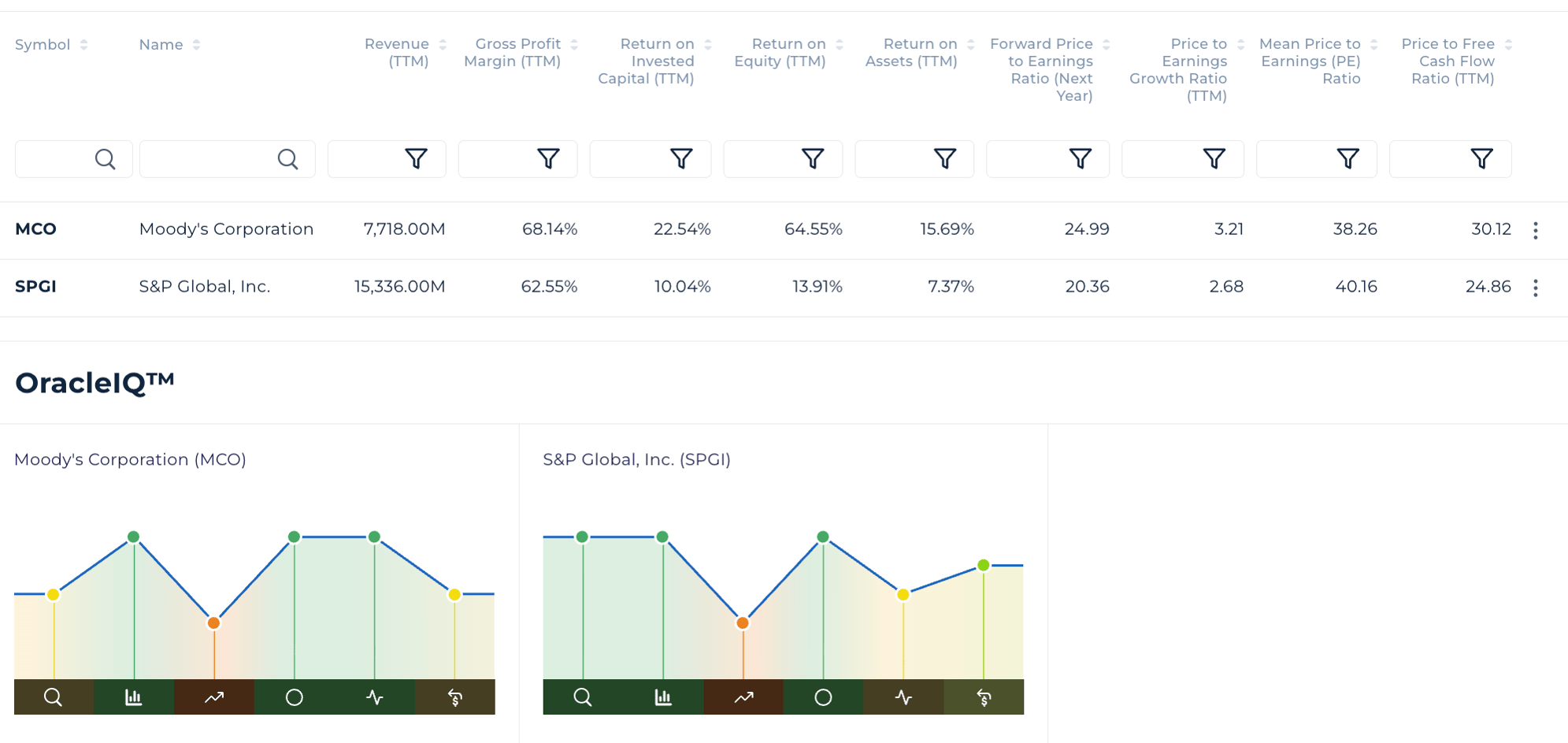
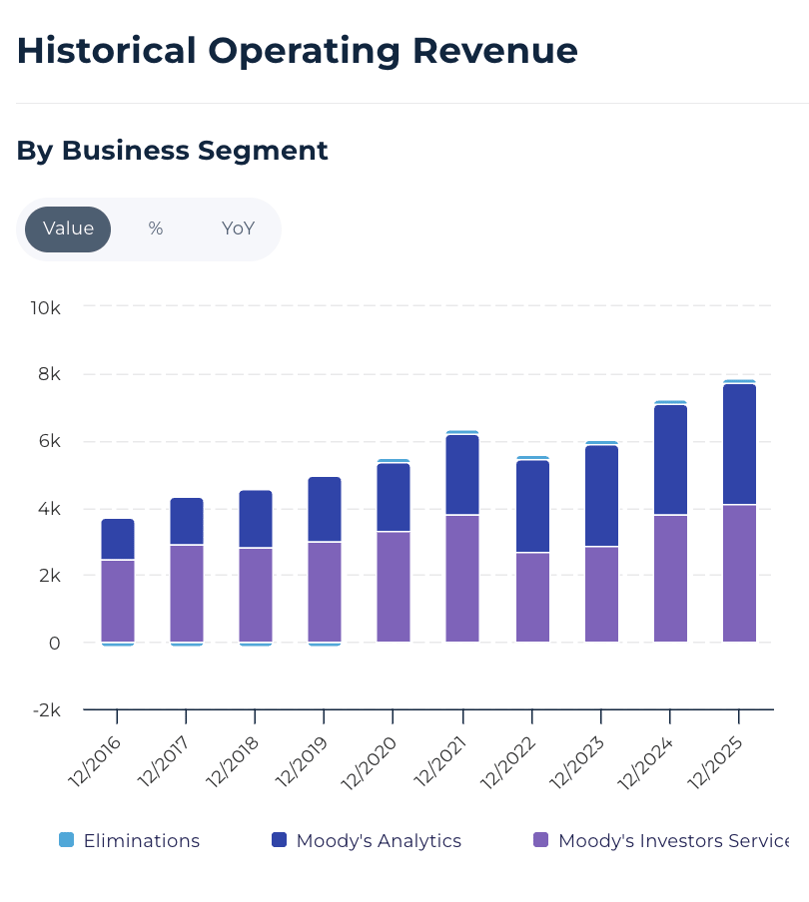
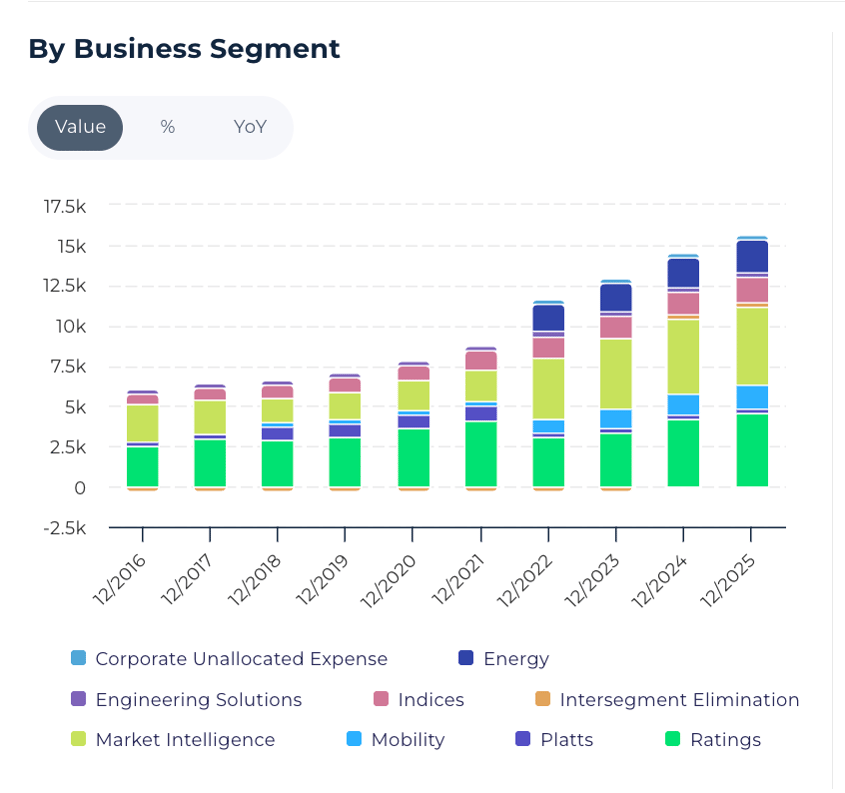
SPGI is the larger business at $15.3 billion in revenue TTM versus MCO's $7.7 billion. But size alone does not tell the full story here. SPGI's scale reflects its 2022 acquisition of IHS Markit, which added Market Intelligence, Platts commodity data, and indices to what was originally a ratings-focused business. Moody's has grown more organically, with Moody's Analytics sitting alongside its core ratings division.
Both companies guided for double-digit EPS growth in 2026. The projected revenue growth rates are nearly identical MCO at 6.40% and SPGI at 6.63% reflecting how similarly positioned these businesses are to the same macro tailwind: a large wall of corporate debt coming due for refinancing over the next two to three years, every dollar of which needs a rating.
Profitability: MCO Has the Edge
The margin and returns comparison is where MCO pulls ahead.
Moody's runs at a gross margin of 68.14% versus SPGI's 62.55%, a gap that reflects the higher cost base SPGI absorbed through the IHS Markit integration. On FCF margin, the gap narrows: MCO at 33.36% versus SPGI at 35.58%, with SPGI marginally ahead as its post-acquisition cost structure normalises.
Moody's Corporation (MCO) Business Segments powered by StockOracle™ - 23 April 2025
SPGI Business Segments powered by StockOracle™ - 23 April 2025
The returns gap reflects business mix as much as efficiency. MCO posts ROIC of 22.54% and ROE of 64.55%, benefiting from a focused, capital-light ratings and analytics model where leverage works cleanly in shareholders' favour.
SPGI's ROIC of 10.04% and ROE of 13.91% are lower, partly a consequence of the goodwill and debt from the Markit deal, but also a structural reality: SPGI runs a far more diversified business spanning ratings, market intelligence, indices, and commodity data, which naturally dilutes the purity of its returns profile. It's a different model, not necessarily a worse one. As SPGI digests the acquisition and FCF compounds across its segments, those returns figures are the ones to watch over the next three to five years.
Financial Strength: Two Leveraged But Cash-Generative Businesses
Moody's Corporation (MCO) Financials Trend Chart powered by StockOracle™ - April 2025
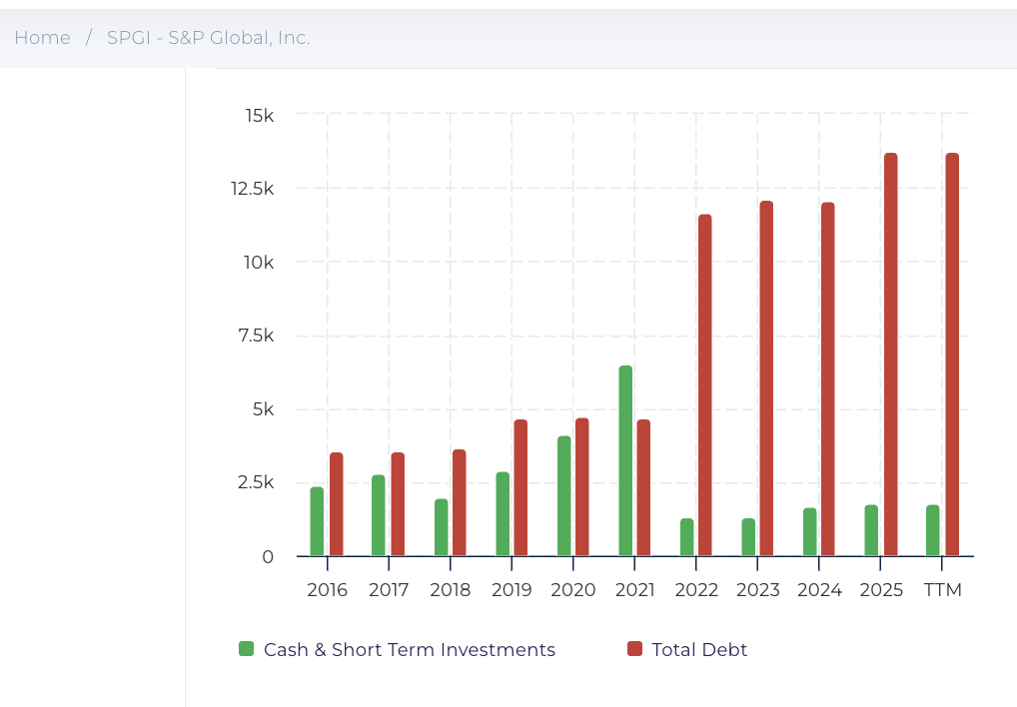
S&P Global (SPGI) Financials Trend Chart powered by StockOracle™ - April 2025
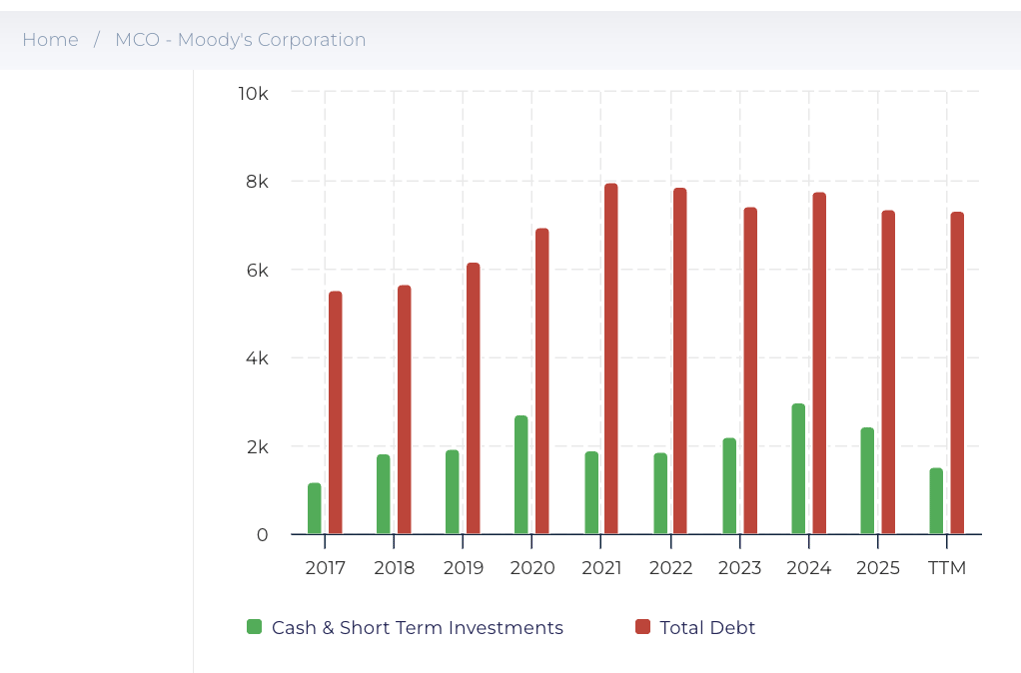
MCO carries approximately $7.3 billion in debt against $2.4 billion in cash in 2025. SPGI carries approximately $13 billion in debt against $1.81 billion in cash.
What makes both balance sheets manageable is the sheer reliability of the FCF engine underneath them. MCO generates approximately $2.8 billion in FCF TTM, while SPGI produces approximately $5.4 billion that are not only large in absolute terms but predictable given the subscription and transaction-based nature of their revenues. That consistency is what makes their debt loads less concerning: both companies can service and reduce debt comfortably without sacrificing growth investment or shareholder returns.
Beyond debt management, both have been steadily reducing share counts through buybacks, which compounds per-share returns.
Any past performance mentioned is not indicative of future results.
The AI Question
It is the most important question to sit with before taking a position in either company.
A credit rating is not just analysis, it is a regulatory artefact. Pension funds, insurance companies, and sovereign debt markets are structurally mandated to reference ratings from Nationally Recognised Statistical Rating Organisations (NRSROs). That designation cannot be replicated by an AI model. The moat is not data or analytical edge; it is regulatory entrenchment and institutional trust baked into global capital markets.
The more credible near-term threat is in the analytics and intelligence layer Moody's Analytics and SPGI's Market Intelligence segment. These businesses sell research tools, risk models, and financial analysis workflows to institutional clients. That is precisely the category of work that AI is beginning to replicate. If clients can get comparable output from an AI platform for less, pricing power in these segments comes under real pressure.
As an investor, the ratings revenue is likely safe given the regulatory moat. The analytics and intelligence revenue deserves a more sceptical eye on pricing power and retention trends over the next few years. The AI risk is a variable that warrants watching during the earnings cycle.
Run your own analysis on MCO and SPGI with StockOracle™
Final Thoughts
Viewed through the StockOracle™ lens, MCO and SPGI are more similar than different. Similar moat, same macro tailwind, near-identical growth outlooks. The distinction is in the current profitability and returns profile. MCO is the cleaner, higher-returning business today. SPGI is the larger, more diversified platform with returns that should improve as the Markit acquisition fully digests.
This analysis is shared for educational purposes. It is not intended as financial advice or a recommendation on any investment.