|
Key Points :
|
Return on Equity (ROE) measures how much profit a company generates for every dollar shareholders have invested. The formula is simple: net income divided by shareholders' equity. It sounds like a dry accounting metric, but when a number swings violently, it tells a story. For Amazon in 2022, that story starts with a $12.7 billion bet on an electric truck company, and ends with the company's first annual loss in nearly a decade.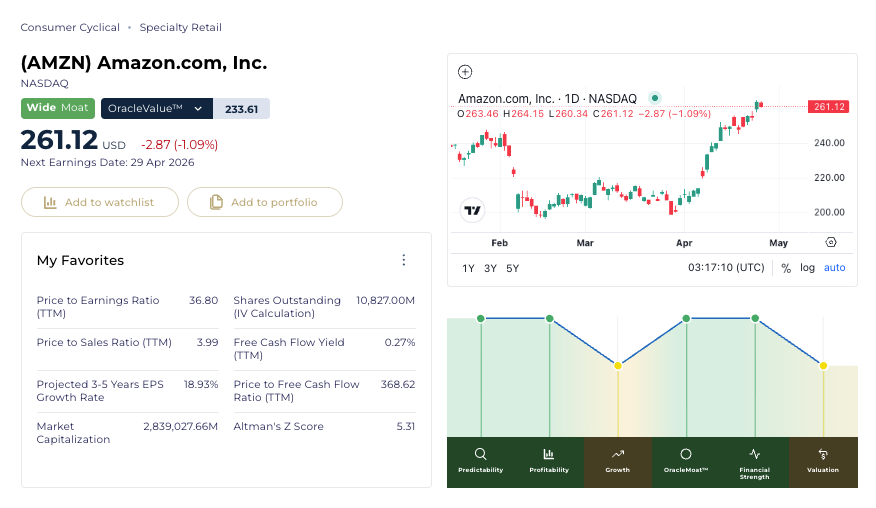 Comprehensive first-load research data on Amazon.com, Inc. (AMZN) powered by StockOracle™ — 28th April 2026
The ROE That Looked Healthy (2016–2021)
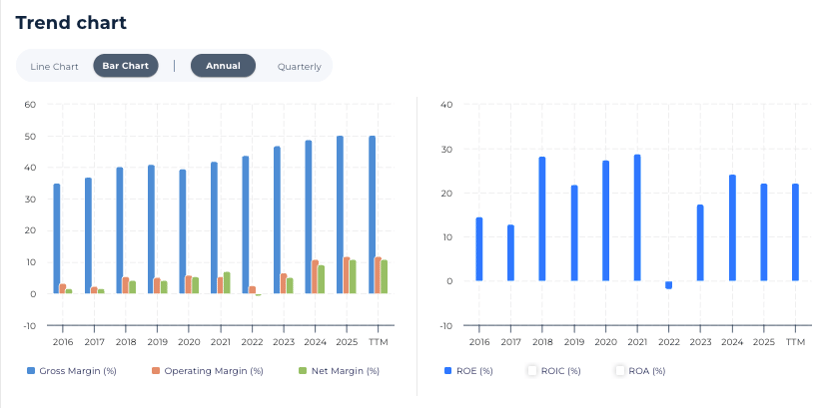 Amazon.com, Inc. (AMZN) Trend Chart powered by StockOracle™ — 28th April 2026
From 2016 to 2021, Amazon's ROE climbed steadily from roughly 15% to a peak of approximately 28%, a number that looked strong on any industry comparison. But the margins chart sitting alongside it told a more complicated story. Through that entire period, operating margins rarely exceeded 5% and net margins were even thinner. Amazon was generating equity returns not through pricing power or profit margin, but through the sheer velocity of its asset turnover and the financial leverage baked into its balance sheet. It was a retailer's ROE, not a technology company's ROE.
What was building quietly underneath was something different entirely: Amazon Web Services (AWS).
The Year That Broke the Number (2022)
In 2022, Amazon's ROE turned negative for the first time since 2014. On the surface, it looked catastrophic. In practice, it was one of the most misleading single-year data points in large-cap investing.
Amazon had bet heavily on Rivian, the electric vehicle startup that went public at a towering valuation in 2021 and subsequently collapsed. As Rivian's stock fell approximately 82% across 2022, Amazon was forced to record a total write-down of roughly $12.7 billion on its investment. The result: a full-year net loss of $2.7 billion, Amazon's first annual loss since 2014, and an ROE that registered around -2%.
ROE, or Return on Equity, measures how efficiently a company generates profit from its shareholders' equity. In normal profitable years, a positive net income divided by equity produces a positive ROE. But in 2022, the $12.7 billion Rivian write-down flipped Amazon's net income deeply negative at -$2.7 billion.
The operating business was also under pressure too from over-hiring and elevated fulfillment costs. But the accounting loss that flipped ROE negative was a mark-to-market write-down on a minority stake, in hindsight not a signal that Amazon's core business had deteriorated. Investors who read the 2022 ROE collapse as a business story missed the actual signal.
The Recovery That Explains Everything (2023–Present)
The return of ROE to approximately 22% by 2024–2025 is where the real analytical value lies, because the mechanism is entirely different from what drove the pre-2022 number.
Look at the margins chart again. Gross margin expanded from roughly 35% in 2016 to approximately 50% today. More significantly, operating margin and net margin both surged from near-zero to approximately 9–10% in 2024–2025. That is not a retail business doing better. That is a technology business asserting itself.
AWS crossed $107.6 billion in revenue in 2024, growing 19% Year on Year, and generated $39.8 billion in operating income, approximately 57% of Amazon's total company operating income, as confirmed in Amazon's Q4 2024 earnings release. Advertising is the second profit engine, growing rapidly and carrying margins that rival AWS. The retail segments still operate on thin margins, but they no longer define the profitability of the consolidated company.
Find out your favorite stocks' OracleIQ™ for Free
The Investor Takeaway
Amazon's ROE today is not the same thing as Amazon's ROE in 2019, even if the percentage looks similar. The source has shifted from leverage and asset velocity to genuine margin expansion. The 2022 collapse was noise, not signal. And the recovery to ~22% ROE is, underneath, a story about a retail and logistics business that built a cloud computing engine large enough to reprice the entire company's profitability. For investors, the key question is not whether Amazon's ROE is good by historical standards. The question is whether the margin expansion has further to run as AWS, Advertising, and AI workloads continue to grow as a share of the mix.

This analysis is shared for educational purposes and is not intended as financial advice or a recommendation on any investment. Any past performance mentioned is not indicative of future results.