Every time you tap your card, a toll gets collected. Between 1.5% and 3% of that transaction flows to the payment network that processed it. Visa processed $17 trillion in volume last year. Mastercard did roughly $11 trillion. American Express operates its own closed loop on top of that.
|
Key Points
|
For decades, this has been considered one of the most durable business models in the world. But stablecoin transaction volume hit $33 trillion in 2025, up 72% Year on Year. Larger than Visa's annual volume. Both V and MA are down from their all-time highs. The market is pricing in some version of this risk.
So which of these three businesses is actually the most resilient? Through StockOracle™, we compare them side by side.
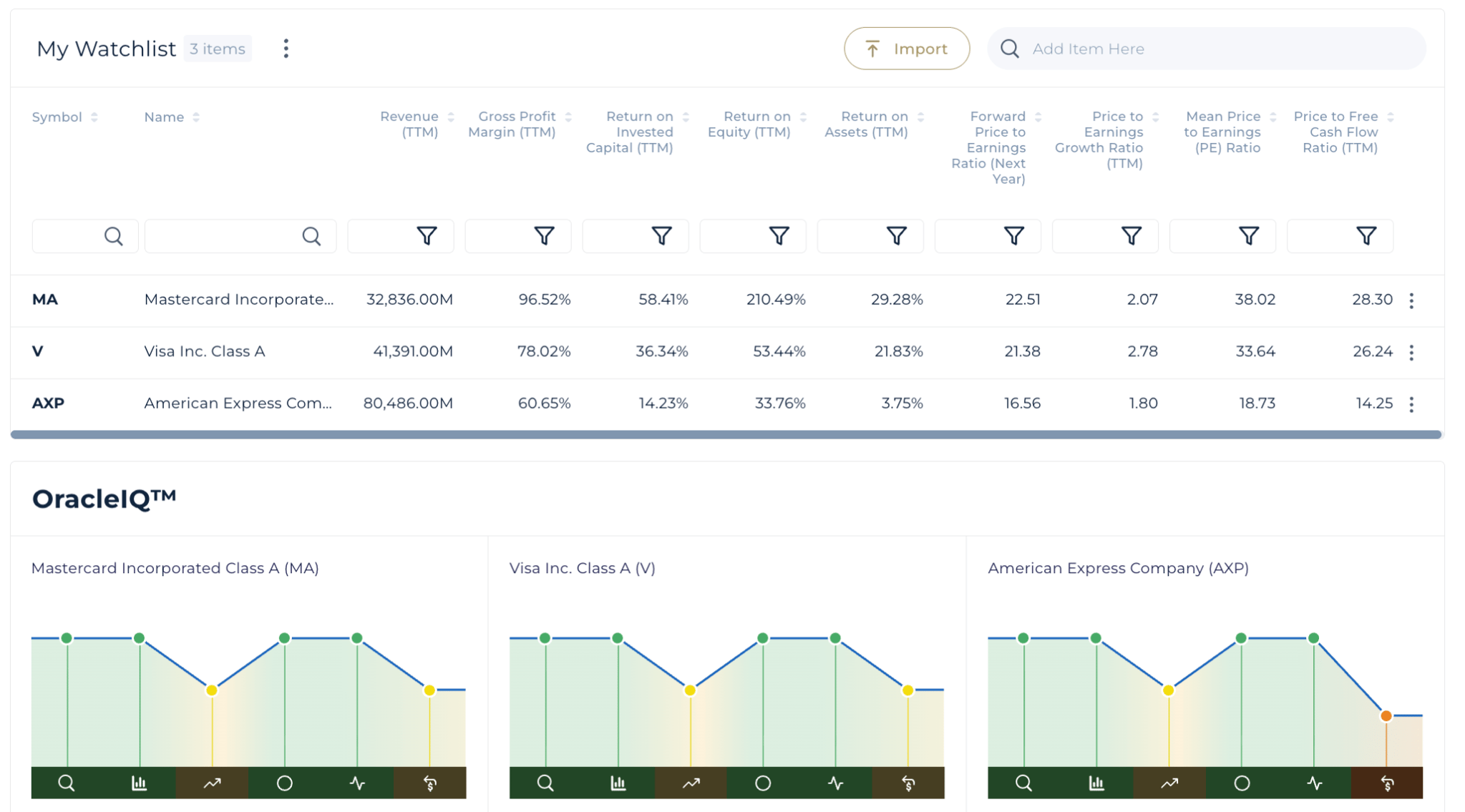
Mastercard (MA), Visa (V), and American Express (AXP) OracleIQ™ comparison powered by StockOracle™ - April 2025
Compare MA, V, and AXP on StockOracle™ — 7-day free trial
Three Payment Companies, Two Different Business Models
Before the numbers, the business model distinction matters.
Visa and Mastercard are pure networks. They do not lend money. They do not take credit risk. They simply process transactions and collect a fee. Every dollar of revenue flows through at extraordinary margins because there is no loan book, no defaults, no provisioning.
American Express is different. It is both the network and the lender. AXP issues cards directly, earns interest on balances, and targets a higher-spending, premium cardholder base. That closed-loop model generates more revenue per customer.
This distinction explains almost every difference you will see in the data below.
Margins: The Pure Networks Win Decisively
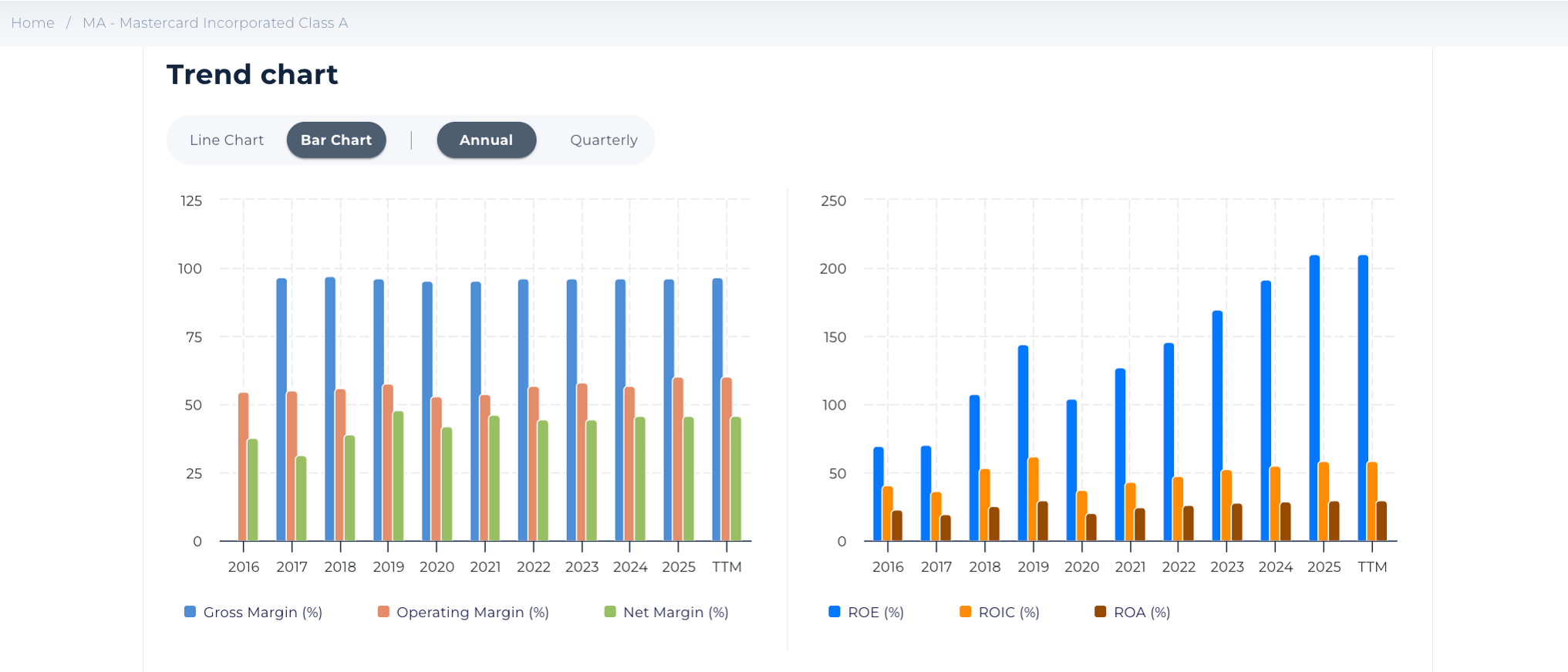
Mastercard (MA) Margins and Returns Trend Chart powered by StockOracle™ - April 2025
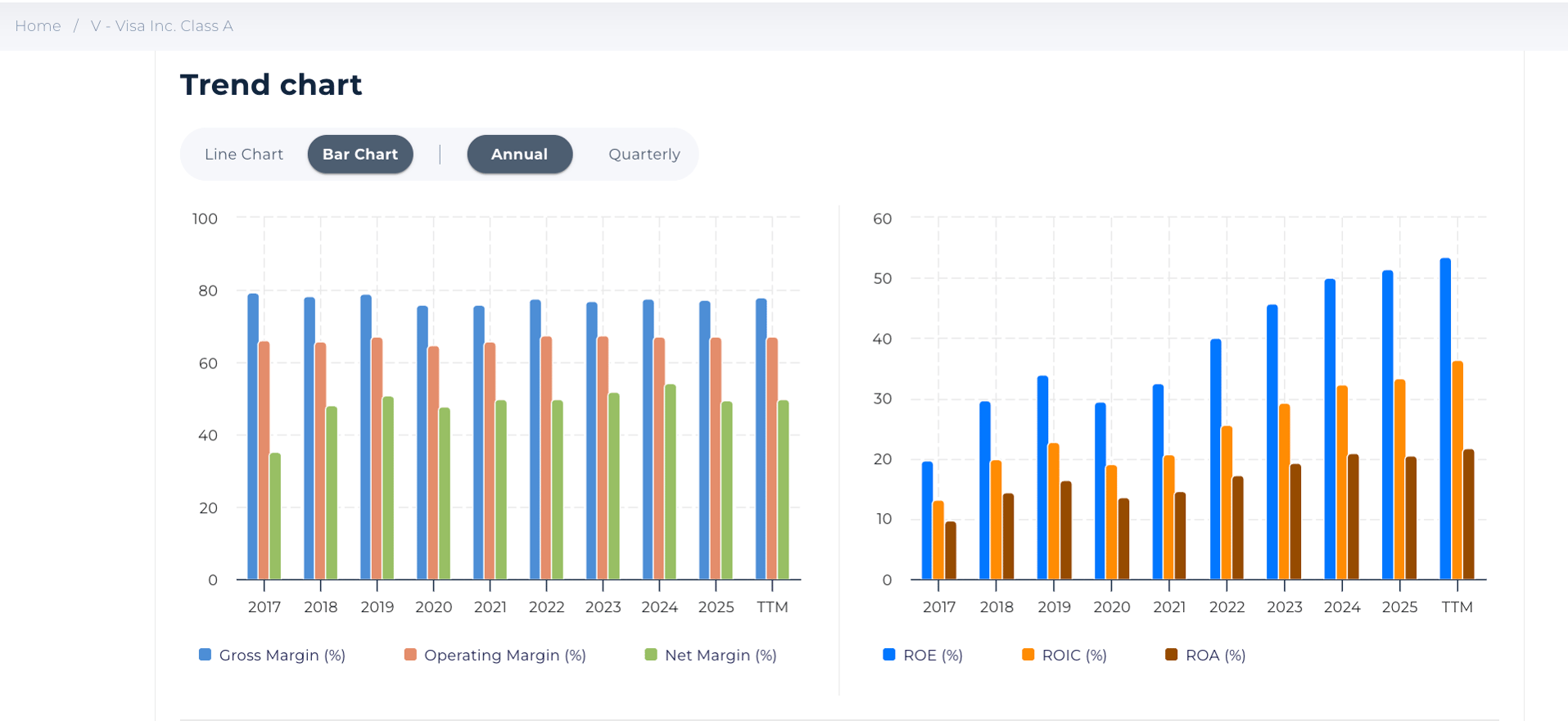
Visa (V) Margins and Returns Trend Chart powered by StockOracle™ - April 2025
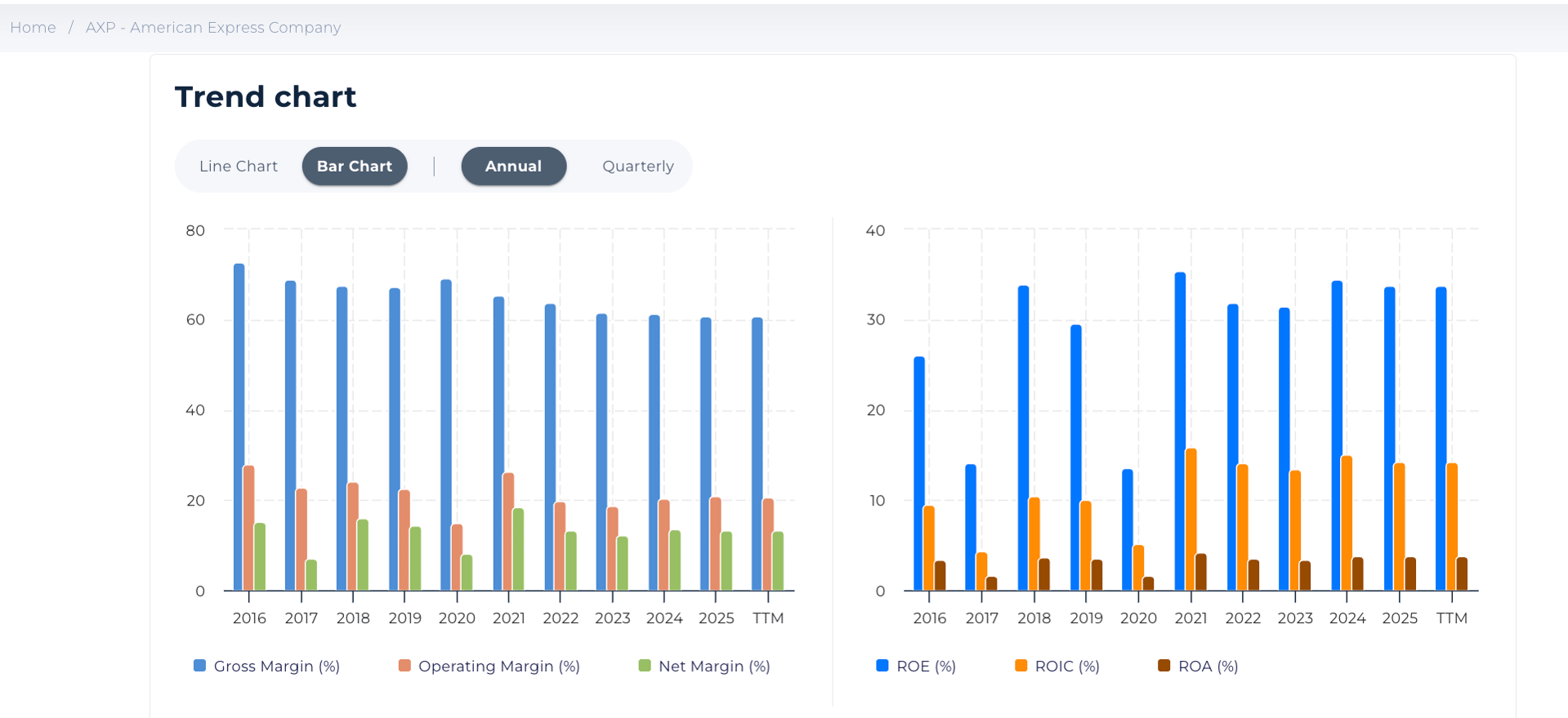
American Express (AXP) Margins and Returns Trend Chart powered by StockOracle™ - April 2025
The margin gap between the pure networks and AXP is structural, not cyclical.
Mastercard runs at a gross margin of ~96% with operating margins near 58% and net margins around 44% TTM.
Visa is almost equal at gross margins of ~78%, operating margins near 67%, and net margins around 50% TTM. .
American Express, by contrast, operates at gross margins of ~60%, operating margins near 20%, and net margins around 13%. And it’s typically not seen as a weakness, it is the cost of running a lending business alongside a payment network. Credit provisions, funding costs, and cardholder rewards all compress the margins that V and MA never have to absorb.
Returns: Mastercard's Numbers Demand a Closer Look
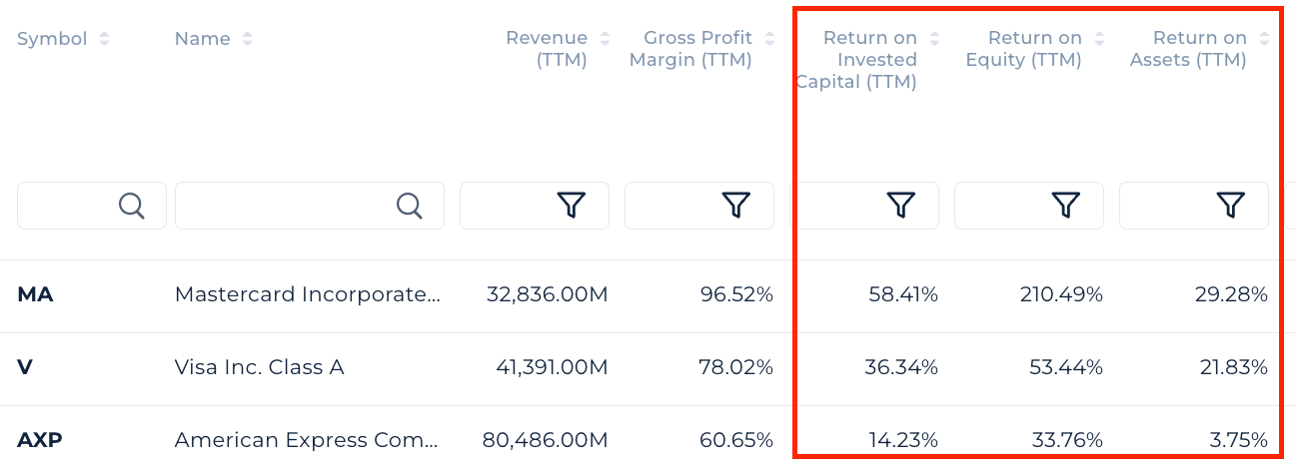
Mastercard's ROE of 210% is the standout figure. That number is real, but it is also a function of MA's aggressive use of debt-funded buybacks, which have compressed equity to a very low base.
The more meaningful signal is ROIC at 58%, indicating that every dollar Mastercard reinvests into the business generates returns well above its cost of capital. That is the number that reflects genuine capital efficiency.
Visa's ROIC of 36% and ROE of 53% both trending sharply upward, tell a similar story with a cleaner balance sheet. Additionally, Visa is net cash positive, carrying approximately $24 billion in cash against $21 billion in debt, giving it balance sheet flexibility that Mastercard does not have to the same degree.
American Express posts ROIC of 14% and ROE of 34% though respectable for a financial services business, it’s structurally lower than the pure networks. AXP's heavy debt load (~$58 billion) reflects its lending book. The Free cash flow (FCF) margin of 19.97% versus MA's 49.29% and V's 55.39% captures the core difference most clearly.
Financial Strength: Scale vs. Efficiency
On the revenue scale, AXP is the largest at $80.5 billion TTM but that figure includes interest income from its lending operations, making a direct comparison with V ($41.4 billion) and MA ($32.8 billion) misleading.
On a pure network fee basis, Visa and Mastercard are the dominant processors.
Free cash flow generation is where the pure networks assert their advantage most clearly. Visa generates approximately $20+ billion in FCF TTM on $41 billion in revenue. Mastercard generates approximately $15 billion in FCF on $33 billion in revenue. These are among the highest FCF conversion rates of any business at this scale. AXP's FCF of approximately $16 billion on $80 billion in revenue reflects the capital intensity of running a bank alongside a network.
All three companies have also conducted sustained share buybacks.
The Stablecoin Question
Can stablecoins really disrupt the toll road? The data above suggests the answer is more nuanced than the threat implies. Visa and Mastercard are not just standing still. Mastercard acquired stablecoin infrastructure company BVNK, and Visa is building crypto payment tools directly into its stack.
The playbook is the same as every previous fintech wave: the network absorbs the disruption and adds it as a new revenue layer.
What stablecoins cannot replicate, at least not yet, is the fraud protection, chargeback infrastructure, merchant relationships, and consumer trust that V and MA have built over decades. The FCF margins and ROIC figures above exist precisely because those networks are structurally irreplaceable in the current payments ecosystem. Whether that remains true over the next decade is the key investor question and one that no single data point can answer definitively.

Final Thoughts
Viewed through the StockOracle™ lens, all three businesses are high-quality but they are not the same business.
Mastercard is the highest-returning pure network, with ROIC of 58% and FCF margins approaching 50%. Visa is the most financially clean, sitting net cash positive with the highest absolute FCF generation and operating margins near 67%. American Express is the premium closed-loop model with lower margins and returns, but a differentiated customer base and a revenue stream that pure networks cannot access.
This analysis is shared for educational purposes. It is not intended as financial advice or a recommendation on any investment.