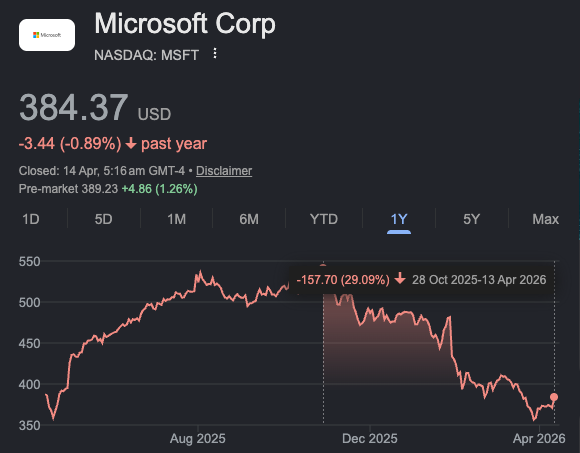
Microsoft has fallen over 30% from its September 2025 all-time high of $555, making it the worst performer among the Magnificent 7 in 2026.
|
Key Points
|
And yet, the business is not broken. Q2 FY2026 revenue came in at $81.3 billion, up 17% year over year. Azure grew 39%. Non-GAAP EPS of $4.14 beat consensus by roughly 6%.
The stock dropped 10% in a single session, erasing $357 billion in market capitalisation. It was the largest single-day dollar loss in Microsoft's history.
Why are investors selling Microsoft (MSFT Stock)?
For the better part of a decade, investors priced Microsoft as a capital-light, high-margin software compounder. The business generated enormous free cash flow with minimal reinvestment needs. It was the ideal compounding machine: sticky enterprise subscriptions, expanding margins, and a growing pile of excess cash to return to shareholders.
That identity is being rewritten.

Microsoft (MSFT) CapEx powered by StockOracle™ - 16 APR 2025
Analyse Stocks with StockOracle™ 7 Day Free Trial
Microsoft's capital expenditure trajectory tells the story:
- FY2022: $23.9 billion (SEC 8-K filing, June 2022)
- FY2023: $28.1 billion (SEC 8-K filing, June 2023)
- FY2024: $44.5 billion (SEC 8-K filing, June 2024)
- FY2025: $64.6 billion (SEC 8-K filing, June 2025)
- H1 FY2026 alone: $72.4 billion ($34.9 billion in Q1 + $37.5 billion in Q2)
Read those numbers again. In the first half of FY2026, Microsoft has already spent more on CapEx than in the entire fiscal year of 2025. Annualised, FY2026 CapEx is tracking towards $130 billion or more.
Microsoft's capital intensity (CapEx as a percentage of revenue) has roughly tripled in three years. The company is transitioning from a software business that happened to run cloud infrastructure, into an infrastructure business that happens to sell software.
That distinction matters to investors, because infrastructure businesses carry structurally lower return profiles than software businesses. The market is punishing the uncertainty around whether this spending will generate the same calibre of returns that the old Microsoft did.
Where does Microsoft Cash Actually Goes

Microsoft (MSFT) FCF Breakdown powered by StockOracle™ - 16 APR 2025
Microsoft (MSFT) FCF Compression
- FY2023: $59.5 billion
- FY2024: $74.1 billion (FCF margin: 30.2%)
- FY2025: $71.6 billion (FCF margin: 25.4%)
FY2025 is the number that should catch your eye. Revenue grew nearly 15% year over year, and free cash flow actually declined 3.3%. That is the first time in recent memory that Microsoft's revenue growth failed to translate into FCF growth. The culprit is straightforward: operating cash flow grew, but capex grew faster.
The Bull Case of Microsoft FCF
Bank of America projected that Microsoft will lead Big Tech peers in free cash flow generation over the coming year. The logic is sound in principle: if CapEx growth moderates (management has guided that FY2026 CapEx growth will slow relative to FY2025) and cloud revenue continues scaling, operating leverage should kick in and FCF margins could expand materially.
One external estimate projects FY2026 FCF could reach nearly $100 billion, which would represent a 39% jump from FY2025 and push the FCF margin back above 30%. If that materialises, the current stock price looks cheap on a price-to-FCF basis.
The Bear Case of Microsoft FCF
The bear case does not dispute the arithmetic. It disputes the timeline. Every quarter, the CapEx number comes in higher than expected. Q2 FY2026 CapEx of $37.5 billion exceeded the $34.3 billion consensus. It is a pattern of spend that consistently outpaces what the market is expecting. The concern is not that spending will never generate returns, but that the conversion from CapEx to revenue keeps getting pushed out, leaving investors holding a stock with compressed margins and no clear inflection point.
The $281 Billion Elephant in the Backlog
OpenAI and the RPO Concentration
On the Q2 FY2026 earnings call, CFO Amy Hood disclosed that commercial remaining performance obligations (RPO) reached $625 billion, up 110% year over year. That is an enormous number, and under normal circumstances, it would be unambiguously bullish.
Then came the second disclosure: approximately 45% of that RPO, roughly $281 billion, is tied to OpenAI.
The $625 billion backlog is the primary justification for the CapEx. If the backlog is solid, the spending is rational. If the backlog carries concentration risk, the spending looks more speculative.
Why This Matters for Microsoft Free Cash Flow
The connection between RPO quality and FCF is direct: a backlog converts into revenue over time, and revenue (minus costs) converts into cash. But the conversion rate depends entirely on the counterparty honouring its commitments on schedule.
OpenAI is not yet a profitable company. It burns significant cash and has relied on successive fundraising rounds to sustain operations. While its revenue has grown rapidly, it remains structurally dependent on external capital to meet its own obligations.
More importantly, OpenAI is actively diversifying its infrastructure providers. It signed a $38 billion deal with AWS, which was disclosed around the same period. It is developing custom AI chips in partnership with Broadcom, with deployments expected in late 2026. These are rational moves for OpenAI, but they introduce optionality that works against Microsoft's backlog certainty.
Hood addressed the concentration on the call, noting that the remaining 55% of RPO (roughly $344 billion) grew 28% year over year and is broadly diversified across customers, industries, and geographies. That is a fair and important counterpoint. The non-OpenAI book is healthy, large, and growing.
But 45% concentration in a single customer that is not yet profitable, is actively building relationships with your direct competitors, and is developing its own silicon to reduce dependence on your infrastructure... that is a risk profile that investors cannot ignore.

How is the Market Repricing MSFT Stock?
The most common misread of Microsoft's sell-off is that the market is overreacting to a capex number. That framing misses the shift.
Microsoft's forward P/E has compressed to roughly 22 to 25 times, near three-year lows. Its price-to-free-cash-flow ratio sits around 35 to 39 times, compared to a 20-year average of about 28 times. Even after the sell-off, the stock is not conventionally cheap on a cash flow basis unless you underwrite the bull case on FCF recovery.
What the market is repricing is not one quarter's spending. It is the probability-weighted return profile of a company that is simultaneously:
- Spending at a pace that suppresses near-term FCF
- Carrying a backlog where the largest single customer accounts for 45% of contracted obligations
- Experiencing cloud gross margin compression as AI infrastructure costs scale
The Question FCF Investors Need to Answer
Microsoft's free cash flow story is ultimately a timing question disguised as a valuation question.
If you believe CapEx moderates from here (management has signalled this), that Azure demand converts the RPO backlog on schedule, and that cloud gross margins stabilise as AI infrastructure scales, then the FCF trajectory looks compelling.
A path to $100 billion in annual free cash flow is not unreasonable, and a stock trading at 22 times forward earnings with that kind of cash generation would be meaningfully undervalued.
If you believe the CapEx cycle has further to run, that OpenAI's concentration introduces conversion risk to the backlog, that margin compression persists as AI costs stay elevated, then the current price is not yet pricing in the full extent of the FCF pressure.
Both views rest on the same set of facts. The divergence is in how much patience you are willing to extend, and how much credit you give a company that has earned the benefit of the doubt for the better part of two decades.
What is no longer debatable is that Microsoft's free cash flow profile has changed. The most predictable cash flow story in Big Tech is now the most contested one. And for investors with capital on the line, understanding that shift is not optional.