The AI disruption narrative has pulled enterprise software stocks down broadly in 2026 and ServiceNow has not been spared.
|
Key Points
|
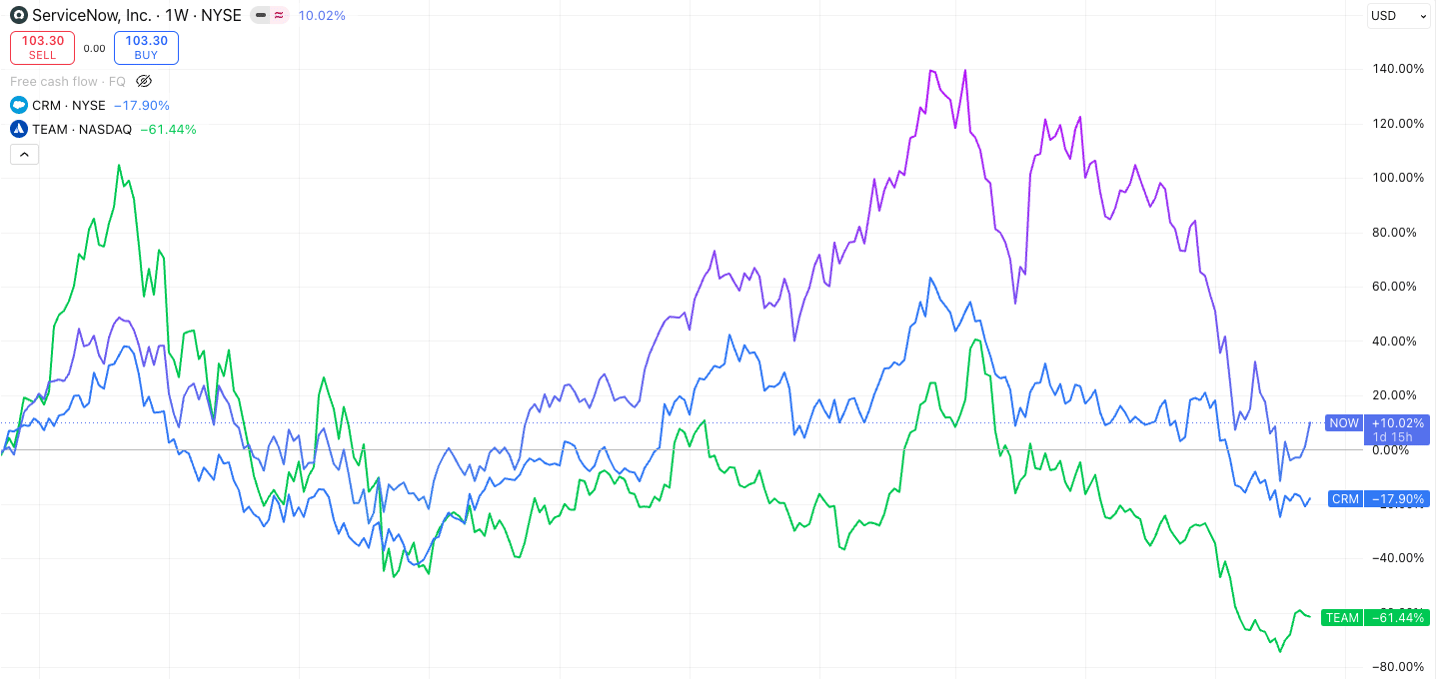
NOW vs CRM vs TEAM (5 Years Performance) -- ServiceNow (NOW) +10.02% , CRM -17.90% , TEAM -61.44%
Yet through two consecutive quarters of 22% subscription revenue growth and a 98% renewal rate maintained for seven years running, the business itself seems to shows little sign of the disruption the market has been pricing in.
That gap between narrative and fundamentals is where the valuation question gets interesting. And this is where investors can find opportunities in a market where everything looks expensive.
What Is ServiceNow's Intrinsic Value?
Intrinsic value of a business is usually the estimated worth of a business based on the cash flows it is expected to generate over time. A margin of safety exists when a stock trades below that estimate.
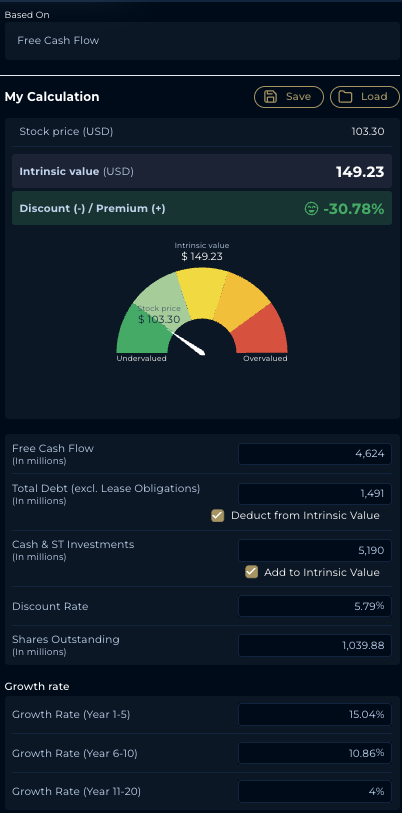
Conservative FCF-Based Intrinsic Value Calculation — Powered by StockOracle™
Using a 20-year DCF model based on free cash flow, with lower near-term growth compressed to 15.04% (Year 1–5) and 10.86% (Year 6–10) — both below analyst consensus estimates, FCF20 estimates ServiceNow's intrinsic value at $149.23 per share as of May 2026.
Revenue Growth: Scaling Without Slowing
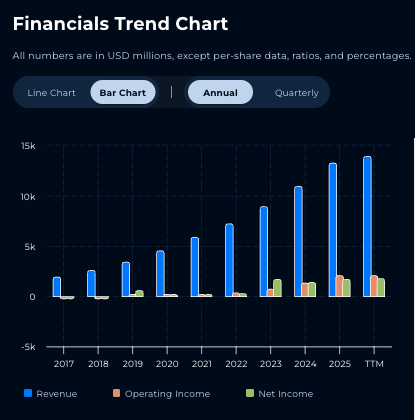
NOW Revenue Trend — Powered by StockOracle™
ServiceNow grew from a $3 billion company in 2019 to a business generating $13.3 billion in total revenues over the last twelve months, a trajectory that reflects broad platform adoption across different business functions and workflows. In Q1 2026, subscription revenues reached $3.67 billion, up 22% year-over-year, beating guidance for the eleventh consecutive quarter.
What drives that consistency is beyond just new customer acquisition. More than 90% of customers now run multiple workflows on the platform, meaning growth is deepening inside existing accounts signifying a more durable, more profitable form of expansion.

Free Cash Flow: The Line That Matters for Valuation
Top-line growth a.k.a revenue growth is the headline. Free cash flow is the receipt.
In 2025, ServiceNow generated $4.6 billion in free cash flow at a 35% FCF margin — meaning the business converted 35 cents of every revenue dollar into real cash after paying for everything required to operate and grow. That is the number DCF models are built on, and it has been expanding consistently.
Growth Catalysts: AI as Revenue Accelerator
ServiceNow's AI product, Now Assist, exited 2025 with over $600 million in annual contract value, tracking toward a $1 billion ACV target for 2026. In Q1 2026 alone, Now Assist customers spending over $1 million in ACV grew more than 130% year-over-year.
But what matters more than the headline ACV figure is what Now Assist runs on. ServiceNow's platform functions as an orchestration layer, routing tasks, context, and decisions across AI agents, enterprise data, and business systems from a single control point. Competitors offering standalone AI tooling do not replicate that function. They require it.
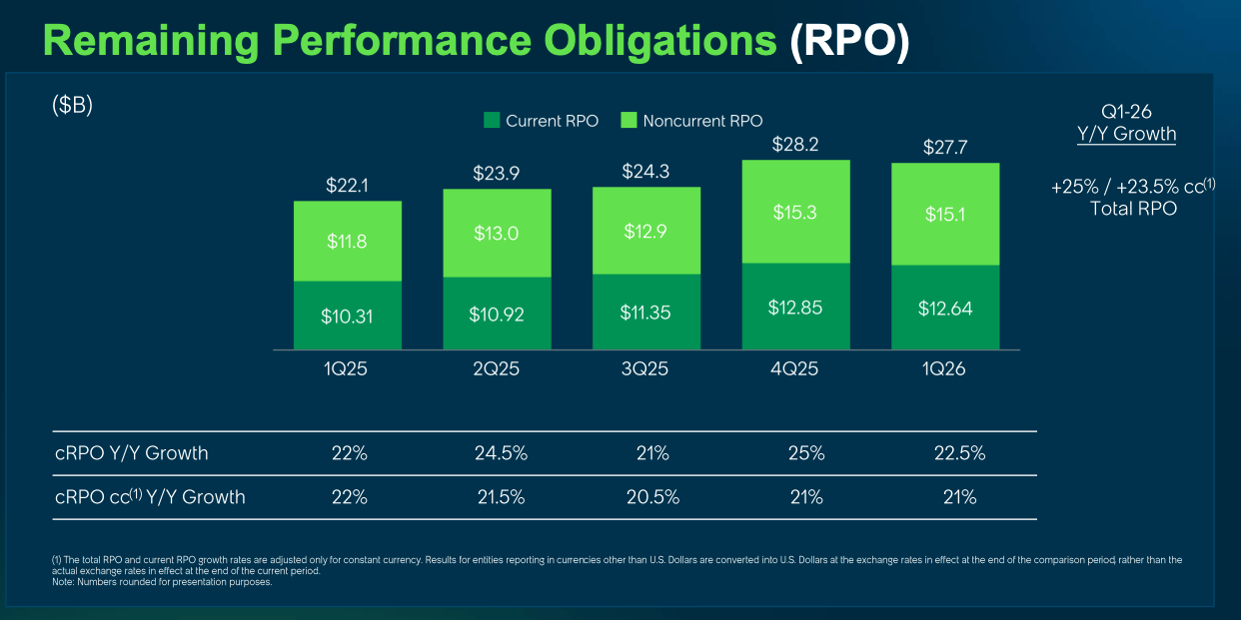
source : ServiceNow (NOW) earnings report Q1 2026
The contracted revenue pipeline reflects this positioning: remaining performance obligations reached $27.7 billion in Q1 2026, up 25% year-over-year, a forward revenue sign that it is not sensitive to whether a single AI tool succeeds or fails.
Economic Moat: Why Switching Costs Remain High
ServiceNow's moat is not a feature set. It is embedded process logic.
When a company runs IT service management, HR workflows, customer operations, and security response through a single platform, that platform becomes part of how the organisation thinks and acts. Replacing it means re-mapping every cross-departmental process, retraining every team, and rebuilding years of institutional configuration. Effectively rewiring the whole enterprise workflow and systems.
The 98% renewal rate, held for seven consecutive years, is the outcome of that depth. Salesforce (CRM) operates horizontal CRM workflows. Atlassian (TEAM) handles developer-specific task management.
ServiceNow has built its platform around — enterprise-wide workflow orchestration across IT, HR, security, and finance simultaneously.
Lastly, ServiceNow's strong balance sheet adds another layer of optionality.
Final Thoughts on ServiceNow's Intrinsic Value
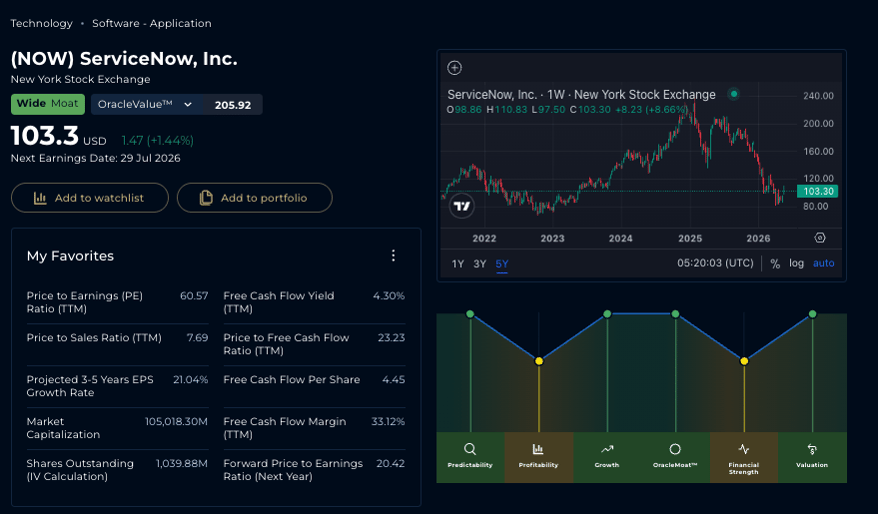
ServiceNow (NOW) Dashboard Powered by StockOracle™ 21st May 2026
- 98% renewal rate for seven years — a direct measure of how embedded the platform is in mission-critical enterprise workflows
- $4.6 billion in free cash flow in 2025 at a 35% margin, with guided expansion in 2026
- Platform-level switching costs that standalone AI tools do not dissolve; they depend on the orchestration layer ServiceNow already provides
- Balance sheet strength providing the runway and acquisition capacity to adapt without disruption pressure
The market's concern about AI disruption to SaaS is a legitimate structural question for many software companies.
For ServiceNow specifically, the evidence the business itself produces, renewal rates, FCF margins, contracted backlog, and AI product growth. The real question investors should be asking is whether ServiceNow can sustain the growth rate required to bring institutional confidence back to the stock.