AMC Entertainment (AMC) was one of the most talked-about stocks in modern investing history, surging to all time highs in 2021 before falling nearly 99% from its peak. Today, the stock trades close to penny-stock territory, leaving thousands of retail investors wondering what went so wrong.
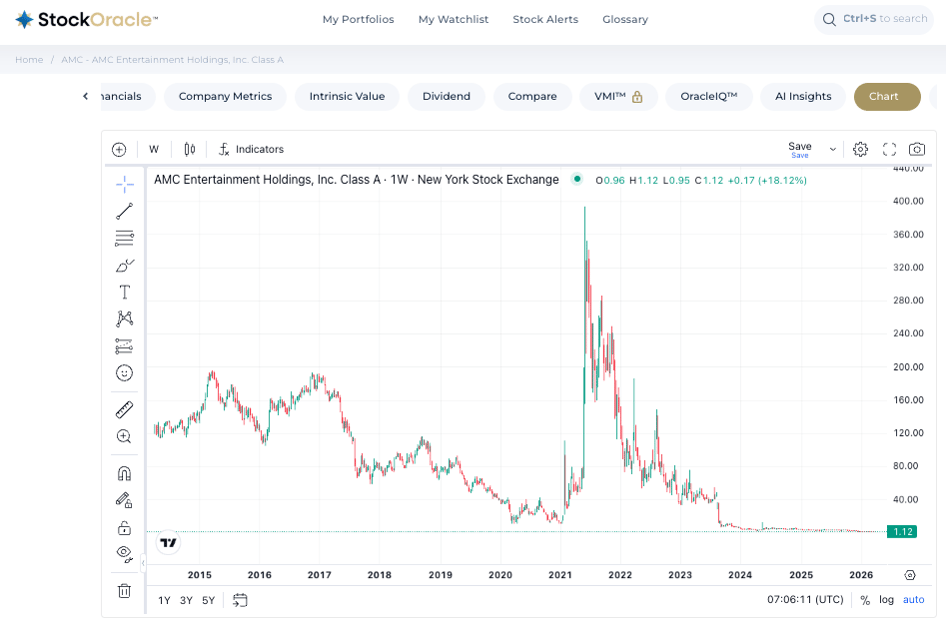
The answer is not one single thing. It is a combination of a structurally challenged business, a mountain of debt, and very aggressive share dilution.
What Does AMC Entertainment Actually Do?
AMC Entertainment Holdings is the largest movie theatre chain in the world. The company operates hundreds of cinema locations across the United States and several European countries. Its core business is straightforward: it sells movie tickets (Admissions), food and drinks inside its venues (Food and Beverage), and a small amount of in-theatre advertising (Advertising).
That simplicity is part of what made AMC so appealing to retail investors during the 2021 meme stock frenzy. People understand movie theatres. Everyone has been to one. The familiarity made it easy to rally behind.
AMC's Revenue: A Business Still Trying to Find Its Footing
AMC Entertainment (AMC) Historical Operating Revenue powered by StockOracle™ - 6th April 2026
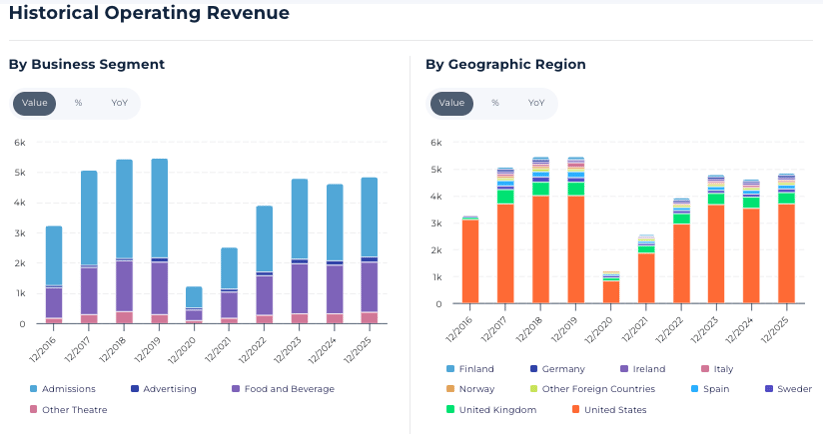
The revenue charts above, pulled from StockOracle™'s research platform, reveal a business that was humming along before the pandemic.
Looking at the By Business Segment chart above, AMC's total operating revenue peaked at around $5.5 billion in the 2017 to 2019 period. Admissions is the dominant revenue driver, followed by Food and Beverage, with Advertising and Other Theatre making up a small fraction of the total. This tells you something important: AMC's revenue is almost entirely dependent on one thing, people physically walking into its theatres and buying a ticket.
Then 2020 hit. Revenue collapsed to roughly $1.2 billion, a fraction of its pre-pandemic level, as governments shuttered cinemas globally. By 2025, AMC was generating approximately $4.85 billion in annual revenue, which sounds impressive until you realise that the number of tickets sold across the industry is still roughly 39% below 2019 levels in terms of volume.
Explore AMC's full revenue breakdown and financial data on StockOracle™ for free
The Financial Reality: Losses, Debt, and Dilution
AMC Entertainment (AMC) Financials Trend Chart powered by StockOracle™ - 6th April 2026
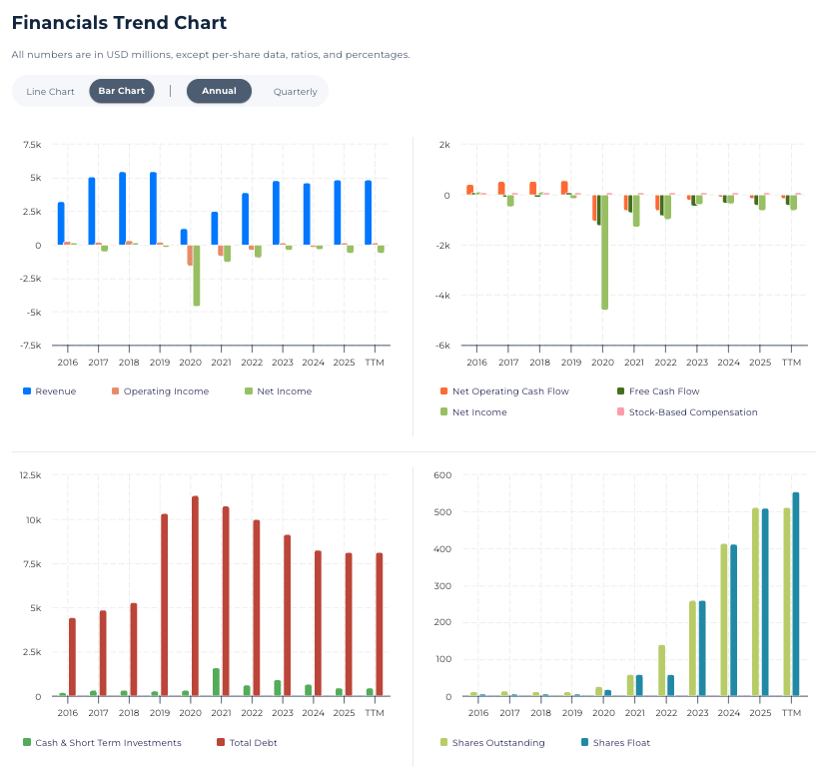
The four charts in StockOracle™'s Financials Trend view tell the real story of why AMC stock is where it is. Let us walk through each one.
A Business That Cannot Turn Revenue into Profit
The top-left chart tracks Revenue, Operating Income, and Net Income from 2016 through the trailing twelve months. The picture is stark. Even in the good years of 2017 to 2019, when revenue was near its peak, net income was barely breaking even.
Operating income hovered near zero, and net income occasionally dipped negative even before the pandemic. AMC was never a highly profitable business. It was a high-volume, thin-margin one.
After the catastrophic 2020 loss (net income plunged to approximately negative $4.5 billion), the business has never returned to sustained profitability. The last full year AMC reported an annual profit was 2018. Every year since, the company has posted a net loss. For the full year 2025, AMC reported a net loss of approximately $632 million, despite generating nearly $5 billion in revenue. The math tells you that even as customers come back to theatres, the company's cost structure, its debt obligations in particular, are consuming every dollar of recovery.
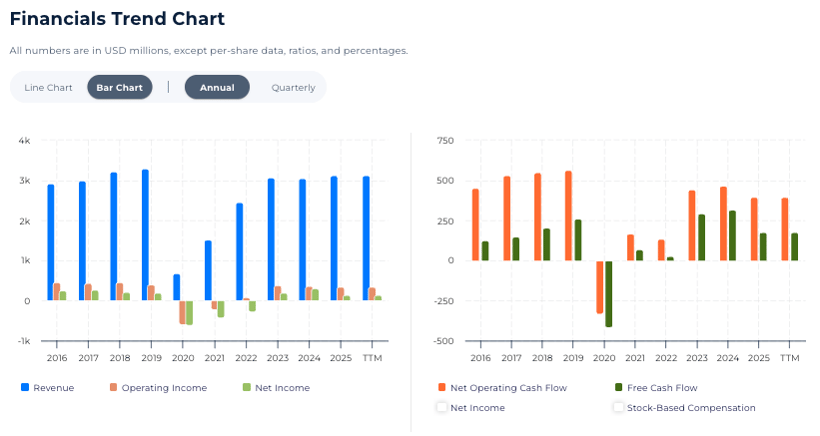
Cinemark Financials Trend Chart powered by StockOracle™ - 6th April 2026
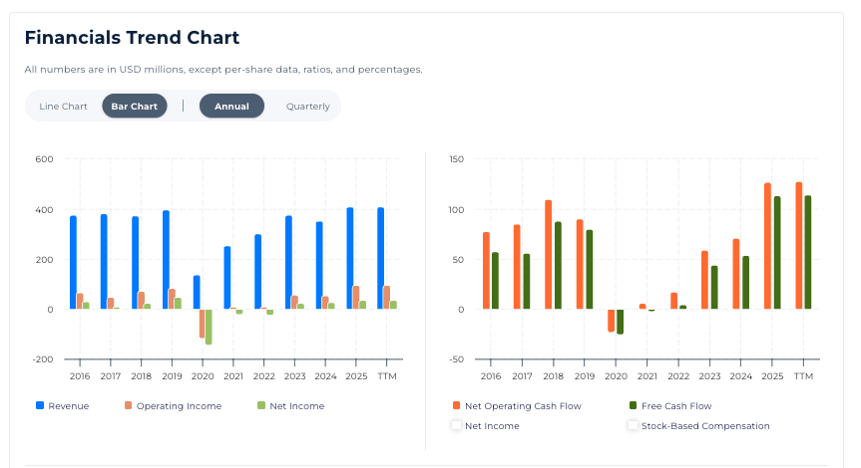
IMAX Financials Trend Chart powered by StockOracle™ - 6th April 2026
For comparison, Cinemark (AMC's closest competitor) and IMAX have generated positive free cash flow. The problem is not that cinemas are dead. The problem is that AMC's specific financial structure makes profitability almost impossible to sustain.
The Debt Mountain
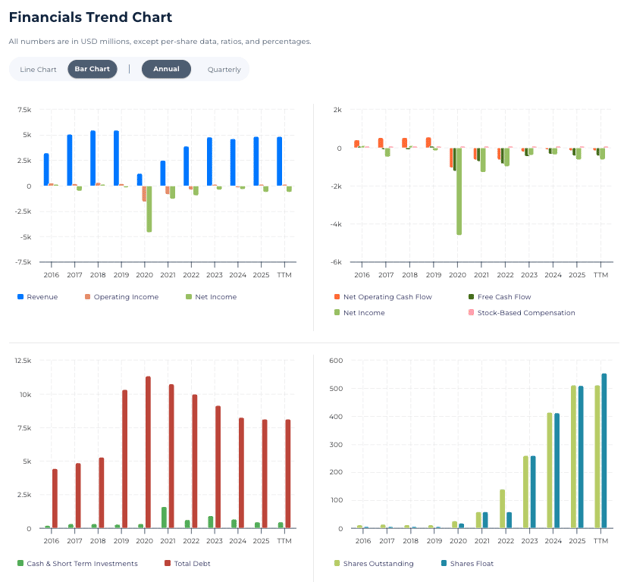
AMC Entertainment (AMC) Financials Trend Chart powered by StockOracle™ - 6th April 2026
The debt and cash chart of AMC is perhaps the most important of the four. The Total Debt shows that AMC entered the pandemic with already-elevated debt levels, then borrowed aggressively to survive the 2020 shutdown. By 2021 and 2022, total debt peaked at approximately $11 billion. Through a combination of debt restructuring and asset sales, that number has come down to roughly $4 billion as of 2025.
Cash and short-term investments tell the other side of this story. Because AMC is not sitting on a cash cushion, It has very little financial buffer. Which is why the company has repeatedly turned to equity markets to raise funds. Which leads to the next problem that’s not great for investors.
The Share Dilution Problem
Shares Outstanding and Shares Float were essentially flat and very small from 2016 through 2022. Then, starting in 2023, they exploded. Today, AMC has approximately 440 to 530 million shares outstanding, compared to roughly 11.8 million in 2019 (on a split-adjusted basis).
This is what "dilution" means in practice. When a company issues new shares to raise money, every existing share becomes a smaller piece of the same pie. If you owned 1% of AMC in 2019, that same number of shares now represents less than 3% of that original 1%. The pie did not grow; it was just cut into way more slices.
Each of these moves was financially necessary for the company's survival. But each one came at a direct cost to existing shareholders.

So Why Is AMC Stock So Low?
AMC is a fundamentally challenged business. At the same time carrying a debt load that consumes most of its operating income, and having diluted its shareholders by a factor of 37x since 2019. The company has not reported an annual profit since 2018, and its free cash flow has been consistently negative. Until AMC demonstrates a credible path to sustained profitability and meaningful debt reduction, the stock price reflects the very real risks that common shareholders carry. The key question investors should ask when considering AMC is whether cinemas are going to remain relevant in the long run, and if AMC is in a meaningful turnaround phase.
Any past performance mentioned is not indicative of future results.
This analysis is shared for educational purposes to illustrate how markets and financial data interact. It is not intended as financial advice or a recommendation on any investment.