By Piranha Profits Team
Last updated on August 14, 2026
Cisco posted a record quarter $17.3 billion in revenue, up 18% year-over-year, with full-year AI infrastructure orders surging 4.5x to $9.3 billion.
Shares still fell nearly 4% after hours on the report, only to rally back the very next session and close just below the stock's all-time high.
What Does Cisco Actually Do?
Cisco built its business on the hardware and software that connects everything inside a company's network. Switches, routers, and the security layered on top of them.
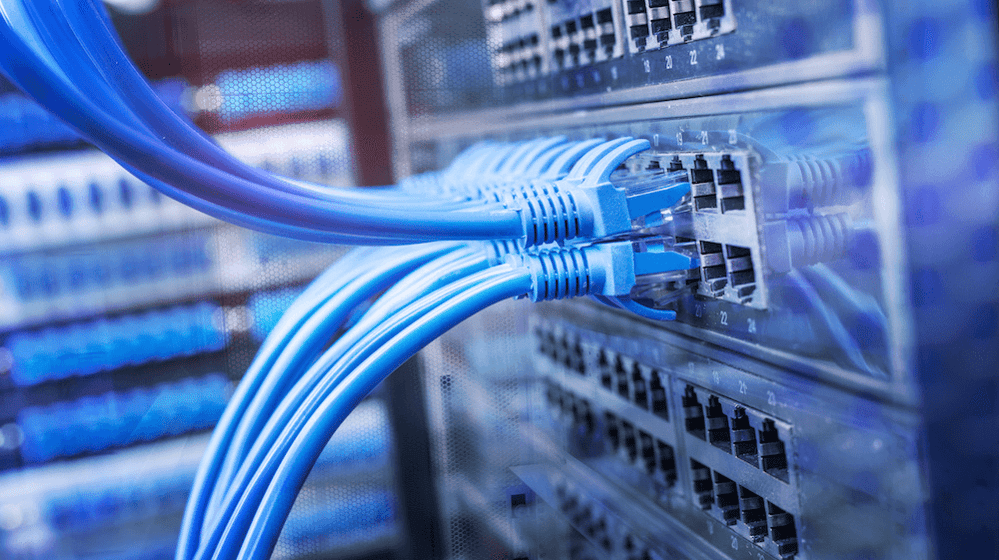
That "plumbing" like role has made Cisco gear the default choice for enterprise IT departments for three decades, generating steady hardware sales plus a growing subscription queue from security and collaboration software.
The newer growth engine is AI infrastructure: Cisco now sells the networking silicon, switches, and optical components that connect thousands of GPUs together inside AI data centers. A role it competes for directly against Nvidia, Arista Networks, and Broadcom.
What Is Cisco's Intrinsic Value?
Intrinsic value is an estimate of what a business is actually worth based on the cash it can realistically generate over time. Not whatever price the market happens to assign it today.
For a mature, still-growing business like Cisco, that estimate depends heavily on how much of its current AI momentum an investor is willing to assume continues, so let's work it through.
Cisco's Fair Value: What a 20-Year DCF Model Says
Run Cisco's own numbers through a 20-year discounted free cash flow model and fair value lands near $127.51 per share.
The model starts from Cisco's trailing free cash flow of $11,788 million, nets out $31,303 million in total debt (excluding lease obligations) against $16,640 million in cash and short-term investments, and discounts future cash flows at 6.34%.
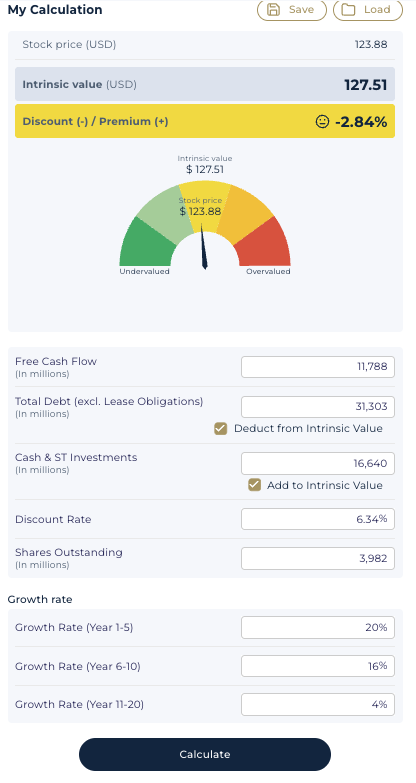
Cisco (CSCO) 20-Year Discounted Cash Flow Model — Powered by StockOracle™ · Accurate as of 13 August 2026
That fair-value read sits against a stock trading at 39.26x trailing earnings — nearly double its own 20.20x five-year average. Multiples that rich don't automatically mean a stock is overpriced, but they do raise the bar for how much growth actually has to show up to justify the price now.
The growth assumptions feeding the $127.51 figure are where the story gets interesting: 20% for Years 1–5, tapering to 16% for Years 6–10.
That near-term assumption is more than double Cisco's own 8.36% projected 3–5 year EPS growth rate. Compounding at 20% a year means Cisco's free cash flow would need to roughly double in 3.8 years and keep growing at that pace for five straight years.
That gap matters because it flips the framing: the DCF model isn't showing Cisco is fairly valued on its own merits, it's showing what has to be true about the AI infrastructure ramp for the current price to make sense. Dial the near-term growth rate back toward that 8.36% consensus figure instead, and the fair-value output compresses well below $127.51.

Cisco (CSCO) Financial Performance
Revenue: The AI Supercycle Shows Up in the Numbers
Cisco's full fiscal 2026 revenue reached $63.3 billion, up 12% year-over-year, with Q4 alone climbing 18% to $17.3 billion. A step up from years of low-single-digit growth earlier in the decade. Management has described this as a networking "supercycle," and the segment mix backs that up: hyperscaler AI infrastructure orders grew far faster than the rest of the business, while non-hyperscaler enterprise orders still grew at a healthy double-digit clip. Growth is showing up in more than one part of the business at once, not just the AI headline.
Free Cash Flow: The Line the Fair-Value Estimate Leans On
Earnings can be shaped by accounting choices. Free cash flow is the cash that actually moves through the business after the bills are paid — and it's the number the $127.51 estimate above is built on.
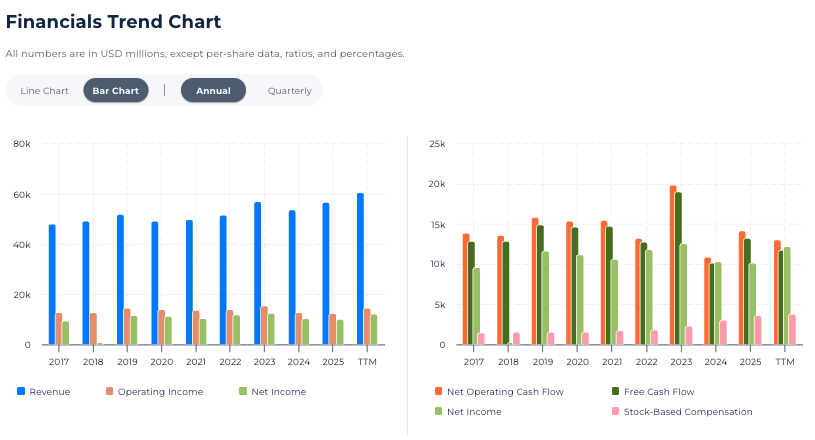
Operating Cash Flow and Free Cash Flow Chart — Powered by StockOracle™
Cisco's free cash flow yield (TTM) sits at 2.39%, meaning for every dollar of Cisco's current market value, a little over two cents of real cash comes back out through the business each year. That's a modest yield on its own, but it's also the base the entire DCF model above compounds forward at 20% annual growth — which is exactly why the growth assumption, not the FCF base itself, is the number worth stress-testing.
Returns on Capital: Cooling From Their Highs
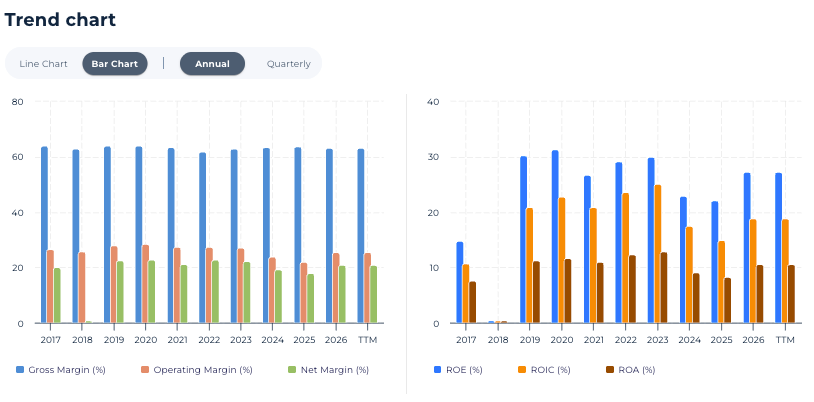
Cisco Margins and Returns Trend — Powered by StockOracle™
Return on equity (TTM) sits at 25.80% and return on invested capital (TTM) at 17.54% both still healthy, but down from the mid-20s-to-low-30s percent range Cisco posted through 2020–2023.
That softening lines up with the same period Cisco's cash pile drew down and its AI infrastructure investment ramped up, which is a reasonable trade-off if the AI segment scales the way management is guiding but it's not yet a foregone conclusion.
Debt and Liquidity: A Quieter Shift Worth Watching
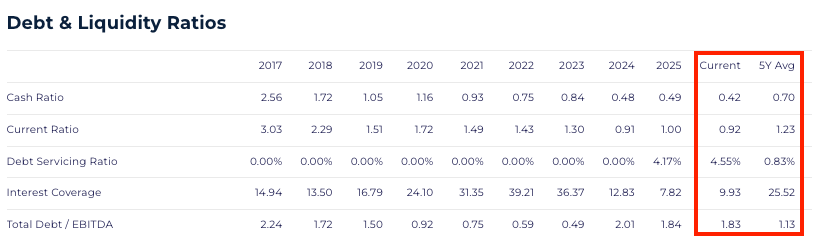
CSCO Debt & Liquidity Ratios — Powered by StockOracle™ · Accurate as of 13 August 2026
Away from the AI headlines, Cisco's balance sheet has drifted in a direction worth noting.
The current ratio, which is the current assets divided by current liabilities, a basic read on whether a company can cover its near-term bills without tapping new financing, has slid from 3.03 in 2017 to 0.92 today, below its own 1.23 five-year average.
A ratio under 1 means current liabilities technically outweigh current assets on paper while it's not unusual for a large, cash-generative company, the steady multi-year decline signals Cisco is running a noticeably tighter short-term balance sheet than it used to.
Cisco still generates strong free cash flow and has ready access to capital markets if a near-term gap ever needed bridging. But the slide lined up with the same period Cisco's cash pile drew down and debt increased, consistent with funding both the AI infrastructure build-out and continued buybacks rather than sitting on excess reserves.
Shareholder Returns: A Shrinking Share Count
Cisco's shares outstanding have fallen from roughly 5.0 billion in 2017 to 3.98 billion most recently. A reduction of about a fifth over eight years, funded through sustained buybacks. Each remaining share now owns a meaningfully larger slice of the company than it did a decade ago, on top of a 1.38% dividend yield.
Growth Catalysts: The AI Networking Story Behind the Rally
This is the part of the business actually driving 2026's rally, so it's worth unpacking in more depth than a single order number.
Silicon One and the AI Infrastructure Ramp
- Cisco's Silicon One chip family — most recently the G300 — now competes at the same performance tier as Nvidia and Broadcom, making Cisco one of only three vendors capable of producing networking silicon at that leading edge.
- Five of the six major U.S. hyperscalers have adopted Silicon One in some form, with three hyperscalers specifically committing to its P200 routing silicon.
- Cisco has shipped over one million Silicon One units to date.
- Its Acacia optical transceiver business — the components that physically link switches and GPUs inside a data center — has crossed $1 billion in orders and is reportedly on track to triple its order book this year.
- Full-year AI infrastructure orders hit $9.3 billion (4.5x the prior year), with $4 billion landing in Q4 alone; management guides for AI infrastructure revenue of roughly $7.5 billion in FY2027, up from about $4 billion in FY2026.
Why it matters for valuation: unlike Cisco's traditional enterprise switches, Silicon One is sold as merchant silicon. A standalone networking chip that hyperscalers and sovereign cloud operators can buy and integrate independently, rather than a captive chip locked into one company's own infrastructure the way Google's or Amazon's in-house silicon is.
That's a structurally different, potentially higher-margin business than Cisco's legacy hardware refresh cycle, which is why investors have re-rated the stock on the strength of this specific product line rather than the business as a whole.
From Enterprise Networking to AI Infrastructure: How Cisco Got Here
This pivot didn't happen in a vacuum. When ChatGPT's public launch in November 2022 kicked off the current generative AI boom, hyperscalers responded by pouring capital into new data centers.. and Cisco, until then a business built almost entirely around traditional enterprise networking, moved to position itself inside that build-out rather than watch it from the sidelines. The company brought in Jeetu Patel as President and Chief Product Officer to help lead the shift, struck an expanding partnership with Nvidia starting in February 2024 to build joint AI infrastructure reference architectures, and closed its $28 billion acquisition of Splunk to add the observability and security layer hyperscalers and enterprises need to run AI workloads at scale. Silicon One and the AI order backlog described above are the output of that multi-year repositioning, not a single product launch.
Cisco's Own Framing of the AI Opportunity
From Cisco's Q4 FY2026 earnings, CEO Chuck Robbins put it this way: "With the breadth and depth of our portfolio and our competitive differentiation in secure networking, Cisco is well positioned to support our customers however or wherever they decide to deploy AI." The bet is less about Cisco winning any single AI compute deal and more about Cisco being the connective layer underneath whichever hyperscaler or model provider wins.
Economic Moat: Why Cisco Still Rates a Narrow Moat
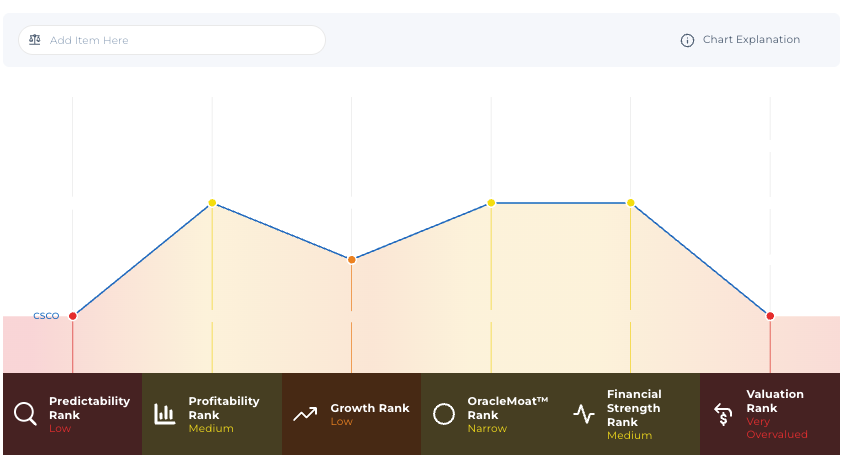
StockOracle™ rates Cisco a Narrow Moat business. The case for it: enterprise networks are expensive and risky to rip out once installed, and Cisco's certification ecosystem (CCNA- and CCNP-trained engineers) means most companies' IT teams are literally trained on Cisco's specific hardware and software.
That moat looks different against each of Cisco's real competitors and in the segment driving this rally, Cisco isn't actually the incumbent.
Arista Networks overtook Cisco as the largest data center Ethernet switch vendor back in 2024 and is now the default choice at hyperscalers like Microsoft and Meta, built on a single unified operating system that Cisco's more fragmented product lines still haven't fully matched.
Broadcom and Nvidia round out the pressure from below and above: Broadcom is the incumbent merchant silicon supplier already embedded in most hyperscaler and white-box switch designs, and Nvidia locks in networking spend through NVLink for GPU clusters already built on its own compute.
Put plainly, Cisco's AI infrastructure business is real, but it's still small next to the rest of the company, and its winning share comes back from a position of catching up rather than leading.
Building Your Own DCF: What Would Have to Be True
The $127.51 estimate above already leans on a 20% near-term growth assumption — more than double Cisco's own 8.36% consensus 3–5 year EPS growth estimate.
Dial that Years 1–5 assumption down toward the consensus figure instead, and the fair-value output compresses meaningfully below $127.51, since a 20-year model this front-loaded is especially sensitive to its first five years of assumed growth.
Final Thoughts on Cisco's Intrinsic Value
- Full fiscal 2026 revenue grew 12% to $63.3 billion, with Q4 accelerating to 18% growth — a genuine re-acceleration, not just an AI headline.
- AI infrastructure orders reached $9.3 billion for the year, 4.5x the prior year, with five of six major U.S. hyperscalers now using Cisco's Silicon One chips.
- Free cash flow remains healthy and continues to fund a shrinking share count, with shares outstanding down roughly a fifth since 2017.
- Return on equity and return on invested capital are both still healthy but have cooled from their 2020–2023 highs as AI capital spending ramps.
- The current ratio has slid well below its five-year average, a sign Cisco is running a tighter short-term balance sheet as it funds the AI infrastructure build-out and continued buybacks.
- The 20-year DCF's $127.51 fair-value estimate only holds up if Cisco's growth roughly doubles its own consensus estimate — a real, checkable assumption rather than a settled fact.
Cisco's 2026 rally isn't a broken business getting a speculative re-rating — the enterprise networking base is genuinely accelerating and the AI infrastructure order book is real. The open question is whether that order book converts into free cash flow fast enough to catch up to a stock already trading at close to double its own historical earnings multiple. If Silicon One and Acacia optics keep converting hyperscaler orders into recognized revenue at the pace FY2027 guidance implies, the fair-value estimate above has real room to climb. If that conversion lags, the multiple has room to compress even while the underlying business keeps executing.
This analysis is shared for educational purposes only and is not intended as financial advice or a recommendation to buy, sell, or hold any security. The DCF figures above are a model output built on stated, adjustable assumptions — not a fixed or guaranteed valuation — and should not be treated as a standalone signal. Past performance, including any figures referenced above, is historical and is not indicative of future results.
Related

For most of its 24-year life, the company was private. The figures floating around came from leaks, ...

A business that still earns a 22.8% return on invested capital, carries no interest-bearing debt, ...
Home Depot trades at 21.95 times trailing earnings, a multiple that assumes the growth engine ...