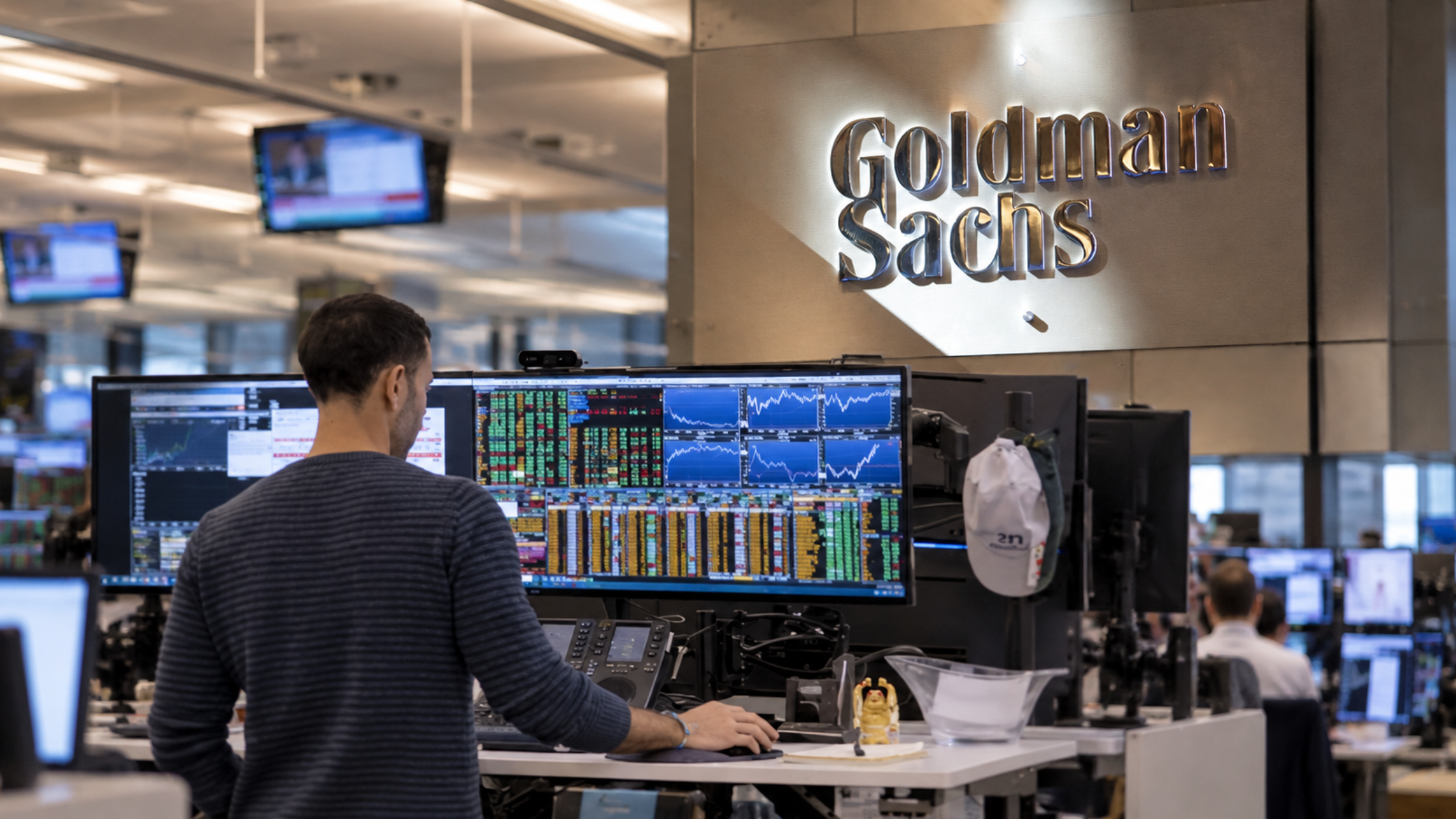
Every AI story eventually runs into the same question: who secures all of it? As enterprises pour billions into AI data centres, every new GPU cluster, AI agent, and inference workload widens the attack surface, and cybersecurity spend has quietly become part of the AI infrastructure itself.
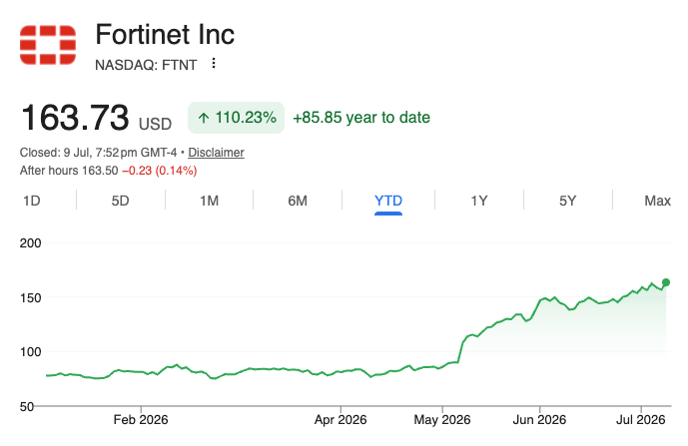
Fortinet has emerged as one of the clearest expressions of that thesis: the stock has roughly doubled in 2026, with Q1 product revenue surging 41% year over year to $645 million on the back of AI data centre deployments. When a stock price moves that fast, the intrinsic value question becomes more important than ever. Has price outrun its value in Fortinet’s case?
What is Fortinet's intrinsic value?
Intrinsic value is a company's true economic worth, independent of what the market is willing to pay for it. The gap between the price and value is where the margin of safety lives.
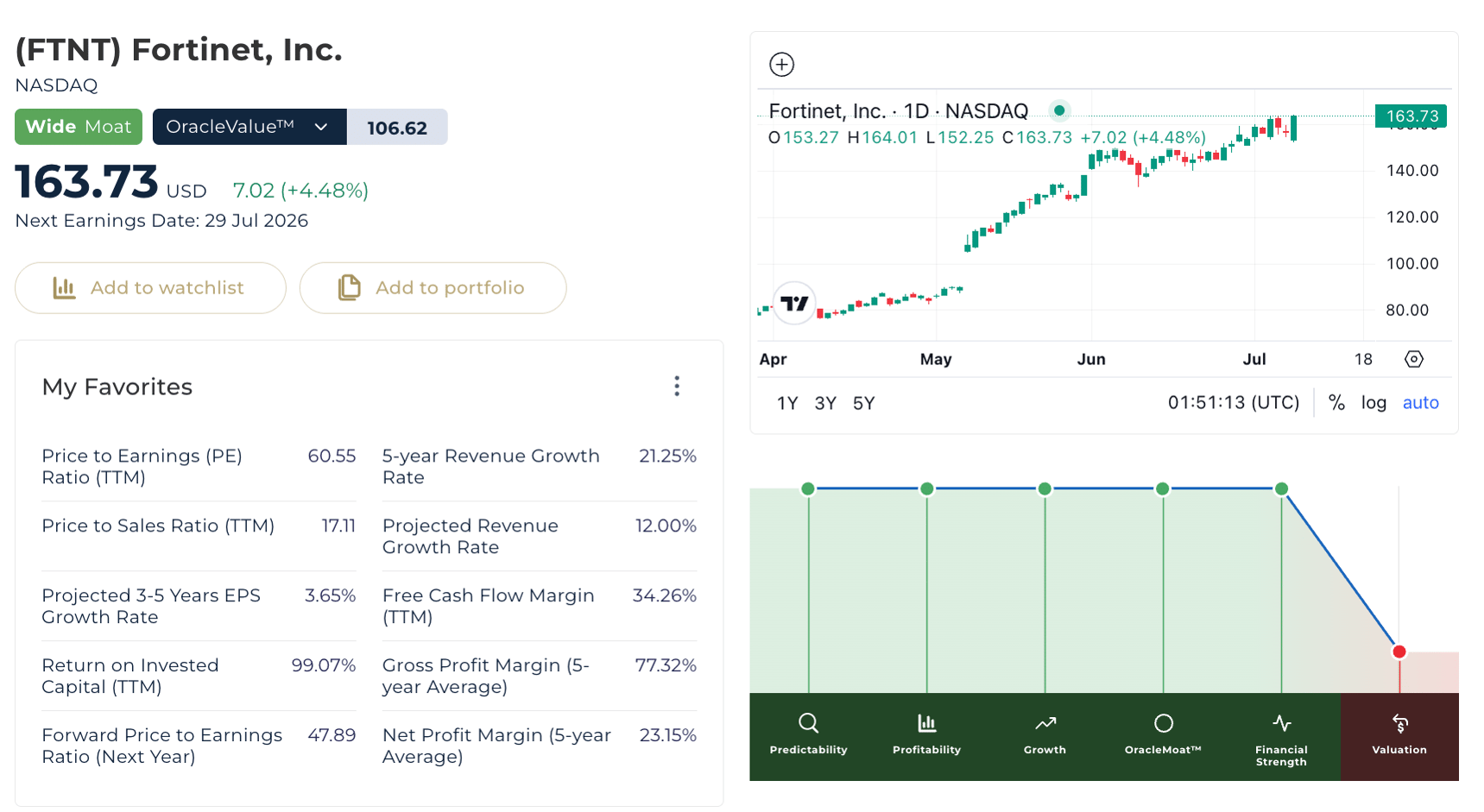
Accurate as of 10th Jul 2026 - Powered by StockOracle™
Based on OracleValue™ estimations, Fortinet's intrinsic value is estimated at $106.62 per share. Read on to find out why.
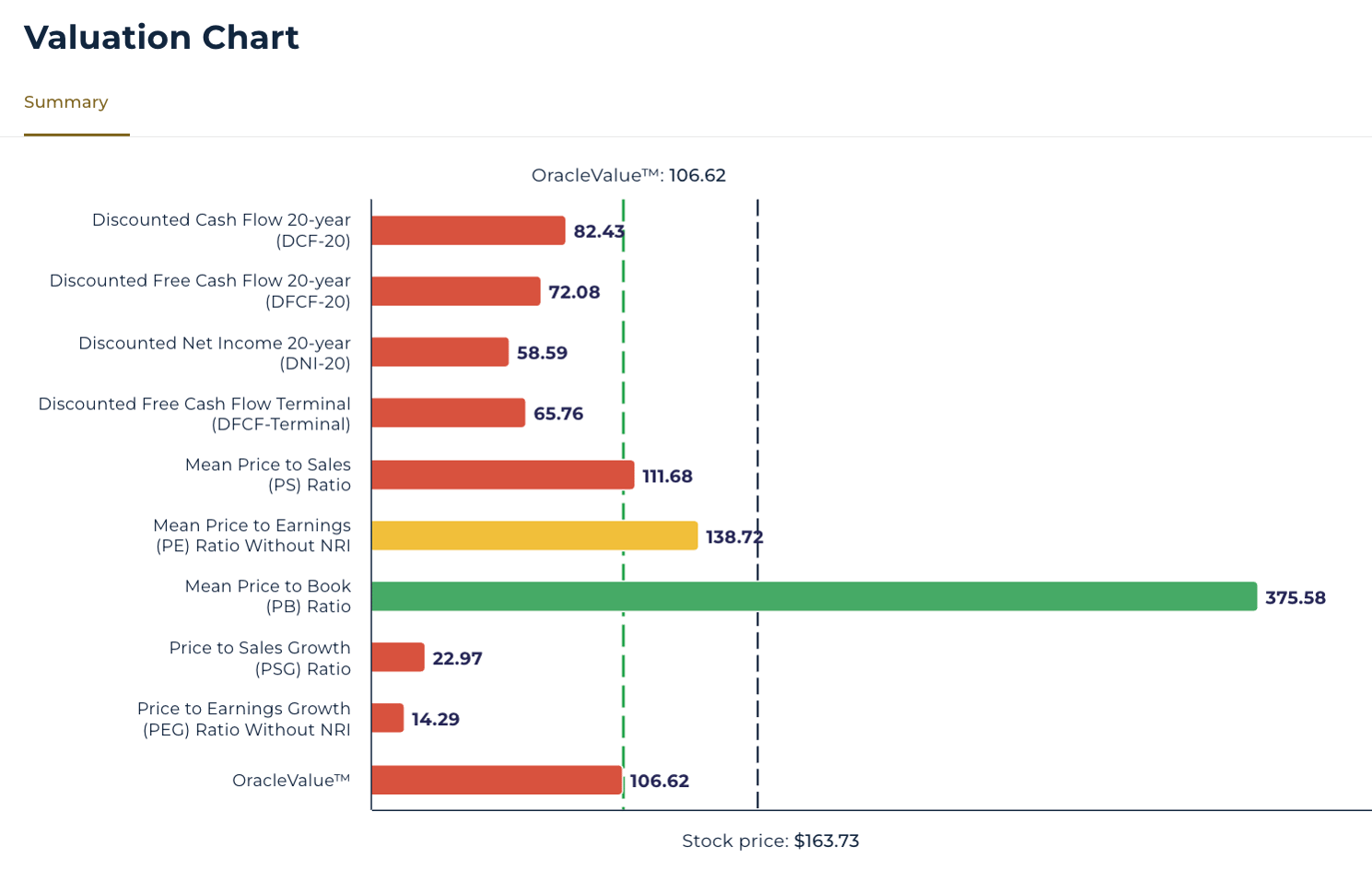
Valuation Chart as of 10th July 2026 - Powered by StockOracle™
Under the 20-Year Discounted Cash Flow (DCF-20) model specifically, the estimate comes in lower, at $82.43 per share. The model applies a 3.65% growth rate for Years 1–5, stepping up to 14.45% in Years 6–10 and tapering to 4% for Years 11–20.
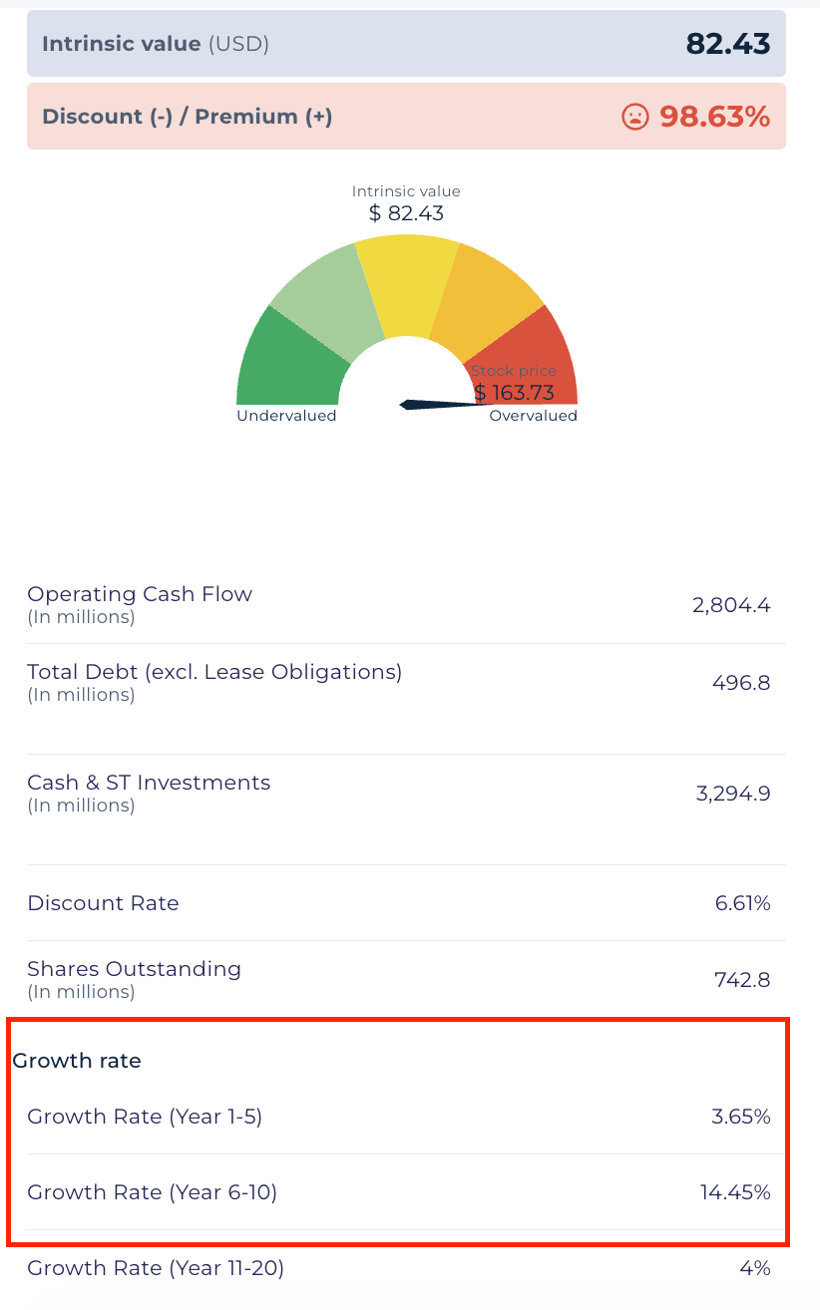
That Year 1–5 assumption deserves a second look depending on your view on the business growth trajectory. A 3.65% near-term growth rate is a deliberately depressed input for a company whose revenue grew around 20% in its most recent quarter, and it drags the DCF-20 output well below.
Cash flow models are front-loaded, this means the earliest years carry the most weight because they're discounted the least, so a conservative near-term assumption compresses the whole valuation.
The broader valuation model tells the same story from different angles. Cash flow and earnings-based approaches cluster in the $58–$82 band, while multiple-based methods like Mean Price-to-Sales sit near $112, and growth-adjusted ratios (PEG, PSG) pull toward the low end.
Revenue Growth of Fortinet
FTNT Revenue Trend Accurate as of 10th July 2026 Powered by StockOracle™
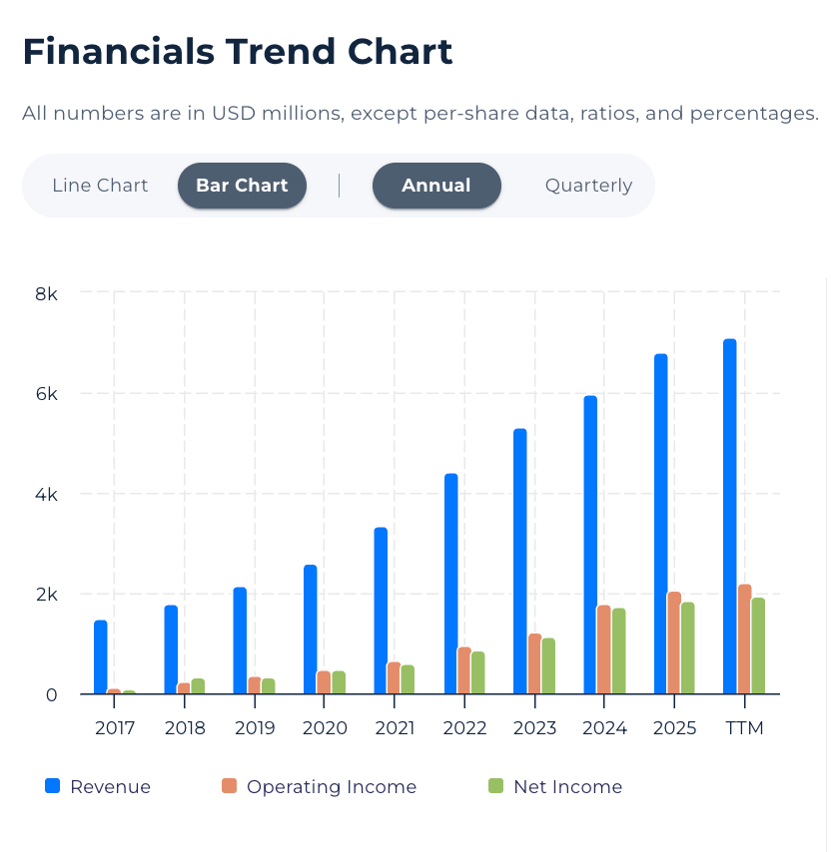
Fortinet's revenue has climbed from roughly $1.2 billion in 2016 to about $6.8 billion in 2025, a five-fold expansion with no down years.
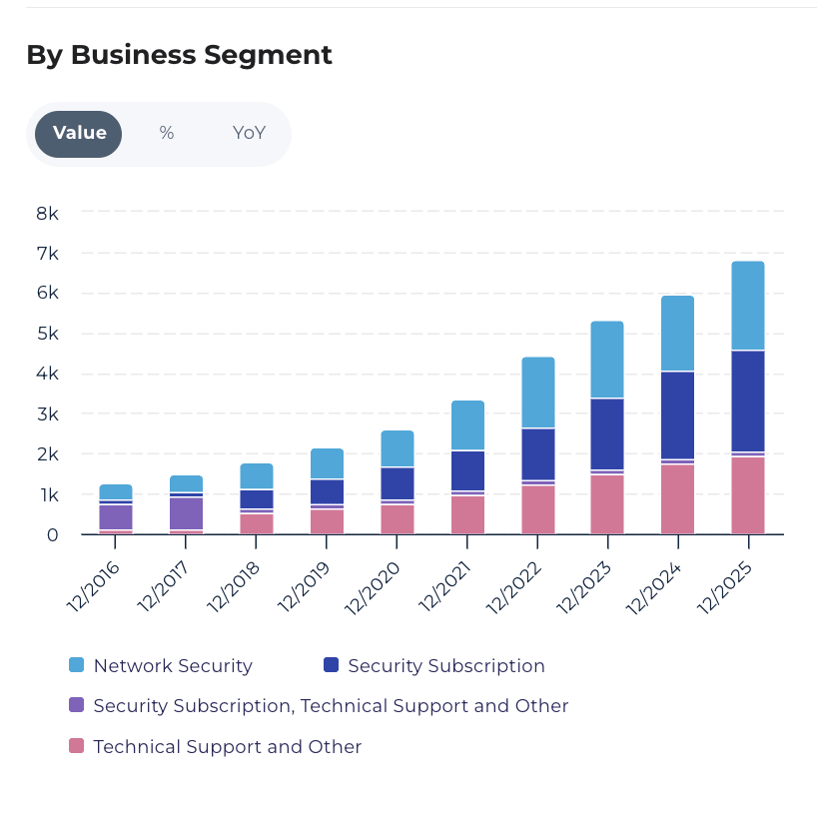
The growth mix matters as well: Security Subscription revenue has steadily grown as a share of the total, layering recurring, high-margin income on top of the firewall appliance base.
FTNT Business Segment Accurate as of 10th July 2026 Powered by StockOracle™
Think of each FortiGate appliance sold as a turnstile installed at a client's front gate. The hardware sale is one-off, but the subscriptions attached to it (threat intelligence, support, cloud services) keep billing for as long as the gate stays up.
Geographically, growth is also broad-based across the Americas, EMEA, and Asia Pacific.
Margins: Where Fortinet’s Operating Leverage Shows Up
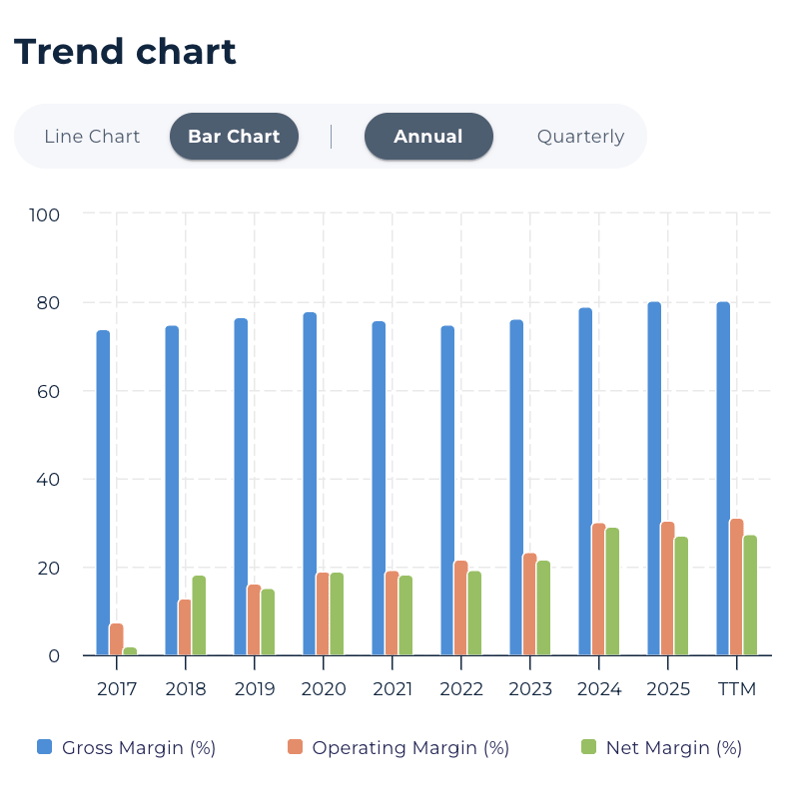
Earnings can be shaped by accounting, but margins over a long period are harder to dress up. Fortinet's gross margin has held in the mid-70s to around 80% for nearly ten years, while operating margin has climbed from single digits in 2017 to roughly 30% on a trailing basis, with net margin near 27%. Those are industry elite numbers.
FTNT Margins Accurate as of 10th July 2026 Powered by StockOracle™
The Operating and Net Margin spread widening is operating leverage in one chart: revenue compounding at scale while the cost base grows slower, helped by the subscription mix shift.
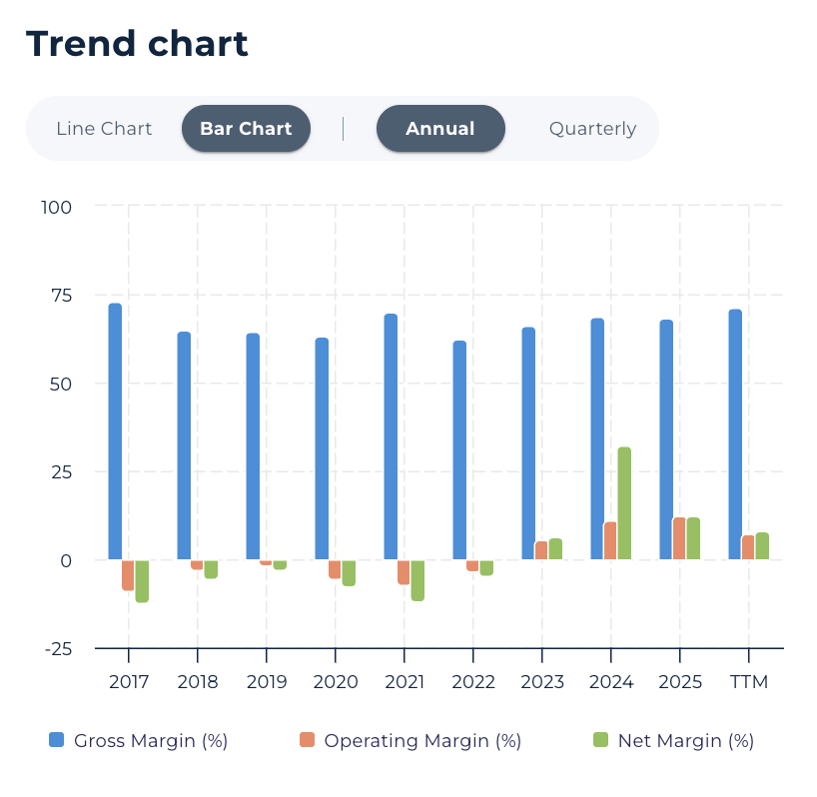
Palo Alto (PANW) Margins Accurate as of 10th July 2026 Powered by StockOracle™
In contrast, PANW financial profile reveals FTNT’s strength: robust revenue growth that fails to translate into bottom-line efficiency. Integration of CyberArk and Chronosphere continues to weigh on their margins in the near term for Palo Alto, highlighting what is perhaps Fortinet’s most formidable competitive advantage.
In a crowded marketplace, FTNT’s ability to generate superior profitability remains its defining economic moat.
Growth Catalysts: The AI Security Buildout
The forward-looking case rests on cybersecurity's position inside the AI capex cycle:
Q1 2026 product revenue grew 41% year over year to $645 million, driven by customers buying higher-performance FortiGate appliances to secure AI infrastructure deployments
New product velocity continues, including FortiSOC, a unified cloud-delivered security operations platform with embedded agentic AI.
Why this matter? The DCF-20 model's 3.65% near-term growth assumption starts to look conservative. If the AI security buildout proves structural rather than a one-off hardware refresh, the realistic intrinsic value range shifts upward. The core question now – what level of growth must the DCF-20 model assume to justify the current market price? We examine those specific growth requirements below after covering FTNT's moat.
Economic Moat: Why the Installed Base Is the Product
Fortinet’s moat comes from high switching costs and a proprietary architecture.
FortiOS and custom ASIC chips offer a price-performance advantage in appliance-based security over software rivals. Competitors possess their own strengths: Palo Alto Networks relies on platform consolidation and a larger EBITDA base, while CrowdStrike leverages an endpoint-native, cloud-first position with strong enterprise penetration.
To defend its ground, Fortinet relies on its large installed base. Once FortiGate appliances are integrated into a network, the Security Fabric ecosystem, subscriptions, and operational familiarity make replacement costly and highly disruptive.
A Fantastic Business at a Bad Price?
The market price of $156.71 (as of this analysis) sits well above most StockOracle™'s intrinsic value figures. However, rather than reading that as a single premium number, the more useful mental frame is this: the current price only reconciles with a DCF if near-term growth runs meaningfully hotter than the model's 3.65% assumption.
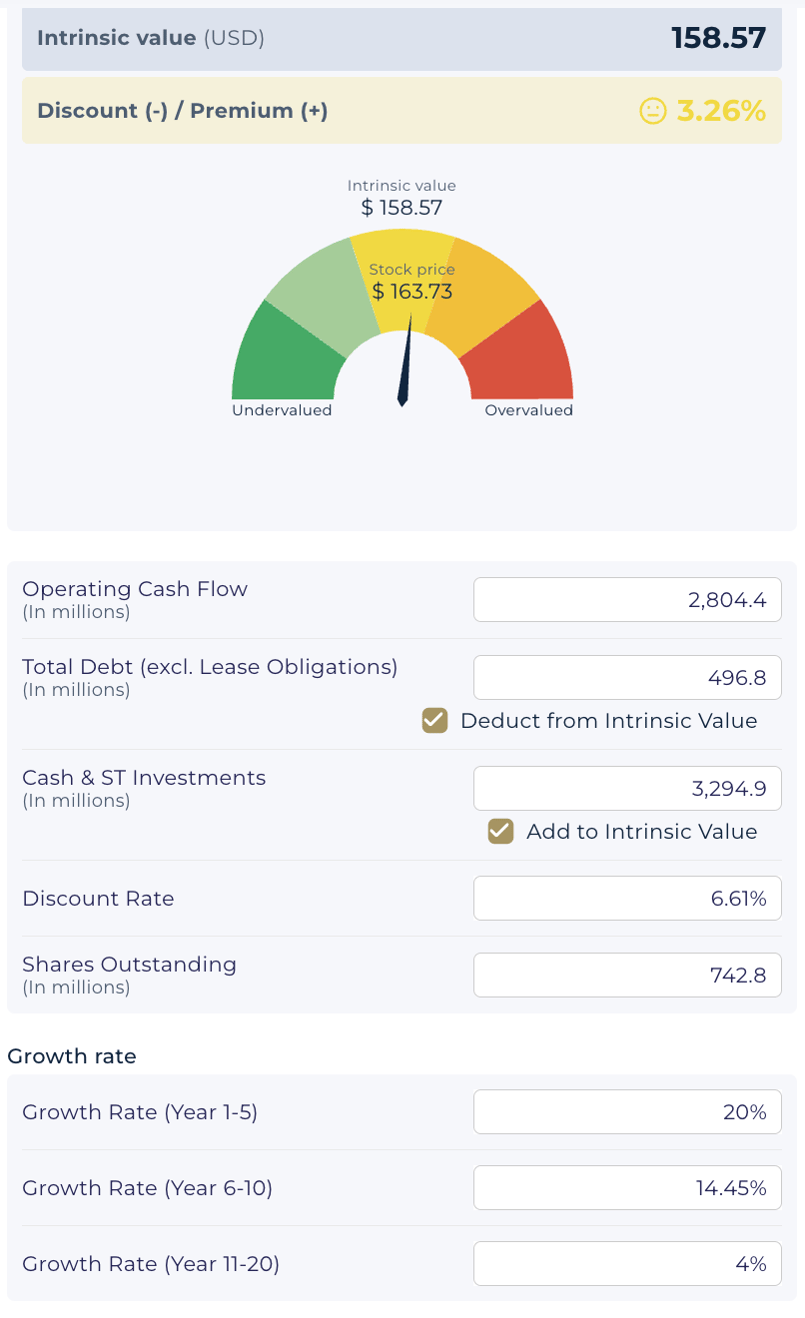
Should the Projected Years 1–5 growth rate accelerate to 20%, the market price aligns much more closely with its true economic worth, as estimated by the StockOracle™ intrinsic value calculator.
Final Thoughts on Fortinet's Intrinsic Value
The business quality case for Fortinet is strong, and the AI security narrative gives it a genuine structural tailwind. The valuation case is where investors' judgement matters: most models place intrinsic value between roughly $58 and $112, with the OracleValue™ at $106.62, all below where the stock trades today. Signifying that the price now probably has high expectations baked in.
If AI-driven demand sustains growth well above the model's depressed near-term assumptions, intrinsic value estimates could trend meaningfully higher from here; the tools to test that scenario yourself are a few clicks away.