Nike will report earnings on 30 June 2026 and the stock has been a long way down from where it traded at its peak.
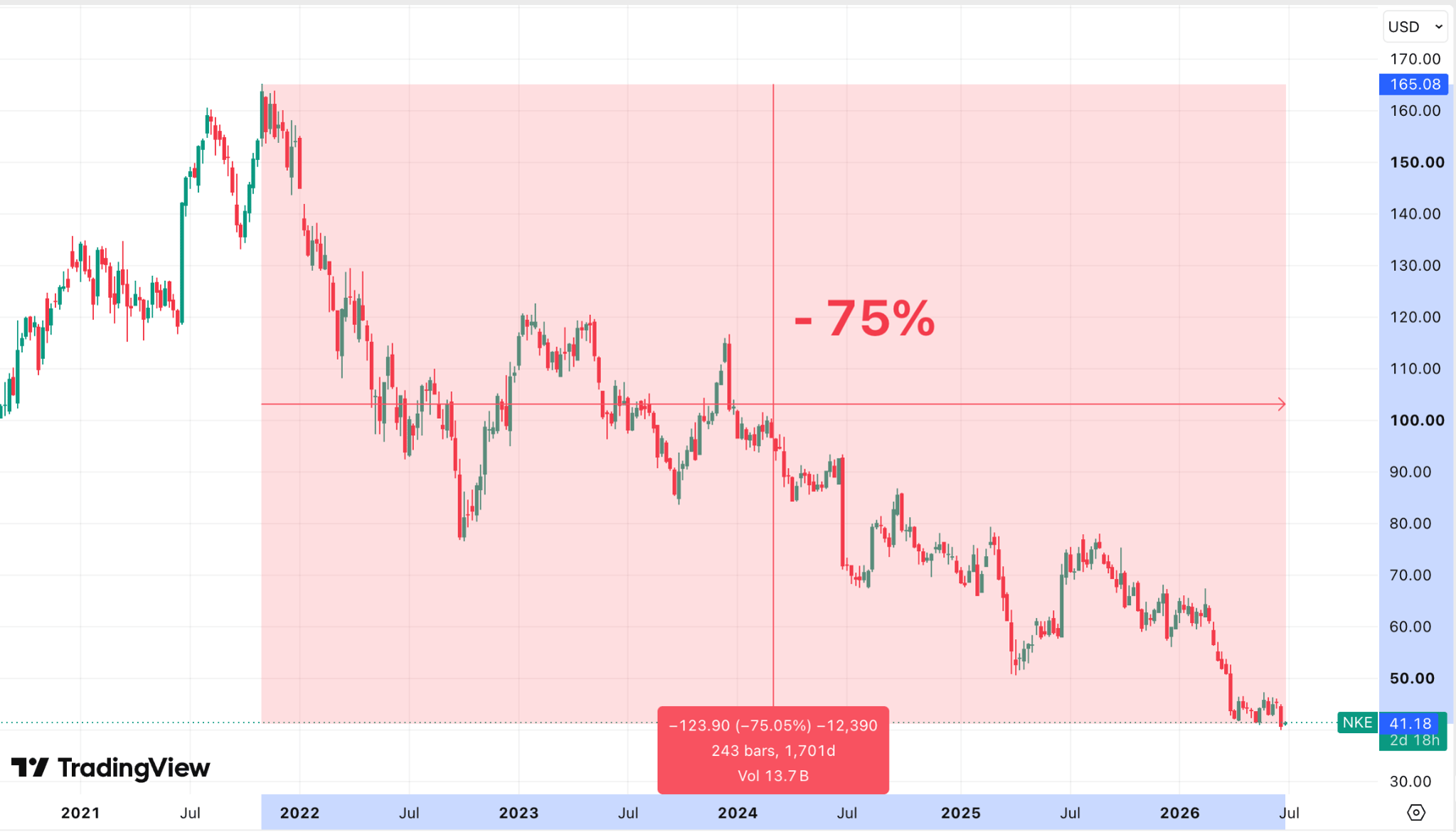
NKE has been one of the most relentlessly sold large-cap consumer names on the market: slowing revenue, margin pressure, inventory problems, and a turnaround story that investors have heard but not yet seen in the numbers.
The knee-jerk read for a business in turnaround tends to be. It is "cheap." But cheap and undervalued are not the same thing, especially for a business mid-turnaround. So before the earnings print lands, let's look at what StockOracle™ actually says about a business like this.
What Is Nike's Intrinsic Value?
Intrinsic value is the estimated economic worth of a business based on the cash it can generate over its lifetime. Not the price the market happens to assign it on any given day.
Using OracleValue™, StockOracle™ estimates Nike's intrinsic value at $79.03 per share.
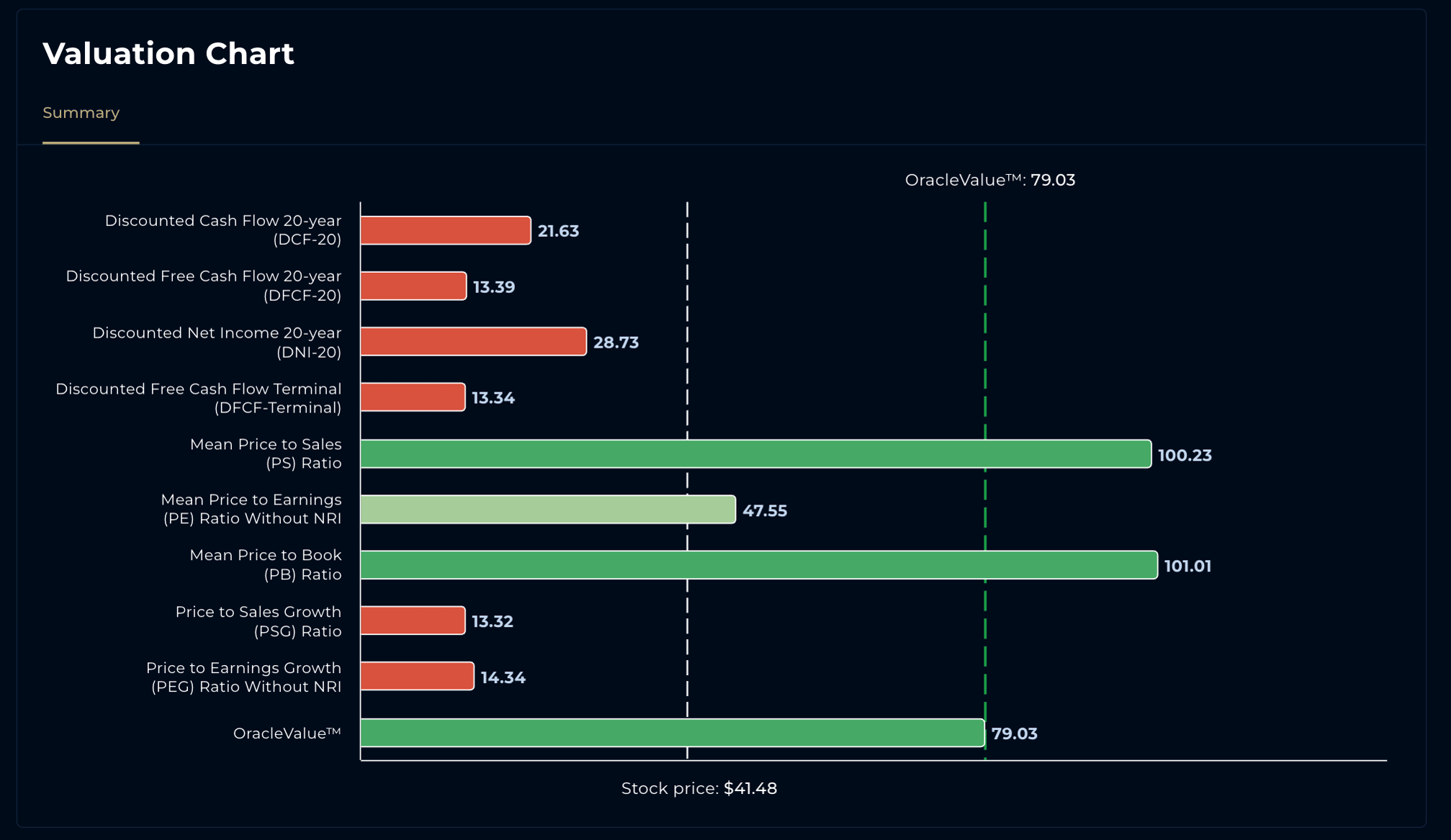
NKE OracleValue™ — Powered by StockOracle™
That figure carries an important caveat: it is a model output built on assumptions about a recovery in growth and margins. A turnaround stock is precisely the kind of business where the gap between a model's estimate and reality depends entirely on whether execution follows.
What's Actually Happening at Nike (NKE)
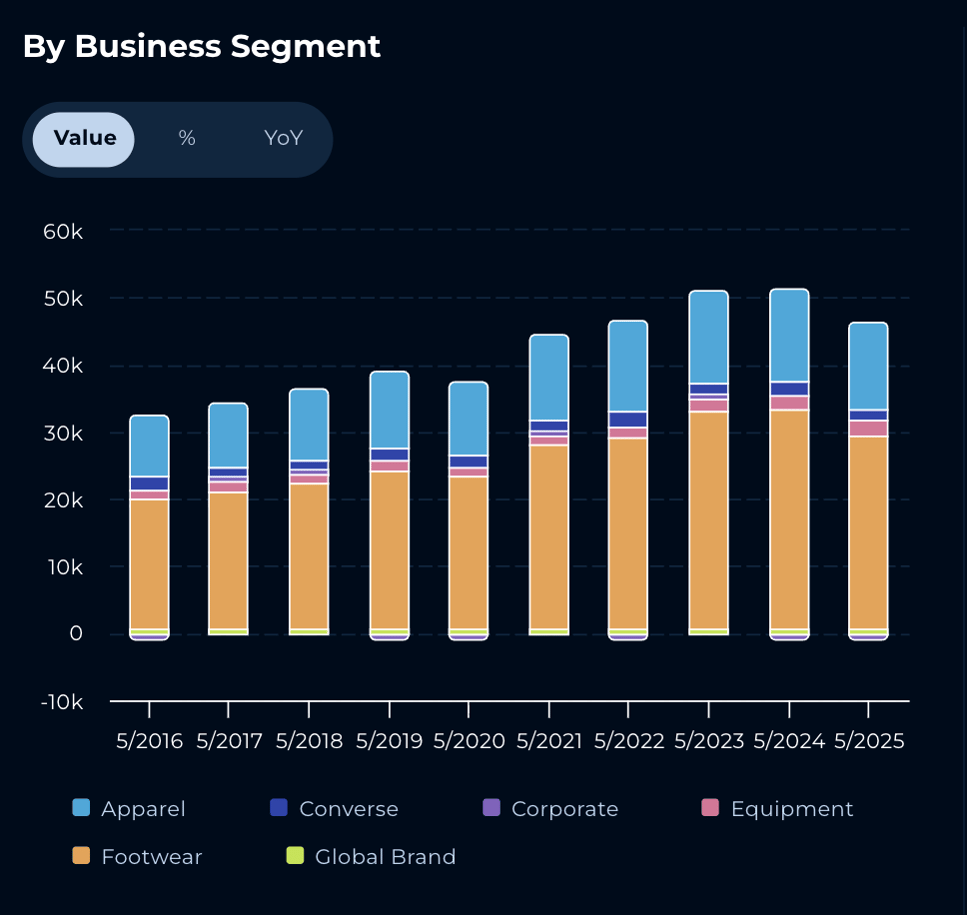
NKE Historical Operating Revenue — Powered by StockOracle™
The revenue picture tells the story plainly. Footwear is the dominant segment by a wide margin, with Apparel a distant second and Converse, Equipment, and Corporate making up the rest.
Geographically, North America is the largest contributor, followed by Europe/Middle East/Africa and Greater China.
What matters is the shape of the recent bars. Revenue climbed steadily to roughly $51B in FY2023 and FY2024, then rolled over to approximately $46B on a TTM basis.
Nike isn't shrinking toward irrelevance. It is still a global brand working through a demand and inventory reset while it repositions its product and distribution.
Nike Financials: Where the Pressure Shows Up
The financials trend chart makes the margin pressure visible. Revenue held near its highs into 2024 before declining, but the more telling movement is net income and free cash flow compressed noticeably in 2025, well below the peaks Nike posted around 2021.
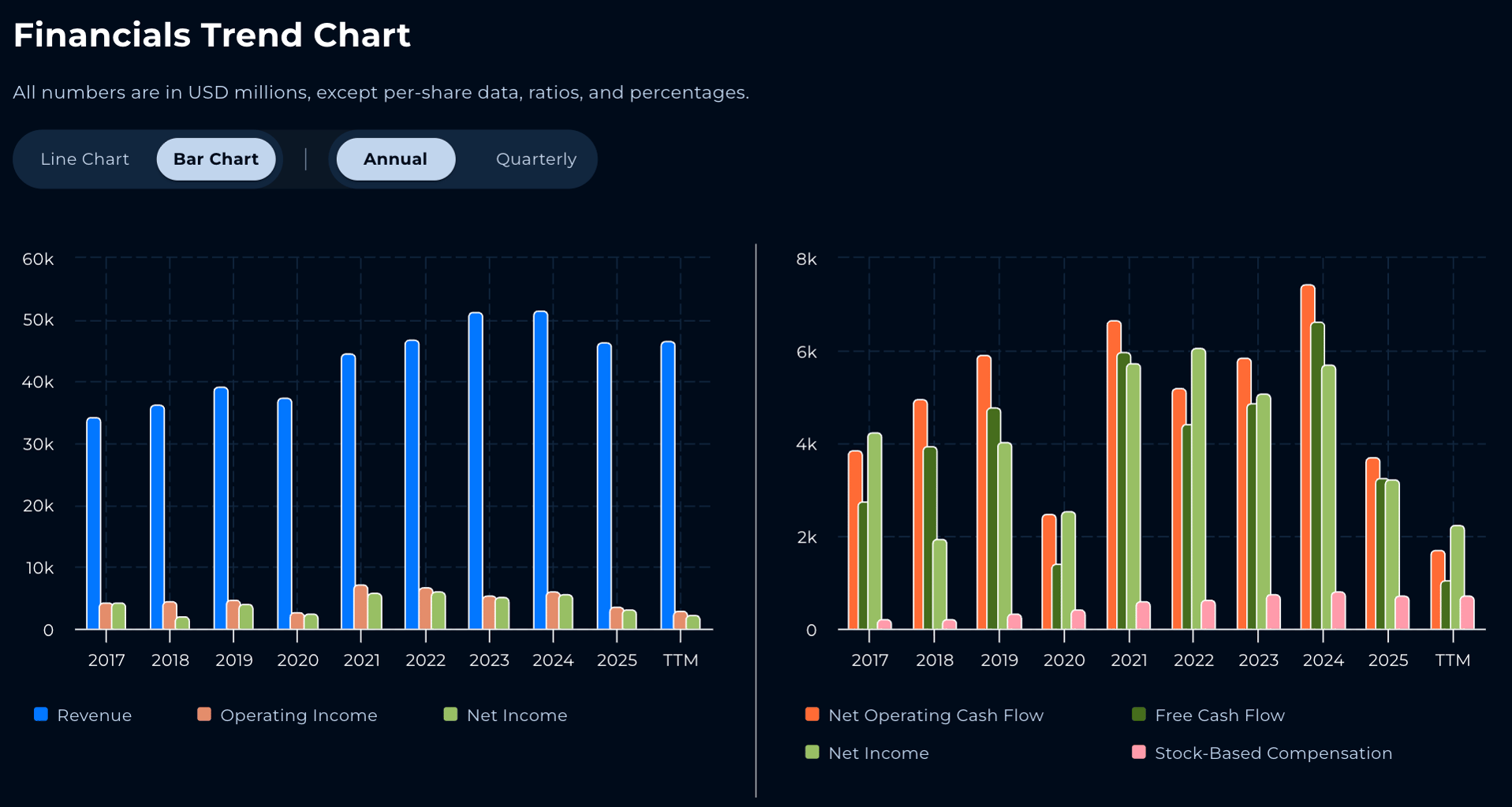
NKE Financials Trend Chart — Powered by StockOracle™
This is the gap between revenue and cash that defines a turnaround. A brand can keep its top line large while its profitability gets squeezed by discounting, elevated inventory, and the cost of resetting the business.
The five-year averages capture the longer-run quality underneath the current dip: a gross profit margin of 43.89% and a net profit margin of 10.74% decent figures for a consumer business.
Free Cash Flow: The Line a Turnaround Has to Prove
Free cash flow is the cash that actually moves through the business after the bills are paid. And for a turnaround, it's the line that has to recover for any intrinsic value estimate to hold.
Nike's free cash flow margin (TTM) sits at just 2.25% meaning about 2 cents of every revenue dollar is currently converting into free cash.
Against a five-year net margin near 11%, that gap is the entire bear-and-bull argument in one number: either current FCF is a cyclical trough that recovers as inventory normalises and full-price selling returns, or it's the new normal.
Returns and the Balance Sheet
Return on invested capital sits at 9.33% the cash generated per dollar of capital put to work.
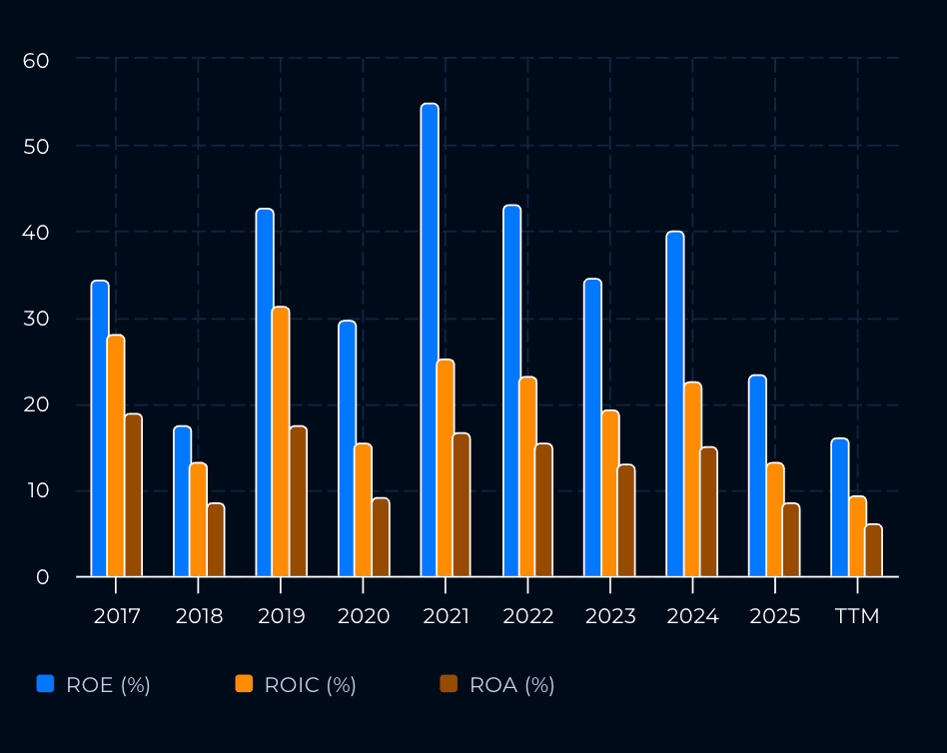
NKE Trend — Powered by StockOracle™
On the balance sheet, Nike carries roughly $8B in cash and short-term investments against ~$11B in total debt on a TTM basis.
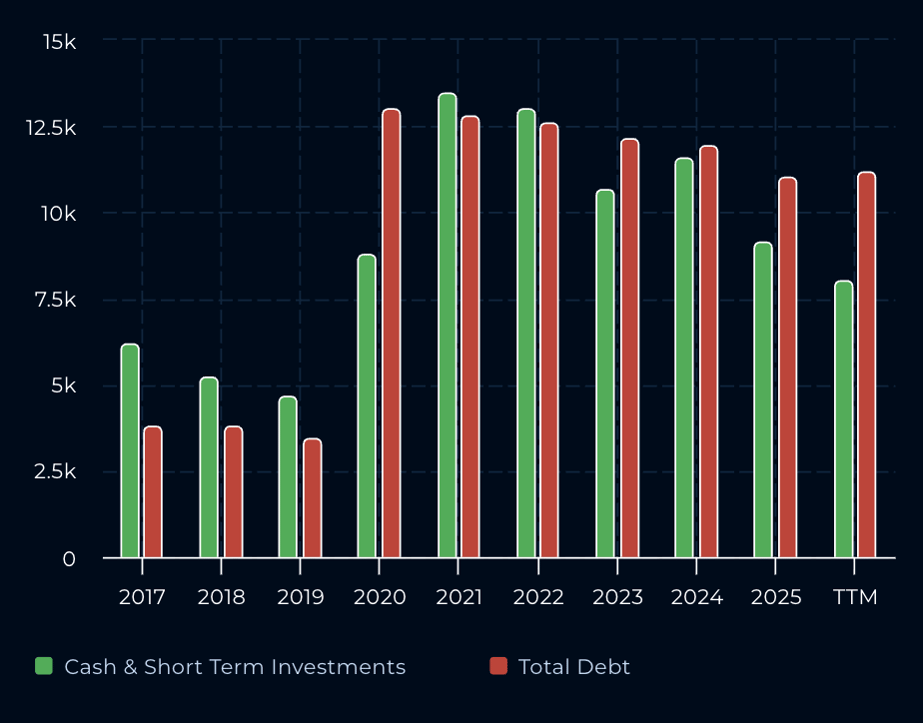
The right-hand panel shows shares outstanding declining steadily while the business bought back stock over the period. Meaning each remaining share now owns a slightly larger piece of the company. A modest net-debt position and a long buyback history give Nike room to fund its turnaround without balance-sheet stress.
What OracleIQ™ Says About a Business in Transition
OracleIQ™ profile is what you'd expect from a turnaround:
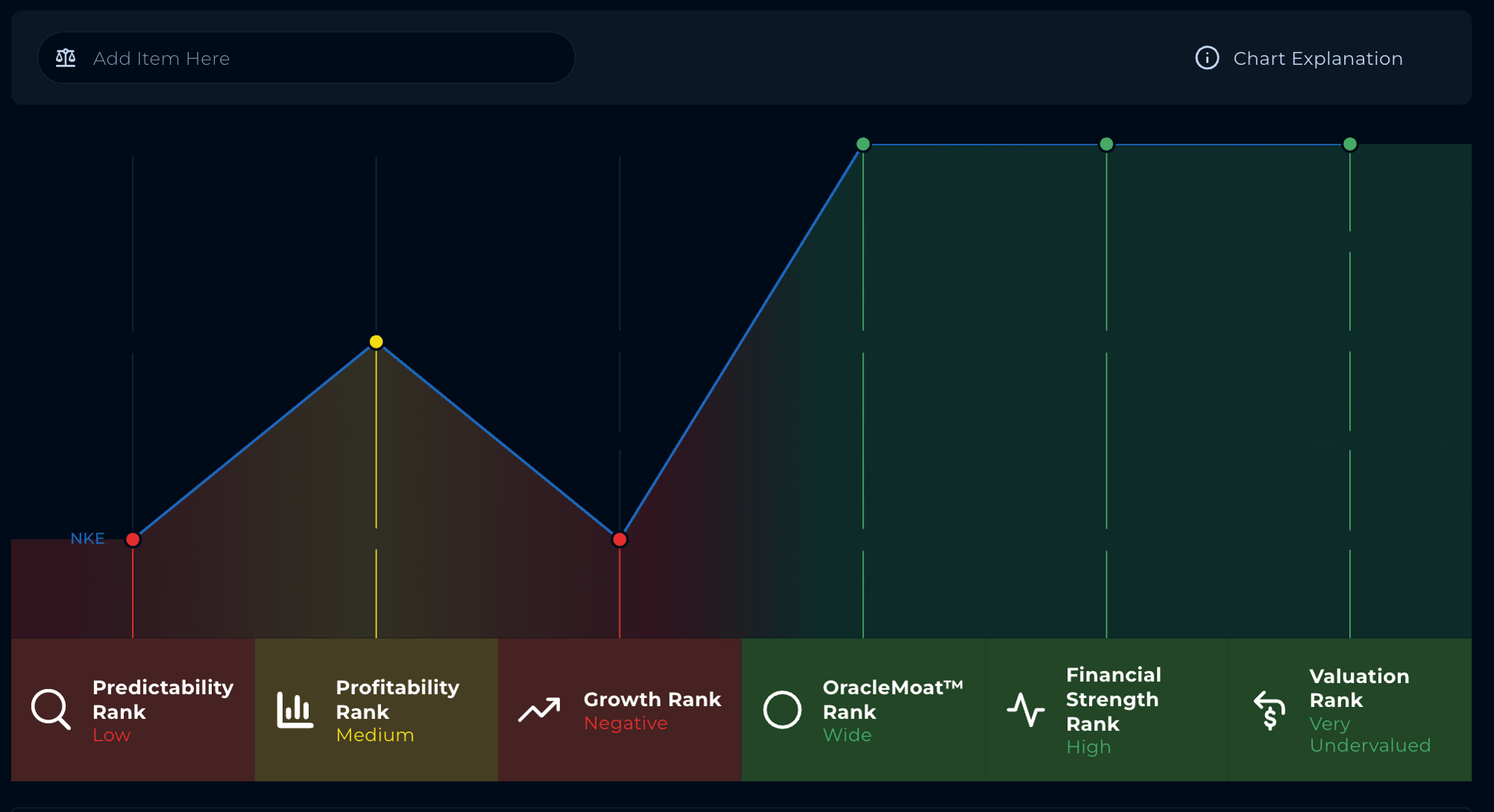
- Predictability — low (red): near-term earnings visibility is poor.
- Profitability — medium (yellow): still profitable, but running below its own historical standard
- Growth — low (red): the stalled revenue and the 2.12% projected revenue growth figure show up here
- OracleMoat™ — high (green): StockOracle™ rates Nike a Wide Moat
- Financial Strength — high (green): the balance sheet still stands strong
- Valuation — high (green): the model sees value at the current price
The shape is the insight. A business scoring red on Predictability and Growth but green on Moat, Financial Strength, and Valuation is the textbook silhouette of a quality business going through a bad patch. Whether that resolves into recovery or a longer slog is what the next few earnings will answer.
Nike's Moat: Why StockOracle™ Still Rates It Wide
A turnaround is only investable if the moat survives the downturn. StockOracle™ assigns Nike a Wide OracleMoat™, and the reasoning rests on advantages competitors can't simply copy.
Nike's moat is built on brand equity accumulated over decades, the scale of its global footwear manufacturing and distribution, its athlete and league relationships, and the cultural footprint of franchises like Jordan.
Its rivals each carry their own specific, embedded advantages: adidas competes on comparable global scale and a deep football and lifestyle heritage; Deckers (HOKA, UGG) and On Holding are taking premium-running share with fast-growing, design-led franchises; Birkenstock owns a century-old category niche with pricing power; Crocs dominates a distinct comfort-footwear lane. None of these is a direct substitute for Nike's full breadth but each is a real competitor Nike has to out-execute.
How Nike Stacks Up Against its Competitors
Put against its peers, Nike's profile is that of the incumbent giant trading on subdued near-term growth.
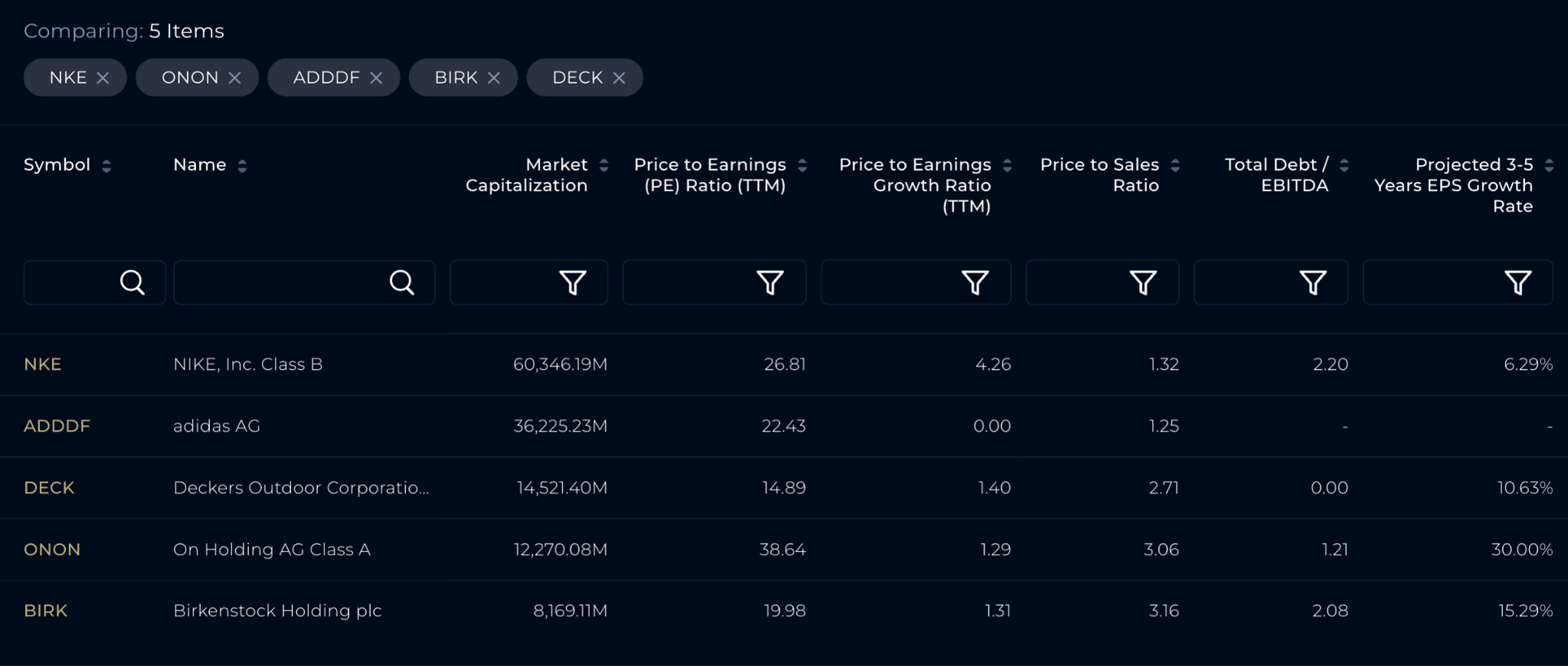
NKE peer comparison — Powered by StockOracle™
Nike remains by far the largest by market cap, but the higher-growth-projection names. On Holding at 30% projected EPS growth, Birkenstock at 15.29% trades at richer sales multiples, as market is paying up for momentum.
Nike's low 6.29% projected 3–5 year EPS growth is a quality franchise priced for a slow recovery rather than a fast one.
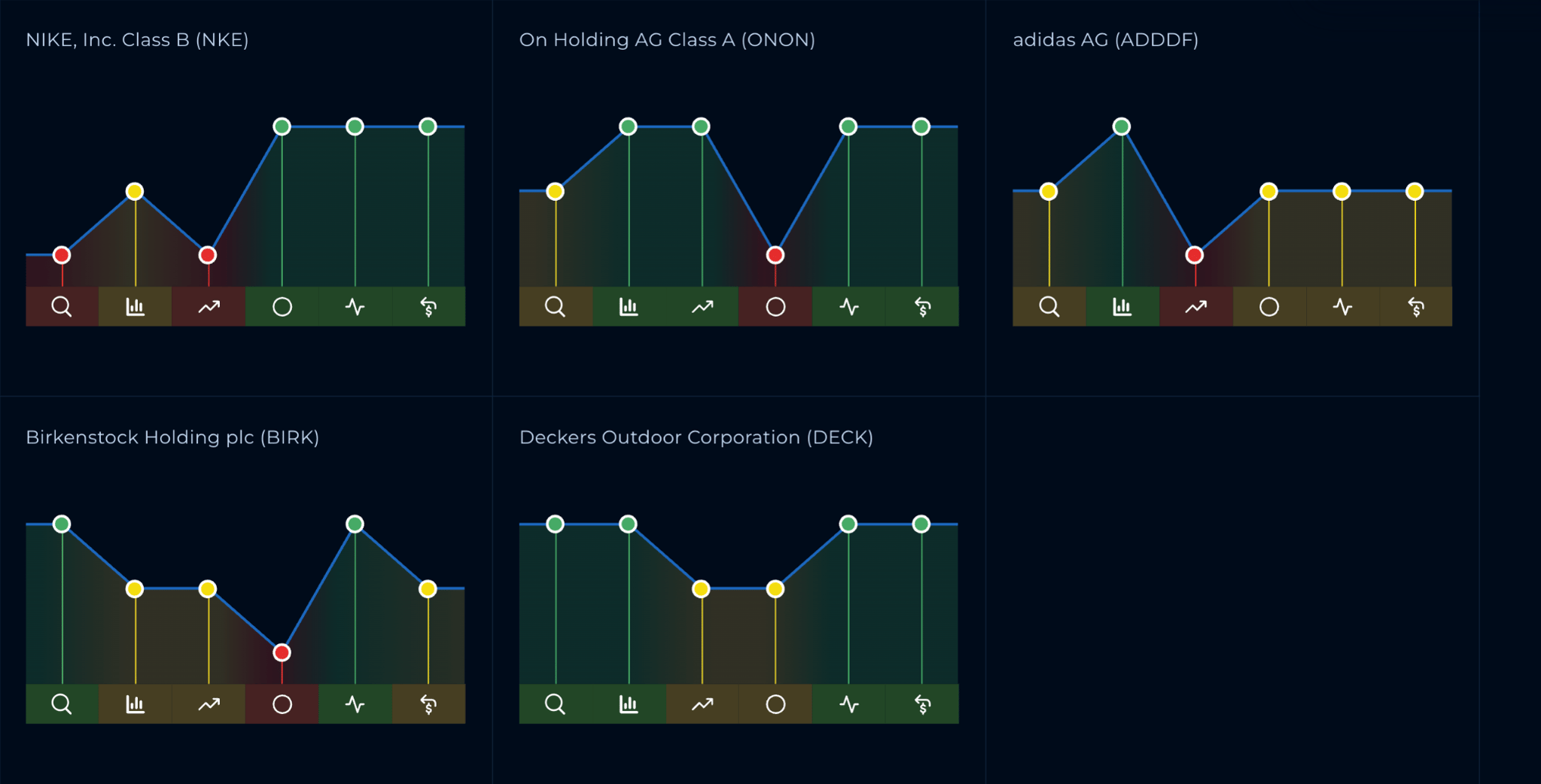
The OracleIQ™ grid across the six names reinforces it. The faster-growing challengers (ONON, DECK, BIRK) light up greener on Growth, while Nike's profile leans on Moat, Financial Strength, and Valuation. The classic incumbent-in-transition shape. It's a useful first filter: the chart silhouette tells you which businesses are being valued for growth and which for durability.

Final Thoughts on Nike's Intrinsic Value
Stripped to its fundamentals, here's what StockOracle™ surfaces on Nike:
The market has spent two years selling Nike on a real deterioration in growth and margins. StockOracle™ doesn't dispute that. The red OracleIQ™ scores name the problem directly. What it adds is the other half of the picture: a wide moat and a balance sheet that give a quality franchise the room to recover, if it executes.
This analysis is shared for educational purposes and is not intended as financial advice or a recommendation on any investment. OracleValue™ is an estimate and should not be taken as a signal to buy or sell. Any past performance mentioned is not indicative of future results.