By Piranha Profits Team
Last updated on September 25, 2026
Goldman Sachs closed the second quarter of 2026 with a quarterly return on equity near 17%, the strongest in the firm's modern history, built on trading and dealmaking revenue.
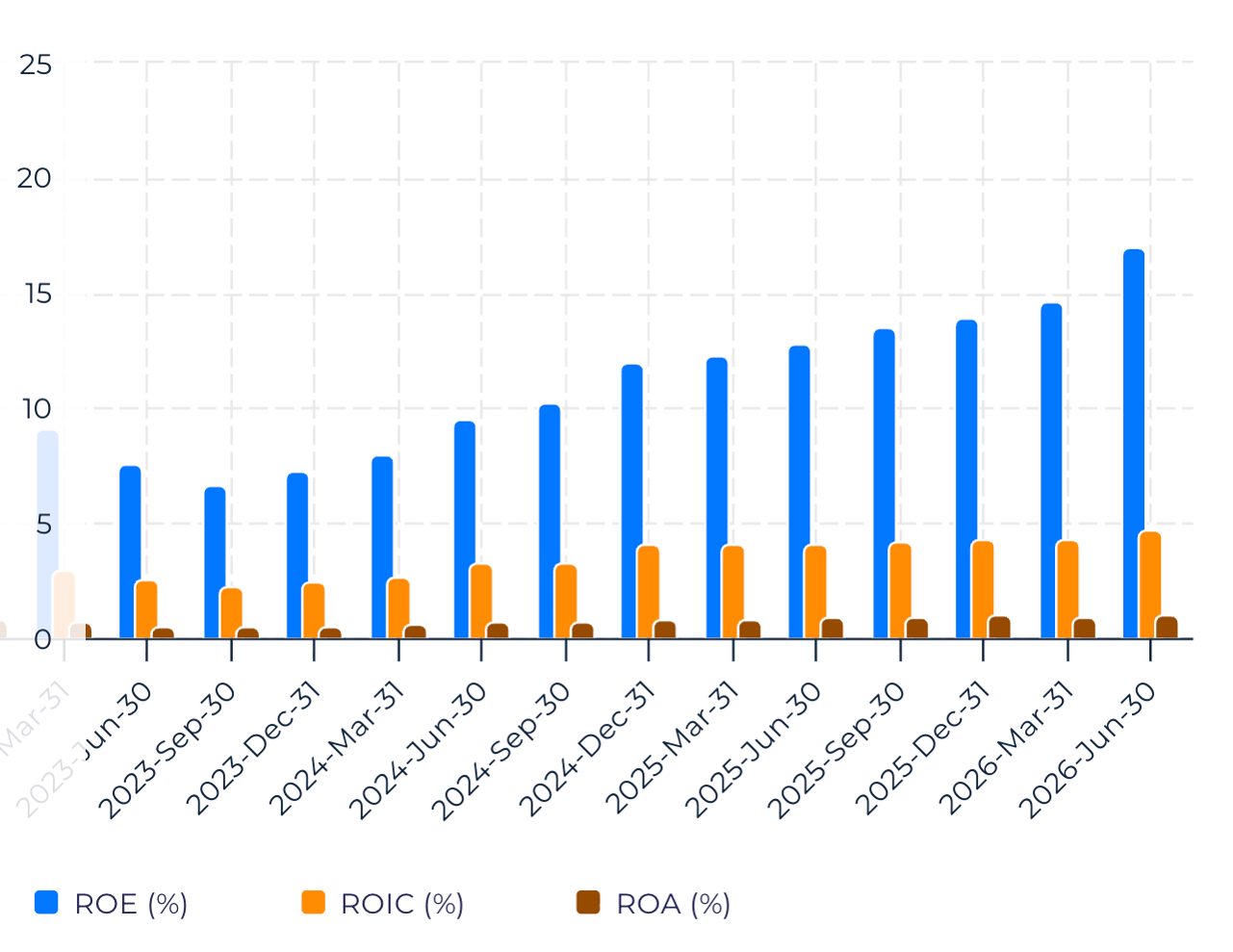
Its closest direct peer, Morgan Stanley, still draws roughly half its business from steadier, fee-based wealth management, the kind of ballast Goldman doesn't carry. Which is exactly the gap this GS intrinsic value question has to work through: is the bank compounding into a genuinely higher level of profitability, or pricing in a cycle peak it might not be able to repeat?
What Is Goldman Sachs's Intrinsic Value?
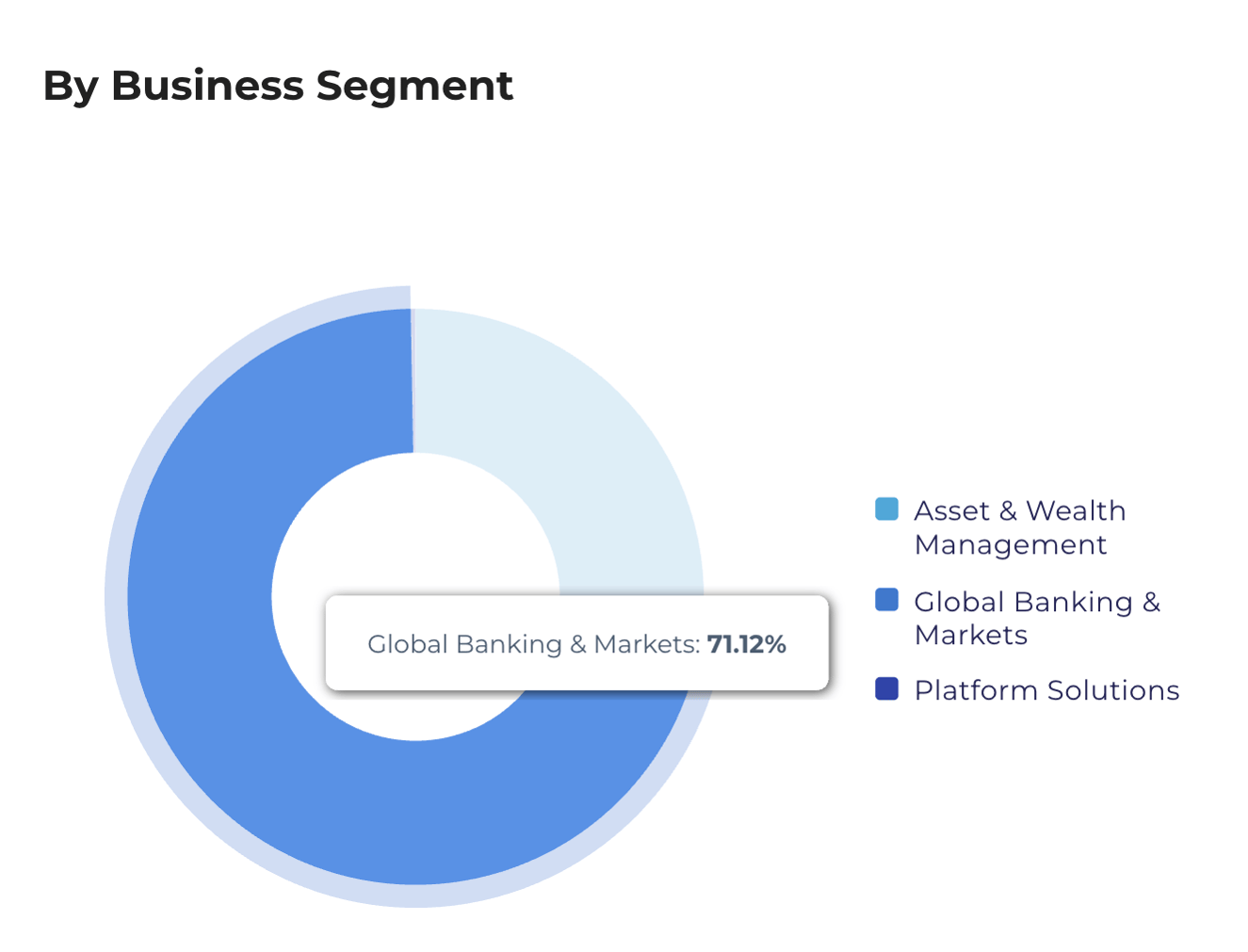
Intrinsic value is what a business is actually worth based on the cash flows and earnings power it can sustain over time, not what the market pays for it today. For a bank, that question doesn't get answered the way it does for a software company or a retailer, because Goldman doesn't sell a product for more than it costs to make. It earns fees on deals and assets it manages, and it trades on its own balance sheet, both of which run through its two main segments: Global Banking & Markets (investment banking fees plus FICC and equities trading) and Asset & Wealth Management (fee-based management of client assets).
GS's Fair/Intrinsic Value: Why a Bank Needs a Different Lens from Discounted Cash Flow
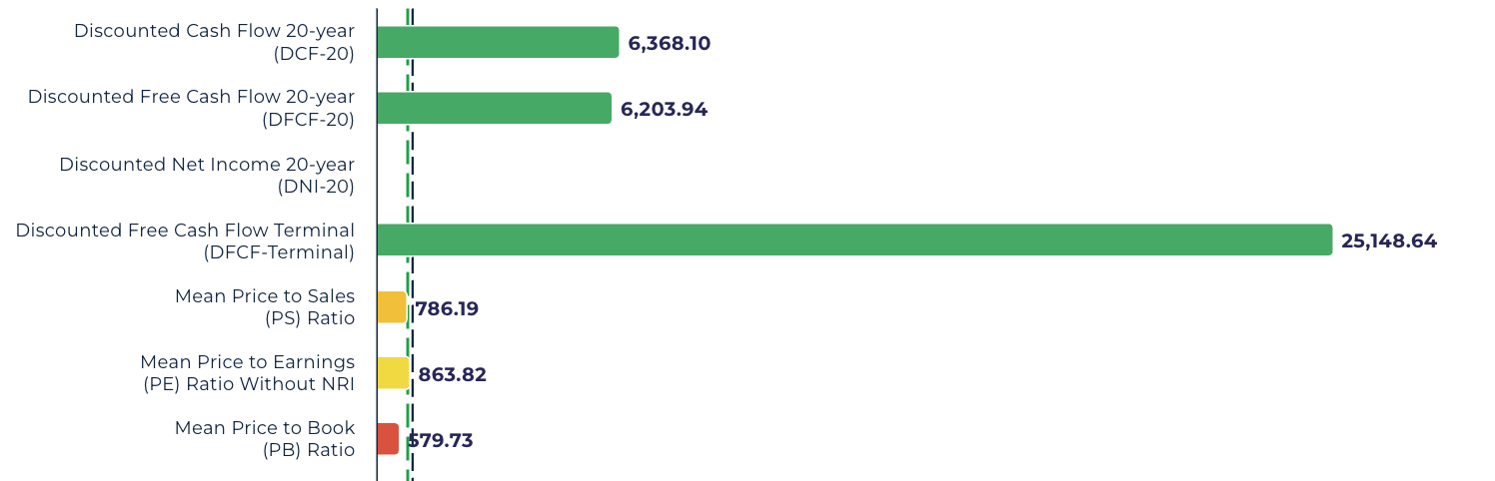
Run Goldman's numbers through a standard 20-year discounted cash flow model and the reason shows up immediately.
Deposits, matched-book trading positions, and financing balances all flow through the same operating cash flow line a DCF model depends on. DCF-20 output for Goldman comes out as a clear outlier, a figure so far removed from any reasonable valuation that it says more about the model's fit for a bank's balance sheet than about what the business is actually worth.
Reported free cash flow for a bank is tangled up with client deposit inflows and trading-book financing, not the cash a product business keeps after paying its bills.
The more useful lens for a bank might be its price-to-book ratio, read against the return on equity behind it.
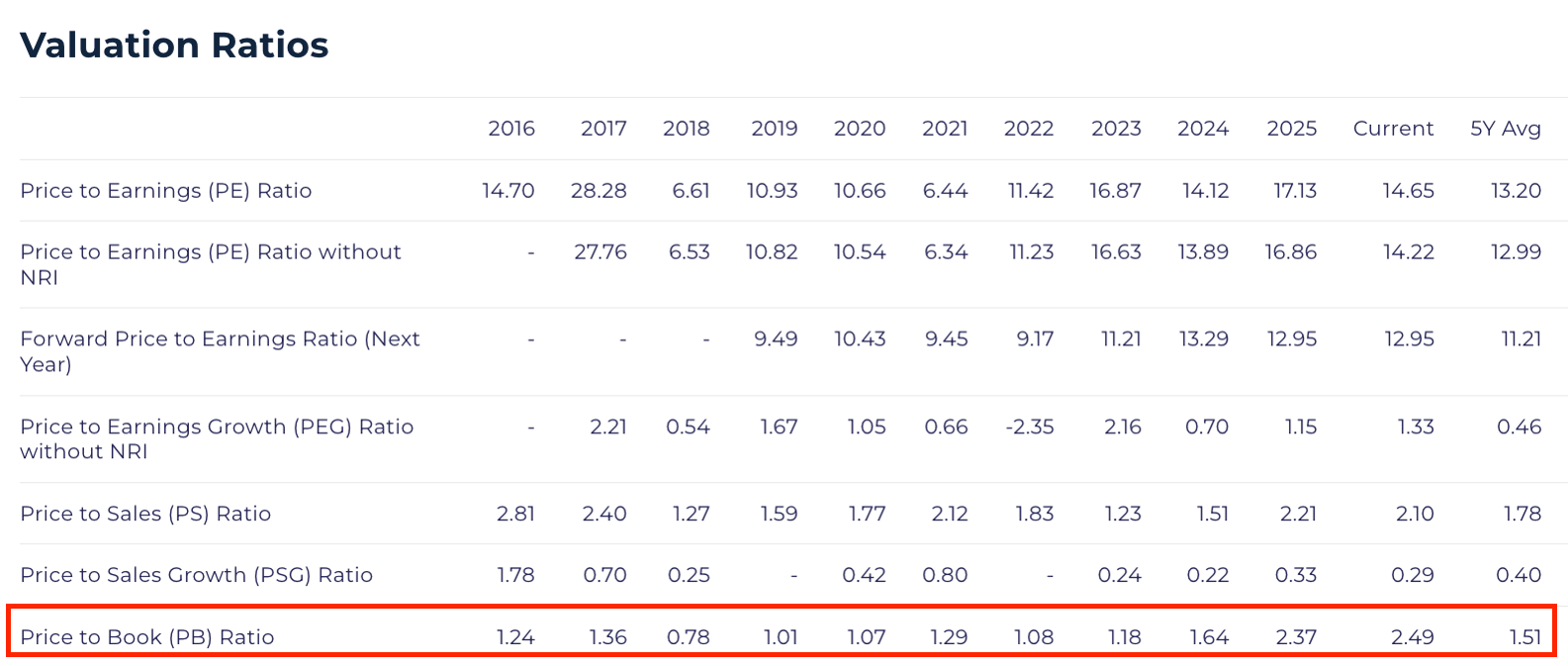
Goldman currently trades at around 2.49 times book value. That's nearly over double its ten-year average of 1.30.
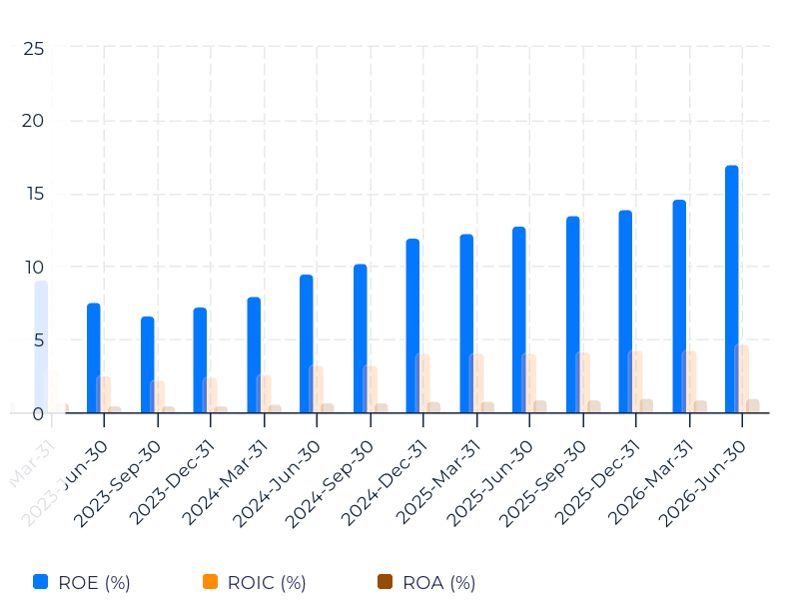
Return on equity has moved up too: trailing-twelve-month ROE of 16.99% sits roughly a third above the five-year average of 12.81%, and about 55% above the ten-year average of 10.93%.
The multiple has re-rated further than the return on equity backing it, which is the specific tension this GS fair value question works through. It holds up if ROE keeps closing that gap from here.
StockOracle™'s own multiples-based models cluster below where Goldman trades today. The mean price-to-book model, built on the stock's PB ratio average multiple, puts fair value near $579.73.
On an earnings basis, the picture looks less stretched. Goldman trades at 16.00 times trailing earnings but only 14.13 times forward estimates.
On a book-value and sales basis, the market is pricing in return-on-equity strength that holds or improves from here. On an earnings basis, forward estimates already bring the multiple back toward where StockOracle™'s own models sit.
Goldman Sachs (GS) Financial Performance
Revenue Growth: Trading and Dealmaking Still Setting the Pace
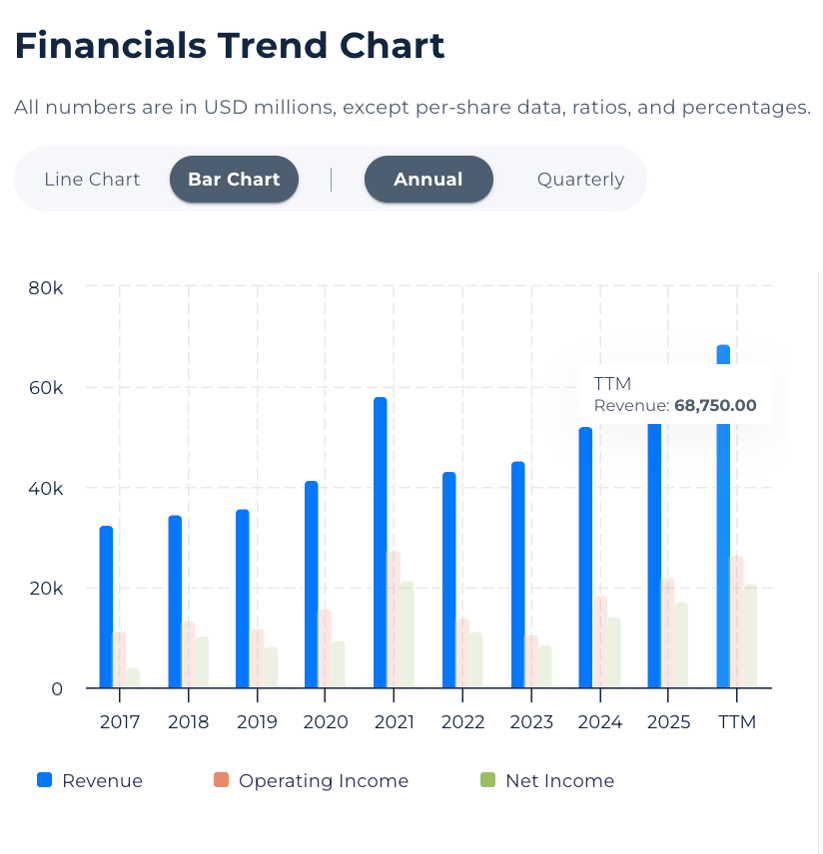
Trailing-twelve-month revenue reached $68.75 billion, up roughly 13.6% from full-year 2025's $60.51 billion.
The GBM surge was broad rather than concentrated: investment banking fees rose 55%, FICC rose 32%, and equities trading hit a record $7.4 billion, up 72%.
That mix, more revenue from a fee base that doesn't reset every quarter, is part of what supports a higher through-cycle ROE than Goldman has historically carried.
Net Income and Profitability: Why This Section Leans on ROE
For a company that sells a product, free cash flow is the report card. For a bank trading on its own balance sheet, net income measured against the equity behind it does that job instead, which is why this section leans on net income and return on equity rather than the cash flow line most non-bank valuation work starts with.
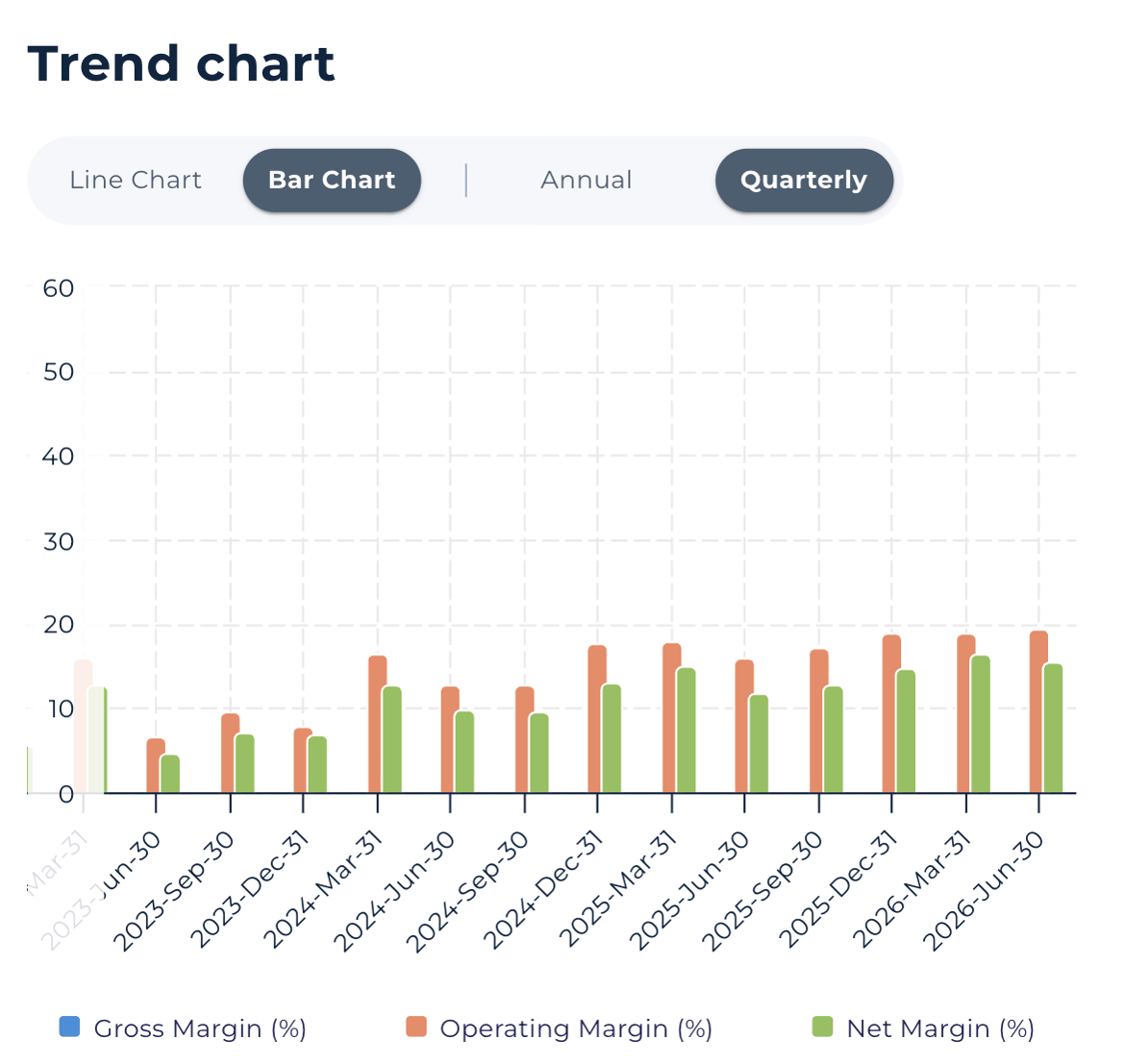
Trailing-twelve-month net income reached $20.97 billion, with $20.05 billion available to common shareholders.
Basic EPS over the same period reached $64.79, up roughly 26% from full-year 2025's $51.32. Net margin stands at 15.40% and operating margin at 19.52%, both StockOracle-reported profitability reads that sit alongside the earnings growth above.
Shareholder Returns: Buybacks and a Bigger Dividend
Goldman paid out $17.00 per share in dividends over the trailing twelve months, a 26.24% payout ratio against basic EPS, leaving the bulk of earnings retained to compound book value.
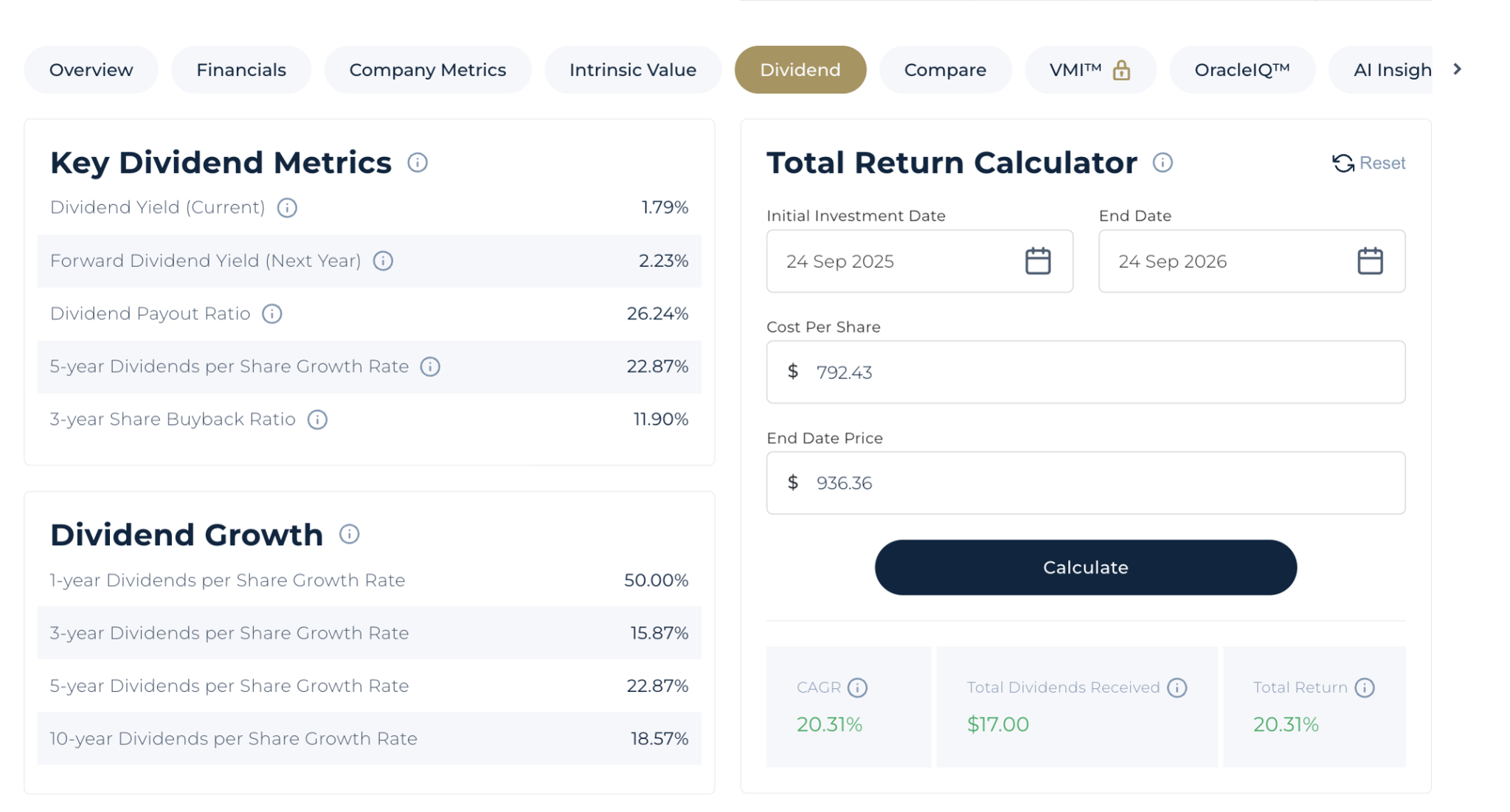
The bank also repurchased $4.0 billion of stock in the second quarter (4.1 million shares), meaning each remaining share now owns a slightly larger piece of the bank. Following the 2026 Federal Reserve stress test, the board raised the quarterly dividend 11% to $5.00 per share, bringing total capital returned to shareholders in the quarter to $5.36 billion. Goldman Sachs's second-quarter 2026 earnings release has the full breakdown.

Growth Catalysts
- Assets under supervision hit a record $4.04 trillion in the quarter, with $91 billion of long-term net inflows.
- Alternative fundraising hit a record $59 billion in the quarter, evidence Goldman's private-markets fundraising machine is scaling alongside its public-markets business.
- Investment banking fees rose 55% year over year across advisory ($1.4 billion), equity underwriting ($985 million), and debt underwriting ($1.0 billion) alike, broad-based improvement rather than one deal carrying the number.
- Goldman advised on roughly $1.48 trillion of announced M&A volume in 2025, a scale of dealmaking few advisory franchises can match.
A growing AWM fee base and a projected EPS growth rate running ahead of projected revenue growth are more durable inputs than a single hot quarter of trading revenue, which is the specific case for treating Goldman's through-cycle ROE as durably higher than its pre-2025 history. The bulk of this year's acceleration, though, still came from GBM's more cyclical lines, which is exactly the tension the valuation section above has to weigh.
Economic Moat: A Specialist Franchise, Not a Deposit Fortress
StockOracle™ rates Goldman Sachs a Narrow OracleMoat™, a real but bounded edge built on a handful of specific, hard-to-replicate advantages rather than the structural, low-cost funding advantage a deposit-heavy universal bank carries.
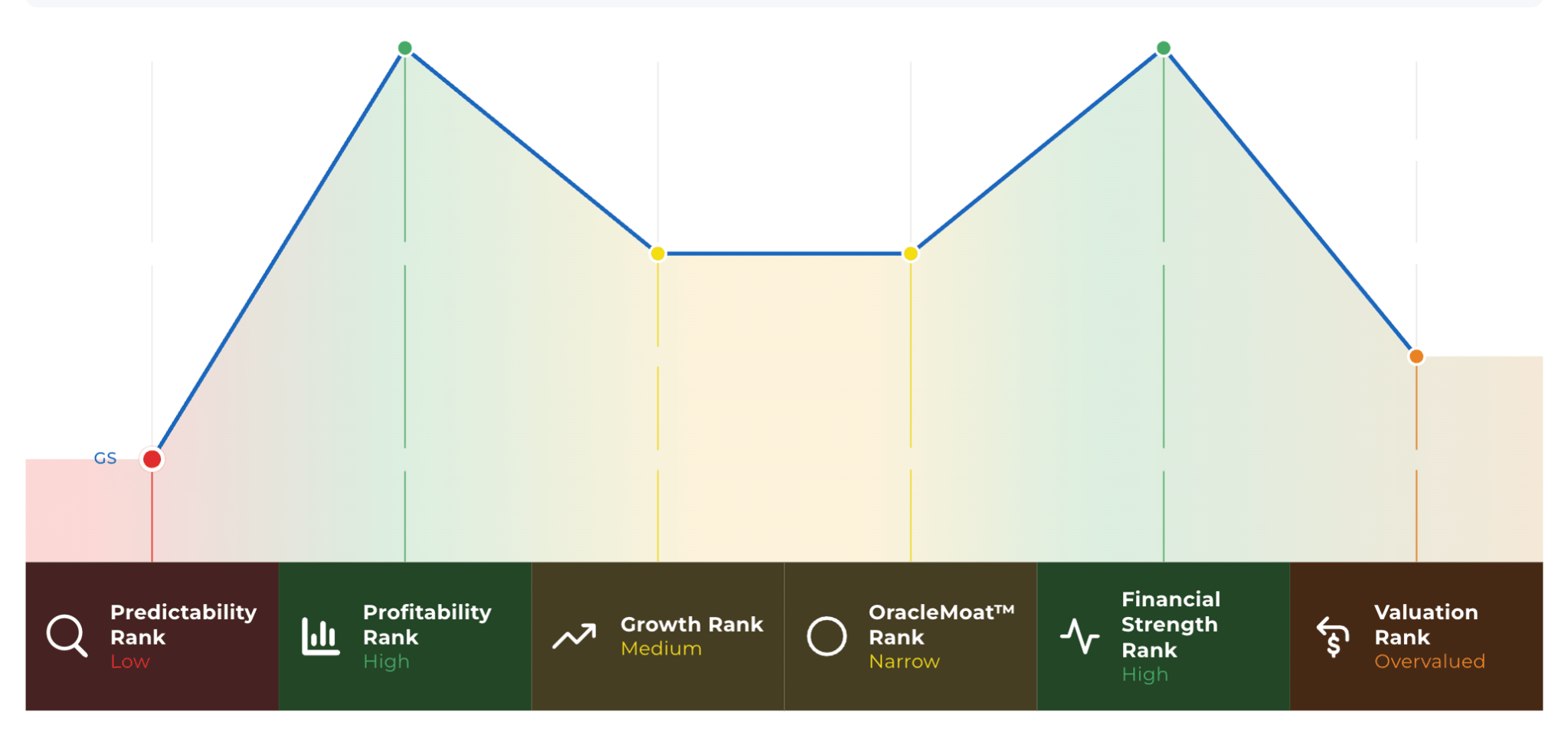
Goldman has been one of the most consistent finishers at the top of global M&A advisory league tables for years running, a reputation that compounds because winning the largest, most complex mandates makes a bank the natural call for the next one.
Its equities and FICC trading desks carry balance-sheet capacity and prime-brokerage financing relationships built over decades, the kind of scale that lets Goldman intermediate large, complex trades that smaller desks simply can't absorb. A
Asset & Wealth Management's multi-trillion-dollar asset base reflects deep relationships with institutions, sovereign wealth funds, and ultra-high-net-worth families that took years to build and don't move for a modest fee discount.
Morgan Stanley runs a larger, stickier wealth management franchise with roughly $10 trillion in combined client assets, a fee base less exposed to any single quarter's trading volume than Goldman's. JPMorgan's Commercial & Investment Bank benefits from a much larger, deposit-funded balance sheet, giving it a structurally cheaper cost of funding for market-making and lending that Goldman doesn't share, the same funding advantage that earns JPMorgan a Wide moat rating rather than a Narrow one.
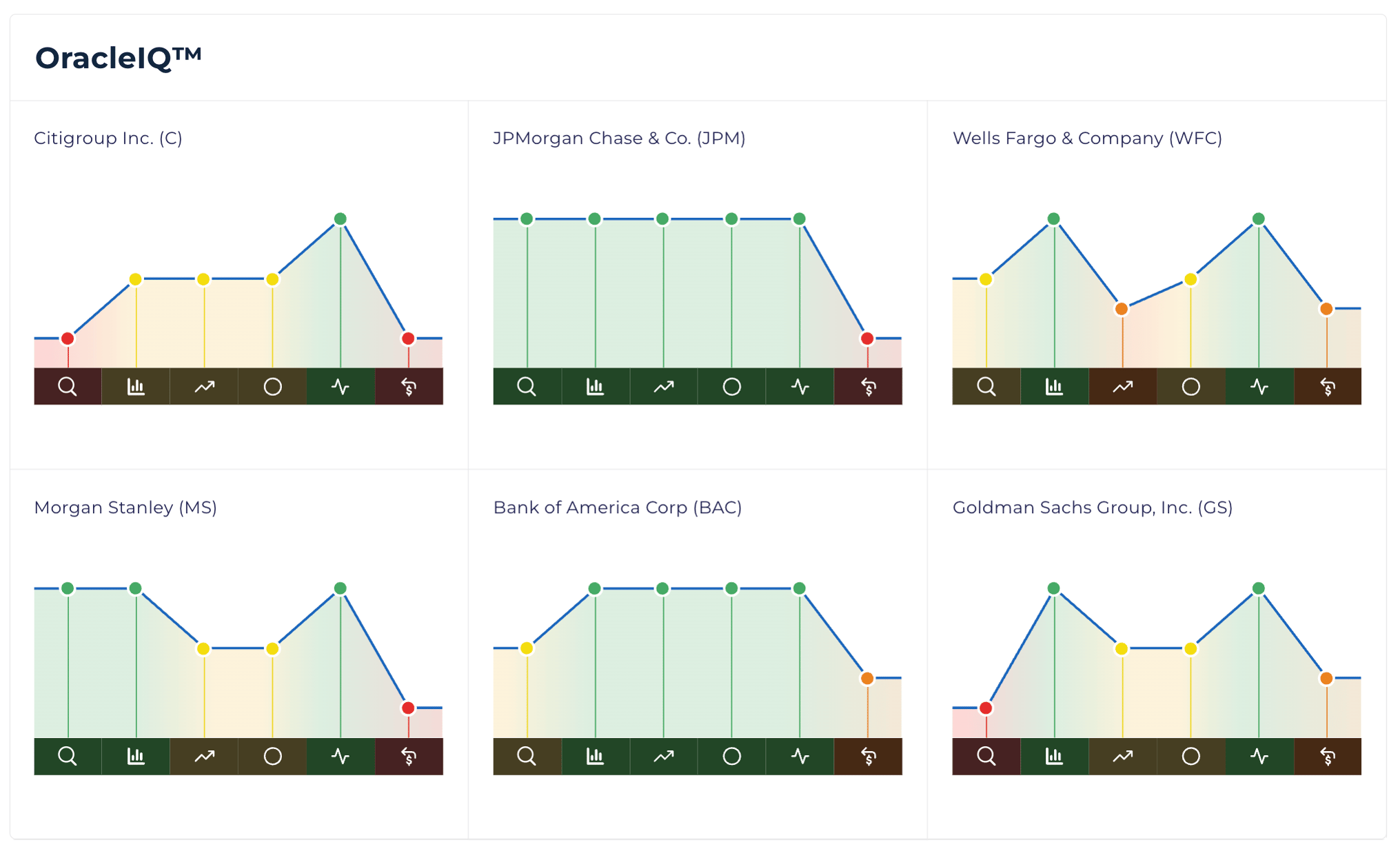
If JPMorgan is a fortress built on cheap, deep consumer deposits, Goldman is closer to an elite surgical unit: it doesn't try to be everywhere, it wins by being first-call on the highest-stakes, highest-fee mandates in the room.
That specialisation is what the price-to-book premium is being asked to justify: pricing power in advisory fees, trading spreads, and asset management fees, rather than the low-cost funding advantage a deposit-heavy bank enjoys.
Final Thoughts on Goldman Sachs's Intrinsic Value
Trailing-twelve-month ROE of 16.99% is running roughly a third above its five-year average of 12.81%, could be evidence of genuine multi-quarter improvement.
Broad-based fee growth, record AWM scale, and a return on equity that has genuinely climbed. What's in question is whether a bank that is concentrated in capital-markets and advisory revenue can keep compounding ROE at a level closer to this year's stronger prints than to its own longer-run history. If Asset & Wealth Management's fee base keeps growing and the M&A pipeline stays open, the current GS stock valuation starts to look earned. If capital-markets activity cools the way it has in past cycles, the gap between the price-to-book multiple and its own historical average becomes harder to dismiss.