By Piranha Profits Team
Last updated on August 07, 2026
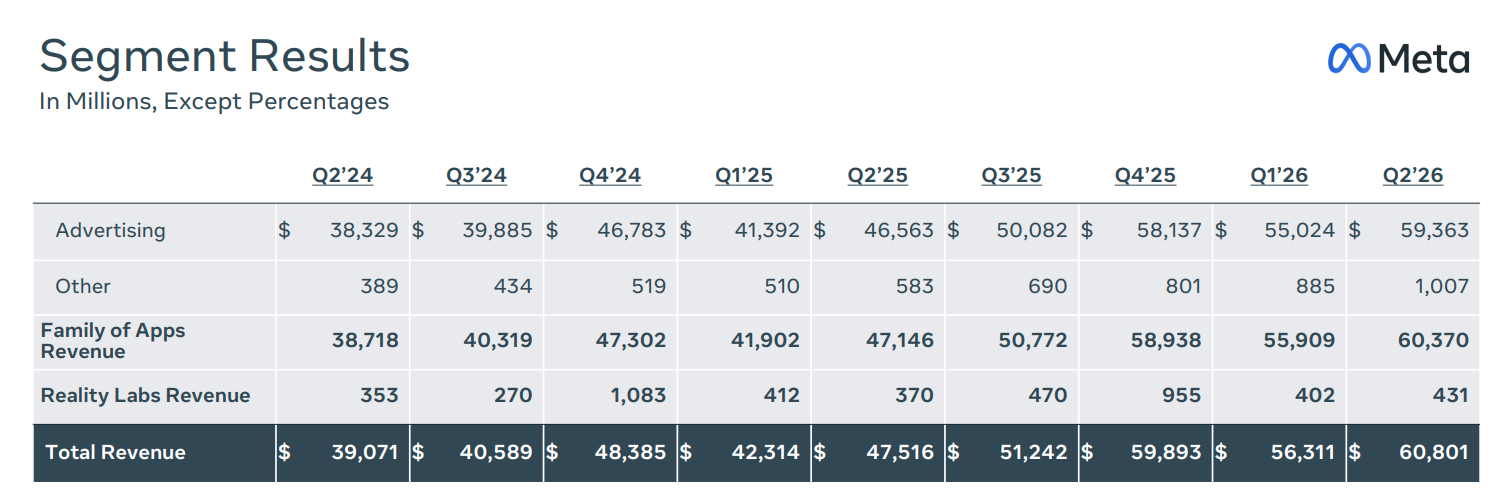
Meta's revenue grew 28% last quarter, to $60.8 billion. Its free cash flow fell 91%, to $784 million.
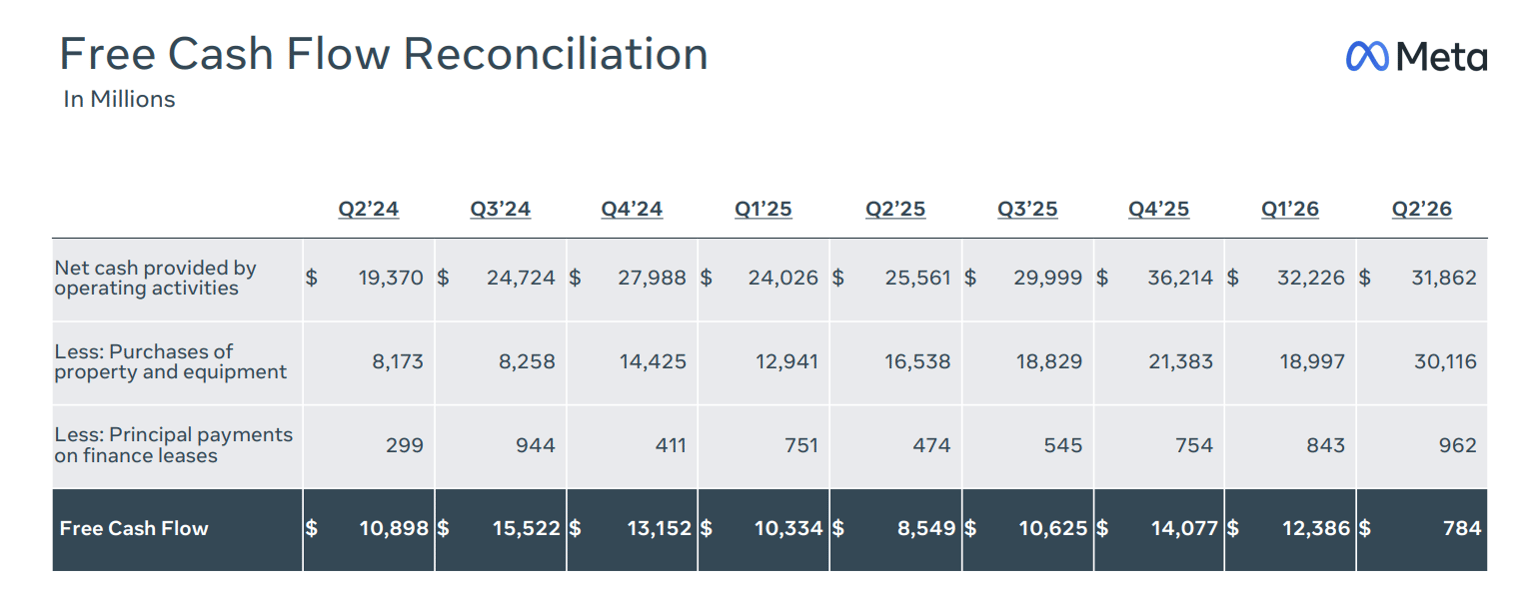
Meta spent roughly $31 billion on capex in Q2 2026 alone, consuming nearly all of the $31.9 billion in operating cash flow the business generated. Add $2.4 billion in legal charges and $1.2 billion in severance from ~8,000 job cuts, and EPS fell 13% year-over-year to $6.18, missing consensus by roughly 14%. Shares dropped almost 10% after hours, from $585.61 close to around $529.
Then something more interesting happened: within a week, the stock was back above $587. A new high, not a recovery to even. The initial reaction and the market's second thought disagreed with each other. That gap is worth exploring.
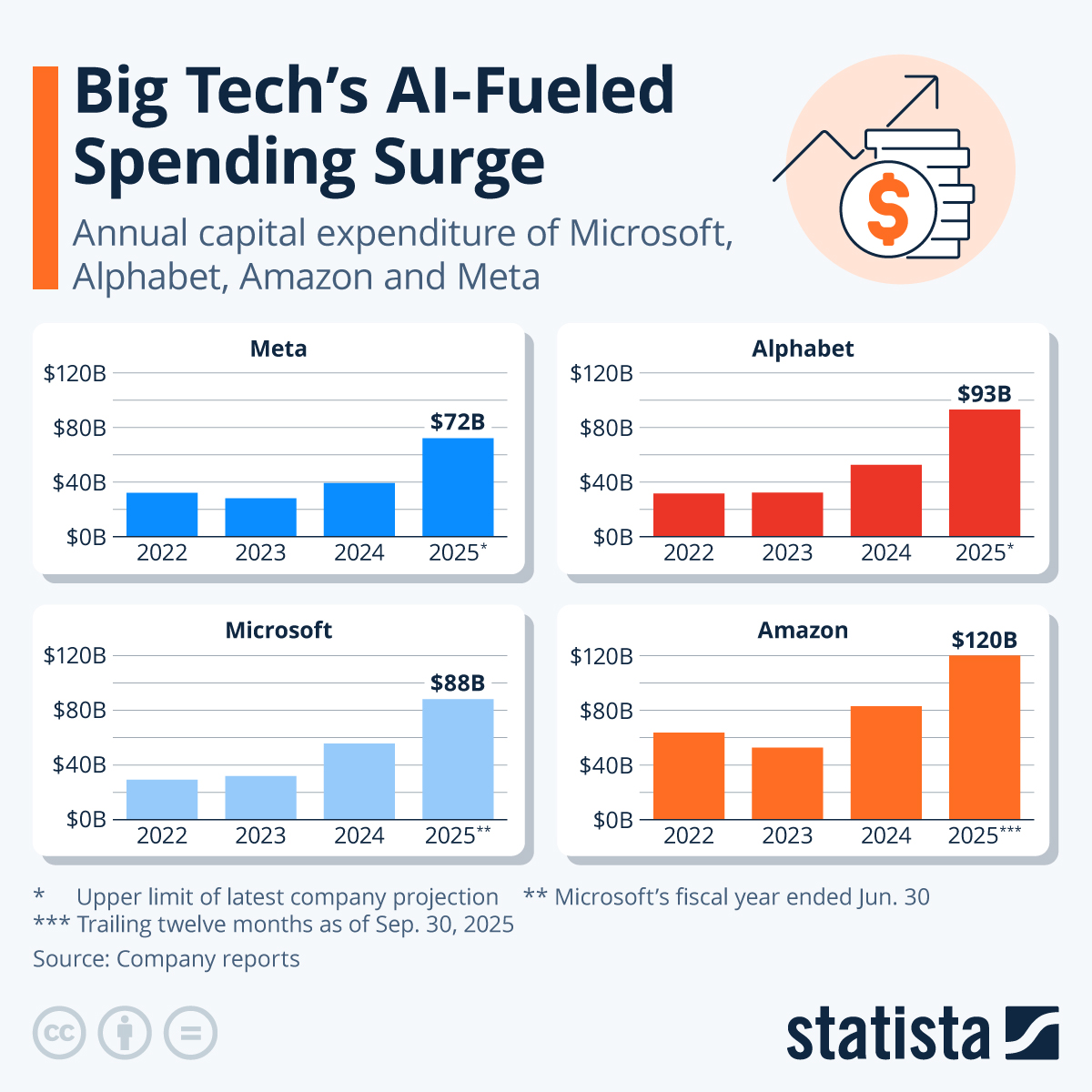
This isn't a standalone Meta story. Alphabet, Microsoft, Meta and Amazon are on pace for roughly $724 billion in combined capex this year, heading possibly toward $950 billion in 2027. Alphabet just posted its first negative free cash flow since its 2004 IPO. The company is known for its warchest of cash. Despite cloud revenue surging 82%. The market punished it anyway.
For years, more AI spending was typically rewarded as a signal of conviction and future revenue. Now it's read cautiously. It used to be the more, the better. Now sometimes the less, the better.
src : https://s21.q4cdn.com/399680738/files/doc_financials/2026/q2/Earnings-Presentation-Q2-2026.pdf
Meta is in a rather odd position as compared to the other hyperscalers. Microsoft and Alphabet can point to a cloud line item that seems like it directly scales with their capex. Meta's AI spend, for now, mostly shows up as a better ad-ranking engine and "Other".
Zuckerberg's own framing is that Meta will eventually see "a significantly higher margin on selling intelligence rather than selling compute directly." That's a thesis, not a reported number yet. When asked directly which revenue stream would show quantifiable ROIC soonest, his answer was: "I think we'll have more to share soon." Not a name, not a date.
On the balance sheet, the shift is clear. Trailing capex now runs at 39% of revenue and actually exceeds trailing operating income (1.03x). Meta is spending more building infrastructure than its core business currently earns in operating profit. Debt-to-EBITDA has climbed from a 10-year average of 0.16x to 0.76x today, and interest coverage has fallen from a 10-year average of 531x to 43x. Both are still comfortable in absolute terms, but the direction matches what CFO Susan Li said outright on the call: Meta now plans to use debt and outside partnerships to fund the buildout, not just cash flow the way it used to. Meta's debt now appears to sit above its cash and short-term investments for the first time in recent years, a reversal from its long-standing net-cash position.
src : https://s21.q4cdn.com/399680738/files/doc_financials/2026/q2/Earnings-Presentation-Q2-2026.pdf
The ad engine that makes up close to 99% of its revenue, remains extraordinarily capital-light: ad impressions up 14%, price per ad up 12%. The drag on free cash flow seems to be a deliberate infrastructure bet layered on top of a healthy business, perhaps not a sign the underlying engine is breaking down.
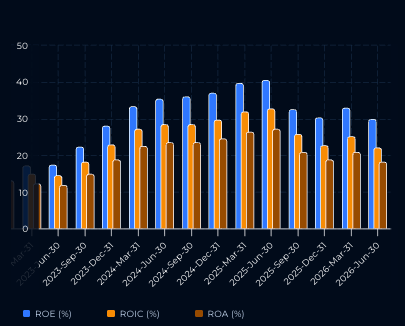
ROE, ROIC and ROA all climbed steadily from 2023 into a 2025 peak. ROE near 38%, then rolled over through the first half of 2026. That's largely mechanical: when the asset base grows faster than earnings, return ratios compress even if nothing about the business itself has gotten worse. The metric to watch from here is whether that compression stabilizes which will show a sign the new capacity is starting to earn.
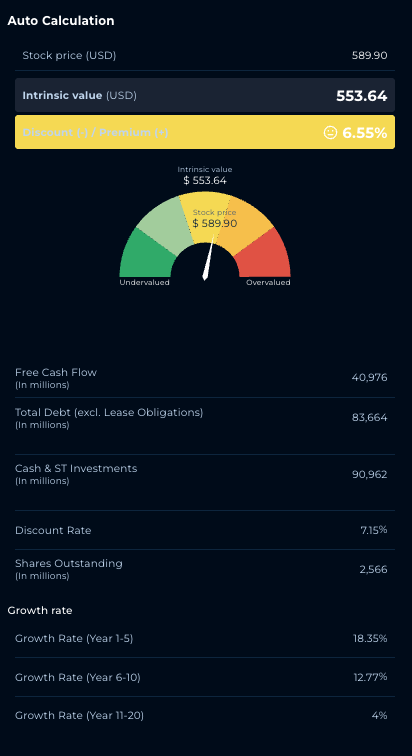
This is where StockOracle™ is useful because it doesn't give you one answer on valuations. Run a 20-year DCF with a conservative growth taper (18.35% years 1–5, 12.77% years 6–10, fading to just 4% by years 11–20) and Meta's intrinsic value comes out to $553.64. Essentially fair value, just a touch rich. Look at OracleValue™ 's headline read instead, which extends higher growth further out, and fair value comes out closer to $905.68. Roughly 35% undervalued. And the entire gap is which growth curve you're willing to believe. It's the model showing you exactly what the market is actually debating.
So the real question with Meta isn't whether $130–145 billion in AI capex is a lot of money. The question is whether Meta's ad engine and balance sheet are strong enough to fund the gap between the spending and the payoff for as long as that gap lasts.. Long enough for "selling intelligence" to become a line item instead of a phrase on an earnings call.
Meta's moat in social advertising is about as durable as any in the market today, and the financials back that up. Durable doesn't mean the bet is guaranteed to pay off on the timeline the market is currently pricing.

This piece is for educational purposes only and isn't financial advice or a recommendation to buy or sell any security. Intrinsic value estimates from StockOracle™ (OracleValue™) are model-based approximations that depend heavily on the growth and discount-rate assumptions used — they are not price targets or guarantees. Past performance and historical metrics are not indicative of future results. Figures above are drawn from Meta's Q2 2026 earnings release, earnings call commentary, and StockOracle™ platform data as of early August 2026; capex figures in particular vary slightly by source ($30.1B per the SEC exhibit vs. ~$31.1B in secondary reporting, likely a lease-accounting difference) and should be verified against the 10-Q before publication.
Related

For most of its 24-year life, the company was private. The figures floating around came from leaks, ...

A business that still earns a 22.8% return on invested capital, carries no interest-bearing debt, ...
Home Depot trades at 21.95 times trailing earnings, a multiple that assumes the growth engine ...