By Piranha Profits Team
Last updated on August 07, 2026
In the first week of August 2026, Palantir grew revenue 93% year-on-year. Faster than the quarter before, and the market's reaction was relief.
All information and data presented is accurate as of 5th August 2026.
To understand why relief was the emotion, you need the price history. Palantir peaked at US$207.52 in Q4 2025. By the time it reported Q2 2026 results on 3 August, the stock was trading around US$123. That’s roughly 40% below that high, in a year when the broader market was near record levels. Then the numbers landed: revenue of US$1.94 billion against consensus near US$1.8 billion, adjusted EPS of US$0.41 against US$0.35 expected. The stock jumped back toward US$158 within days.
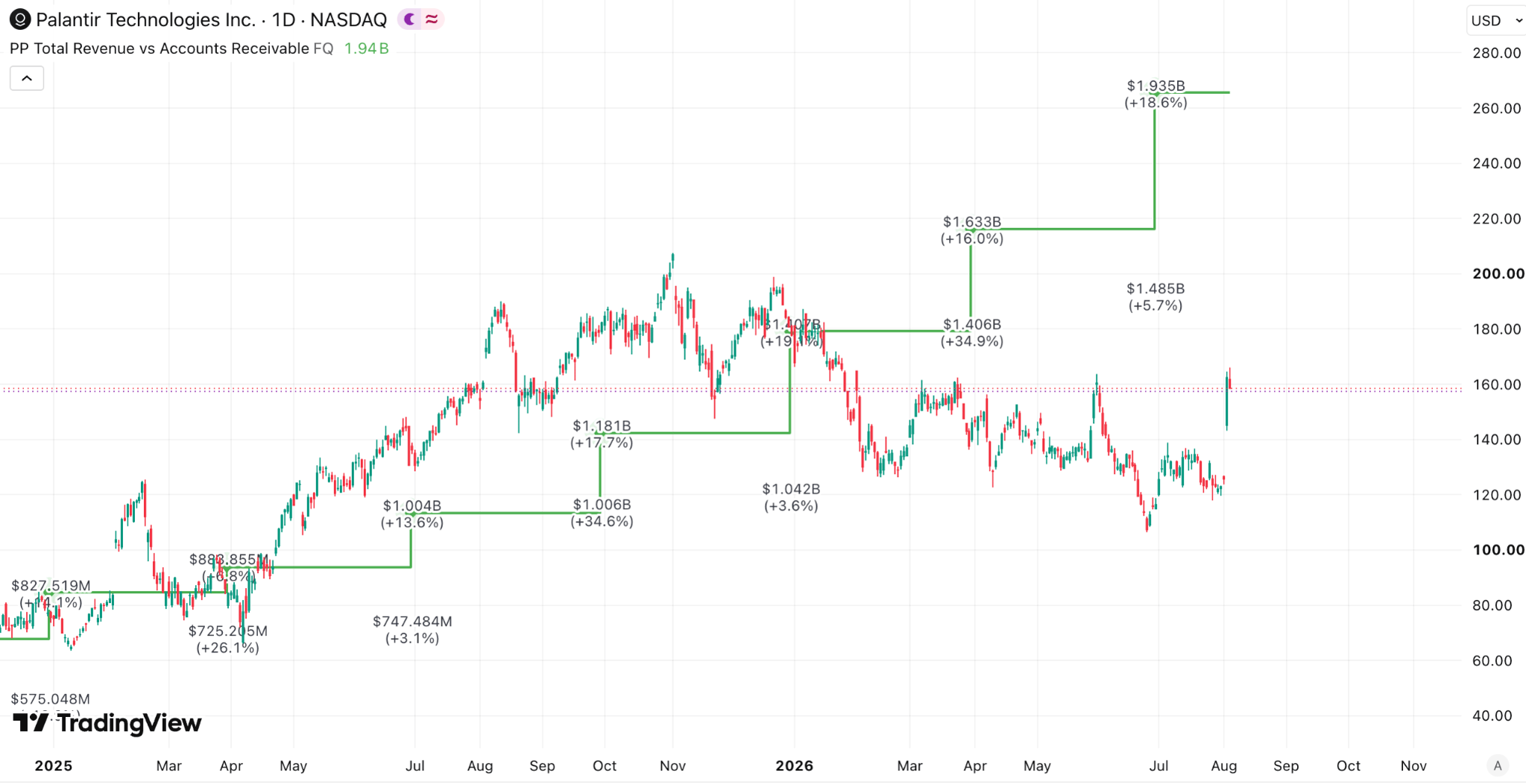
Accurate as of 6th August 2026 PLTR PRICE vs REVENUE
So in about seven months, Palantir investors watched the business roughly double in size and the share price fall 40%, then recover 30% in under a week.
Now let’s dive into Palantir and we’re going to work through that in four levels. First, what Palantir does. Second, what investors are feeling and why. Third, what the Q2 2026 numbers actually say. Fourth, and this is the part that matters. Bull and bear angles, including several we'll then argue against ourselves.
Part 1: What Palantir Actually Does?
Lets start with an analogy. Picture a global airline. It has thousands of spreadsheets, a different software system for every department, sensors on every engine, crew rosters in one database, passenger bookings in another, maintenance logs in a third. All of that data exists. None of it talks to each other. These data collected is also known as dark data. Data that organisation collects but not placed into any use.
So when a storm grounds a plane in Chicago, nobody can answer the only question that matters, what should we do right now? because answering it requires knowing, simultaneously: which passengers connect to what, which crew members are about to hit their legal rest limits, what a cancellation costs versus a delay, which spare aircraft is nearest, and what each choice does to tomorrow's schedule. And many other questions left unanswered. Traditionally, that answer arrives as a report, days later.
Palantir's software builds what it calls an Ontology. A working model of the organisation itself. Once the software knows what things are and how they relate, a manager can ask a question and get an answer in seconds instead of days. And crucially, the system can act, not just report. Further down the deep dive, we will talk about real case studies of Palantir's customers.
The four platforms
Foundry is the version built for commercial enterprises, the operating system a business builds its own applications on top of.
Gotham is the defence and intelligence version, used to find targets in enormous data sets, identify threats, and plan real-world action.
AIP (Artificial Intelligence Platform) is the newest layer. It connects large language models to an organisation's private data without that data leaving the organisation's control. So employees can use AI on real internal information rather than on the public internet.
Apollo is the plumbing. It handles deploying and updating software everywhere from a normal cloud environment to a satellite or a drone at the edge of a battlefield.
What this looks like in practice
The value is easiest to see in specific cases:
https://investors.palantir.com/ -- Q2 2026 Earnings Reports
- BP built a "digital twin" of its oil fields on Foundry, using it to optimize drilling and flow management. Reported value added: approximately US$1 billion through higher production and lower operating costs.
- Airbus built "Skywise" with Palantir to track the health of its entire A350 supply chain. Reported result: production ramped roughly 33% faster and US$1.7 billion in annual cost savings.
- Sompo Japan integrated nursing-home data, medical records and insurance claims to predict which patients needed care before an emergency. Reported: US$60 million profit improvement over three years.
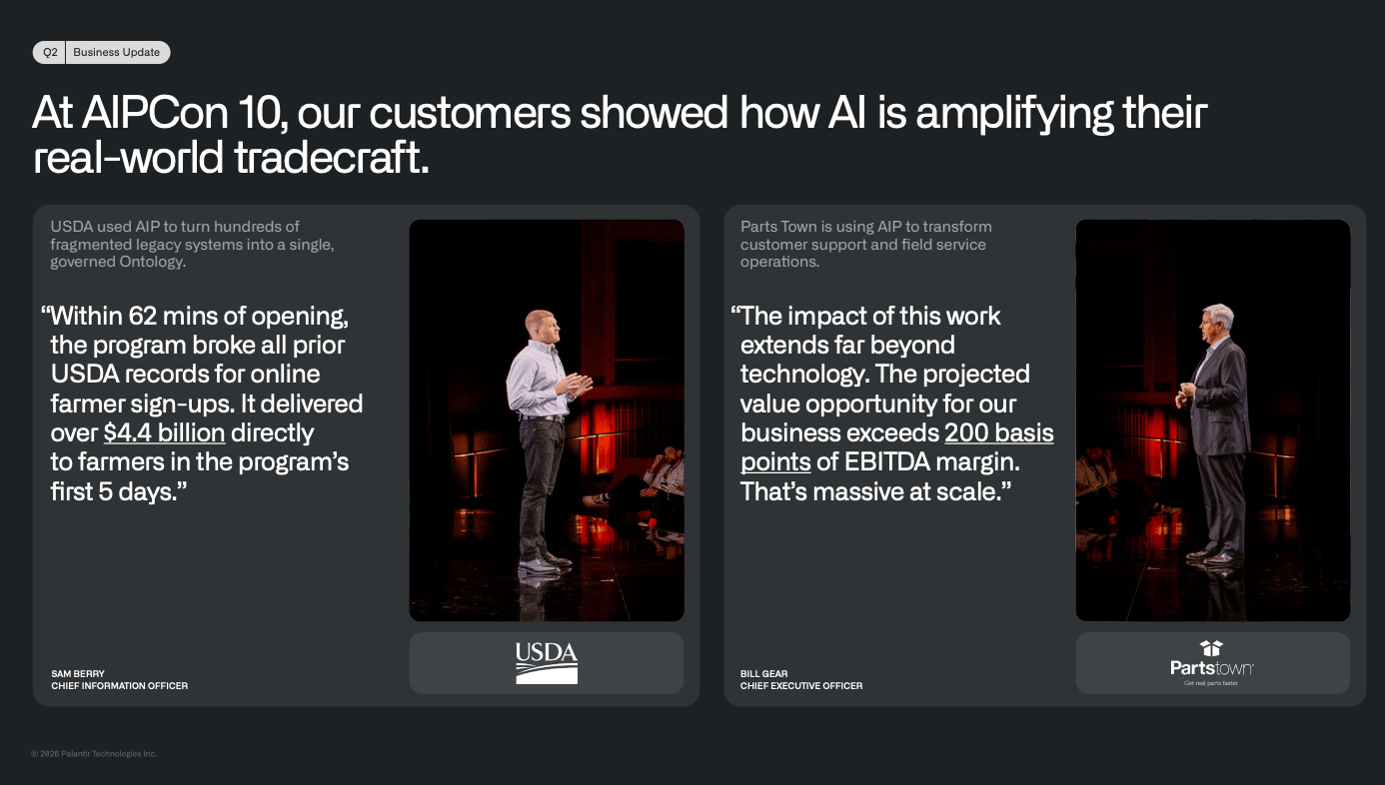
- USDA consolidated hundreds of fragmented legacy systems into a single governed Ontology. Its CIO said the resulting programme broke every prior record for online farmer sign-ups within 62 minutes of opening, and delivered over US$4.4 billion directly to farmers in its first five days.
- Kirkland & Ellis, the law firm, is using AIP across private equity fundraising. A member of its global executive committee: "What used to take days for a lawyer to analyze, discuss, and draft, now happens in minutes."
- Centrus Energy is using AIP to accelerate its uranium enrichment expansion. Its CEO cited "nearly US$300 million in savings we have identified to date."
The part that explains the weirdly huge margins
Palantir doesn't sell the way enterprise software companies would normally sell. There is no army of salespeople running twelve-month procurement cycles.
src: https://www.youtube.com/playlist?list=PLSoYzKs38mqI
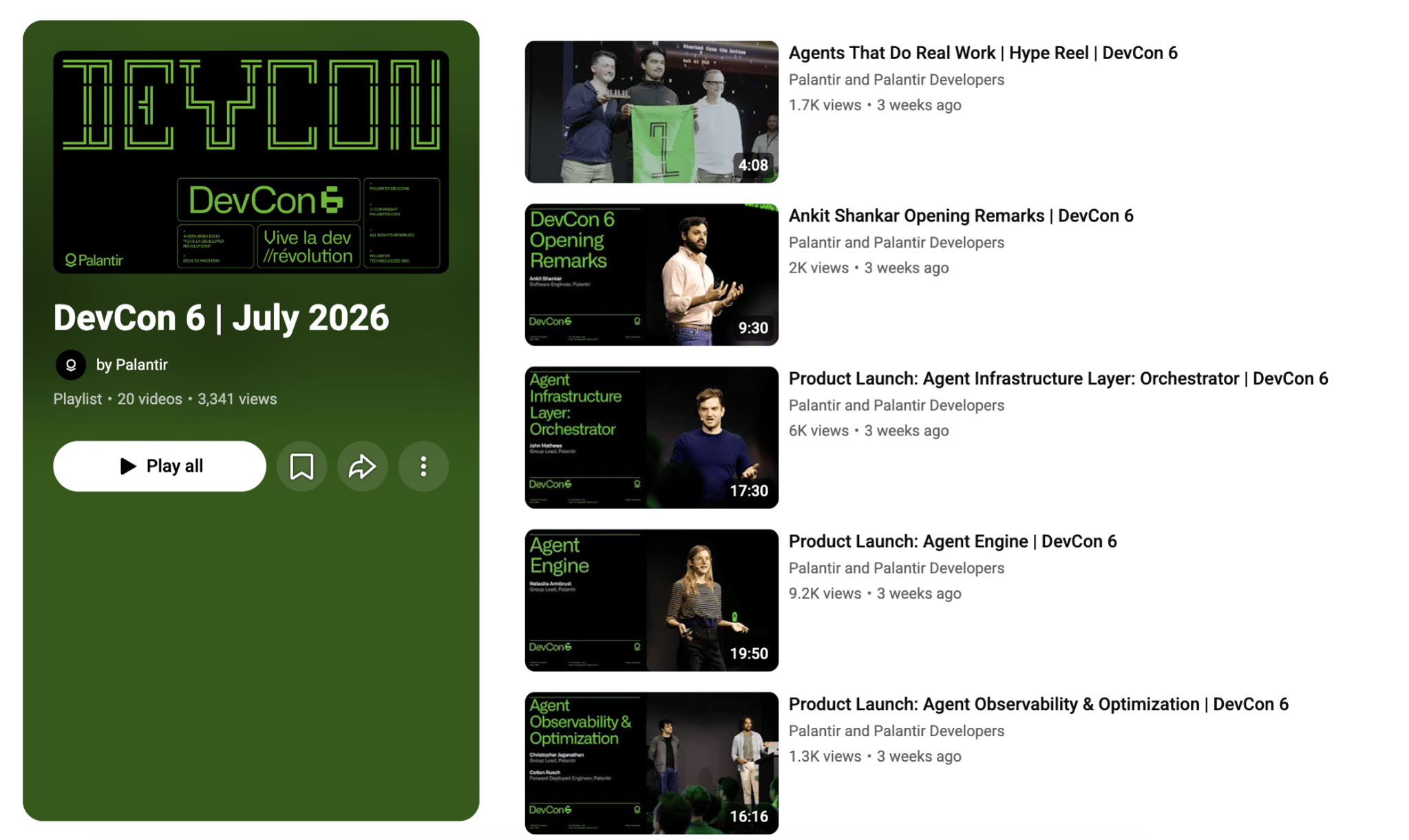
Instead there are bootcamps. Five-day sessions where a prospective customer brings their own data and builds something with it. And there are conventions: AIPCon, DevCon, the American Builder Summit. Customers demo their own results on stage.
A conventional software company at Palantir's growth rate would have to spend enormously on sales. Palantir doesn't, which is a large part of why it can grow 93% and run a 62% adjusted operating margin at the same time. Those two numbers usually don't coexist in a company like Palantir, although many AI investors will argue that there is no company like Palantir.
So What Are Investors Actually Feeling
Here is the emotional arc of the last three quarters.
Late 2025. Euphoria. Palantir had become the retail investor's favourite AI story: the only listed "pure play" on enterprise AI deployment, run by a founder who says provocative things, with a chart that had gone almost vertically up. The stock touched US$207.52.
H1 2026. The air comes out. By May, Palantir was down around 26% year-to-date while the broader market sat near all-time highs. By July it was roughly 36% off its peak. Going into the August print it was around 40% below. Meanwhile revenue growth accelerated from 63% to 70% to 85% to 93%.
The share price fell by 40% during a period when the business roughly doubled.
August 2026. Q2 beat on both lines. The stock ran back toward US$158. And the argument immediately restarted.
What the two camps are actually arguing about
Going into the print, analyst positions were split. Average target around US$181, with Baird at US$200 calling PLTR the "premier AI growth asset." The bear case was almost entirely valuation. A price-to-sales ratio in the sixties described as disconnected from fundamentals.
That's the mood: two groups of people with high conviction, looking at the same company, disagreeing about the price.
The de-rating already happened
Pull the multiple history from StockOracle™:
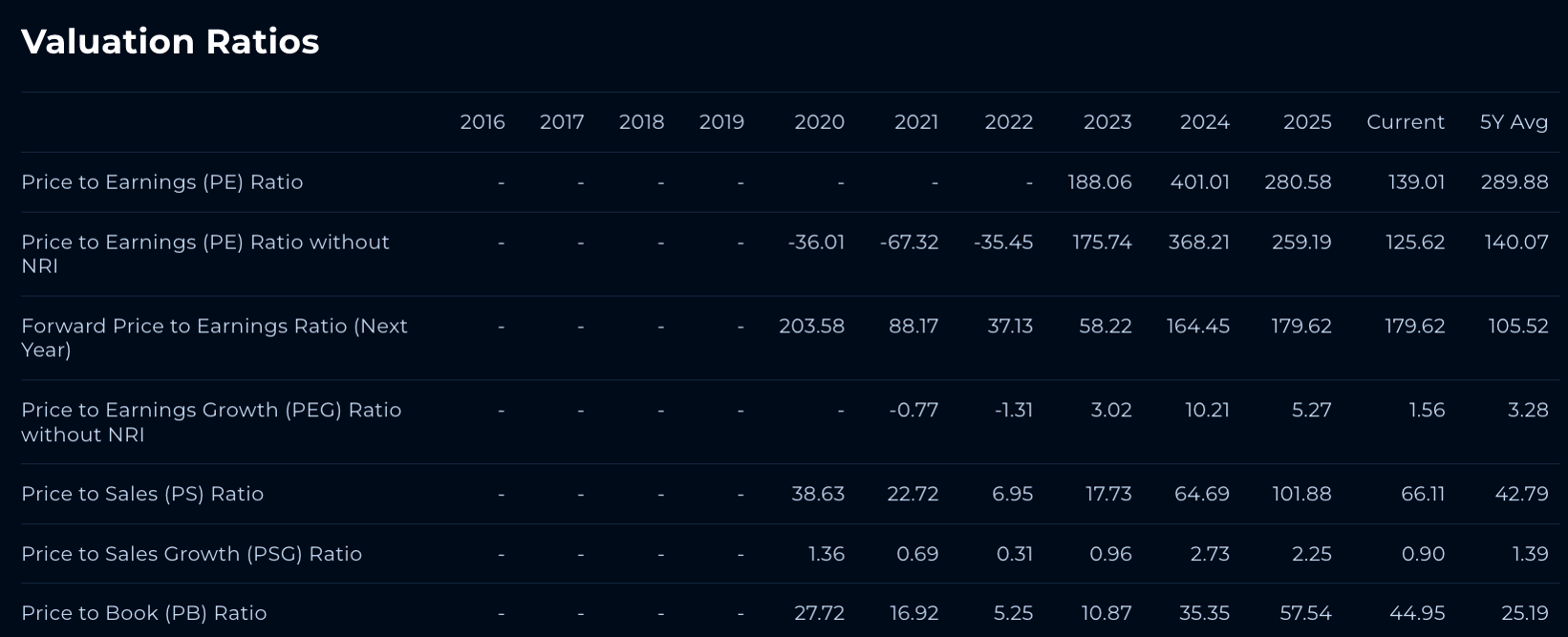
Palantir's trailing P/E has fallen roughly 65% from its 2024 level. Its price-to-sales has come down by more than a third from 2025. The 5-year and 10-year average P/E both sit at 289.88, meaning that on its own history, Palantir currently trades at less than half its typical multiple. Simply because while prices dropped, the company continued to push out solid numbers.
The share price is higher than it was in 2023. The multiple is dramatically lower. That combination simply put? Earnings grew faster than the price.
That doesn't immediately make Palantir cheap. 139× earnings is still an extraordinary price. But "expensive and getting cheaper" is a materially different situation from "expensive and getting more expensive," and most commentary out there hasn't updated.
The Q2 2026 Numbers that cause the market to re-rate Palantir
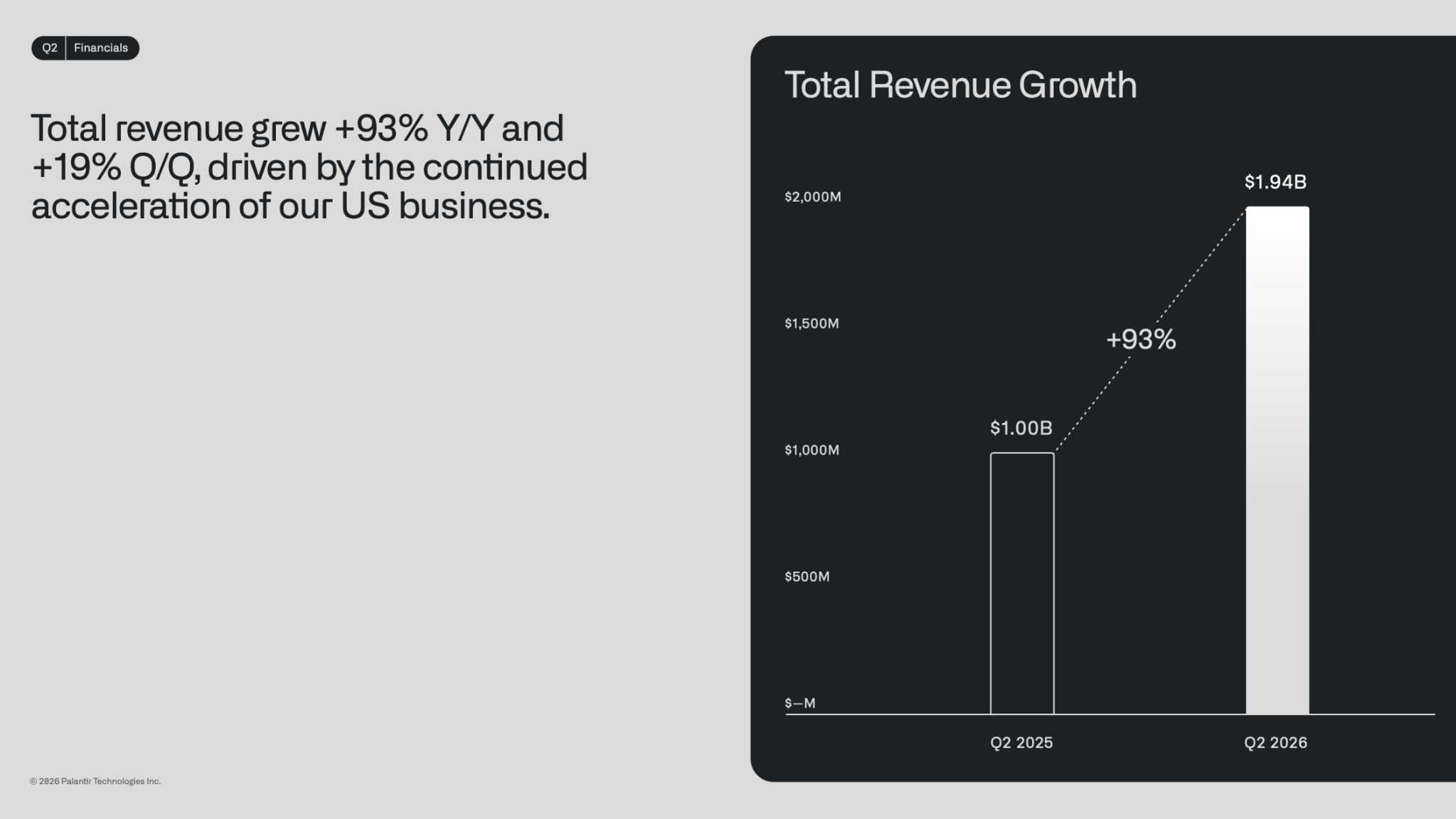
Here is what Palantir reported for the quarter ended 30 June 2026.
Growth
- Total revenue: US$1.94 billion, +93% year-on-year, +19% quarter-on-quarter
- US revenue: US$1.57 billion, +115% Y/Y, +23% Q/Q
- US commercial revenue: US$764 million, +149% Y/Y, +28% Q/Q
- US government revenue: US$809 million, +90% Y/Y, +18% Q/Q
- Total commercial: US$945 million (+110%).
- Total government: US$990 million (+79%)
Profitability
- Adjusted operating income: US$1.19 billion — a 62% margin
- GAAP operating income: US$912 million — a 47% margin
- GAAP net income: US$1.06 billion. GAAP EPS US$0.41; adjusted EPS US$0.41
- Adjusted gross margin: 86%
- Rule of 40 score: 155% (93% growth + 62% adjusted operating margin)
For context on that last figure: the Rule of 40 says a healthy software company's growth rate plus its profit margin should exceed 40. Palantir scored 155. Across the 100 largest listed companies in the world, only a handful of memory and semiconductor names sit higher, and none of them are software.
The trend line is the remarkable part. Rule of 40 by quarter: 68% → 81% → 83% → 94% → 114% → 127% → 145% → 155%. Eight consecutive quarters of improvement, driven by growth accelerating and margins expanding simultaneously.
Cash and commitments
- Adjusted free cash flow: US$1.22 billion — a 63% margin
- Cash, equivalents and US Treasuries: US$9.2 billion, with no debt
- Billings: US$2.07 billion, up 88% Y/Y
- Total remaining performance obligations (RPO): US$4.90 billion, up from US$2.42 billion
- Deals closed: 220 above US$1 million, 98 above US$5 million, 73 above US$10 million
- US commercial total contract value: US$2.13 billion, +153% Y/Y — a record quarter
- US commercial remaining deal value: US$6.24 billion, +124% Y/Y
Guidance
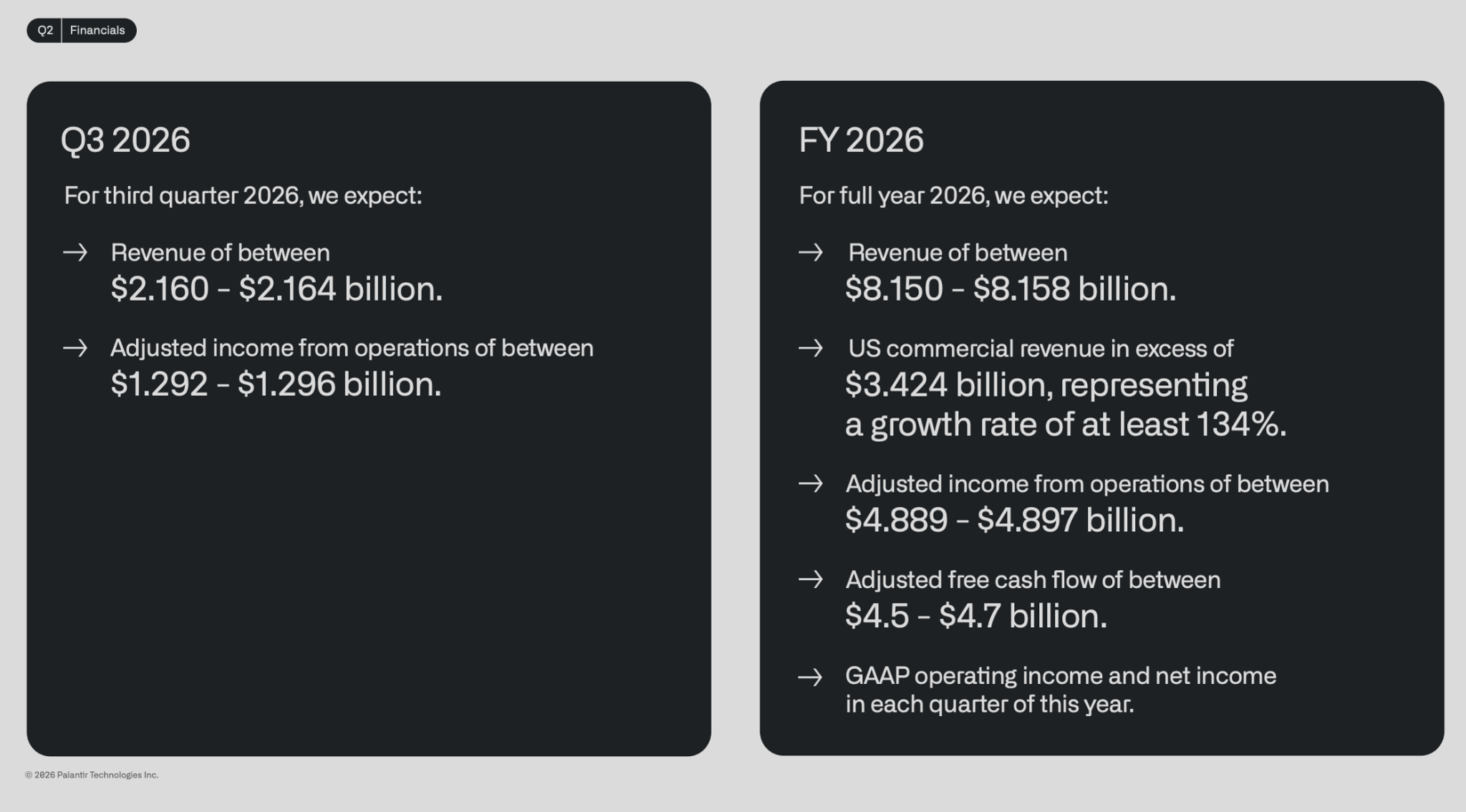
- Q3 2026 revenue: US$2.160–2.164 billion
- FY 2026 revenue: US$8.150–8.158 billion
- FY 2026 US commercial revenue: above US$3.424 billion, implying growth of at least 134%
- FY 2026 adjusted free cash flow: US$4.5–4.7 billion
- GAAP operating income and net income in every quarter of the year
The Real Strengths of Palantir
An useful exercise is understanding the mechanism behind each of the bull points, because mechanisms are what tell you whether something is durable.
1. Switching costs that compound rather than decay
Most software switching costs are about migration pain, while annoying, but finite. Palantir's are different in kind. When an organisation builds its Ontology, it isn't storing data in Palantir; it's encoding how it makes decisions into Palantir. Every workflow modelled, every rule captured, every piece of institutional judgment turned into logic makes the system harder to leave and more valuable to keep.
The evidence is net dollar retention of 157%. That figure means existing customers spent 57% more this year than last. Customers aren't just staying, they're expanding faster than most software companies grow in total.
2. Margin structure that shouldn't exist at this growth rate
An 86% adjusted gross margin and 62% adjusted operating margin while growing 93%. The bootcamp go-to-market is the reason: Palantir converts customers by letting them build something, not by selling them something. Sales cost stays low; conversion stays high.
The proof is in operating leverage. Adjusted operating margin over five quarters: 46% → 62%. Revenue nearly doubled; expenses grew far more slowly. Adjusted expenses went from US$539 million to US$741 million while revenue went from US$1.00 billion to US$1.94 billion.
3. A balance sheet that removes an entire category of risk
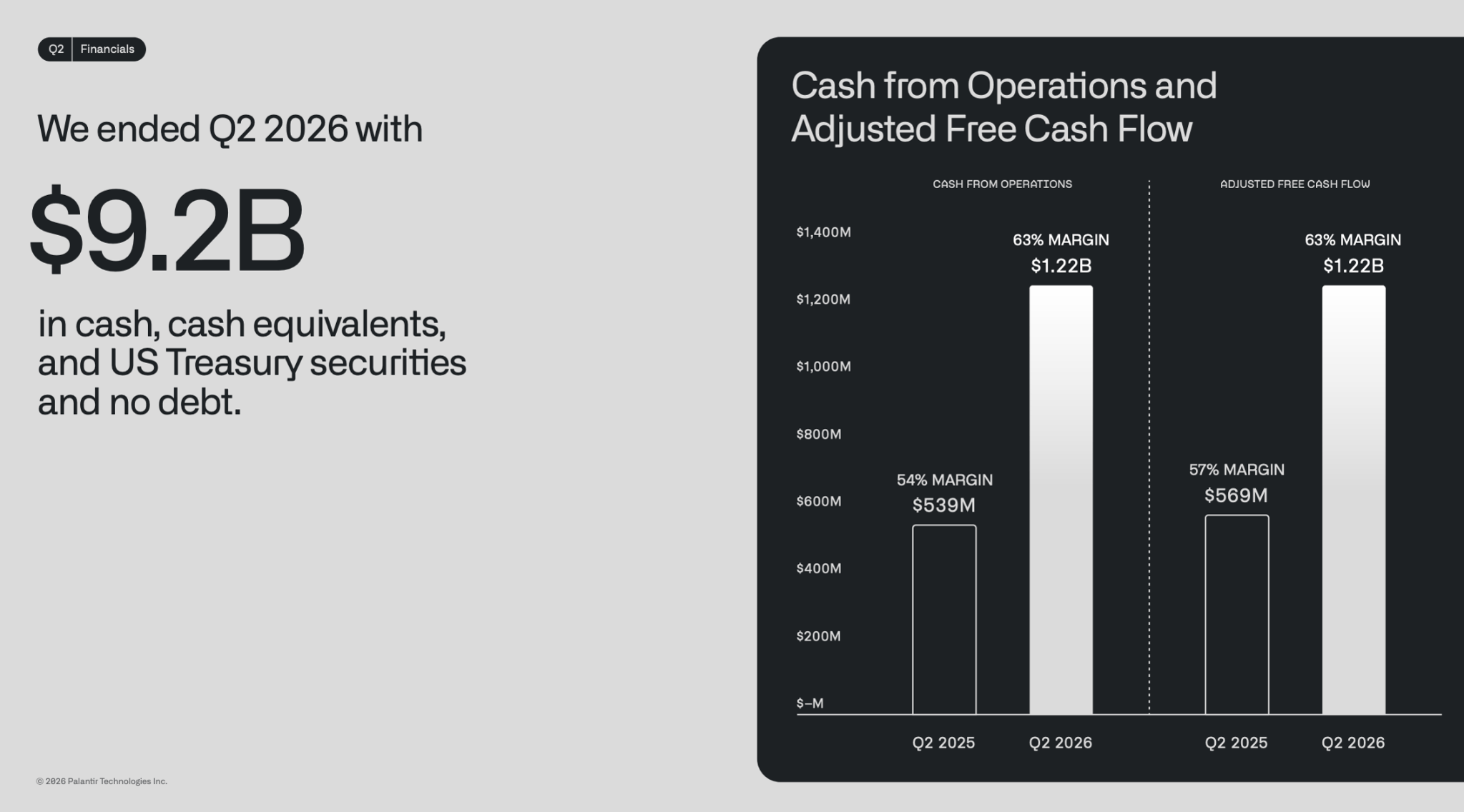
US$9.2 billion in cash and Treasuries, no debt, and US$4.5–4.7 billion of free cash flow guided for the year. Palantir has no financing risk, no refinancing risk, and no need to raise capital on someone else's terms. In a sector where a lot of AI ambition is beginning to be funded with debt and vendor financing, that's a genuine structural advantage.
4. Government entrenchment that behaves like infrastructure
The US Army awarded Palantir a contract worth up to US$10 billion in mid-2025, consolidating dozens of separate agreements. In March 2026 the Pentagon moved to designate Maven a program of record. Bureaucratic language for "this is now permanent budgeted infrastructure rather than a project."
That distinction matters enormously. Projects get cancelled. Programs of record get funded through appropriation cycles, get their own line items, and become the thing new systems must integrate with.
5. Returns on capital that justify the attention
StockOracle™ shows return on equity of 32.89% and return on invested capital of 31.94% (both TTM). Those are excellent figures in absolute terms. The operating business is generating better returns than the reported numbers suggest.
The Devil's Advocate Arguments
This is the section worth your time.
Palantir's moat and ceiling might just be the same thing
Palantir's message in 2026 is AI sovereignty. The business own framing: "An organization's most important secrets are its treasure; in their richness is the alpha. Yet companies are paying misaligned labs to turn that treasure, the very basis for their competitive advantage, into training data for future models. Our architecture keeps you sovereign."
It's a superb pitch.
Every argument for why a US institution should keep its alpha in its own hands is, word for word, an argument for why a French or German institution should keep its alpha out of an American vendor's software.
And this is no longer theoretical:
- France. The DGSI, France's domestic intelligence agency, renewed its three-year Palantir contract in December 2025 and within roughly six months was preparing to exit, moving to French firm ChapsVision. Prime Minister Sébastien Lecornu's stated rationale: France "cannot accept new strategic dependencies in the digital sphere."
- United Kingdom. Britain's Science, Innovation and Technology Committee called Palantir's role in NHS data infrastructure an "unacceptable point of weakness" and urged the government to use a February 2027 break clause on a contract reported at £330 million. Palantir's UK executive Louis Mosley called the opposition "ideologically motivated," pointing to over 110,000 additional NHS procedures since launch.
- Germany. Reported to be pulling back from Palantir contracts.
- Switzerland. A reported legal setback.
Now put that against the numbers, which is where it gets interesting. Q2 2026 reports US revenue of US$1.57 billion out of US$1.94 billion total. That leaves roughly US$365 million of international revenue up about 35% year-on-year, against +115% for the US.
International revenue as a share of the total has fallen from roughly 27% to 19% in a single year. And sequentially, using Q1's reported international split, international revenue grew only around 4% quarter-on-quarter while US revenue grew 23%.
This is not a growth problem. Palantir can compound at 90% for years on the US market alone. But it is a duration problem. It doesn't affect the next four quarters, it caps the terminal size of the business. And terminal size is precisely what a 139× multiple might be paying for.
When you buy a stock at that price, almost none of the value is in next year's earnings. Nearly all of it sits on the assumption that this business keeps compounding for a decade or more. A company that can only operate freely within the United States and a shrinking set of comfortable allies has a smaller decade than one that can sell anywhere.
The growth is getting deeper, not wider (may not be a bad thing, but there is always two sides of a coin)
US commercial revenue grew 28% quarter-on-quarter. US commercial customer count grew 6% quarter-on-quarter. Huge segment of the growth came from existing customers spending more, not from new customers arriving.
Watch the sequential customer additions in the US commercial segment. Decelerating slightly, every quarter, while revenue continue to accelerate.
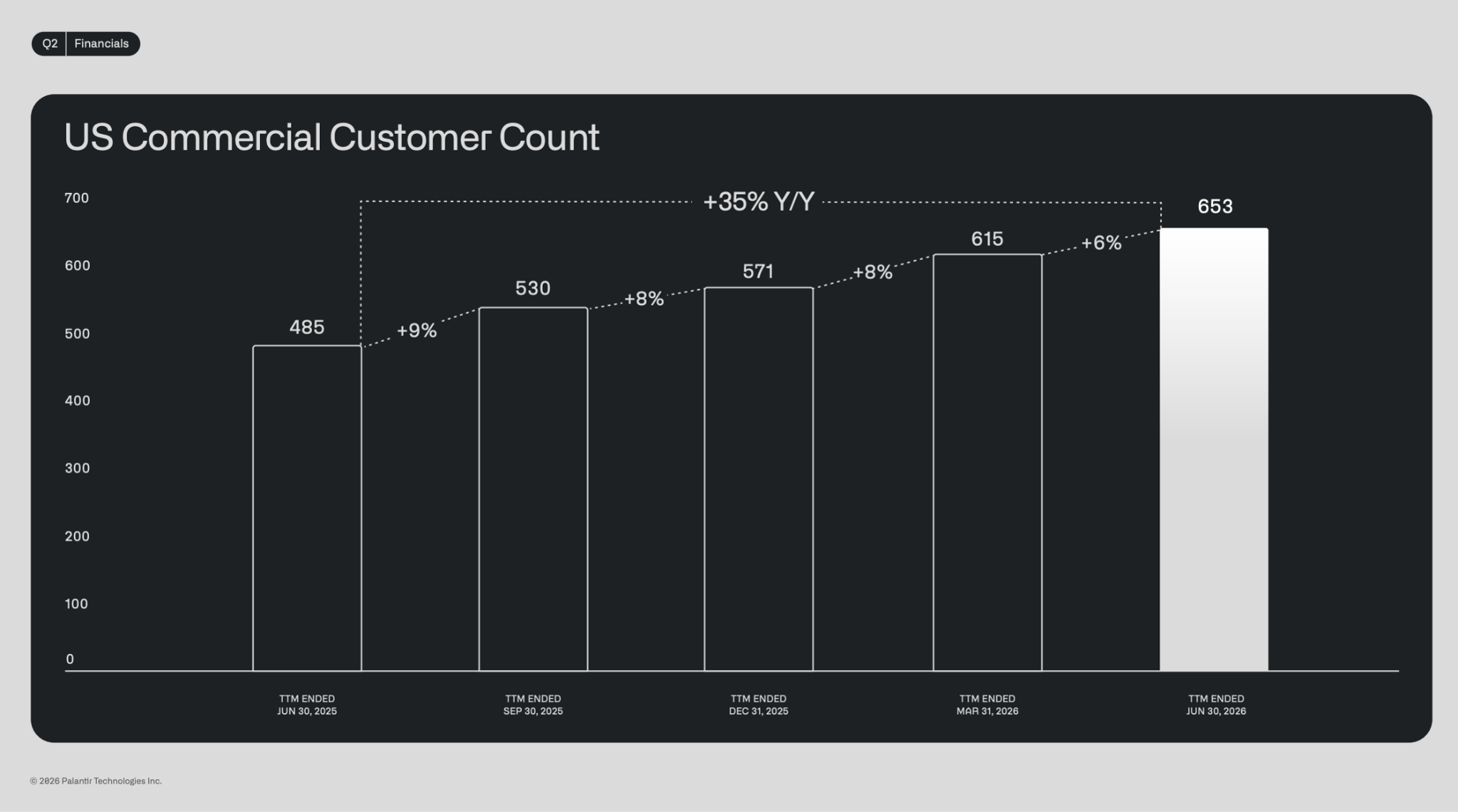
653 US commercial customers generating US$764 million in a quarter is about US$1.17 million per customer, per quarter. Clearly Palantir is not a volume business. It is a very small number of very large relationships.
Expansion-led growth is high quality. Better margins, better retention, cheaper to acquire. But it has a structural dependency: the expanded engine runs on the output of the land engine. Every customer that expanded 57% this year was landed in a previous year. If landing decelerates for long enough, the pool of accounts available to expand into stops growing, and expansion-led growth eventually meets its own ceiling.
This is still, technically, largely a government company
Total government revenue: US$990 million. Total commercial revenue: US$945 million.
Government is still the bigger half. Large part of the market narrative treats Palantir as the enterprise AI story, and the P&L says: government heavy, commercially adjacent.
US government revenue grew an extraordinary figure for public-sector software. But it's might also be the least repeatable line in the model, because it rests on annual appropriations, one administration's specific priorities, and a small number of very large vehicles: the US$10 billion Army enterprise agreement, the Maven program of record.
Reading Palantir Through StockOracle™
StockOracle™ breaks a business into six dimensions.
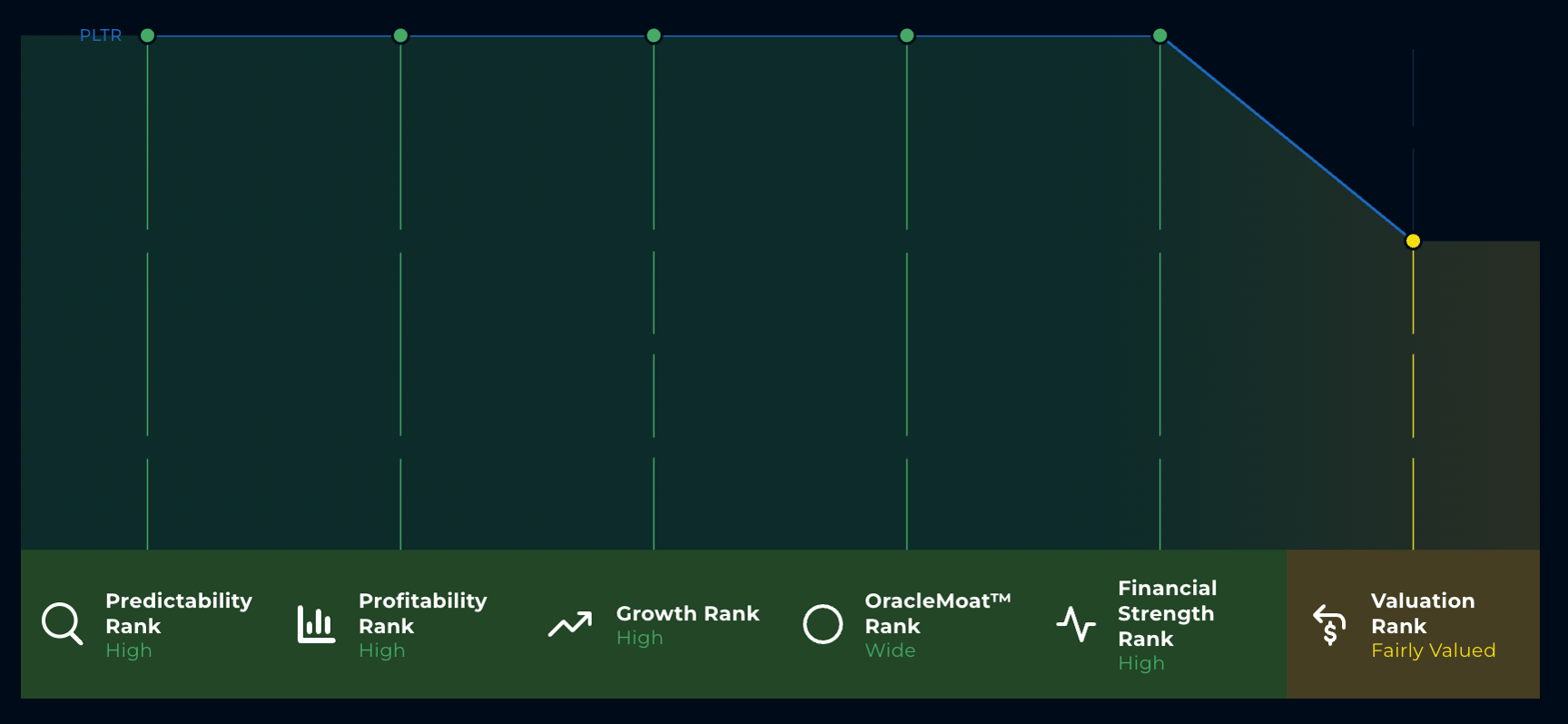
Predictability. Palantir scores well here. One caveat here - Predictability is backward-looking: it measures how consistent revenue and earnings history has been. High predictability describes the track record know that it is not a forecast. However, it's a still a good and healthy sign of a growing business.
Profitability. This segment is clear as day. An 86% adjusted gross margin, 62% adjusted operating margin, 47% GAAP operating margin, 63% free cash flow margin, ROE of 32.89% and ROIC of 31.94%. Five quarters of continuous margin expansion during a period of accelerating growth.
Growth. Revenue +93% Y/Y. US commercial +149%. Eight straight quarters of accelerating year-on-year growth. Accelerating growth at a US$8 billion annual revenue run-rate is solid figures.
OracleMoat™ — Wide. StockOracle™ classifies Palantir's moat as Wide, and the mechanism is the Ontology switching cost discussed. Customers encode their decision-making into the platform, not merely their data. The evidence sits in net dollar retention. A wide moat inside the United States and a contested one abroad is still a wide moat.
Financial Strength. US$9.2 billion in cash and Treasuries, zero debt, US$4.5–4.7 billion of free cash flow guided for the year.
Valuation — the one weak leg. This is where the OracleIQ™ profile drops slightly. OracleValue™ currently estimates Palantir's value at US$156.89 per share. StockOracle™ also shows a free cash flow yield of 0.81%, price-to-book of 44.95 against a 5-year average of 25.19, and a forward P/E that requires checking.
The shape of the OracleIQ™ profile tells the story better than any paragraph: five dimensions at or near the top of the range, and valuation alone falling away. It is an exceptional business where the price is doing all of the work, and it is why the same stock can fall 40% and rise 30% within seven months without a single thing changing about the operations.

Remember that OracleValue™ is an estimate produced by a model, not a target, not a forecast, and not a prediction. It shifts as inputs shift. It is one input into your thinking, not a conclusion.
This article is for educational purposes only. Nothing here is a recommendation to buy, sell or hold any security. All valuation figures, including OracleValue™ estimates, are model-based estimates that change as inputs change. They are not forecasts, targets or guarantees. Historical growth rates, margins and share price movements described here are historical and do not indicate future results. All investing carries risk, including the risk of loss of capital. Do your own research and consider your own circumstances before making any investment decision.
Related

For most of its 24-year life, the company was private. The figures floating around came from leaks, ...

A business that still earns a 22.8% return on invested capital, carries no interest-bearing debt, ...
Home Depot trades at 21.95 times trailing earnings, a multiple that assumes the growth engine ...