In February, Airbnb raised its full-year outlook, grew free cash flow 30%, and saw its shares reach a 52-week high of $193.45. It could suggest that demand is running ahead of the plan management built
Free cash flow is the number that matters most here. Intrinsic value is built on the cash a business can generate over its lifetime, so when free cash flow grows 30% in a year, the starting point for every future year rises with it.
Yet ask various valuation models what the stock is worth, and the answers range from under $50 to almost $470 per share.
The market is asking a harder question. If AI agents can plan and book an entire trip, will travelers still start their search on Airbnb?


That gap is why the ABNB intrinsic value question matters right now. One side sees a cash machine still compounding. The other sees a platform whose front door AI could one day move.
What Does Airbnb Do?
Founded in 2008, Airbnb runs an online marketplace that connects travelers with hosts who rent out their homes, apartments or spare rooms.
It owns none of the properties listed. Instead, it earns a service fee on each booking, which is why it can grow with very little spending on buildings or equipment.
Today the platform has over 9 million active listings and more than 5.5 million hosts, and it is expanding into experiences, services such as airport pickups and car rentals, and boutique hotels.
What Is ABNB Intrinsic Value in 2026?
Intrinsic value is an estimate of what a business is truly worth, based on the cash it can generate in the future. Investors compare it with the market price to judge their margin of safety, the buffer between what they pay and what they believe they get.
AirBnB (ABNB) fair value based on its 20-year discounted cash flow model (DCF-20) is around $468.83 per share as of October 20, 2026. A DCF-20 model projects Airbnb's free cash flow 20 years forward, then discounts each year's cash back to today's dollars.
ABNB's value based on its Price to Sales Growth (PSG) ratio is around $49.57 per share, the lowest in the range.
The PSG ratio divides the price-to-sales multiplied by revenue growth. Airbnb trades at roughly 7.8x trailing sales while revenue grew 10% in 2025, so a growth-adjusted sales model treats that multiple as stretched.
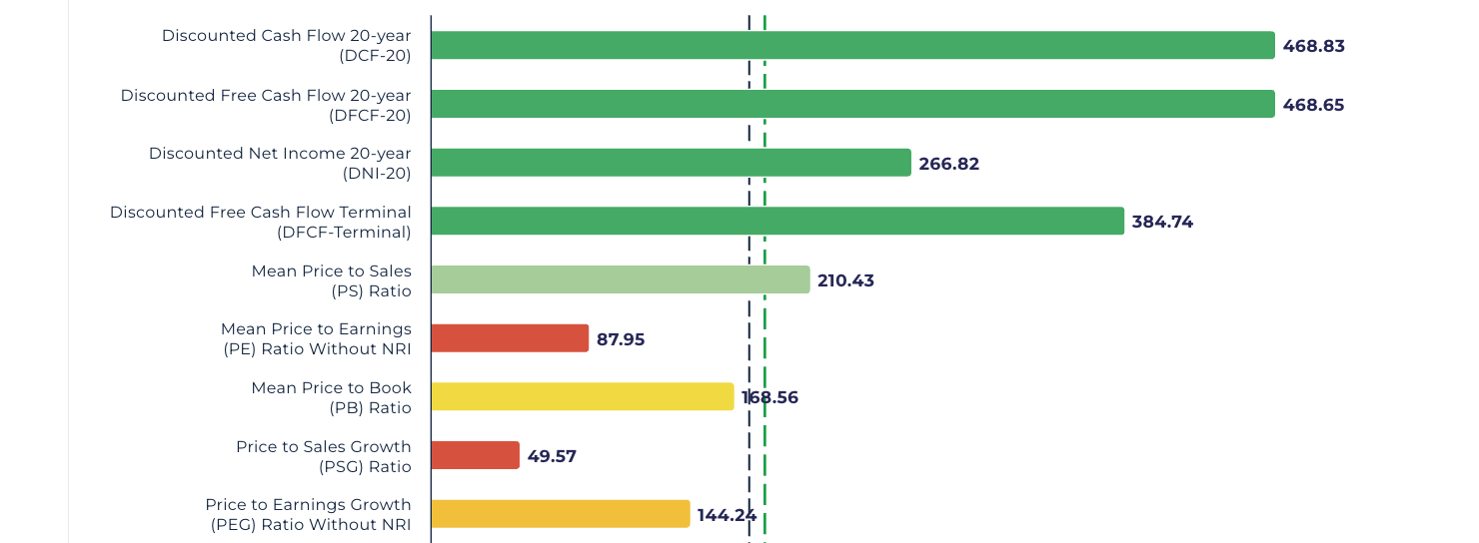
ABNB Valuation Chart Powered by StockOracle™
Why ABNB Intrinsic Value Estimates Range From $50 to $469
Cash flow models tend to reward Airbnb's high free cash flow margin over a 20-year horizon.
Multiple-based models anchor on past earnings, which run well below cash flow: Airbnb earned $2.5 billion of net income in 2025 against $4.6 billion of free cash flow, partly because of stock-based compensation. . Its earnings history is uneven, with a large loss in 2020 and a one-time tax boost in 2023, which makes historical multiples a shakier guide
ABNB intrinsic value is best read as a range of outcomes under different assumptions, and it depends on which inputs you focus on the most, whether it be cash flow or earnings, or how long double-digit growth can last.
The Numbers Behind ABNB Intrinsic Value
Revenue Growth of ABNB Is Accelerating Again
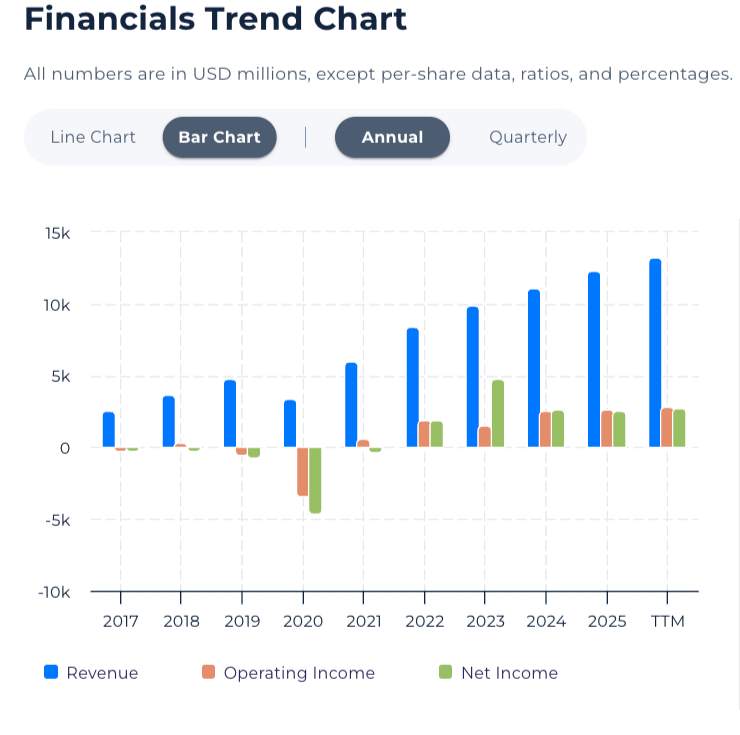
ABNB Revenue Trend Powered by StockOracle™
Airbnb grew revenue 10% to $12.2 billion in 2025. In 2026, growth is picking up speed: Q2 revenue rose 17% to $3.6 billion, and management raised its full-year outlook to at least mid-teens growth.
The growth comes from two levers pulling together: more nights booked (+10%) and higher average daily rates (+5% to $184).
Some of the lift also comes from a weaker US dollar, so the 13% currency-neutral figure is the cleaner read on demand.
Margins held firm as revenue grew, with adjusted EBITDA at a 35% margin in Q2. That pairing signals operating leverage: each extra booking adds more to profit than it adds to cost.
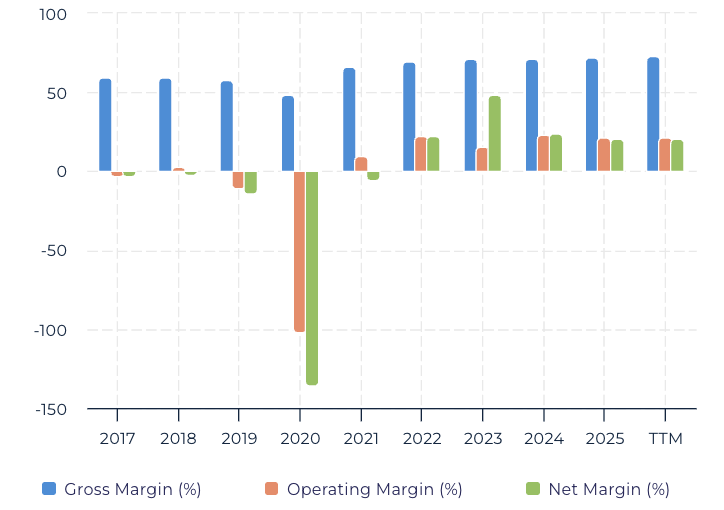
ABNB Margin Trend Powered by StockOracle™
ABNB Free Cash Flow: 37 Cents of Cash Per Dollar of Revenue
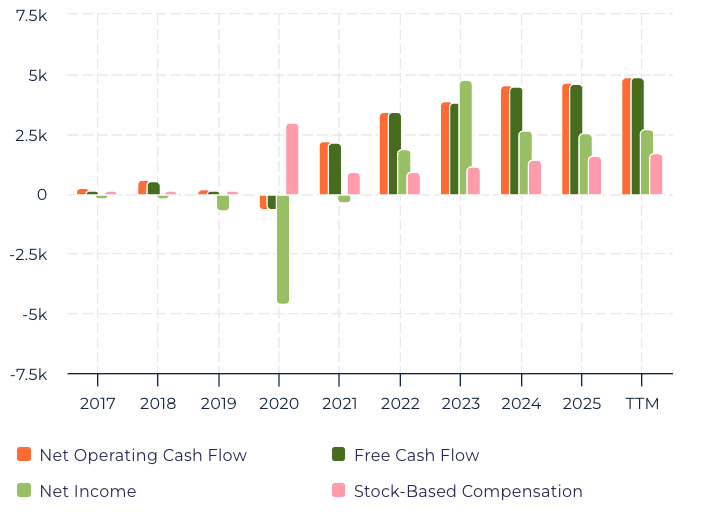
Operating Cash Flow and Free Cash Flow Chart Powered by StockOracle™
Free cash flow is the cash left after the business pays for everything it needs to run and grow.
Airbnb generated $4.8 billion of it over the past 12 months, a 37% margin. That means roughly 37 cents of real cash for every dollar of revenue, and Q2 free cash flow alone grew 30% year over year.
Two details deserve a closer look before plugging that number into a model
- Airbnb held $12.2 billion of guest funds as of June 30, 2026. That float flatters cash flow in growth periods, and Reserve Now, Pay Later shifts some of that timing later.
- Airbnb recorded about $1.7 billion of it over the past four quarters, equal to roughly 35% of free cash flow. It uses no cash today, yet it dilutes shareholders over time..
Why Net Income Swung So Sharply in 2020
The chart shows a huge dip in Net Income in 2020. COVID-19 hit first: revenue fell 30% to $3.4 billion and nights booked dropped 41%, with CEO Brian Chesky saying Airbnb “lost almost all” of its business in four to six weeks.
Most of the loss, though, came from two non-cash charges tied to the December 2020 IPO: $2.8 billion of stock-based compensation and an $827 million mark-to-market charge on warrants issued with an emergency loan that April. That is why the stock compensation bar spikes the same year.
A business can be hit by unforeseen events, from a pandemic to a sudden change in rules, regardless of how strong or predictable it seems.
A single bad year can wipe out reported earnings, even when the business recovers afterward, as Airbnb's net income did in 2020. Which is why intrinsic value works best as a range, and why a margin of safety matters:it leaves room for the year that goes wrong.
Buybacks Are Shrinking the Share Count
Airbnb repurchased $3.8 billion of stock in 2025 and another $2.1 billion in the first half of 2026, with $3.4 billion still authorized. Diluted shares fell from 626 million to 597 million year over year in Q2.
Each remaining share now owns a slightly larger piece of the company. That lifts intrinsic value per share even when total business value stays flat.

Growth Catalysts That Could Move ABNB Intrinsic Value
Beyond the Home Rental

- Experiences: supply grew nearly 80% year over year in Q2 2026
- Hotels: boutique hotel nights are growing about 3x faster than homes, from a single-digit share of nights
- Services: now spans grocery delivery, car rentals, airport pickups, luggage storage and resort passes
- Guest travel insurance: revenue up more than 60%, available in 12 countries
Each new category sells to guests Airbnb already has. That is cheaper growth than winning new customers, and it lengthens the runway behind long-term cash flow assumptions.
AI and the App Are Lowering Costs
- Nights booked on the app rose 23% and now make up 64% of all nights
- The AI support assistant resolves nearly 45% of the issues it handles without a human agent
- Support cost per booking fell about 16% year over year
Lower costs per booking help keep margins steady while the company invests in new categories.
Airbnb's Economic Moat
Over 5.5 million hosts have welcomed more than 2.5 billion guest arrivals, and the platform listed over 9 million active listings at the end of 2025.
The platform sits inside several parts of a trip
- Searching and booking unique homes
- Guest payments, including Reserve Now, Pay Later
- Host income, reviews and reputation
- Experiences and local services at the destination
- Travel insurance and customer support
Competitors carry their own advantages
- Booking.com owns deep hotel supply and a loyalty program that already captures frequent travelers
- Vrbo, owned by Expedia, links whole-home rentals to Expedia's One Key loyalty program across Expedia and Hotels.com
- Direct-booking sites let professional hosts keep more of each booking by skipping platform fees
Airbnb's task is to defend its position against these strengths.
Its brand, review history and two-sided network protect pricing power and the recurring flow of bookings that drives free cash flow.
Airbnb Stock: Buy or Sell? How to Weigh the Bull and Bear Case
No intrinsic value figure can answer this on its own, because the right call depends on what you believe about the next ten years.
A more useful approach is to line up both sides, decide which assumptions you find more convincing, and check how much margin of safety the current price leaves you under each one.
|
Theme |
Bull case |
Bear case |
|
Growth |
Revenue growth accelerated to 17% in Q2 2026, and new categories open fresh revenue streams |
Core home rentals are maturing, with nights booked growing 10%, slower than revenue |
|
Cash flow |
$4.8B of free cash flow at a 37% margin funds buybacks and investment |
About $1.7B of yearly stock compensation and guest prepayments make reported FCF look richer |
|
Competition |
Brand, reviews and 9M+ listings create strong network effects |
Booking.com, Vrbo and direct-booking sites compete for the same hosts and guests |
|
Regulation |
A global footprint spreads the risk across many cities and countries |
Cities such as New York and Barcelona have tightened short-term rental rules, which can cap supply |
ABNB Bull and Bear Thesis - Powered by StockOracle™
Three questions help frame your own view:
- Which growth rate do you find realistic? The DCF above shows the market price leans on roughly 11% to 12% annual cash flow growth for a decade.
- How long is your time horizon? Short-term moves often follow earnings surprises and travel headlines, while intrinsic value plays out over years. Additionally, the travel industry is known to be cyclical. So which part of the cycle is travel in right now?
- What margin of safety do you need? A wider gap between price and your own estimate gives more room for error if growth or travel slows.
The AI Disruption Risk to ABNB Intrinsic Value
Disruption already underway
- Google started testing AI agents that book hotels end to end on August 7, 2026, with Booking Holdings among its first partners.
- Booking.com and Expedia already take bookings inside ChatGPT. Airbnb doesn’t yet.
- Dtravel, a blockchain rental marketplace, launched in 2021 advertising 7.5% fees. Airbnb is moving most hosts to a single 15.5% fee.
- However It’s still small: Booking Holdings’ CFO said conversational AI agents bring in under 1% of its room nights.
How Airbnb is positioned
- Bernstein estimates about 70% of Airbnb’s listings are exclusive to it and about 45% of its web traffic comes in directly.
- Around 90% of guests message their host after booking.
- Airbnb plans to launch its own AI agent in 2027.
Why it matters for the valuation
Lower-fee rivals appear to have made limited headway so far, possibly because they lacked reach, and AI agents could be one way they gain it. If that happens, fees could become a pressure point for Airbnb's 37% free cash flow margin.
If its own agent succeeds, the same technology could lower costs instead.
About 70% of listings are on Airbnb only, and years of reviews make it costly for hosts to leave.
For now, the impact seems small. The better question for ABNB intrinsic value may be less about whether AI replaces Airbnb, and more about whether Airbnb can remain the place guests start their search.
Final Thoughts on Airbnb's Intrinsic Value
- Revenue growth accelerated to 17% in Q2 2026, with full-year guidance raised to at least mid-teens
- $4.8 billion of trailing free cash flow at a 37% margin
- Buybacks cut diluted shares from 626 million to 597 million in a year
- Experiences, hotels and services add new revenue on top of an existing guest base
- AI support and app bookings are lowering the cost of each booking
The market remains divided on how much growth is left in a maturing home rental business, and regulation and competition are real risks.