In one week, Booking Holdings reports its Q3 2026 results, and the market has already placed its bet.
The stock last traded at $155.83 on October 23, 2026, about more than 25% below its highest close of the past year, even as the company generated $3.6 billion in free cash flow last quarter alone.
When the headline numbers land on November 3, they will move the share price for a day or two.
Earnings releases are often volatile and unpredictable events. When the headline numbers land on November 3, the share price could jump, slide or simply drift sideways as investors weigh the results.
Before we take a look at how the market might react, The BKNG intrinsic value question is the one that matters for the next ten years.
What Does Booking Holdings Do?
Booking Holdings (NASDAQ: BKNG) is the world's largest online travel company by revenue, headquartered in Norwalk, Connecticut.
Today it runs a family of brands that many travelers use without realizing they share a parent: Booking.com, Priceline, Agoda, KAYAK and OpenTable, serving customers in over 220 countries and territories
Rather than owning hotels or planes, Booking earns a commission or fee each time a traveler books a stay, flight, rental car or restaurant table through its platforms. In 2025, that model handled 1.2 billion room nights and generated $26.9 billion in revenue.
What Is BKNG Intrinsic Value?
Intrinsic value is a company's true economic worth, based on the cash it can generate for shareholders over its lifetime.
Investors compare it with the market price to judge whether a stock offers a margin of safety, a buffer that protects them if their assumptions turn out too optimistic.
BKNG Intrinsic Value: What StockOracle™ Models Show
StockOracle™ runs Booking Holdings through nine valuation models, and eight of them produce a per-share figure. The results span a wide range, from $62.80 to $558.35 per share, which tells you how much the answer depends on the lens you focus.
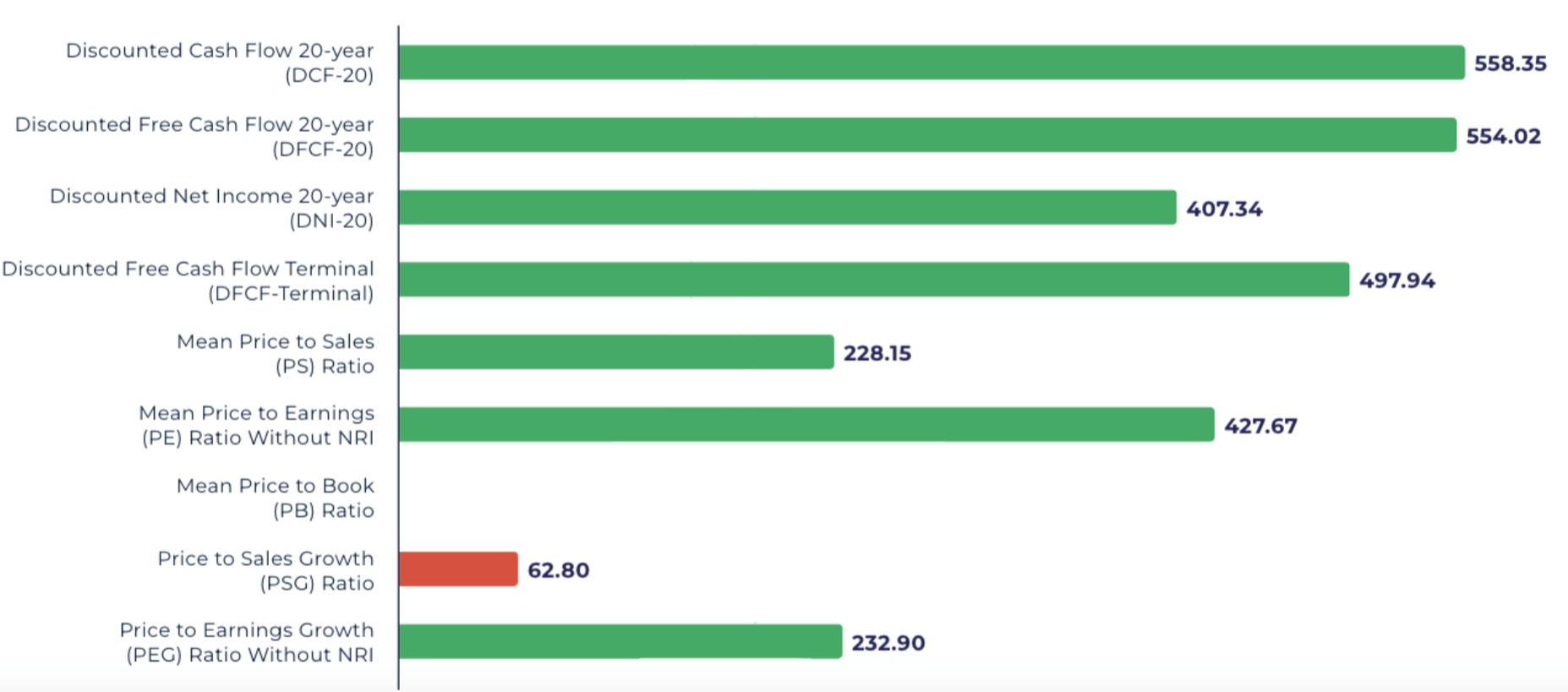
BKNG Intrinsic Value Across Nine Valuation Models - Powered by StockOracle™
The three cash flow models cluster at the top. That pattern fits a business that converts a large share of its revenue into cash and needs very little capital to grow.
In 2025, Booking turned $26.9 billion of revenue into $8.8 billion of operating income and $9.1 billion of free cash flow. Every margin below widened between 2023 and 2025, with operating margin up more than 5 percentage points .
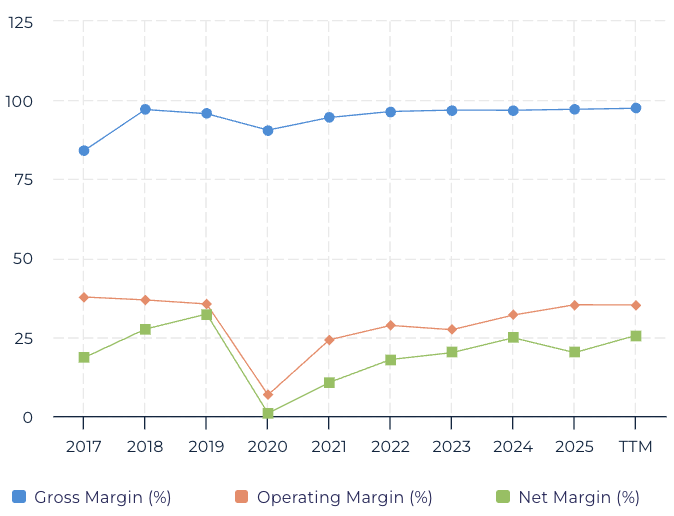
BKNG Margin Chart Powered by StockOracle™
The ratio-based models sit lower, and the PSG model lands far below the rest. PSG compares price with revenue growth, so a year of slower top-line growth pulls it down sharply, even when cash generation stays strong.
The Price to Book model shows no value because Booking reported a total stockholders' deficit of $10.8 billion as of June 30, 2026. Years of buybacks have pushed book equity below zero, so a book value multiple has nothing to anchor to. For an asset-light platform like Booking, cash flow is the more useful measure.
BKNG Financial Performance
Revenue Growth
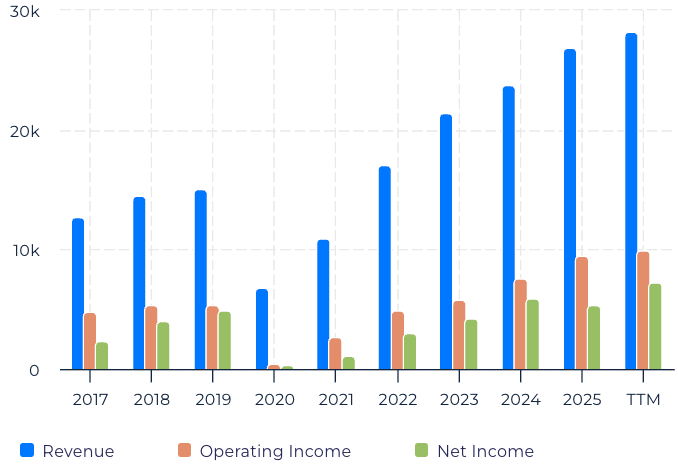
BKNG Revenue Trend Powered by StockOracle™
Booking grew revenue 13% to $26.9 billion in 2025, as gross bookings climbed 12% to $186.1 billion. Growth slowed in 2026 as the Middle East conflict weighed on travel to a high-value region, yet Q2 revenue still rose 8% to $7.4 billion.
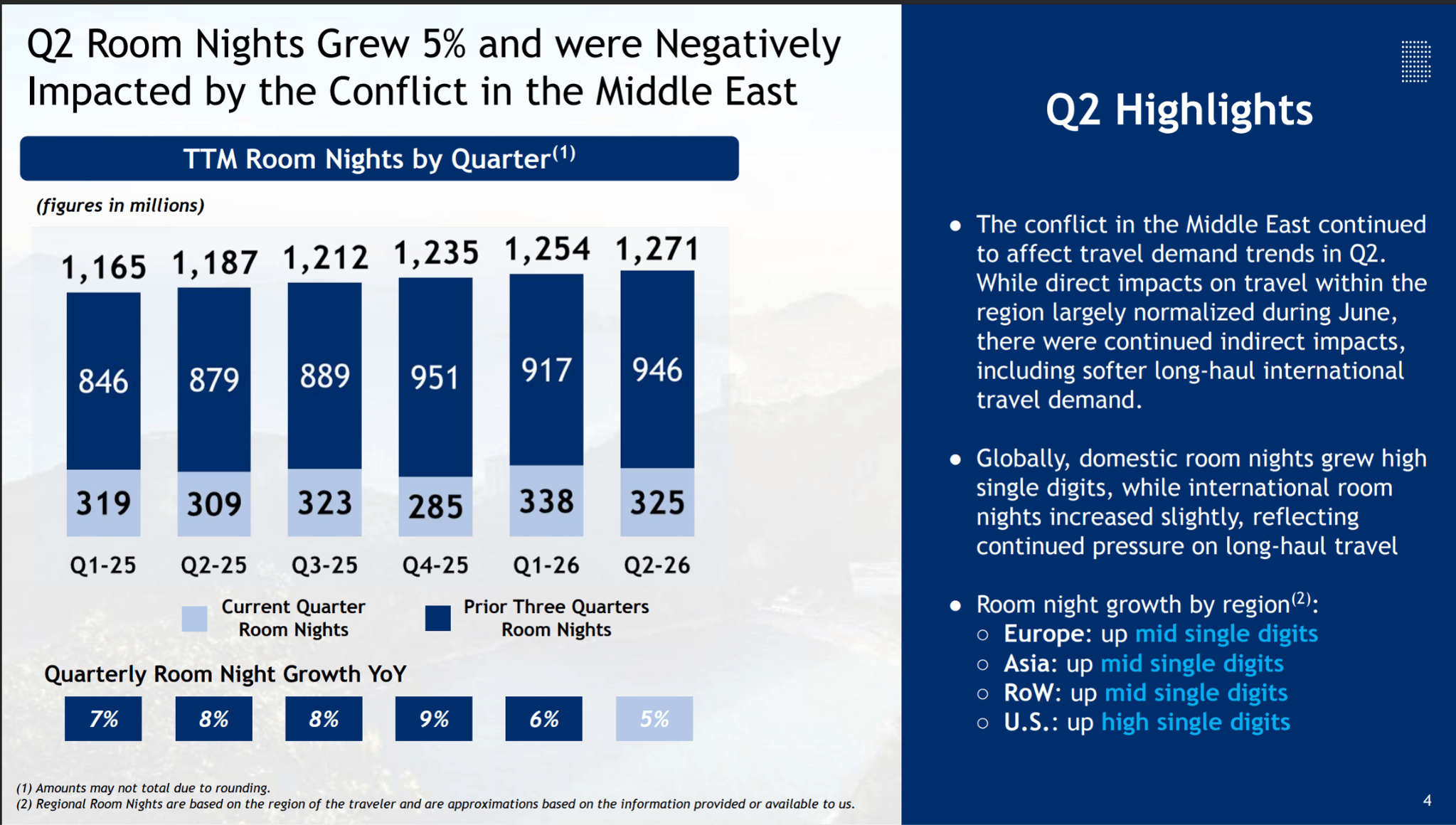
BKNG Trailing Twelve-Month Room Nights by Quarter. Source: Booking Holdings Q2 2026 Earnings Presentation, slide 4.
The more telling detail is underneath. Adjusted EPS grew 15% in Q2, nearly twice the pace of revenue, which points to a business that keeps more of each new dollar as it scales.
BKNG Free Cash Flow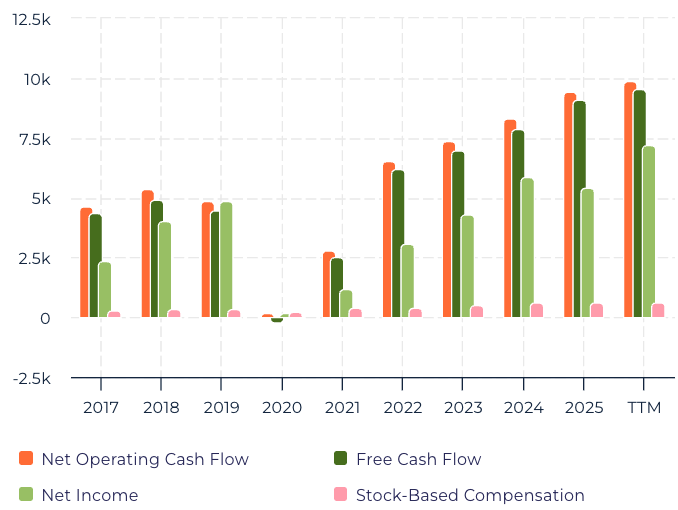
Operating Cash Flow and Free Cash Flow Chart Powered by StockOracle™
Topline growth is the headline. Free cash flow is the receipt. It is the cash left after the business pays for everything it needs to run and grow.
Booking produced $9.1 billion in free cash flow in 2025, up 15%. That works out to roughly 34 cents of real cash for every dollar of revenue, and the first half of 2026 added another $6.75 billion, up 7%.
Capital spending was just $183 million in the first six months of 2026. Booking runs a marketplace, not a hotel chain, so it collects a fee on each stay without owning the rooms. Since every DCF model starts from this cash, it is the number that drives BKNG intrinsic value most.
BKNG Shareholder Returns
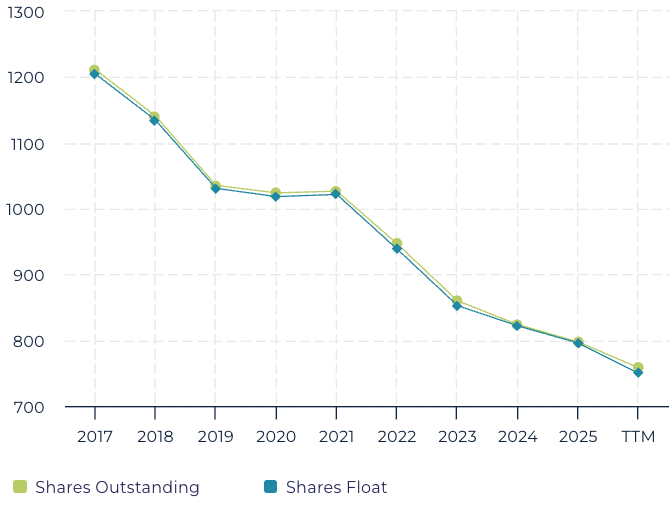
Shares Outstanding and Shares Float Chart Powered by StockOracle™
Booking repurchased $7.8 billion of stock in the first half of 2026 alone, more than the $6.4 billion it bought back in all of 2025, and still has $14.5 billion of authorization remaining. Each remaining share now owns a slightly larger piece of the company, with diluted shares at about 770 million in Q2 2026.
BKNG Stock Split 2026: Does It Change Intrinsic Value?
Booking completed a 25-for-1 forward stock split in April 2026. Shareholders of record on March 6 received 24 additional shares for every share held, and split-adjusted trading began on April 6, 2026. A share that closed at $4,117.51 on March 30 became roughly $165 after the split.
A stock split changes the price tag, not the value. Cutting a pizza into 25 slices instead of one leaves the same amount of pizza on the table.
That is why every per-share figure in this article, from the StockOracle™ models to EPS and dividends, is on a post-split basis.
|
BKNG split detail |
Date or figure |
|---|---|
|
Split ratio |
25-for-1 |
|
Record date |
March 6, 2026 |
|
Distribution date |
April 2, 2026 |
|
Split-adjusted trading began |
April 6, 2026 |
BKNG Dividend: Small Yield, Big Buybacks
Booking pays a quarterly dividend of $0.42 per share on a post-split basis, which equals $10.50 before the split and marks a 9.4% increase from 2025. The company only began paying dividends in 2024, so this is a young and growing payout.
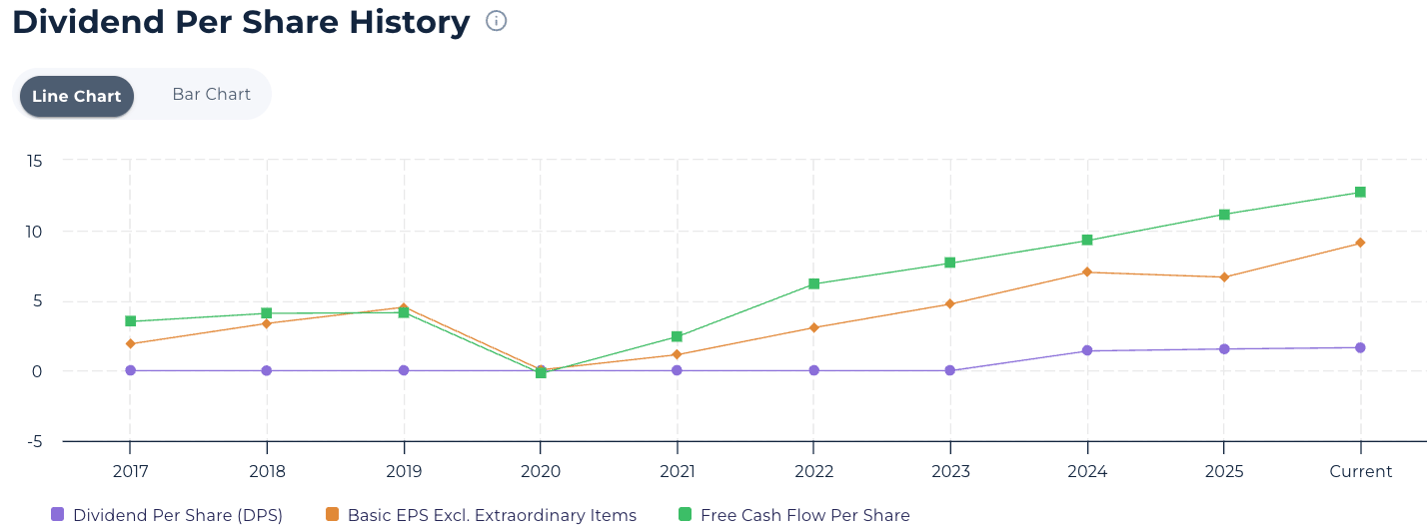
Dividend Per Share History Powered by StockOracle™
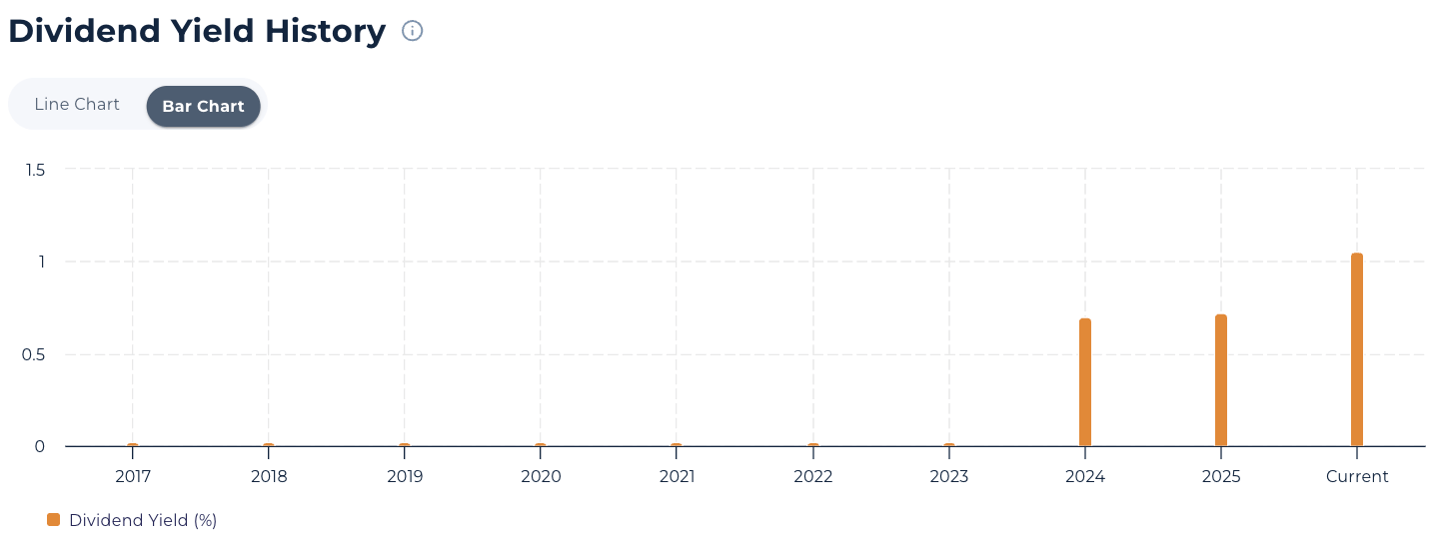
Dividend Yield History Chart Powered by StockOracle™
Buybacks do the heavier lifting: in 2025, Booking paid $1.2 billion in dividends but spent $6.4 billion repurchasing shares.
For income-focused investors, the dividend is a bonus. For long-term investors, the buyback engine is what quietly lifts free cash flow per share.
Growth Catalysts Behind BKNG's Future Cash Flow
Cost Discipline: The Transformation Program
- Expected annual run-rate savings raised to about $650 million, up from about $550 million
- Savings targeted by the end of 2027
- Q2 2026 adjusted EBITDA margin reached 36.0%
- Management guides to low to mid-teens adjusted EPS growth for full-year 2026
When savings flow straight to the bottom line, free cash flow can grow faster than revenue. That gap is what lifts intrinsic value even in a slower travel year.
AI: From Threat to Tool
- Booking unveiled Vayo, a Seattle-based AI travel agent, on October 14, 2026, with a planned investment of up to $100 million
- Vayo opened a free private beta waitlist, starting with restaurant reservations, with flight and hotel booking to follow
- Booking.com is testing an AI-powered discovery experience for the early trip-inspiration stage
- Management reports customer service cost per booking falling at a double-digit rate
The market fears AI agents will bypass online travel agencies. Booking's response is to build its own agent and use AI to cut service costs, which makes the near-term growth estimates look more plausible if adoption follows.
BKNG Economic Moat
Booking is embedded in nearly every step of a trip:
- Booking.com for hotels, homes and apartments worldwide
- Agoda for travelers across Asia
- Priceline for deal-focused U.S. travelers
- KAYAK for price comparison across flights, hotels and cars
- OpenTable for restaurant reservations
- Vayo for AI-led trip management
The traffic and repeat guests flow through the Booking.com platform, so few properties can afford to walk away.
However, rivals still carry real advantages.
Google owns the search page where many trips begin, Airbnb has a brand built around unique stays and a loyal host community, and Expedia holds a strong position with U.S. travelers and corporate partners.
Booking has to defend its share against each of these, and its scale of property supply and repeat bookings is what protects its pricing power and recurring revenue.
Is BKNG a Good Stock to Buy?
Whether BKNG is a good stock to buy depends on your time horizon, risk tolerance and which growth path you believe in.
Intrinsic value gives you a framework for that decision rather than a yes or no.
What supports the long-term case:
- Free cash flow of about 34 cents per revenue dollar, with minimal capital spending.
For investors, this means most of the cash Booking earns is free to be returned to shareholders or redeployed into new growth, rather than tied up in maintaining the business
- Record buybacks steadily shrinking the share count
- A growing dividend, raised 9.4% in 2026
- Management guiding to low to mid-teens adjusted EPS growth for 2026
What could weigh on it:
- The Middle East conflict cut room night growth by about 2 percentage points in Q1 2026, and Q3 guidance calls for revenue growth of only 4% to 6%
- AI agents from larger technology companies could change how travelers search and book
- Booking is designated a gatekeeper under the EU's Digital Markets Act, which limits some commercial practices in its largest market
- Currency swings can move reported results, since almost 90% of revenue comes from outside the U.S.
The November 3 earnings release will show whether bookings recovered in the second half as management expected. That data point matters more for intrinsic value than the share price reaction on the day.

Final Thoughts on Booking Holdings' Intrinsic Value
- StockOracle™ cash flow models estimate BKNG intrinsic value between $497.94 and $558.35 per share
- Free cash flow reached $9.1 billion in 2025 and keeps growing in 2026
- Buybacks of $7.8 billion in H1 2026 boost each share's claim on future cash
- The 25-for-1 split changed the share price, not the value of the business
- Vayo and AI-driven cost savings give Booking its own answer to the AI disruption story
Sentiment around Booking is cautious, with travel disruption and AI fears dominating the headlines. The fundamentals tell a steadier story: a capital-light platform that turns a large share of every booking into cash.
If Booking keeps compounding free cash flow and shrinking its share count, its intrinsic value could trend higher over time.