Type a sentence into a chatbot today and, within seconds, you can get a polished image, a logo or a short video clip. For a company that has spent four decades selling the tools creatives use to make exactly those things, that should sound like a nightmare.
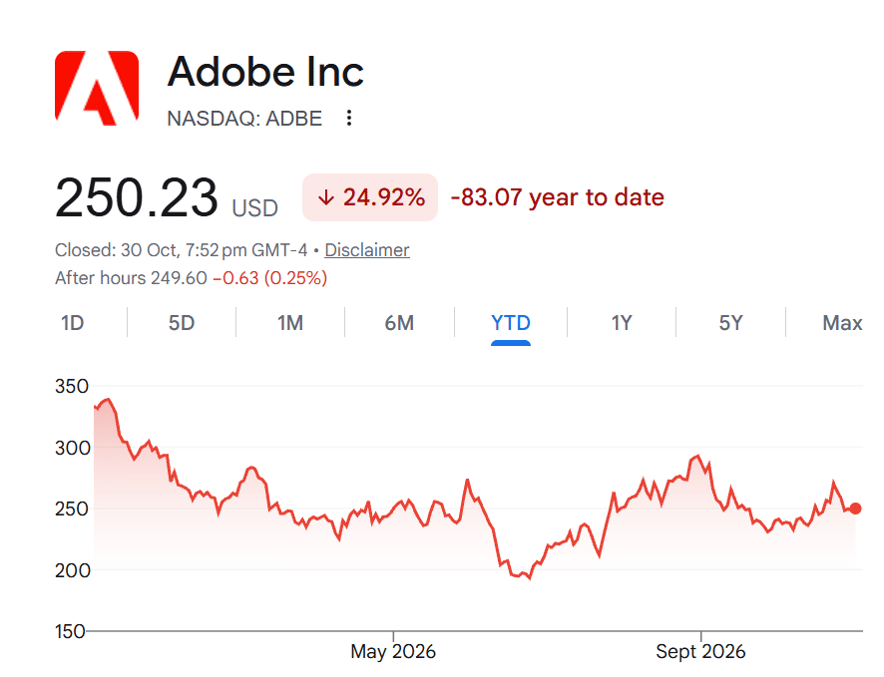
Wall Street spent much of 2026 treating Adobe as one of generative AI's first casualties. Shares slid to a 52-week low of $190.12 in June, and even after a rebound the stock closed at $249.76 on October 28, more than 60% below its late-2021 high.
Yet inside the same company, does AI actually look like a threat?. Adobe's AI-first annual recurring revenue (ARR) now tops $650 million, up more than 150% year over year, alongside record quarterly revenue of $6.76 billion.
So is the market pricing in the AI killer or the AI winner? To answer that, we need to look past the headlines and estimate the Adobe intrinsic value based on the cash the business actually produces.
What Does Adobe Do to Make Money?
ADBE Historical Operating Revenue by Segment Powered by StockOracle™
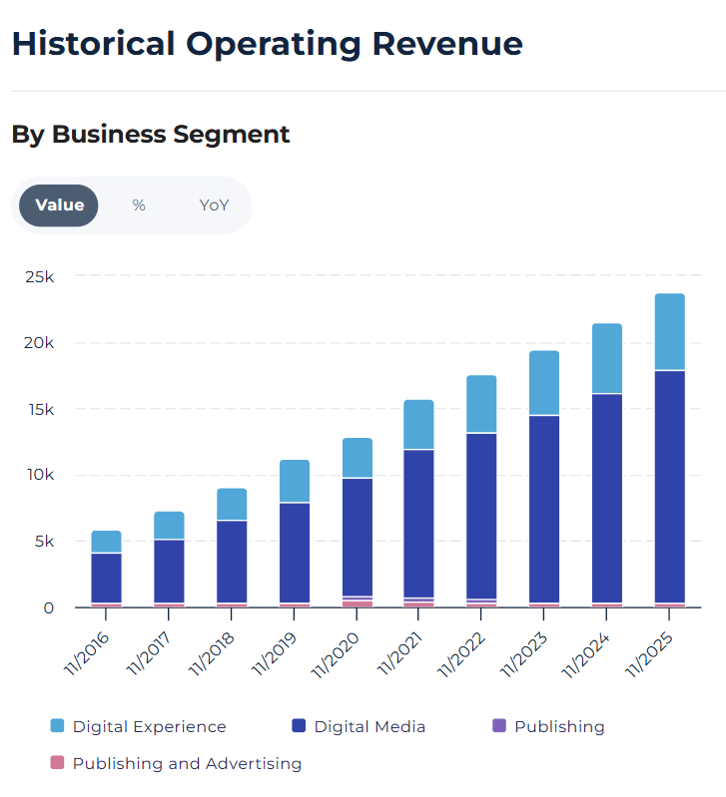
The chart splits Adobe's revenue into the business segments reported by the company over the years.
- Digital Media:
Creative Cloud and Document Cloud, including Photoshop, Illustrator, Premiere Pro, Lightroom, Express, Firefly, Acrobat and Acrobat Sign. This is Adobe's largest business by far.
- Digital Experience:
Adobe Experience Cloud, the software large companies use to understand customers and run marketing campaigns, such as Adobe Analytics, Experience Manager, Marketo Engage, Workfront and Commerce.
- Publishing:
Adobe's older legacy products, such as eLearning tools, technical document publishing, web conferencing, forms and high-end printing technology.
- Publishing and Advertising:
Created in fiscal 2020, when Adobe combined the Publishing segment with Advertising Cloud, which moved over from Digital Experience.
It replaced the standalone Publishing segment and remains a small slice of revenue.
It sells most of these as subscriptions through Creative Cloud and Document Cloud, and helps large companies run their digital marketing through Adobe Experience Cloud.
If you have ever edited a photo, signed a PDF or scrolled past a slick brand campaign, there is a good chance Adobe software played a part.
What Is the Adobe Intrinsic Value in 2026?
Intrinsic value is an estimate of what a business is truly worth, based on the cash it can generate over its lifetime, discounted back to today. Think of it as the fair price for a money-making machine if you knew roughly how much cash it would hand you each year.
When a stock trades below a conservative intrinsic value estimate, investors call the gap a margin of safety: a cushion in case the assumptions turn out too optimistic.
ADBE Intrinsic Value Across 9 Valuation Methods: What do the StockOracle™ Models Show
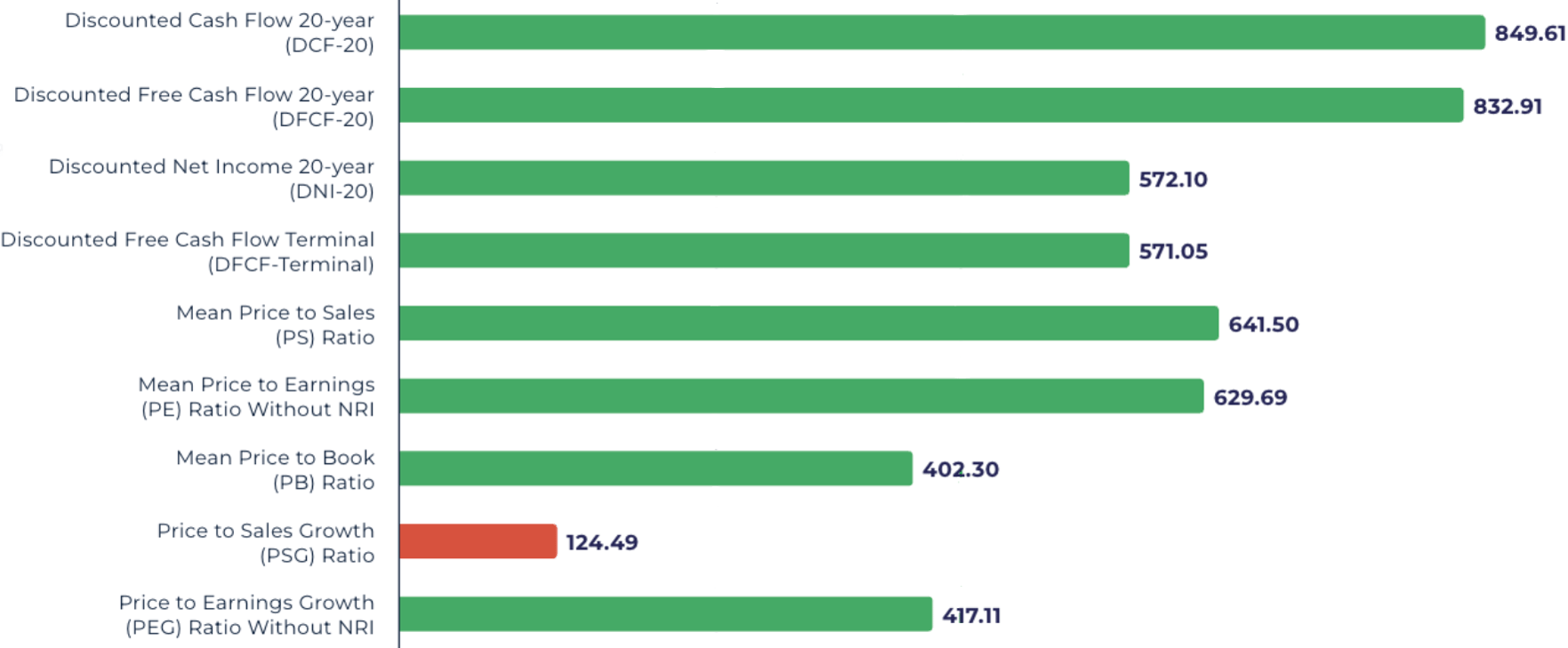
ADBE intrinsic value across 9 valuation methods as of October 30, 2026 - Powered by StockOracle™
Eight of the nine methods place the ADBE intrinsic value above $400 per share. The two 20-year cash flow models sit highest, and the reasons are worth unpacking.
Why the 20-Year DCF Figures Sit So High
The DCF-20 ($849.61) and DFCF-20 ($832.91) estimates project Adobe's cash flow 20 years forward, and a few features of the business push them above the other methods.
We bring our focus to DFCF-20, which values Adobe on its free cash flow: the cash left after the business pays for its operations and investments, and the money that can potentially flow back to shareholders through buybacks or dividends.
DCF-20 uses operating cash flow, which ignores capital spending.
The two land close together for Adobe because its capex is small, but for capital-heavy businesses the gap can be large, so free cash flow is the more consistent measure.
Here are a few main points :
- Adobe's free cash flow grew roughly 9.5% a year from fiscal 2021 to the latest 12 months, so these estimates assumes a stronger growth path.
- Cash flow runs ahead of profit. Trailing 12-month net income is $7.28 billion, about 30% below free cash flow, partly because non-cash costs such as stock-based compensation are added back to cash flow. That gap lines up closely with DNI-20 ($572.10) sitting about a third below DCF-20.
- A shrinking share count. Buybacks spread the same cash across fewer shares, lifting every per-share estimate.
The 20-year models here show what Adobe could be worth if its cash engine keeps compounding at a healthy pace, which is exactly the assumption investors must test.
Why the PSG Ratio Sits Far Below the Rest
One bar stands out: the Price to Sales Growth (PSG) method returns just $124.49.
Unlike the mean P/S, P/E and P/B methods, which lean on the multiples investors have paid in the past, the PSG approach links the sales multiple to how fast sales are projected to grow. That makes it highly sensitive to the growth assumption behind it.
Adobe's revenue grew about 23% in fiscal 2021 but 11% in fiscal 2025, and that deceleration likely carries most of the gap.
Two other factors likely widen it. Sales growth gets no lift from buybacks, while earnings per share does: Adobe's diluted share count fell from 424 million to 395 million in a year, which helps explain why the PEG estimate lands more than three times higher. The PSG lens also treats every revenue dollar alike, even though Adobe turns roughly 40 cents of each sales dollar into free cash flow. In short, the PSG figure reflects a growth-only lens rather than a verdict on profitability.
ADBE DCF Inputs: Revenue and Free Cash Flow
Revenue Growth
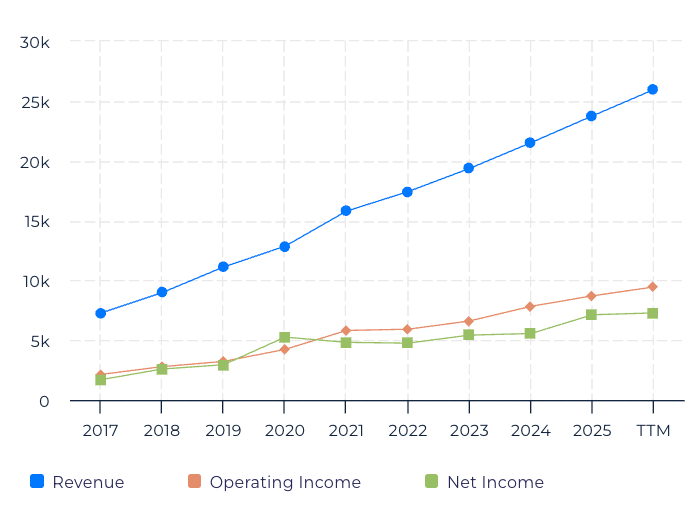
Adobe Revenue Trend Powered by StockOracle™
Adobe's revenue climbed from $15.79 billion in fiscal 2021 to a record $23.77 billion in fiscal 2025, and management now targets $26.58 billion to $26.63 billion for fiscal 2026. Subscriptions make up about 97% of revenue, so most of each year's sales renew like a utility bill rather than restarting from zero.
Adobe’s interim CFO pointed to "continued strength in retention across the enterprise customer base" in fiscal Q3 2026.
Adobe also holds $22.16 billion in remaining performance obligations, with 67%, or roughly $14.8 billion, expected within the next 12 months. That is equal to more than half of its full-year fiscal 2026 revenue target, already under contract.
Growth in fiscal Q3 2026 came from both ends of the customer base: Business Professionals and Consumers grew 16%, while Creative and Marketing Professionals grew 13%. Part of this year's lift also comes from SEMrush, which Adobe acquired for $1.87 billion in April 2026.
Adobe (ADBE) Free Cash Flow
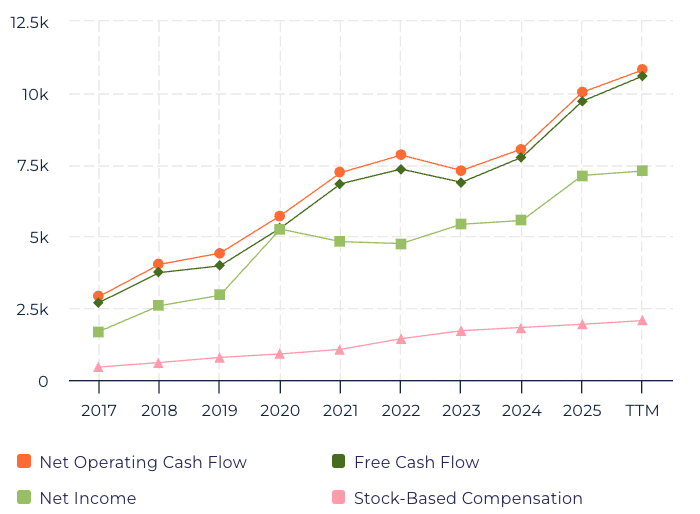
ADBE Operating Cash Flow and Free Cash Flow Chart Powered by StockOracle™
Adobe generated $9.85 billion of free cash flow in fiscal 2025, a margin of about 41%. That works out to roughly 41 cents of real cash for every dollar of revenue, and trailing 12-month free cash flow reached $10.59 billion by August 2026.
Because a DCF model values a company on its future cash, this is the number that carries the most weight in any ADBE DCF. A business that consistently keeps 40 cents of each sales dollar gives the model a high-quality starting point.
Shareholder Returns
Adobe spent $11.76 billion on buybacks in fiscal 2025 and another $6.82 billion in the first nine months of fiscal 2026, cutting diluted shares from 424 million to 395 million in a year. Each remaining share now owns a slightly larger piece of the company, which lifts the per-share intrinsic value even when total profits stay flat.
Growth Catalysts Behind Adobe

AI Monetization
- AI-first ending ARR (annual recurring revenue) ,which tracks yearly subscription revenue from Adobe’s standalone AI products, is above $650 million, up more than 150% year over year
- Ending ARR across Firefly apps and credit packs up 40% quarter over quarter
- Acrobat AI Assistant monthly active users doubled quarter over quarter
- Monthly active users across Adobe's creativity and productivity apps passed 1 billion, up more than 20%
AI-first ARR is still only about 2% of Adobe's $27.5 billion total ARR. The near-term growth estimates start to look more plausible when investors see AI features turning into paid usage rather than just free add-ons.
Contracted Revenue and Leadership
- Remaining performance obligations (RPO) of $22.16 billion, with 67% expected within 12 months
- Fiscal 2026 revenue target raised to $26.576 billion to $26.626 billion
- Anil Chakravarthy becomes CEO on December 1, 2026, with Shantanu Narayen moving to Executive Chair
RPO works like a restaurant's confirmed bookings with the revenue already signed for, waiting to be served. That visibility narrows the range of outcomes a DCF has to account for, while the CEO handover adds an execution question to watch.

The Bear Case: Risks to Adobe and why is the stock down?
A bull case is only as strong as the bear case it survives. These are the risks that could pull the Adobe bull story down.
1. AI Could Shrink the Market for Creative Software
Tools from OpenAI and Midjourney let anyone generate images in seconds, and investors worry fewer people will need professional software.
That fear left Adobe shares down 26% year to date by mid-February 2026, and Citi cut its price target to $253 in April. If AI lowers the value of creative skills, Adobe could face pressure on both seat counts and pricing.
2. Growth Is Slowing, and Part of It Is Acquired
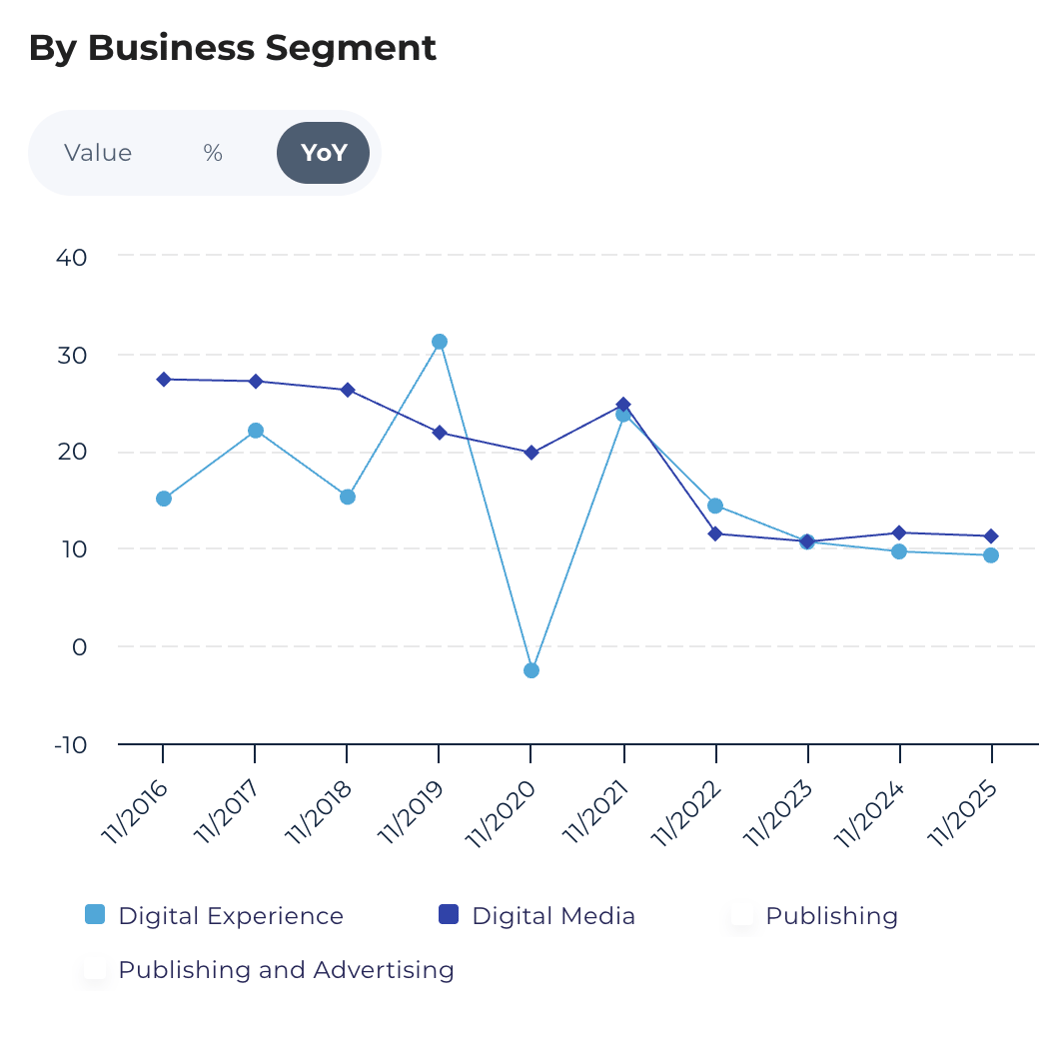
Revenue growth has cooled from 23% in fiscal 2021 to 11% in fiscal 2025, and Adobe's ending ARR growth target for fiscal 2026 is 10.2%.
SEMRush also added about $480 million of ARR when it joined, so organic growth runs below the headline 13%. Any DCF that assumes double-digit growth for years needs that pace to hold.
3. AI Revenue Is Still Small
AI-first ARR (annual recurring revenue) is only about 2% of total ARR.
Adobe is also leaning into free entry-level plans to attract new users, a shift expected to weigh on near-term ARR growth. Fast growth from a small base shows demand, but not yet scale.
4. Profits Are Lagging Revenue
In fiscal Q3 2026, revenue grew 13% but GAAP net income grew only 3%, and gross margin slipped about 0.6 percentage points to 88.7%.
Free cash flow also looks stronger than net income partly because stock-based compensation is added back.
That cost is real for shareholders, since part of each buyback goes toward offsetting shares issued to employees.
5. Leadership Turnover
Shantanu Narayen, CEO since 2007, hands the role to Anil Chakravarthy on December 1, and CFO Dan Durn left in June 2026, with an interim CFO in place.
New leadership could reset priorities, targets or capital allocation.
6. Acquisition and Legal Risk
Goodwill on Adobe's balance sheet rose to about $14.0 billion after the Semrush deal, and Adobe recorded a $70 million goodwill impairment in the first nine months of fiscal 2026.
Adobe also faces a class-action lawsuit alleging it used pirated books to train AI models, with the outcome still uncertain.
Adobe's Economic Moat
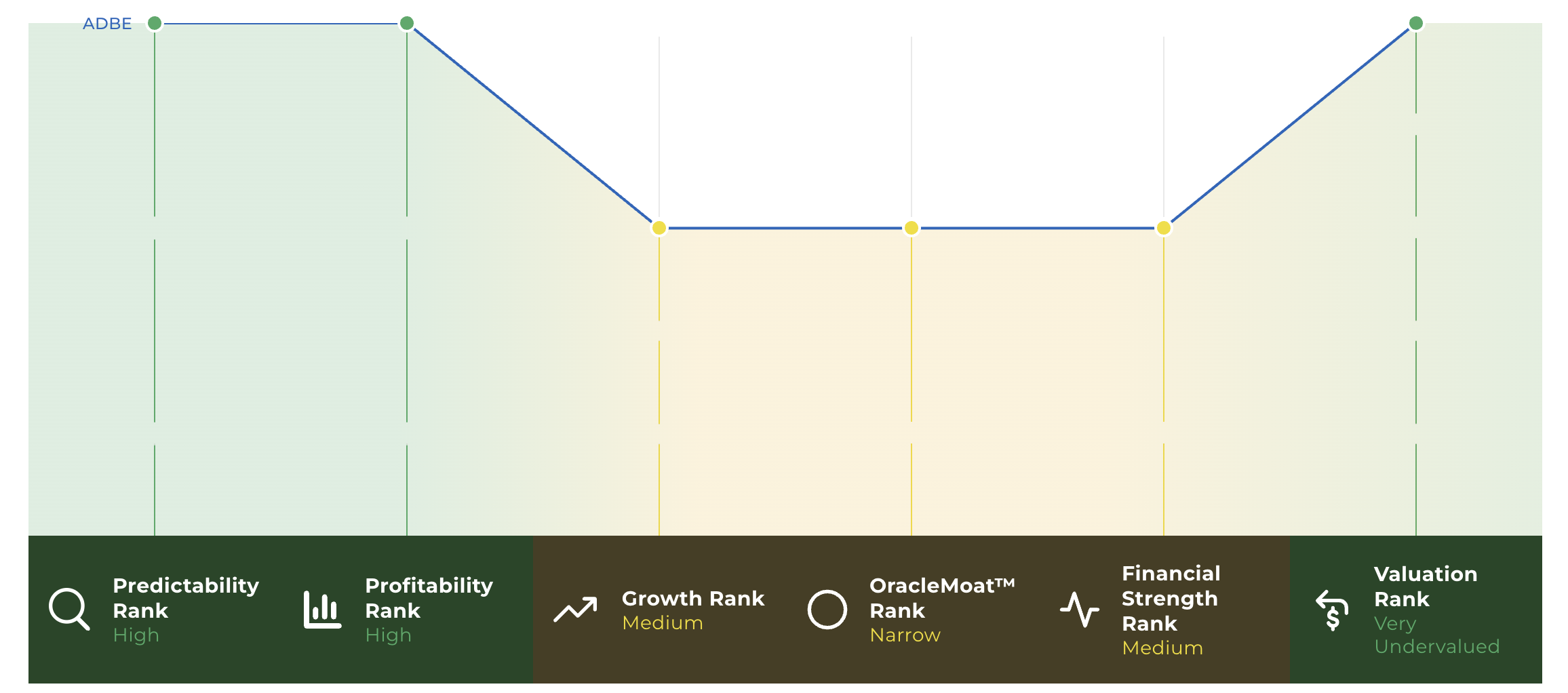
Adobe sits inside workflows used by professionals every day and yet it achieves a narrow moat by OracleMoat™:
- Photoshop for image editing and retouching
- Premiere Pro for video editing
- Illustrator for vector design and branding
- Acrobat, with more than 400 billion PDFs opened each year
- Adobe Experience Cloud for enterprise marketing and customer data
- Semrush for search and AI visibility tracking
Switching away is like asking a newsroom to change languages mid-deadline: files, templates, plug-ins, trained staff and client handoffs all run on the same format. However, the competition carries real embedded advantages.
Canva reaches non-designers with a free, browser-first editor and a huge template library.
Figma owns real-time collaborative product design, after Adobe's planned acquisition was abandoned in 2023. AI model providers also bundle image generation into chat assistants people already open daily.
Adobe has to defend its professional workflows against each of these, which is why it now connects its tools to platforms like ChatGPT, Claude, Microsoft Copilot and Perplexity rather than competing with them head-on.
What the moat protects is pricing power with professionals, recurring subscription revenue and long enterprise relationships.
Final Thoughts on Adobe Intrinsic Value
- Record revenue of $6.76 billion in fiscal Q3 2026, up 13%
- Free cash flow margins around 40%
- $22.16 billion in contracted future revenue (RPO)
- AI-first ARR above $650 million and growing more than 150%
- Diluted share count down about 7% in a year
The market's AI anxiety is real, and the CEO handover adds a fresh variable.
Even so, Adobe's fundamentals point to a business that still converts a large share of every sales dollar into cash. If AI features keep turning into paid usage and cash generation holds near current levels, the Adobe intrinsic value could trend higher from here.