GuruFocus is one of the most complete and longest standing value investing platforms around. But when the renewal notice arrives, you might realised you have used only a fraction of the features, or you just want a cleaner way to answer one question: what does this business do? and how much is it worth?
In this guide, we compare five GuruFocus alternatives.
We run the same stock, Meta Platforms (META), through each tool, so you can see how differently they answer the same question.
Why investors look for a GuruFocus alternative
Most people who leave GuruFocus are not unhappy with the data provided. They typically leave for one of six practical reasons.
- Price. GuruFocus's site currently shows its Premium trial converting at $499 a year. Competitors quote higher figures for full global coverage: Stock Rover cites $1,273 a year for Premium Plus, while TIKR cites $2,014 a year for global data. Check the live pricing page before you decide.
- Regional add-ons. Coverage beyond the US costs extra. That matters if you hold SGX, Hong Kong or other stocks alongside US names. Spreading yourself into different markets will make your plan slightly more expensive.
- Interface density. Most also describe GuruFocus as hard to navigate. With hundreds of metrics per stock, finding the few that matter takes practice. GuruFocus tends to reward already savvy investors who know what they are looking for.
- Billing flexibility. Plans are billed yearly. Some investors prefer tools with monthly options so they can test before committing.
- The limits of guru cloning. A guru's trades reach you through quarterly filings, weeks after they happen. As one forum member put it, a small investor learns about a position only after it is bought, and is late again when it is sold. Guru tracking works best as an idea source, not a way to copy strategy. Sometimes a Guru’s trade may end up becoming noise instead.
- More data than you need. Some investors want a clear read on value and quality, not 30 years of every line item.
Many long-time users say that GuruFocus is worth the money and it's true if you are able to utilize every aspect of the platform's features. If you mine deep historical history data every day, staying may be the right call. The alternatives below suit investors whose needs are narrower, or different.
What draws investors to GuruFocus in the first place
Before switching, it helps to know what you would be giving up if you are a GuruFocus user. GuruFocus earns its following with five main things.
- GF Value. GuruFocus's own estimate of intrinsic value, shown against the share price on almost every stock page. GF value gives investors a good starting point on what the business is worth.
- Deep financial history. GuruFocus shows 30-year financials, so you can study a business across several full economic cycles.
- Guru portfolio tracking. The feature the brand was named after. You can see what well-known investors bought and sold, based on their regulatory filings.
- The All-in-One Screener and GF Score. 500+ metrics in their filters, plus a 0 to 100 score that shows profitability, growth, financial strength, momentum and valuation into one number.
- Data people trust. Reviewers often praise its data accuracy and speed.
First, where the data comes from, and why it matters
Most investing platforms do not collect financial data themselves. They license it from a handful of institutional providers, then build their own metrics and valuations on top. Knowing the source tells you two things: how much to trust the raw numbers, and why two tools can sometimes disagree, especially on projected figures.
|
Platform |
Primary data source |
Markets covered |
|
GuruFocus |
FactSet |
Global; some regions are paid add-ons |
|
StockOracle™ |
FactSet |
US-listed stocks only (currently) |
|
TIKR |
S&P Capital IQ |
Global on paid plans |
|
Stock Rover |
Morningstar |
Major North American exchanges |
|
Alpha Spread |
Not Stated |
Global ("100,000+ stocks" in its search) |
|
Koyfin |
S&P Capital IQ & Morningstar |
Global |
Three lessons follow from this table.
- Same data, different answers. GuruFocus and StockOracle™ both draw fundamentals from FactSet. If their intrinsic values for the same stock differ, the gap comes from the valuation models and estimations, not the inputs.
- Different data, different raw numbers. Providers tend to normalise statements differently: one-off items, segment adjustments and update timing vary.
- Coverage is a real trade-off. StockOracle™ and Stock Rover both focus on North American listings. If you need SGX and Hong Kong coverage, a global tool will serve you better for those markets.
Our rule of thumb: before trusting any single figure, check the provider and the methodology page. For major decisions, cross-check key numbers against the company's own filings.
GuruFocus alternatives at a glance
Each alternative replaces a different part of GuruFocus, so the right pick depends on which part you actually use. Prices and features as of October 2026; confirm on each vendor's site.
|
Platform |
Best for |
Data source |
Markets |
Intrinsic value tool |
Guru tracking |
Starting price |
|
StockOracle™ |
Guided valuation with customisable metrics, moat read on US stocks and overview of US markets valuations |
FactSet |
US only |
OracleValue™ |
No |
Pro $270/year; Pro+ $365/year |
|
TIKR |
Guru tracking and global data at lower cost |
S&P Capital IQ |
Global (paid) |
Yes |
Free; Plus $24.95/mo; Pro $54.95/mo |
|
|
Stock Rover |
Deep screening plus portfolio reporting |
Morningstar |
North America |
Fair value and margin of safety |
Guru model portfolios |
$348 to $948/yr |
|
Alpha Spread |
Transparent DCF with bear, base and bull cases |
Not stated |
Global |
DCF and relative valuation |
No |
Free; paid from $144/yr |
|
Koyfin |
Charting, dashboards and analyst data |
S&P Capital IQ and Morningstar |
Plus $39/mo; Premium $79/mo |
The alternatives, compared hands-on
We ran the same three tasks on Meta in every tool: (A) find a valuation view, (B) build a quality-plus-value screen, and (C) see what a well-known investor holds. Where a tool cannot do a task, we say so.
Meta is used purely to demonstrate how these tools work. This is not a recommendation to buy or sell Meta or any security. Figures change daily.
1. StockOracle™: best for a guided, customisable valuation and Moat read on US stocks
Data and coverage: FactSet fundamentals; US-listed stocks only.
Similar to GuruFocus: an intrinsic value estimate (OracleValue™) and a quality lens (OracleMoat™). Like GuruFocus, it draws fundamentals from FactSet.
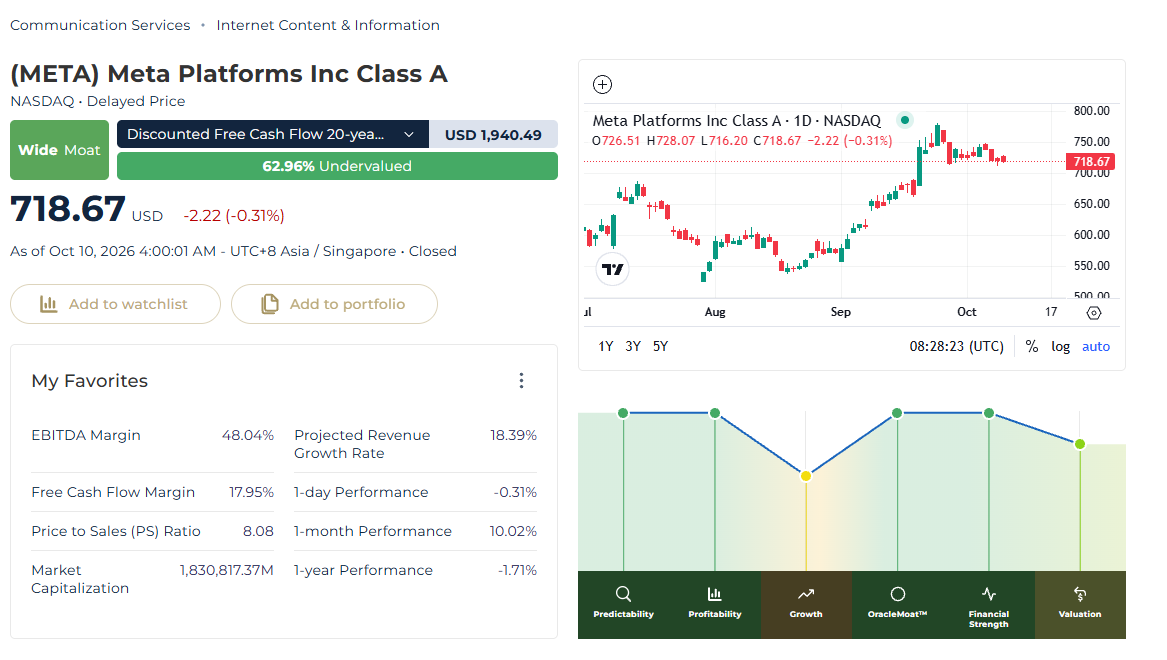
Design and user experience : OracleIQ immediately identifies a business strong and weak points. Meta is seen as a strong business with growth slightly lower as compared to high growth businesses. It also tells me how Meta makes their money.
Different from GuruFocus: instead of hundreds of metrics, it gives a structured read: value, moat, and an OracleIQ™ summary.
Its screener starts from nine curated screening ideas rather than a blank filter page.
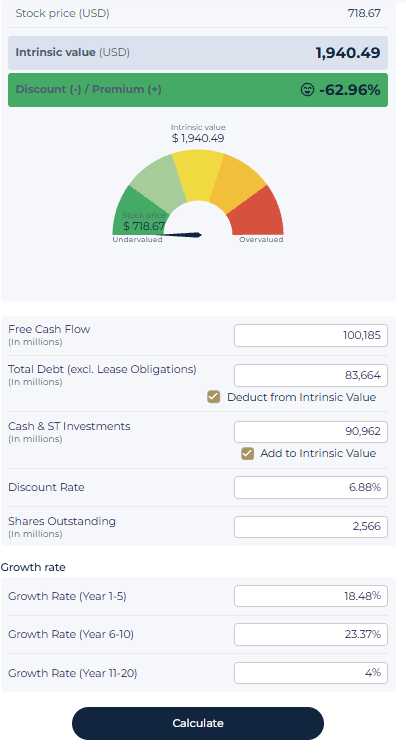
Individually, It also allows investors to adjust certain metrics like projected growth to estimate various intrinsic value outcomes. Providing a range of valuation based on individual investors' projections.
Trade-offs: no SGX, Bursa or Hong Kong coverage today.
2. TIKR: best for guru tracking and global data at a lower price
Data and coverage: professional-grade data from S&P Capital IQ; global coverage on paid plans
Design and user experience : Starts by showing news and updates with regards to Meta. Gives investors a look into what is happening in the market that is related to the stock. Customisable charts based on balance sheet, etc. Able to do your own analysis based on business/company metrics.
Similar to GuruFocus: tracks investing gurus, offers a customisable screener and detailed valuation data.
Different from GuruFocus: a more modern interface, Wall Street consensus estimates front and centre, and a free tier with US data.
3. Stock Rover: best for deep screening plus portfolio reporting
Data and coverage: Morningstar data under licence; North American exchanges only.
Design and User experience : Creates a sharable PDF for individual stocks in your portfolio. Historical data analysis and technical analysis as well. Includes macro and comparison with similar peers.
Similar to GuruFocus: computes a fair value and margin of safety for every stock in its universe, with screening on historical data.
Different from GuruFocus: stronger portfolio tracking and reporting; up to 20 years of history rather than 30.
Trade-offs: no coverage outside North America, the same limitation StockOracle™ has today.
4. Alpha Spread: best for a transparent DCF you can adjust
Data and coverage: data source not stated on the pages we checked; global coverage.
Similar to GuruFocus: an intrinsic value on every stock page, plus a screener.
Different from GuruFocus: shows bear, base and bull cases, spells out its growth and margin assumptions in plain English, and publishes a valuation backtest
Trade-offs: no guru tracking; less financial history than GuruFocus
5. Koyfin: best for charting, dashboards and analyst data
Data and coverage: Mix of S&P Capital IQ and Morningstar
Similar to GuruFocus: deep fundamentals and a screener.
Different from GuruFocus: built around customisable dashboards and comparative charts rather than a single valuation verdict.
How to use StockOracle™: a walkthrough with Meta
This walkthrough shows how investors would research Meta in StockOracle™, from first search to a screen. Meta is an example only, not a recommendation.
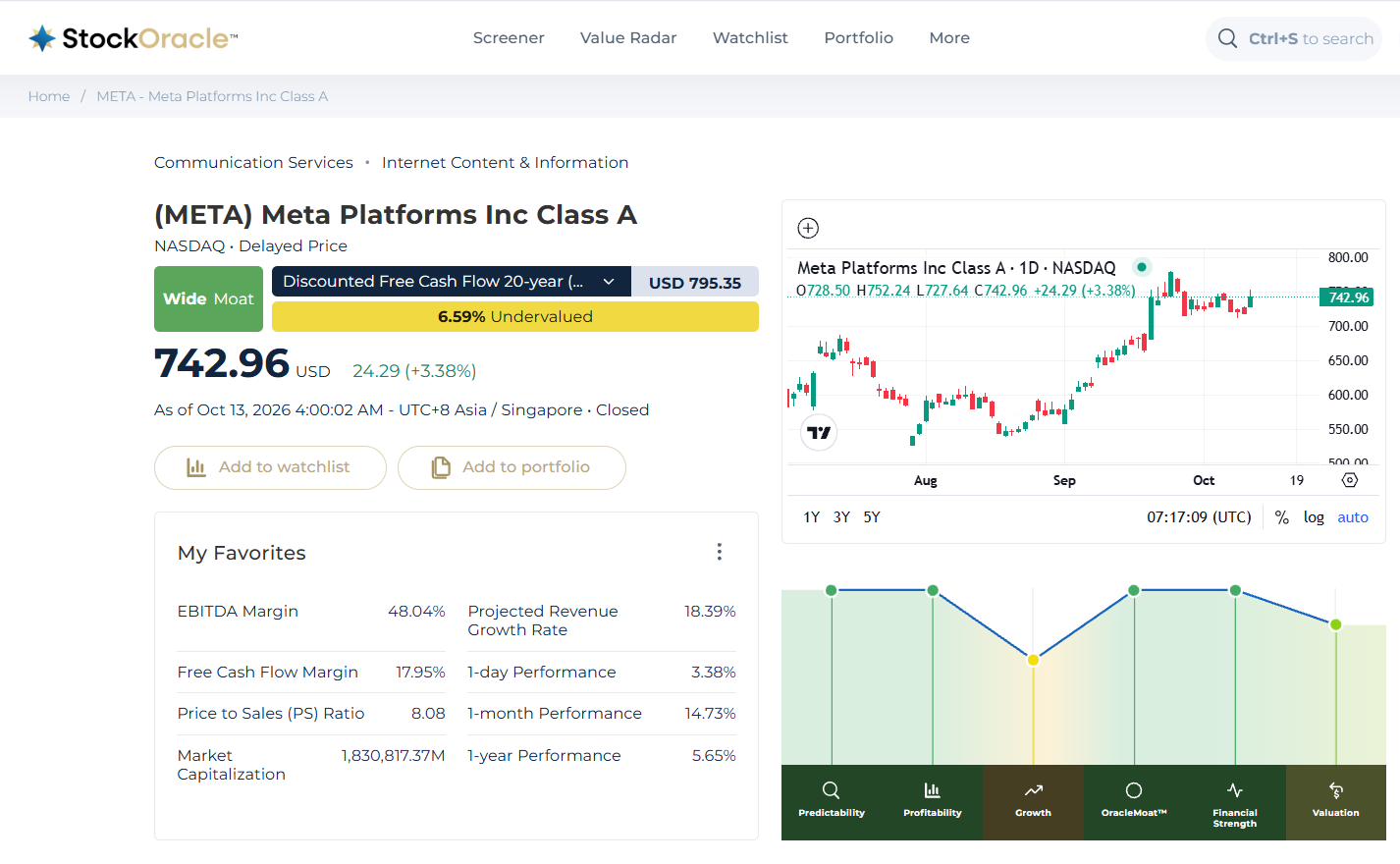
- Search META and open the stock page. The overview shows price, sector and the data date. Fundamentals come from FactSet.
- Read OracleValue™. Compare the intrinsic value estimate with the current price. The gap between them is a starting point for judging margin of safety, and it depends on the model's assumptions.
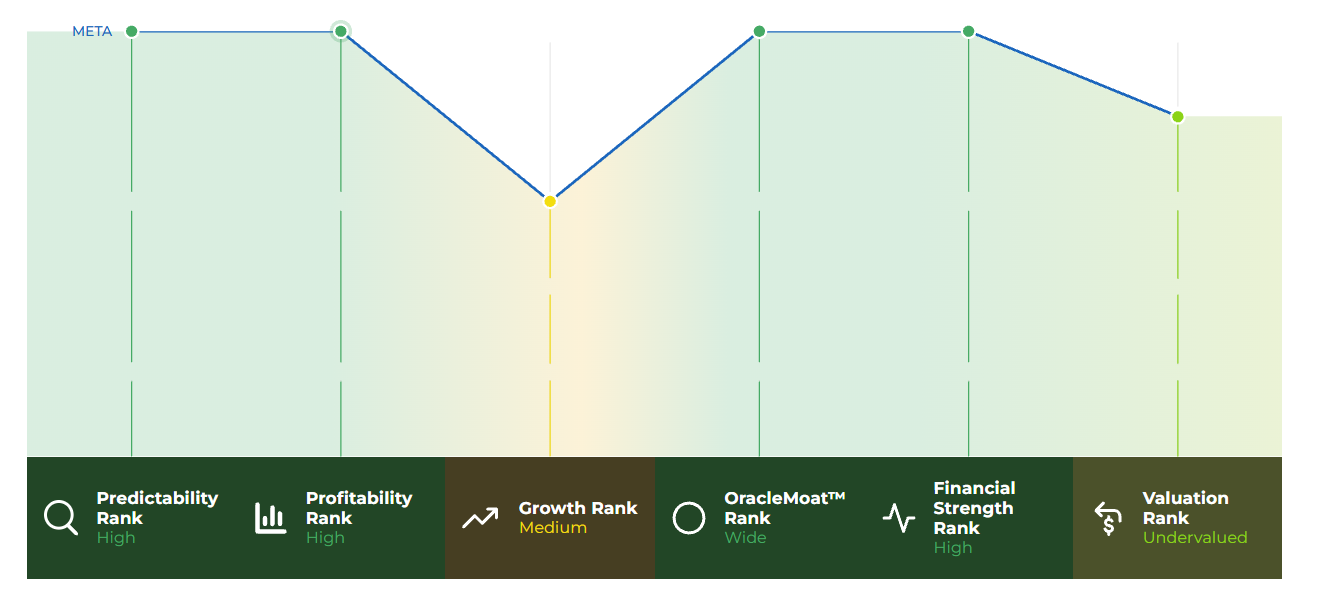
- Check OracleMoat™. Valuation without durability is half the picture. A wide moat makes long-range cash flow estimates more believable.
- Review the OracleIQ™ summary. Use it as a structured starting point for your own research, not a verdict.
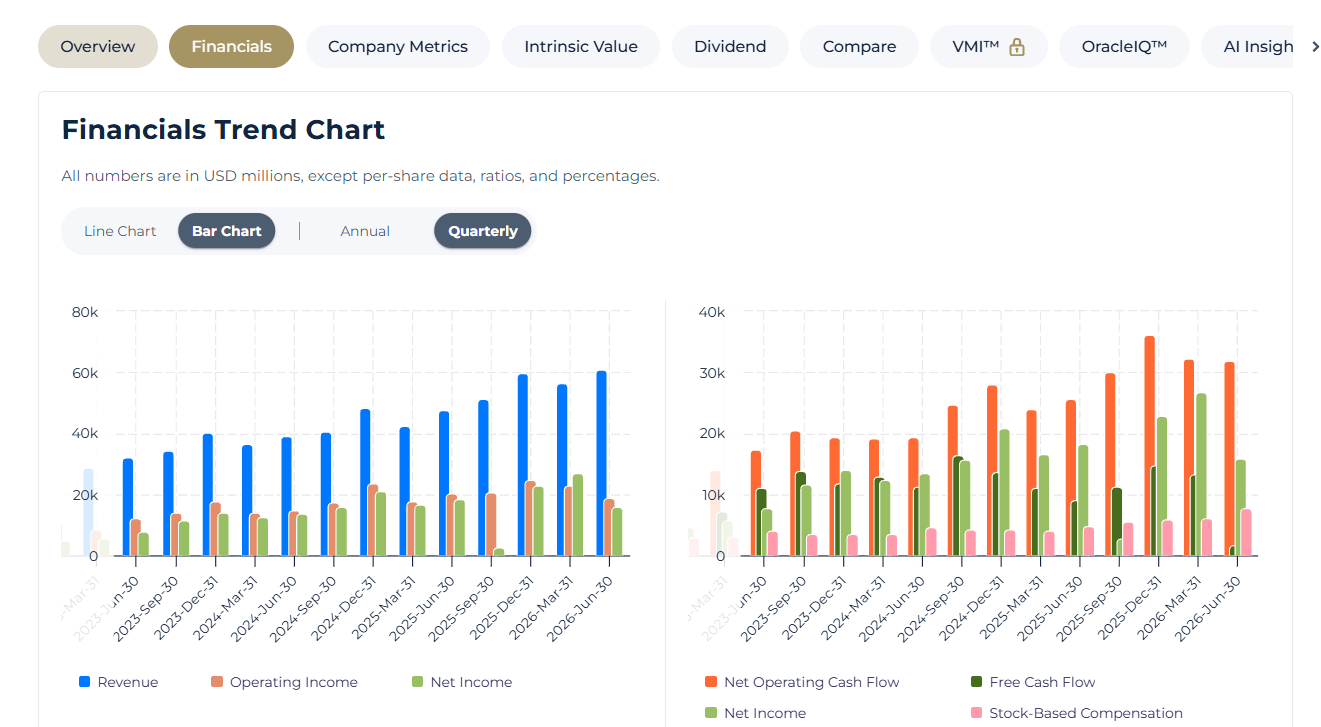
- Look at the history behind each OracleIQ segment. Scan revenue, margins and free cash flow over time. Identify the bear and bull case of the stock and make your own judgement in its projected growth rates.
Same task, different workflow
The biggest practical difference between these tools is how many steps it takes to get from a ticker to a decision-ready view. Here is how each one handled the same Meta tasks.
|
Task (Meta) |
GuruFocus |
StockOracle™ |
TIKR |
Stock Rover |
Alpha Spread |
Koyfin |
|
Where the valuation lives |
GF Value on the summary page |
OracleValue™ on the stock page |
NIL
|
NIL |
Intrinsic value at the top of the summary page |
NIL |
|
Assumptions visible? |
Partly; GF Value method is proprietary |
Visible and editable |
NIL | NIL |
Yes; growth and margin assumptions stated |
NIL |
|
Screen on the tool's own valuation? |
Yes |
Yes |
NIL | NIL | NIL | NIL |
|
Guru holdings |
Yes |
No |
Yes |
Guru model portfolios |
No |
NIL |
|
Data source |
FactSet |
FactSet |
S&P Capital IQ |
Morningstar |
Not stated |
NIL |
|
Learning curve |
Steep |
Gentle |
Moderate |
Steep |
Gentle |
NIL |
How to choose the right GuruFocus alternative
Start from the GuruFocus feature you rely on most, then match it.
|
If you mostly used GuruFocus for... |
Look at |
Why |
|
GF Value on US stocks |
StockOracle™ or Alpha Spread |
A clear intrinsic value read; Alpha Spread shows its assumptions, StockOracle™ adds a moat lens and a customisable assumption segment |
|
Guru tracking |
TIKR |
Guru tracking at a lower price; remember 13F data is delayed |
|
Screening plus portfolio reporting |
StockOracle™ or Stock Rover |
Deep screens and portfolio analytics, North America only |
|
SGX, Bursa or Hong Kong stocks |
TIKR or Alpha Spread |
Global coverage |
|
Charts and macro context |
Koyfin |
Dashboards and comparative charting |
Whichever platform you choose, start by running it on a company you already understand well, perhaps one you’ve followed for years, own, or simply know as a customer. You already have a sense of how that business makes money, what its margins have looked like, and what risks matter. That background knowledge turns the trial into a fair test of the platform.
As you work through it, pay attention to two things.
The first is how easily you can get to the data. Can you find revenue, free cash flow, margins, and debt levels within a few clicks, or are they buried across different tabs? Does the history go back far enough to show how the business performed through a full cycle? And do the figures match what you’d see in the company’s own filings? If the numbers on a company you know feel off or incomplete, that’s a signal worth noting before you rely on the platform for anything less familiar.
The second is how well the platform helps you build or challenge a thesis. A good tool doesn’t just display numbers; it helps you connect them.
Does it show you why a company looks undervalued or overvalued, and which assumptions drive that view? Can you see whether its strengths come from a durable competitive advantage or a one-off good year? If the platform’s conclusion on a business you understand lines up with your own reasoning, or surfaces something you hadn’t considered but can verify, that’s a good sign. If it contradicts what you know without a clear explanation, you’ve learned something about its limits.
Once a platform passes this test on familiar ground, you can use it with more confidence on stocks you’re researching for the first time.
Frequently asked questions
Is GuruFocus worth the money? For investors who use its deep history, global coverage and guru tracking every week, many say yes. If you mainly check one valuation figure on US stocks, a narrower tool may cover your needs for less.
Where does GuruFocus get its data? Its site footer states that fundamental company data is provided by FactSet, updated daily. StockOracle™ uses the same provider.
Why do sites show different intrinsic values for the same stock? Each uses its own model and assumptions. In October 2026, GuruFocus's GF Value for Meta was about $862 while Alpha Spread's base case was about $663, a gap of roughly 30%.
Is there a free alternative to GuruFocus? TIKR and Alpha Spread both offer free plans with limits. Free tiers are useful for testing whether a tool fits your process before paying.