A Business That Got Better. A Stock That Went Nowhere.
Try this thought experiment. You are monitoring a business. Over the past 12 months, they reported roughly $9 billion in revenue, a gross profit of $7.7 billion, and an 85% gross margin. Operating income sits at roughly $2.8 billion, a 31% margin. Solid numbers by almost any measure.
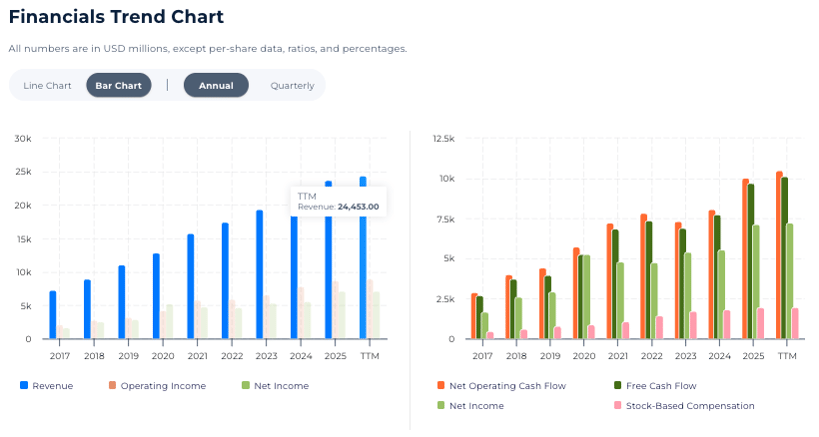
Financials Trend Chart powered by StockOracle™ - 2nd April 2026
Now fast forward seven years. Revenue has crossed $23.7 billion, more than 2.6 times what it was before. Gross margins have improved from 85% to 88%. Operating income has climbed to $8.7 billion at a 36% margin. By every measurable metric, this is a meaningfully better business than it was seven years ago.
So here is the question: what happened to the share price over that same period?
It went nowhere.
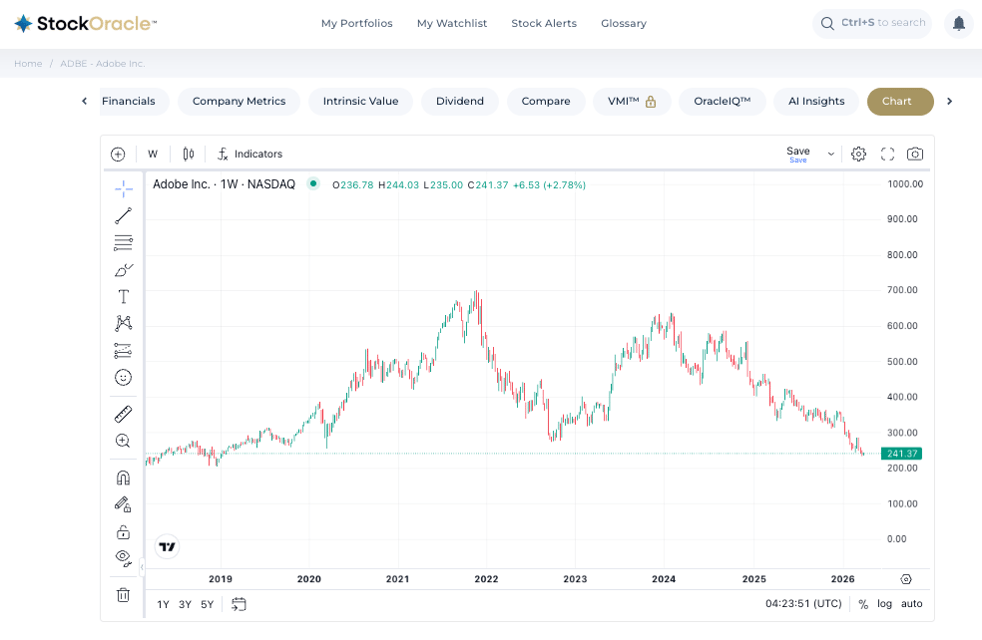
A business that more than doubled its revenue, expanded its margins, and compounded its profits produced essentially no return for its shareholders over seven years. And this is not a thought experiment. The stock in question is Adobe Inc. (ADBE), and its story has quietly become one of the most instructive case studies in modern investing.
Any past performance mentioned is not indicative of future results.
Why Software Was the Most Loved Business Model on Earth
To understand what happened to Adobe (ADBE) and the broader software sector, it helps to start with why investors fell so hard for these businesses in the first place.
Most traditional businesses operate on what you might call a one-and-done relationship with their customers. A car manufacturer builds a vehicle, sells it, and that is largely the end of the transaction. To grow, they need more customers, more factories, and more workers. Every incremental unit of revenue costs real incremental money to deliver.
Software does not work this way. Think about what a company like Salesforce actually sells. It is code. And once code is written, it costs virtually nothing to deliver to the next customer. The ten-thousandth customer costs almost the same to serve as the first one through the door. You send them a login and the transaction is done.
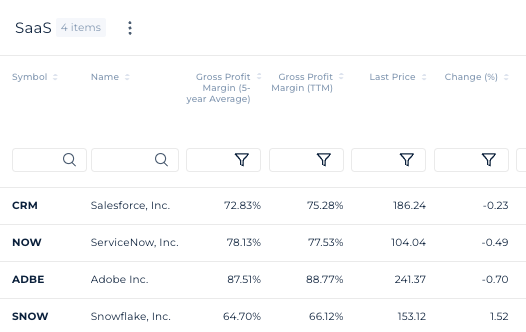
Comparison Table powered by StockOracle™ - 2nd April 2026
That is why software companies routinely report gross margins of 75%, 80%, even 88% as in Adobe's case. Those margins are not normal. They are extraordinary.
But the margins were only half the story. What truly made software companies special was how they charged their customers. Rather than one-time sales, almost every major software company moved to a subscription model. Monthly or annual payments, locked in as long as the product was in use. And the kicker? Customers almost never leave.
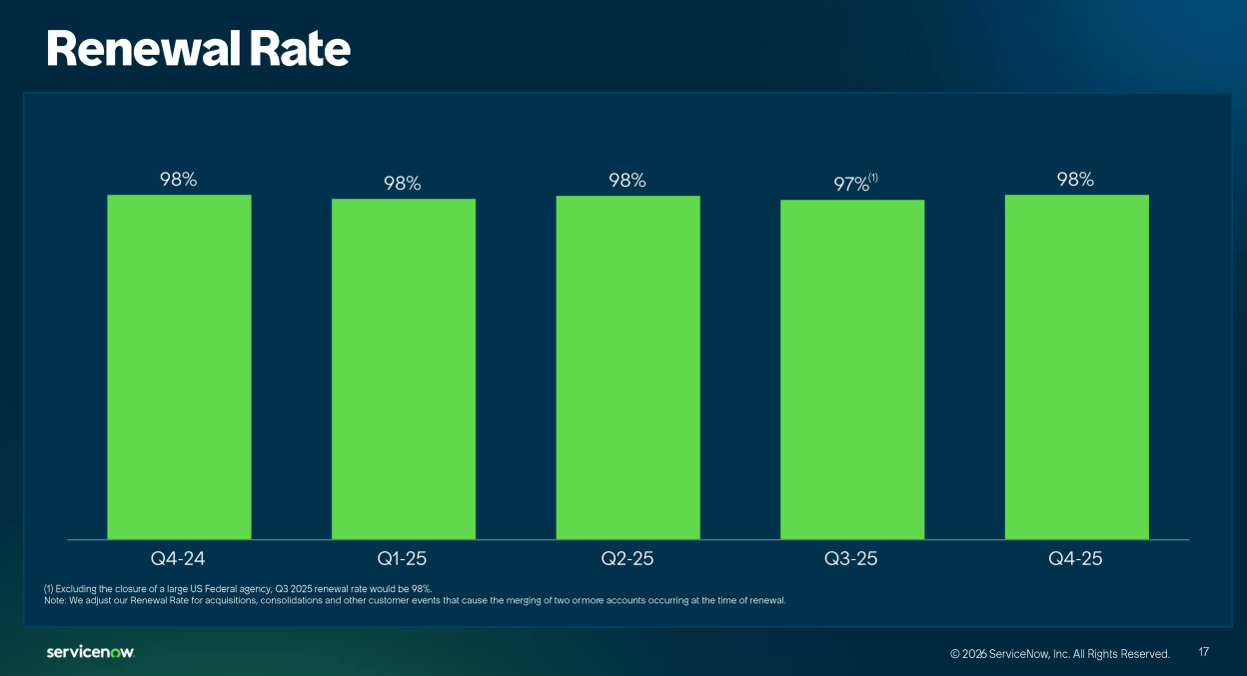
ServiceNow, for example, renews roughly 98% of its customers every single year. That is not customer loyalty. That is closer to a structural dependency.
This dynamic created something investors dream about: predictable, recurring revenue. A software-as-a-service company could enter January 1st already knowing, with reasonable confidence, what the majority of their revenue for the entire year would look like before making a single new sale.
For analysts and fund managers trying to model future cash flows, that kind of visibility is genuinely rare.
There was one more layer that supercharged the growth story: net revenue retention. Existing software customers do not just stay. They tend to increase their spend over time as they get comfortable with the platform and unlock new features.
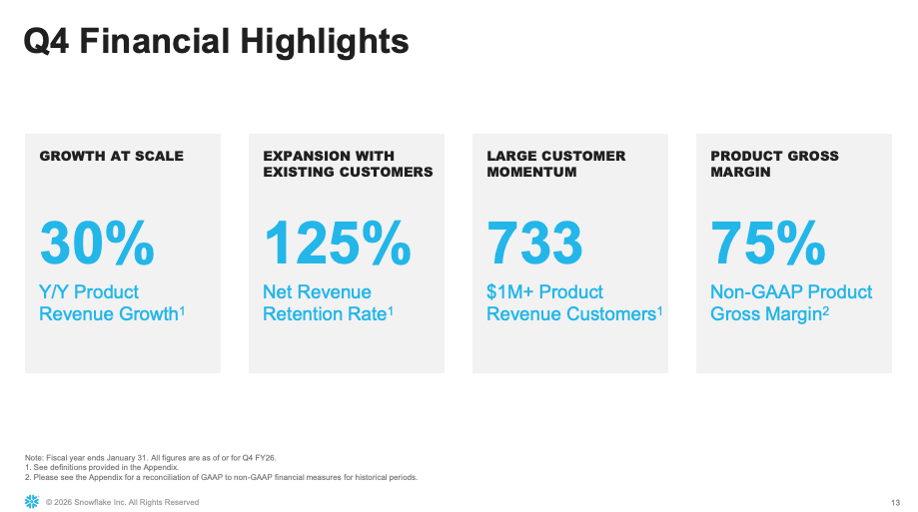
At its peak, Snowflake reported net revenue retention above 150% and 125% in the latest earnings at Q4, meaning every existing customer was spending more year over year without a single new customer being added.
Put all of that together: extraordinary margins, predictable recurring revenue, customers who barely leave, and an existing base that grows itself. You would pay a premium for that kind of business too. And investors did. These companies routinely traded at 15, 20, sometimes 30 times annual revenue. By normal standards, that sounds absurd. But for a model this clean, this predictable, and this capital efficient, it is not hard to understand why the market valued it that way.
Find out your favorite stocks' OracleIQ™ for Free
The Three Fears Reshaping Software Valuations Today
For most of 2024 and into 2025, the AI conversation was mostly background noise for software investors. The general consensus was that large software companies would simply incorporate AI features into their existing product suites, charge a modest premium, and life would go on. The business model survives. Maybe it even gets better.
But something shifted. In early 2026, Anthropic released a suite of autonomous AI agents capable of handling complex, multi-step business tasks entirely on their own, including lead generation, contract review, and legal auditing. The legal software sector was hit first, and it was hit hard. London Stock Exchange Group fell 13% in a single day. Thomson Reuters dropped 16%. Smaller legal technology names fell 20% or more. The market began asking a question it had never seriously entertained before: if AI can do the work, do you still need the software subscription that was attached to the human doing that work?
Three specific fears are now being priced into the sector, and understanding them is essential to evaluating any software stock today.
Fear one: the death of the seat. The traditional SaaS billing model is built around people. A company with 500 employees using Salesforce pays for 500 seats. If AI agents can do the work of humans, companies need fewer humans. And if they need fewer humans, they need fewer seats.
Some mid-market software companies have recently reported enterprise seat counts declining for the first time in their history. Consider the implication for Adobe: if a marketing team of 100 people can achieve the same output with 60 because AI is handling a significant portion of the workload, that is a 40% revenue reduction for Adobe with no change in product quality.
Fear two: the budget rotation. For the better part of two decades, enterprise software spending ran on a simple assumption: if your team needed a tool, you went to market and bought the best one available. With AI dramatically lowering the cost and complexity of building software, companies are now genuinely reconsidering what they need to buy versus what they could build internally.
Every contract renewal has become a negotiation. Every CFO is asking not just which vendor to use, but whether a vendor is needed at all.
Fear three: the margin problem. To stay competitive, every major software company is now integrating AI features directly into their products. Adobe adds generative imaging tools. Salesforce builds AI agents into its CRM. But those features are not free to run. Every time a user generates an image in Adobe, that requires compute power, and a portion of the revenue from that feature gets paid to the infrastructure provider running the underlying model. The margin profile that investors fell in love with gets structurally murkier. Add to that the seat reduction dynamic, and software companies face a genuine double pressure: fewer seats on one side, lower margins per seat on the other.
The Dividing Line Running Through the Software Sector
Not every software company faces the same level of risk, and the market's current response has been to reach for a sledgehammer rather than a scalpel. It is hitting every software company with similar force regardless of actual AI exposure. That indiscriminate selling is uncomfortable. But historically, it is also where the most interesting investment opportunities tend to emerge.
The key distinction is this: there is a dividing line between software companies whose revenues are fundamentally tied to human headcount and those whose revenues are tied to business activity and transaction volume. AI is compressing headcount rapidly. It is not compressing business activity at the same pace. A company might need 20% fewer employees in an AI-enabled world, but it is not necessarily doing 20% less business.
Their survival story is ultimately an execution story: can they successfully reprice their products around outcomes and efficiency before seat dilution eats into the revenue base?
The honest answer is that we do not know yet. But these are not fragile businesses. They have the resources, the customer relationships, and the institutional trust to attempt that transition. And right now, the market is not giving them any credit for it.
That gap between what the market is pricing and what the business might actually be worth is exactly what StockOracle™ is designed to help investors navigate.
StockOracle™'s OracleIQ™ Analysis on Adobe (ADBE)
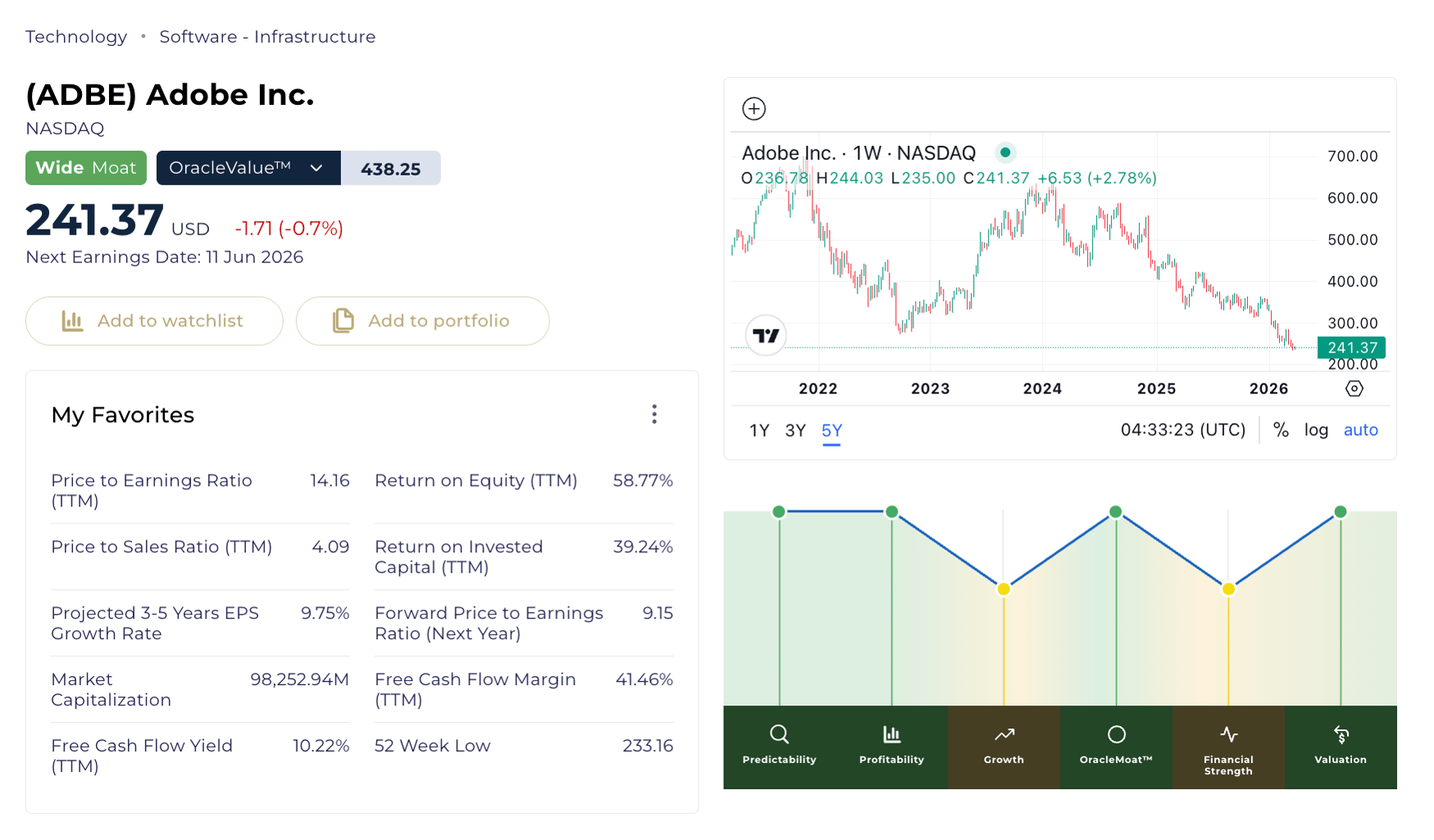
Adobe Inc. (ADBE) OracleIQ™ powered by StockOracle™ - 2nd April 2026
OracleIQ™ is a visual health check for U.S. stocks. Instead of digging through financial statements, OracleIQ™ condenses the most important data into one clear, at-a-glance view.
Through StockOracle™ Adobe's breakdown, the company scores highly across Predictability, Profitability, Financial Strength, and OracleMoat™. Growth sits at a moderate level, which reflects both the scale Adobe already operates at and the near-term uncertainty around its AI transition. Valuation is where the picture becomes particularly interesting, and we will get to that shortly.
Find out your favorite stocks' OracleIQ™ for Free
Adobe (ADBE) Predictability
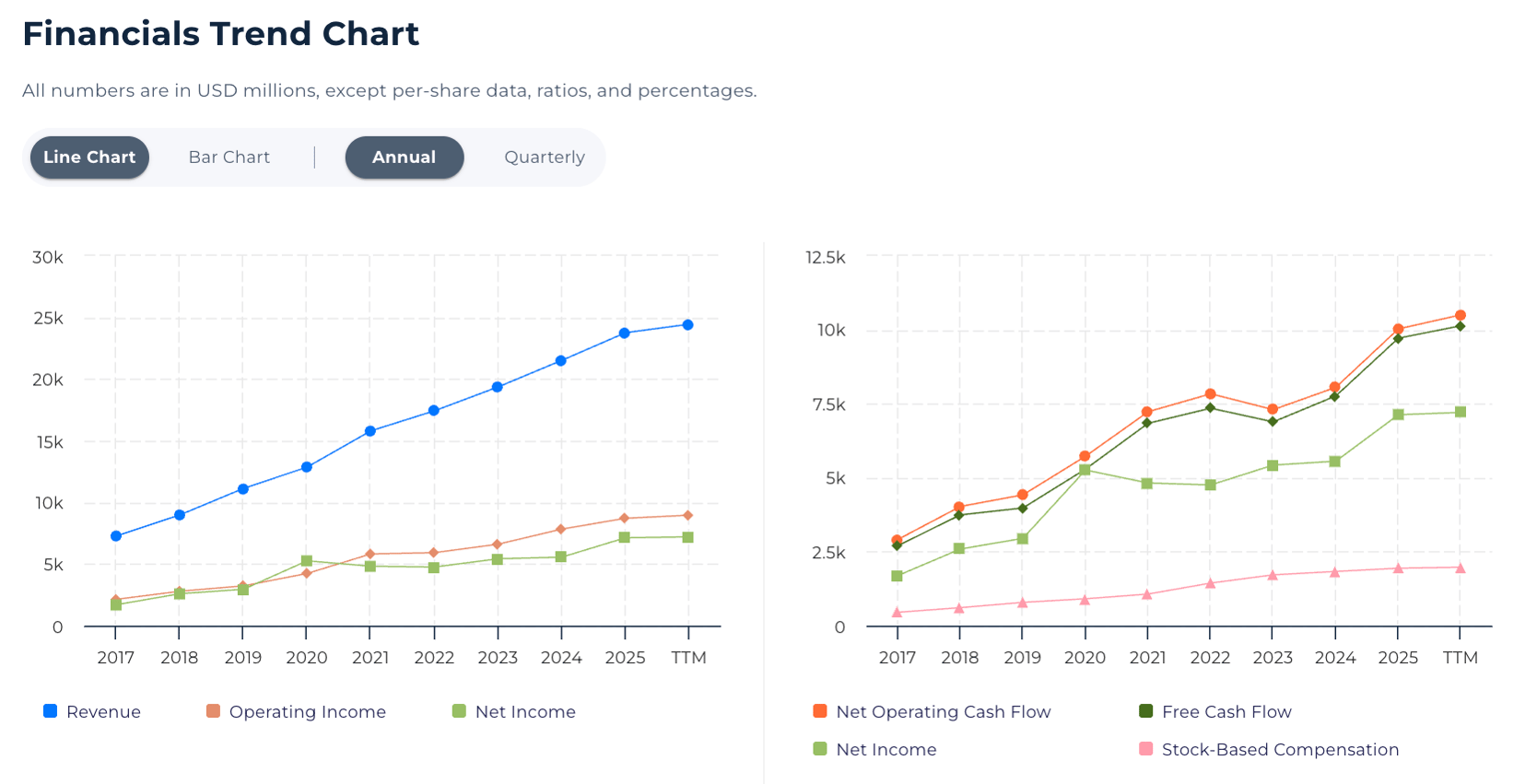
Adobe Inc. (ADBE) Financials Trend Chart powered by StockOracle™ - 2nd April 2026
Adobe's Predictability dimension reflects a consistent financial track record in the software industry. Revenue has grown in a near-unbroken upward line from approximately $7 billion in 2017 to over $24 billion today, with no meaningful declines even during periods of broader economic stress. Operating income and free cash flow have tracked revenue higher across the same period, reinforcing the quality and repeatability of the model.
This consistency is a direct product of Adobe's subscription architecture. Creative Cloud and Document Cloud lock users into monthly and annual payment cycles with high switching costs.
Adobe (ADBE) Profitability
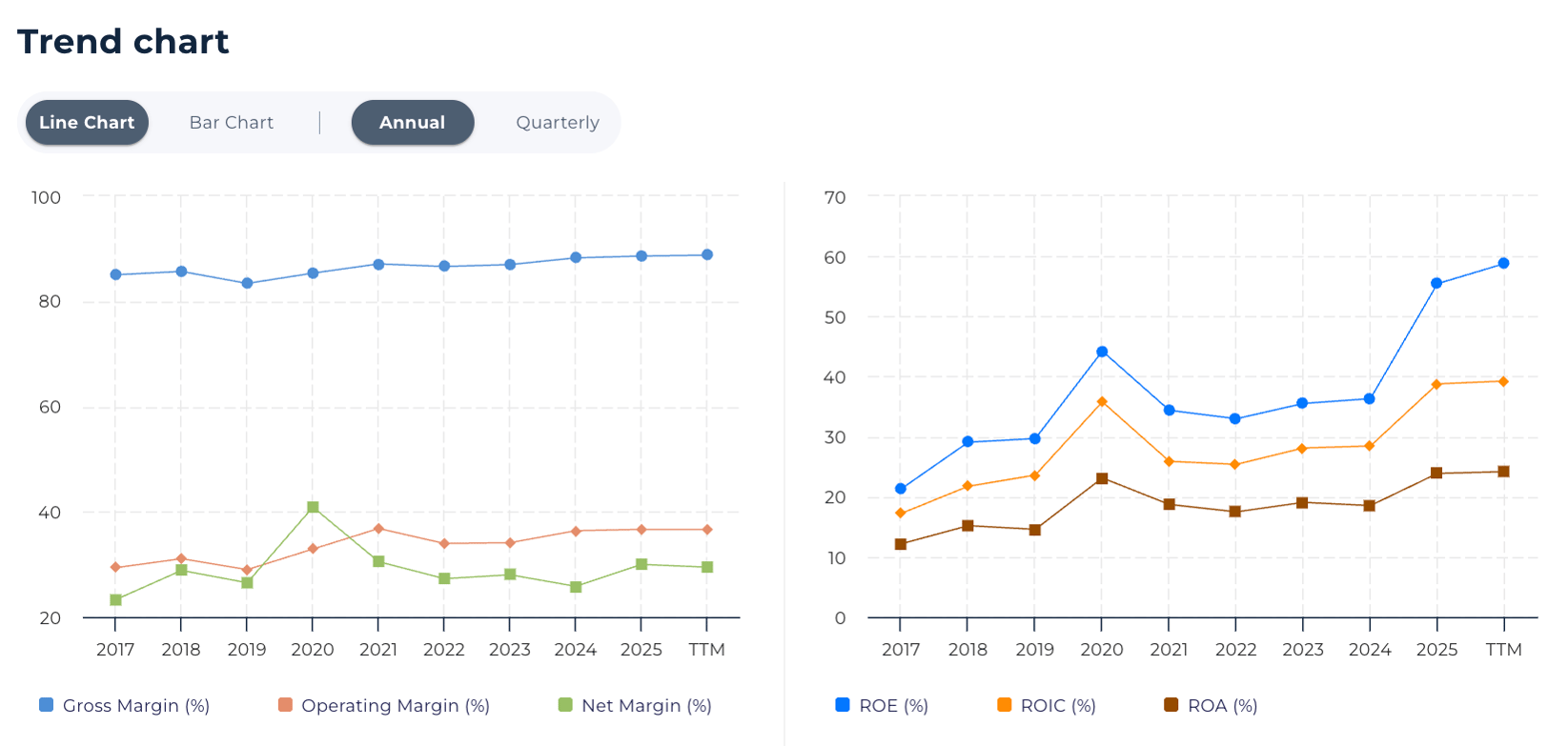
Adobe Inc. (ADBE) Margins and Returns Trend Chart powered by StockOracle™ - 2nd April 2026
Adobe (ADBE) continues to deliver profitability metrics that place it among the strongest businesses in the market. The gross margin sits at approximately 88%, the operating margin at 36%, and the net margin at roughly 29%. These are not just high in absolute terms. They have been improving over time, which signals that the business is not just growing but becoming more efficient as it scales.
The returns picture reinforces this. Return on Equity (ROE) stands at 58.77%, Return on Invested Capital (ROIC) at 39.24%, and Return on Assets (ROA) at approximately 24%.
Adobe (ADBE) Growth
Adobe's Growth dimension reflects the structural reality of operating at a revenue base north of $24 billion. The projected 3 to 5 year EPS growth rate sits at 9.75%, which is a respectable number at Adobe's scale but not a standout figure compared to earlier periods in the company's history. The market is weighing that projection against the seat compression headwind and asking whether even that modest estimate holds if AI adoption accelerates.
Adobe (ADBE) Financial Strength
Adobe's balance sheet reflects a business that generates cash at a rate that gives it significant flexibility. Free cash flow has expanded consistently alongside revenue, and the company carries manageable debt levels relative to its cash generation. With a free cash flow yield of 10.22% at current prices and strong operating cash flow trends visible across the historical chart, Adobe has the financial resilience to fund its AI transition internally without needing to lean on external capital markets.
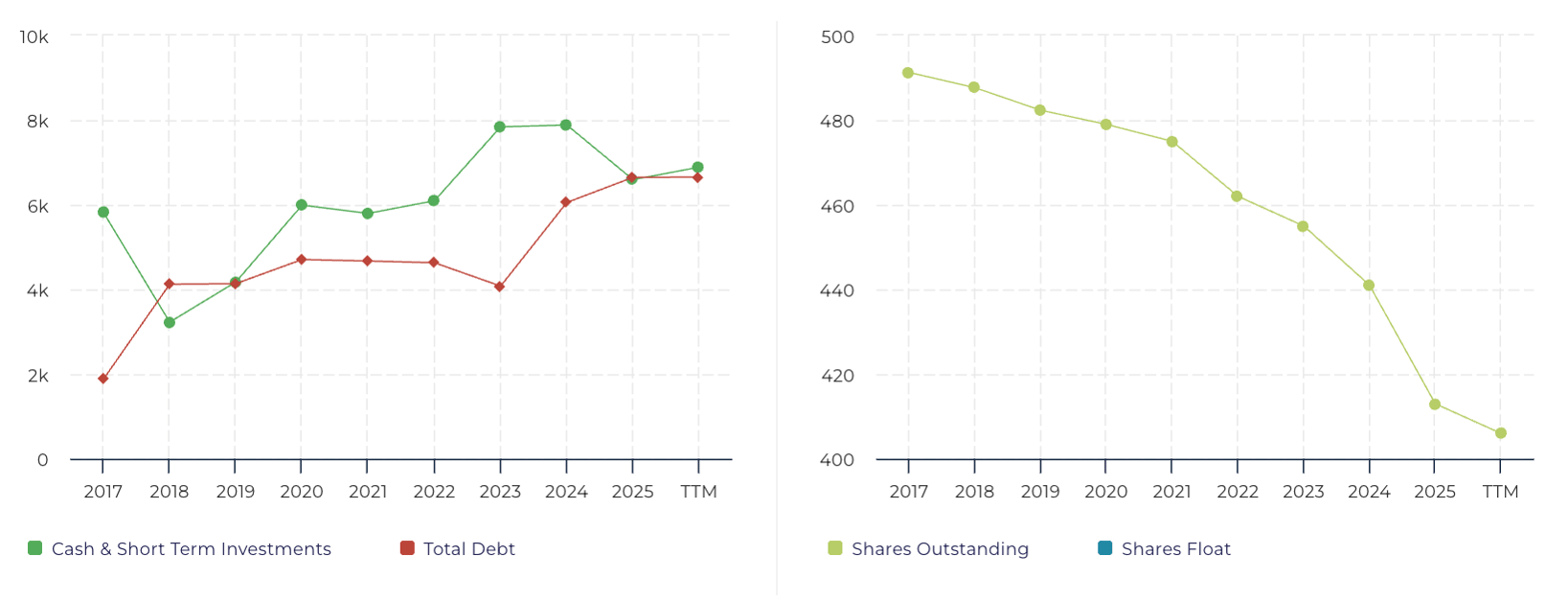
The share count has also been declining steadily over time, from approximately 480 million shares outstanding in 2017 to around 405 million today, a meaningful reduction that has supported per-share earnings growth even during periods of slower headline revenue growth.
OracleMoat™ of Adobe (ADBE) on StockOracle™
Adobe carries a Wide OracleMoat™ rating, underpinned by multiple reinforcing competitive forces that are particularly durable in the creative and document software categories.
Switching costs: Creative professionals invest years building workflows, presets, templates, and institutional knowledge inside Adobe's ecosystem. Migrating to an alternative is not simply a software decision. It is a retraining and workflow disruption decision, which most enterprises and individual creators are unwilling to make.
Network effects and industry standardization: The PDF format, Photoshop file formats, and Adobe's creative standards have become the default language of creative industries globally. When clients, agencies, and employers all operate on Adobe formats, the individual professional has limited incentive to deviate.
Brand and trust in enterprise: Adobe's Document Cloud and Acrobat are embedded in legal, financial, and government workflows where format fidelity and compliance matter. These are not relationships that flip based on price.
Expanding AI surface: Adobe Firefly and its generative AI tooling are being built into existing Creative Cloud workflows, meaning that AI adoption by Adobe's customers deepens product engagement rather than threatening it directly.
While not immune to the structural pressures described earlier, Adobe's competitive position is materially stronger than the simpler, less embedded software businesses facing genuine existential questions from AI-assisted development.
Adobe (ADBE) Valuation Calculation on StockOracle™
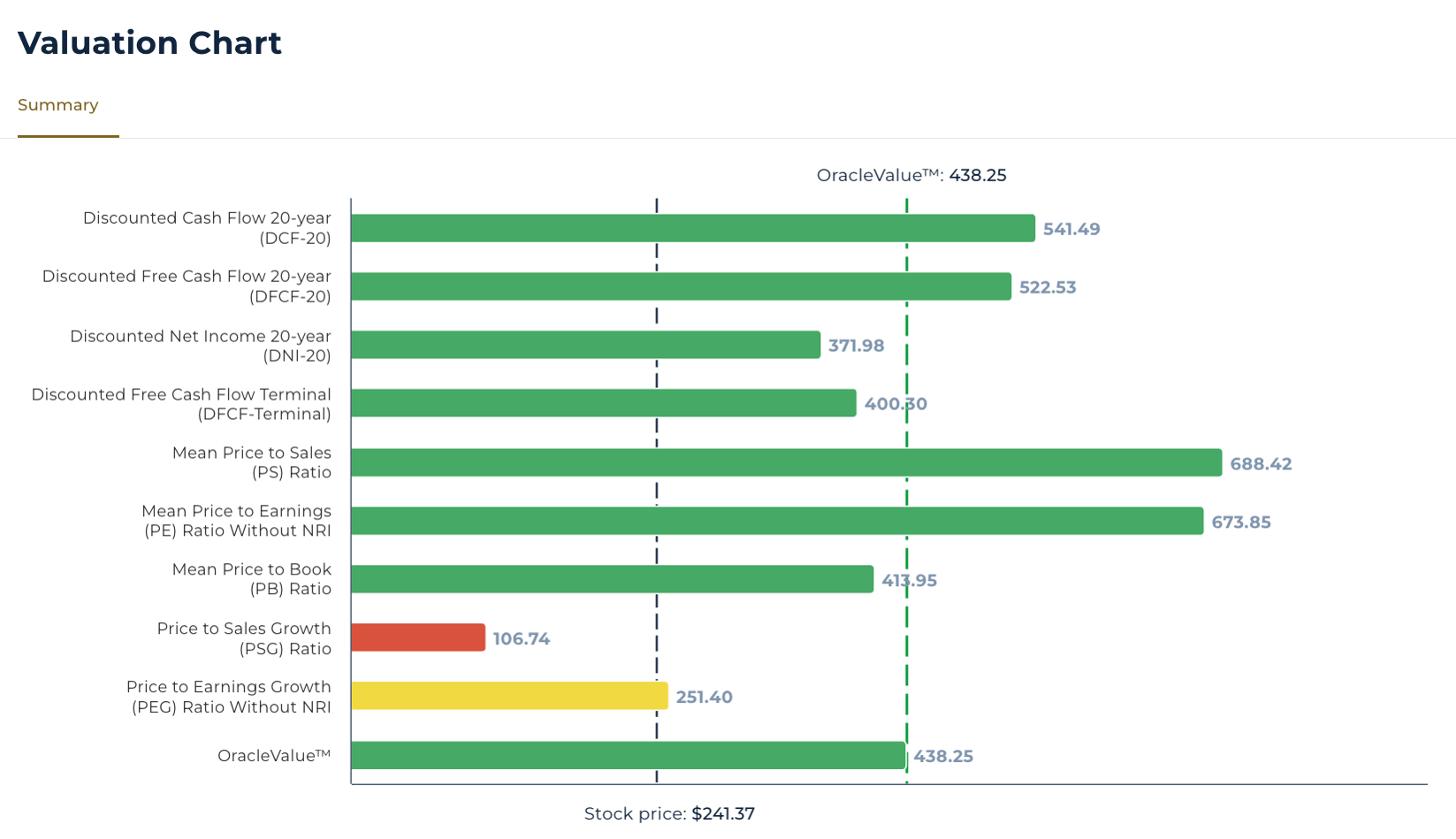 Adobe Inc. (ADBE) Valuation Chart powered by StockOracle™ - 2nd April 2026
Adobe's valuation today is essentially a vote on that transition. The market is not saying the business is broken. It is saying it is not yet willing to give Adobe credit for navigating the shift successfully. For patient investors with a multi-year horizon, the gap between $241 and a fair value range clustering around $400 to $540 is a meaningful one. Whether it represents opportunity depends entirely on one's conviction about where Adobe lands on the dividing line described earlier.
All growth rates and valuation outputs shown are hypothetical model inputs and not in any way a representation of forecasts or future performance.
Intrinsic value estimates are based on long-term financial projections and assume multi-year holding periods. Short-term market movements may differ significantly from valuation estimates.
OracleValue™ is an estimate and should not be taken as a recommendation or a signal to buy or sell stocks.
Don't borrow Wall Street's assumptions. Calculate ADBE's intrinsic value your way. 7-day free trial.
Final Thoughts
Adobe's story is a useful lens for thinking about the entire software sector right now. The business has genuinely gotten better by every fundamental measure over the past seven years. Revenue is up more than 2.6 times. Margins have expanded. Cash generation is exceptional. And yet the stock has gone nowhere, because the market is no longer pricing the business it sees today. It is pricing the business it is uncertain about tomorrow.

StockOracle™'s OracleIQ™ framework makes it easier to cut through that noise, anchoring analysis in the actual quality dimensions of the business rather than the prevailing sentiment surrounding the sector.
This analysis is shared for educational purposes to illustrate how markets and valuation models react to new information. It is not intended as financial advice or a recommendation on any investment.