By Piranha Profits Team
Last updated on March 20, 2026
Despite reporting strong financial results, ServiceNow (NYSE:NOW) has experienced a significant decline, dropping almost 60% since its peak in January 2025. The core concern among investors is whether the rise of agentic AI will disrupt the conventional "seat-based" Software as a Service (SaaS) model such as Salesforce.
|
Key Points
|
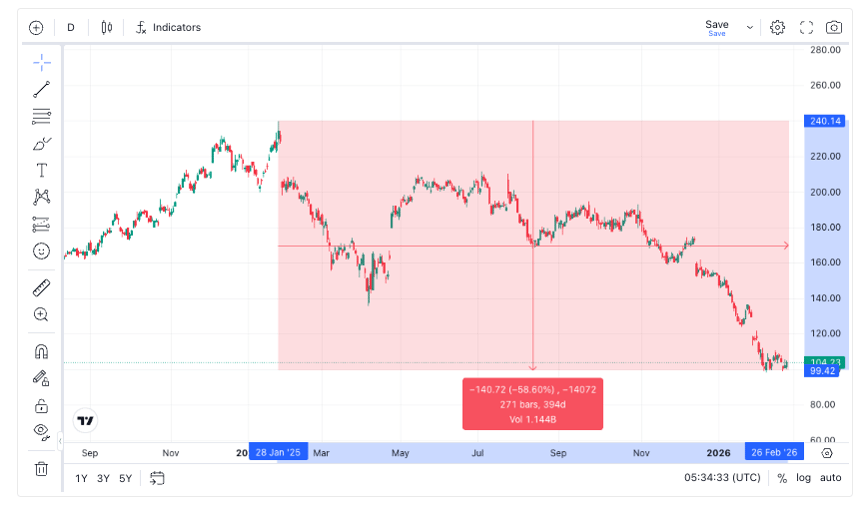
If AI agents allow companies to replace ten employees with two managers overseeing automation, software subscriptions tied directly to headcount could shrink. As growth across the broader software sector slows, the market reacts defensively, and ServiceNow has been caught in that wave.
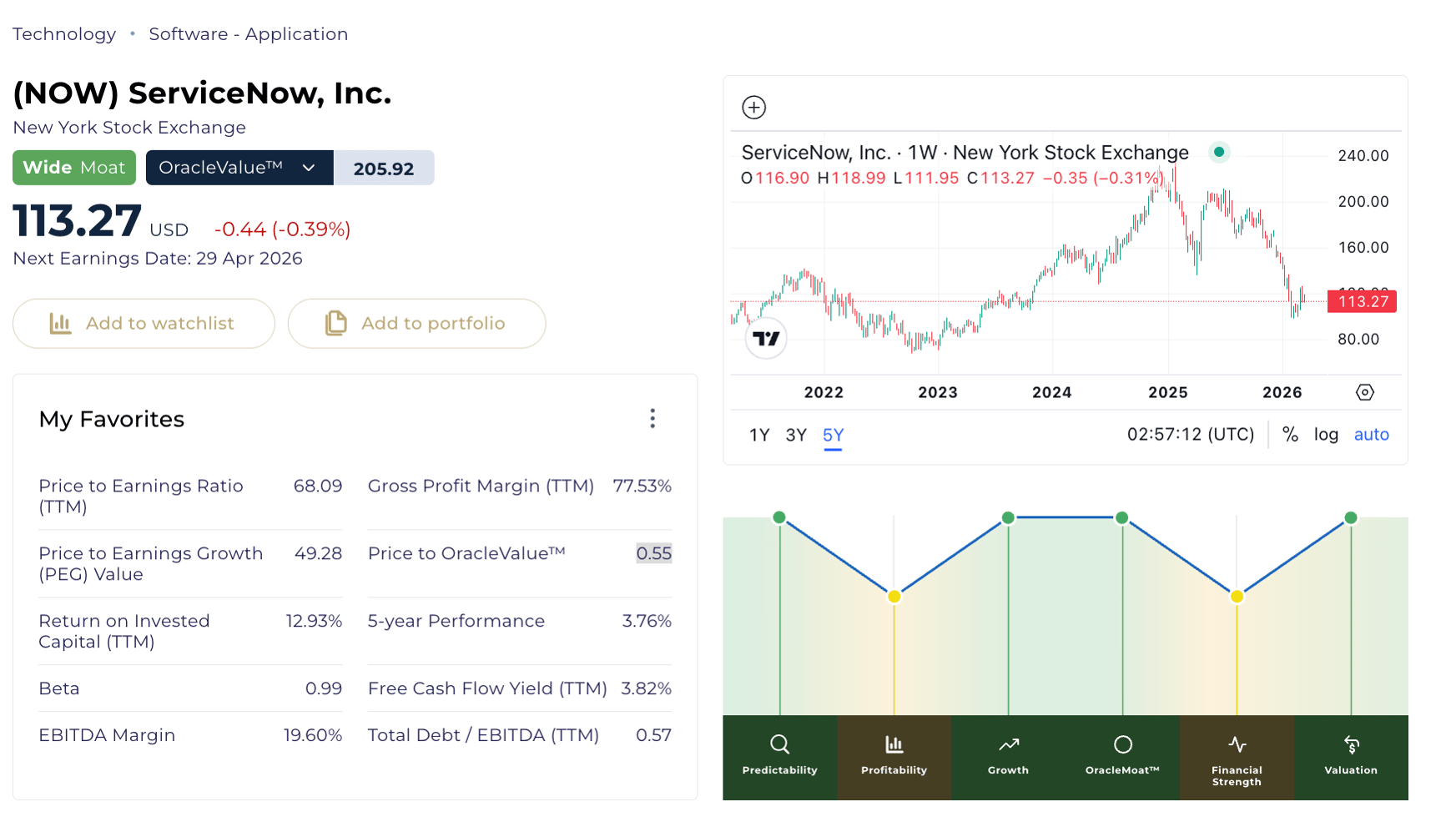
ServiceNow Charts Powered by StockOracle™ 20th March 2026
Analyse other SaaS Stock like Salesforce , Intuit Inc and WorkDay on StockOracle™
To properly evaluate ServiceNow, let’s look past its fluctuating price and focus on its financial fundamentals using OracleIQ™'s six pillars: Predictability, Growth, Profitability, Financial Strength, Competitive Moat, and Valuation. While revenue narratives are straightforward, long-term success is usually revealed by sustainable profitability, balance sheet resilience, and competitive advantages.
Predictability and Growth of ServiceNow's Revenue
ServiceNow’s revenue trajectory since 2016 has been uninterrupted. What began as approximately $1.5 billion in revenue in 2016 has expanded to $13.27 billion on a trailing twelve-month basis in 2025. That kind of scaling suggests a highly durable demand model.
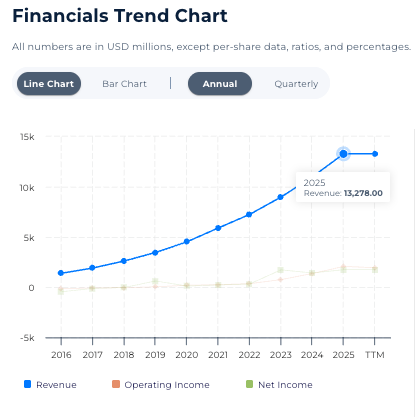
ServiceNow Financial Trends Powered by StockOracle™ 26th Feb 2026
In 2025 alone, subscription revenue reached $12.88 billion, representing 21% year-over-year growth.
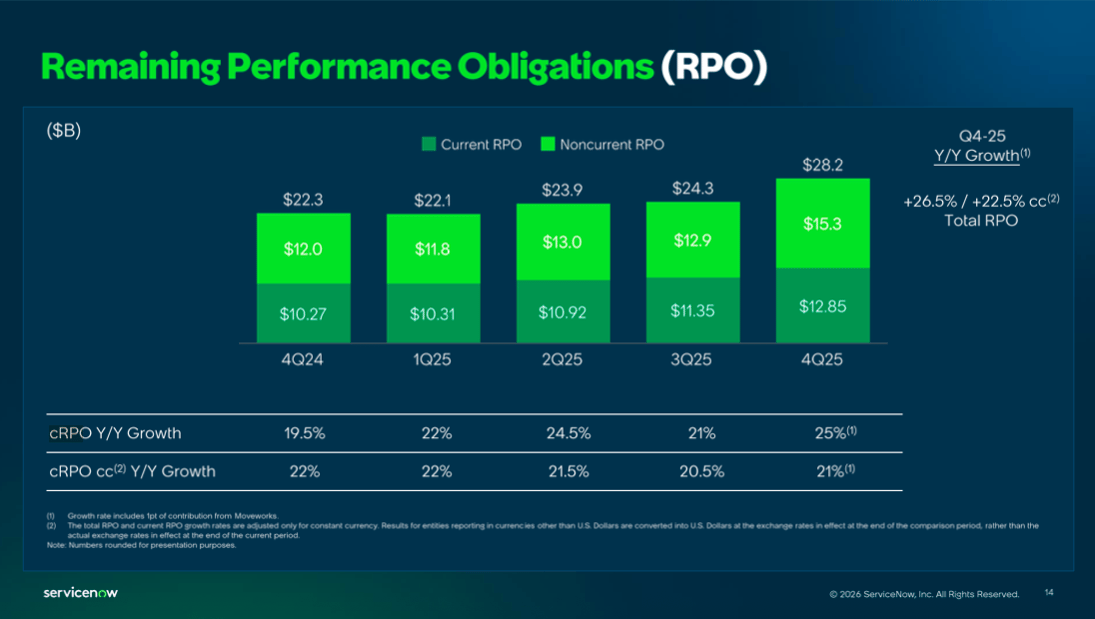
Current Remaining Performance Obligations (cRPO) also totaled $12.85 billion, growing 25% year-over-year. cRPO is particularly important because it represents contracted revenue scheduled to be recognized within the next 12 months. When that number grows faster than revenue itself, it usually indicates expanding demand visibility and predictability.
ServiceNow is seemingly operating a reliable growth engine supported by long-term enterprise contracts.
Profitability of ServiceNow
The company has consistently maintained gross margins around 77.5%, typical of high-quality enterprise SaaS models such as Salesforce. High gross margins provide structural flexibility to invest in R&D, sales, and infrastructure.
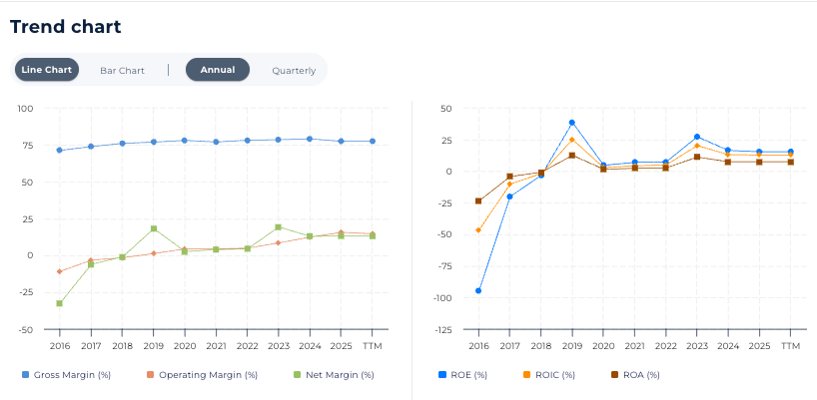
ServiceNow Margin and Returns Metrics Powered by StockOracle™ 26th Feb 2026
In 2016, operating and net margins were deeply negative. Fast forward to 2025, net margins have turned sustainably positive.
This shift demonstrates operating leverage. As revenue scales, fixed costs are absorbed more efficiently, pushing profitability upward.
ServiceNow's capital efficiency has also improved meaningfully, with Return on Invested Capital (ROIC) at 12.93% and Return on Equity (ROE) in the mid-teens. These figures indicate that ServiceNow is generating healthy returns on incremental capital.
Cash Flow Strength of ServiceNow
Cash flow is often the most honest financial metric. Operating cash flow shows how much real cash the business produces from selling its products or services. Free cash flow goes a step further, it is the cash left after the company pays for capital expenditures such as servers, infrastructure, or equipment.
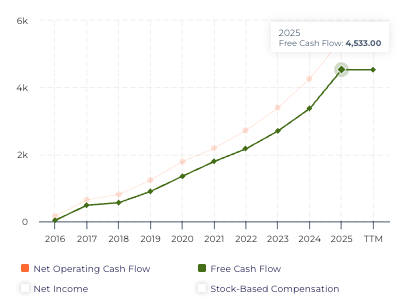
ServiceNow Cash Flow Charts Powered by StockOracle™ 26th Feb 2026
In 2025, ServiceNow generated $5.44 billion in operating cash flow and $4.63 billion in free cash flow. The operating cash flow chart resembles a steady upward slope, reinforcing that profitability improvements are translating into real cash generation.
Financial Strength of ServiceNow
A strong income statement must be supported by a resilient balance sheet.
ServiceNow holds over $6 billion in cash and short-term investments against approximately $2.4 billion in total debt, with a low debt-to-EBITDA ratio of 0.57. In simple terms, it has significantly more cash than debt and very modest leverage, giving it flexibility to invest, acquire, or return capital without financial strain.
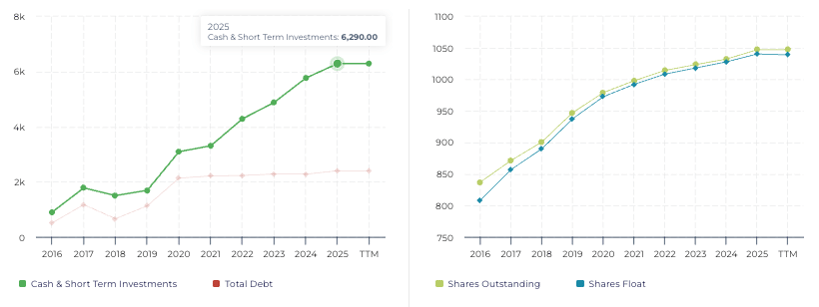
ServiceNow Cash and Shares Charts Powered by StockOracle™ 26th Feb 2026
Like many early-stage software companies, ServiceNow relied heavily on stock-based compensation. Shares outstanding increased from roughly 850 million in 2016 to over 1.04 billion (adjusted for the recent 5-for-1 split).
However, recent trends show stabilization. From 2024 into 2025, share count growth has begun to flatten. Management has also authorized a $5 billion share repurchase program, including a $2 billion accelerated buyback in Q4 2025 earnings call.
This signals a transition from capital formation to capital return and better alignment of shareholder value creation with operating performance.
Competitive Positioning: A Wide Moat
A company’s long-term value depends heavily on competitive durability. ServiceNow is a cloud-based platform that helps businesses automate and manage IT, HR, customer service, and other enterprise workflows. It centralises operations so teams can track, resolve, and streamline tasks more efficiently across the organization.
ServiceNow qualifies as a wide-moat enterprise based on switching costs and ecosystem integration. Once embedded into enterprise workflows, automation layers, compliance systems, and AI agents, migration becomes complex, expensive, and operationally risky.
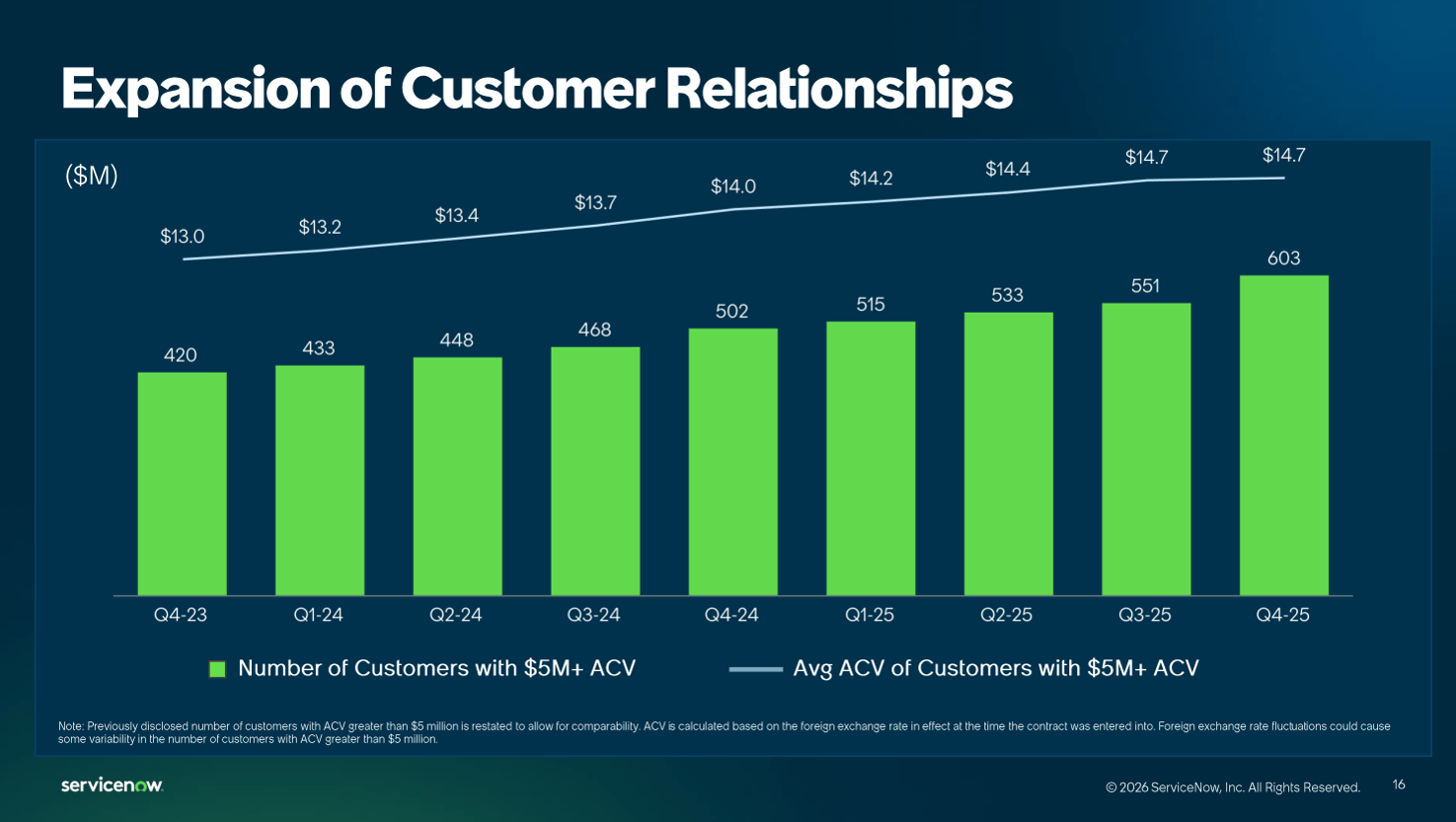
Recent customer metrics reinforce this stickiness. ServiceNow has 603 customers spending over $5 million annually, representing a 20% increase year-over-year.
This information is extremely crucial for Service now because high-spending enterprise clients rarely switch core infrastructure platforms. The deeper ServiceNow integrates into mission-critical operations, the stronger its retention becomes.
Intrinsic Valuation Estimates of ServiceNow
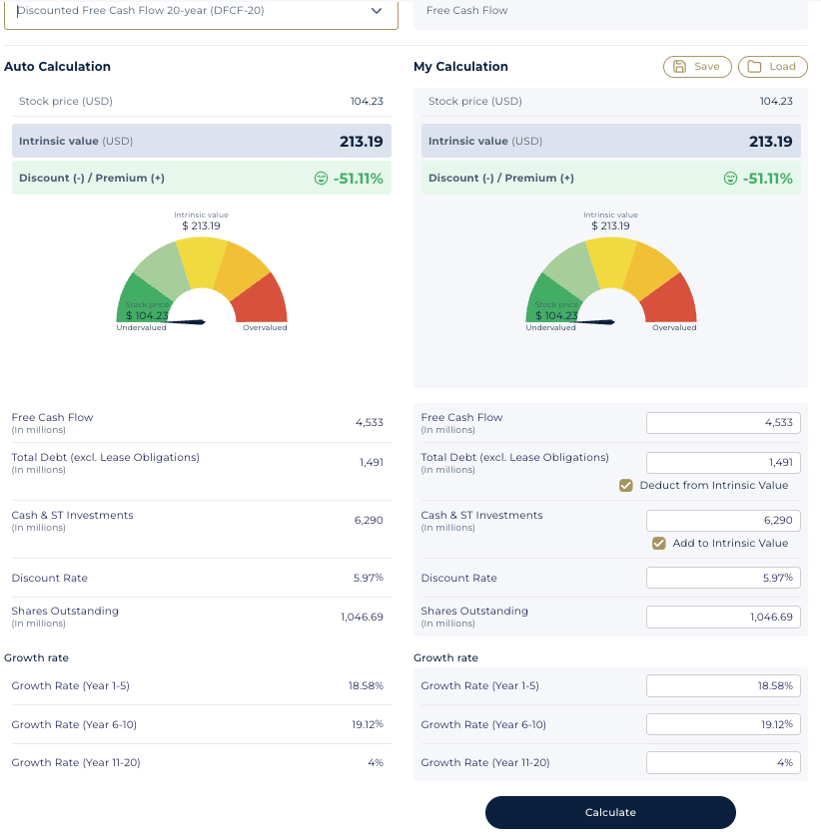
StockOracle™ Intrinsic Value Calculator using individual growth assumptions
OracleValue™ intrinsic value modeling estimates a value of $206.50 per share, implying a Price-to-OracleValue™ ratio of 0.55.
In practical terms, the stock may be trading at a discount to estimated intrinsic value. While intrinsic value models are never precise, a wide gap between price and estimated value provides a potential margin of safety.
Do you think that ServiceNow(NOW) estimated near term growth rate is too optimistic? Calculate your intrinsic value with StockOracle™ using your assumptions of ServiceNow.
Final Thoughts
While there is widespread concern that artificial intelligence will disrupt traditional software revenue models. The company continues to demonstrate sustained and predictable revenue growth, improving operating margins, strong capital efficiency, and free cash flow generation exceeding $4.6 billion annually. Its balance sheet remains robust, holding substantially more cash than debt with low leverage, providing strategic flexibility and downside protection.
Management is also managing dilution through potential buybacks, enterprise switching costs remain high, customer spending continues to expand.
In a sector now clouded by fear, ServiceNow’s financial trajectory reflects underlying structural strength. It is uncertain if the market will close the valuation to price gap in the short to mid term. However, the fundamentals are clear: ServiceNow is scaling efficiently, sustaining profitability, and reinforcing its competitive position.
Related

Home Depot trades at 21.95 times trailing earnings, a multiple that assumes the growth engine ...

Philip Morris International posted its first $11.2 billion revenue quarter, with organic growth ...

Lam Research stock has surged more than 90% this year, outrunning nearly every semiconductor peer, ...