Mastercard has just posted a beat-and-raise quarter, with 14% revenue growth and 22% EPS growth. Yet the stock traded near the bottom of its 52-week range after falling roughly 22% earlier this year, partly because investors feared that Middle East travel disruption could signal a lasting slowdown.
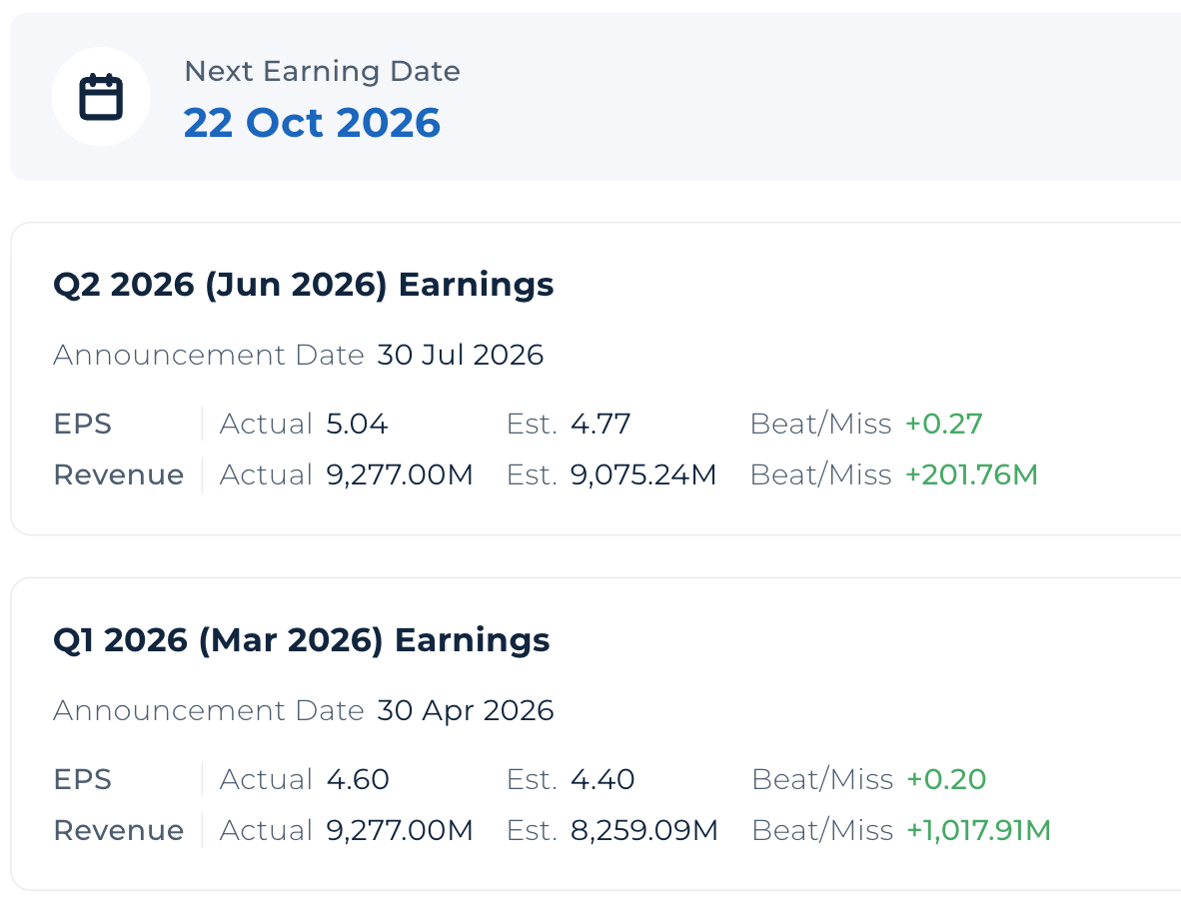
Visa also outgrew Mastercard in the first two quarters of 2026, narrowing Mastercard's historical valuation premium. The central question is whether Mastercard's growth advantage has faded or whether investors are overlooking two emerging strengths: cybersecurity and stablecoin infrastructure.
What Does Mastercard Actually Do?
Mastercard does not lend money or issue cards. It operates the network that lets a bank's card communicate with a merchant's payment terminal in seconds. Its core revenue comes from switched transactions, cross-border activity and assessment fees.
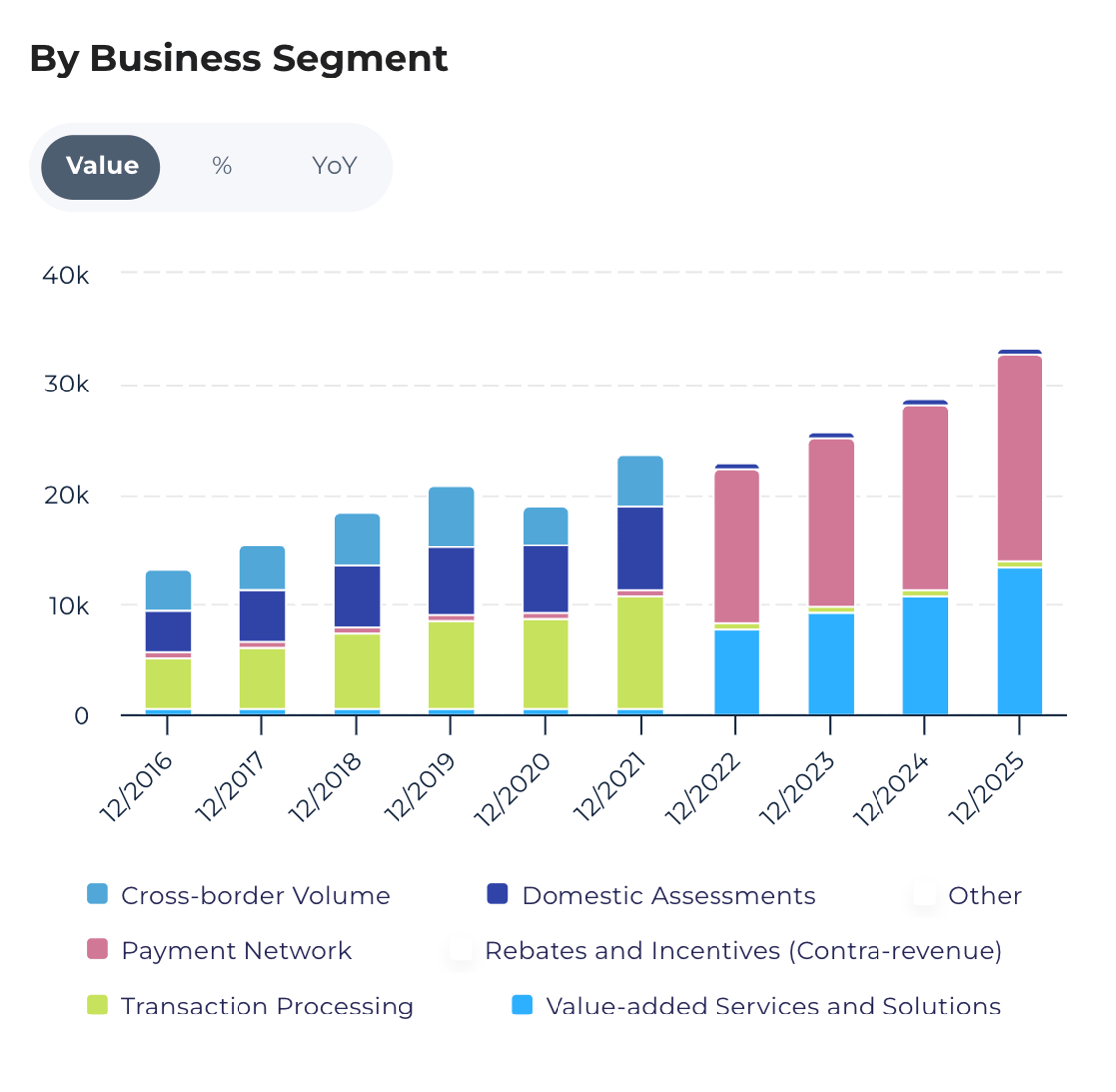
The faster-growing segment is Value-Added Services and Solutions (VAS). It includes fraud scoring, identity verification, threat intelligence, loyalty programs and marketing analytics. Mastercard sells these services to many of the same banks and merchants that already use its network. VAS is approaching 40% of total revenue and growing roughly twice as fast as the core business, making it central to the company's next stage of growth.
What Is Mastercard's Intrinsic Value?
Intrinsic value estimates what a business is worth based on the cash it can generate over time, rather than its current market price. Think of it as valuing an asset by the income it may produce, not by today's auction price.
For Mastercard, the estimate depends heavily on how long VAS can maintain its current growth. That assumption matters because faster growth in the early years compounds through the entire valuation.
Mastercard's Fair Value: What a 20-Year DCF Model Says
A 20-year discounted cash flow model estimates Mastercard's fair value at about $787.31 per share. It starts with $17.2 billion in operating cash flow, adjusts for cash and debt, and discounts future cash flows at 5.79%.
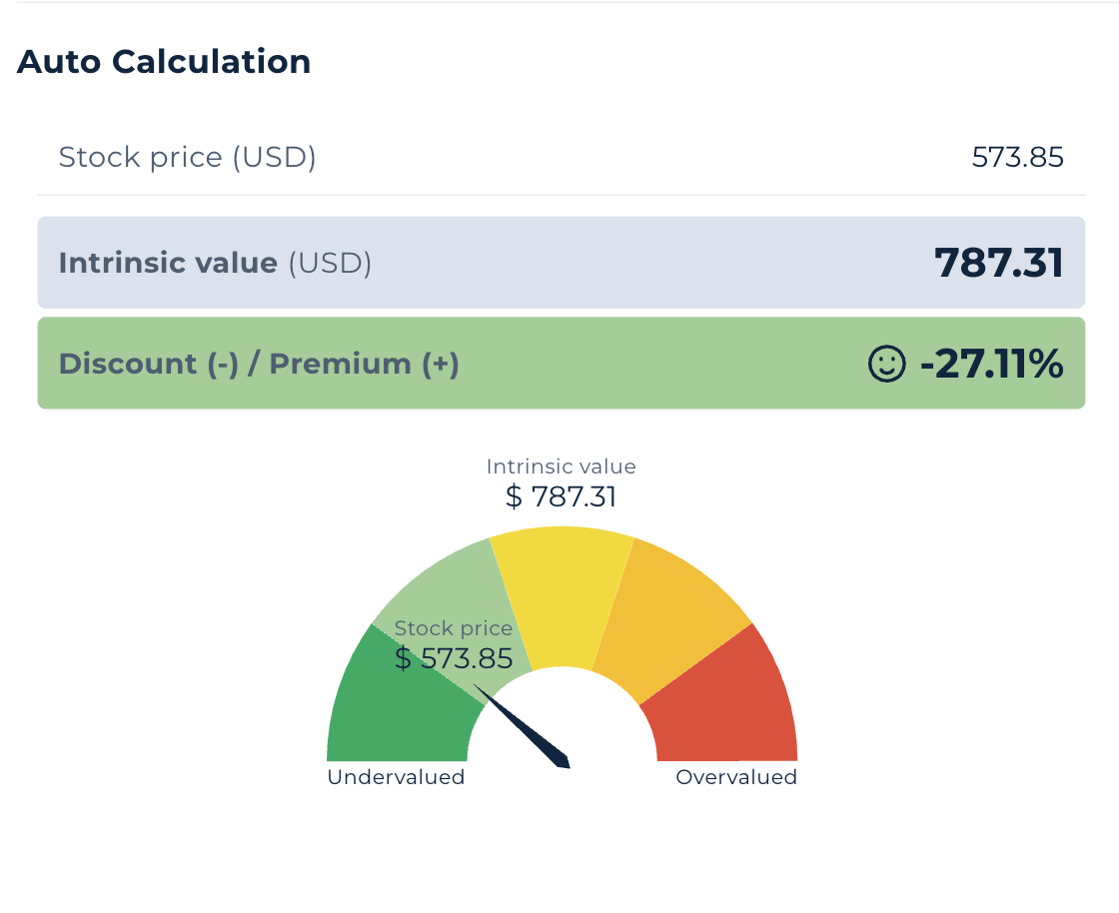
Mastercard (MA) Valuation Chart: 20-Year DCF Model. Powered by StockOracle™. Accurate as of 20 August 2026.
The model assumes growth of 15.65% in Years 1 to 5, 17.22% in Years 6 to 10, and 4% in Years 11 to 20. The first two rates come from separate standard growth estimates rather than a manually chosen acceleration.
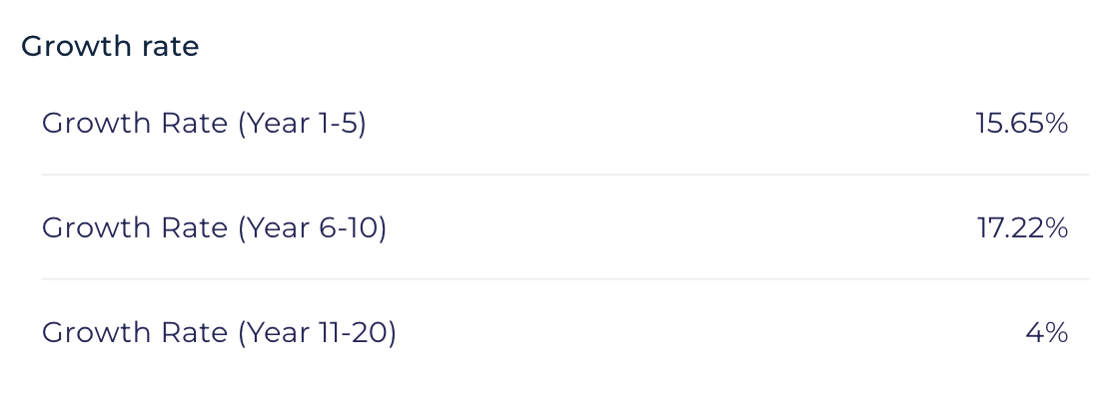
For investors, the key issue is not whether each decimal point proves accurate. It is whether the model reflects a reasonable growth path. The early years carry the most uncertainty because they assume Mastercard can keep expanding well above mature payment-industry growth. The later 4% rate is more conservative, but it still assumes the company can grow steadily after two decades. A DCF should therefore be read as a range of possible values, with $787.31 as the base case, rather than as a precise prediction.
The bull case is straightforward. VAS is growing about twice as fast as the network business, while a $14 billion buyback authorization approved in December 2025 should continue reducing the share count. Cybersecurity and stablecoin infrastructure may add further upside if they become meaningful profit contributors.
The bear case is equally important. The valuation requires low-to-mid-teens growth for a decade. If Visa continues to outgrow Mastercard or VAS slows toward the pace of the core network, fair value would move closer to the current market price.
This balance matters because a high-quality company is not automatically a good investment at every price. The business can continue growing while the stock disappoints if the valuation already assumes an even better outcome. Investors should separate confidence in Mastercard's competitive position from confidence in the model's price estimate.
Mastercard (MA) Financial Performance
Revenue: Value-Added Services Is Driving the Mix Shift
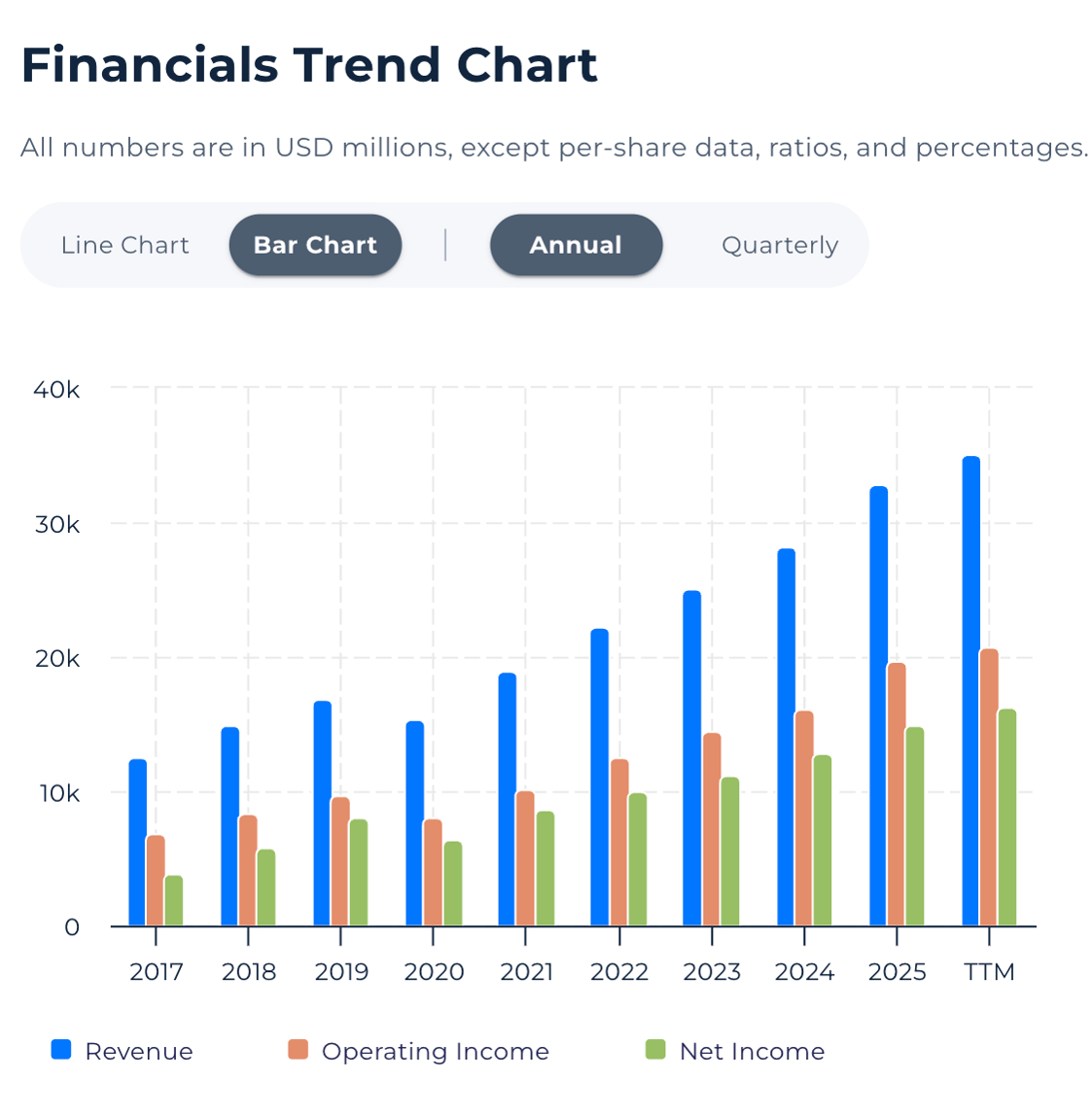
Mastercard (MA) Revenue, Operating Income and Net Income Trend. Powered by StockOracle™.
Trailing 12-month revenue reached $35.1 billion, up from $32.8 billion in fiscal 2025. The quality of that growth matters as much as the total. VAS revenue rose 20% in the latest quarter, while switched transactions increased 9%. Mastercard is becoming less dependent on transaction volume alone.
That mix shift can improve the durability of growth. Transaction revenue rises and falls with consumer spending, travel and payment volumes.
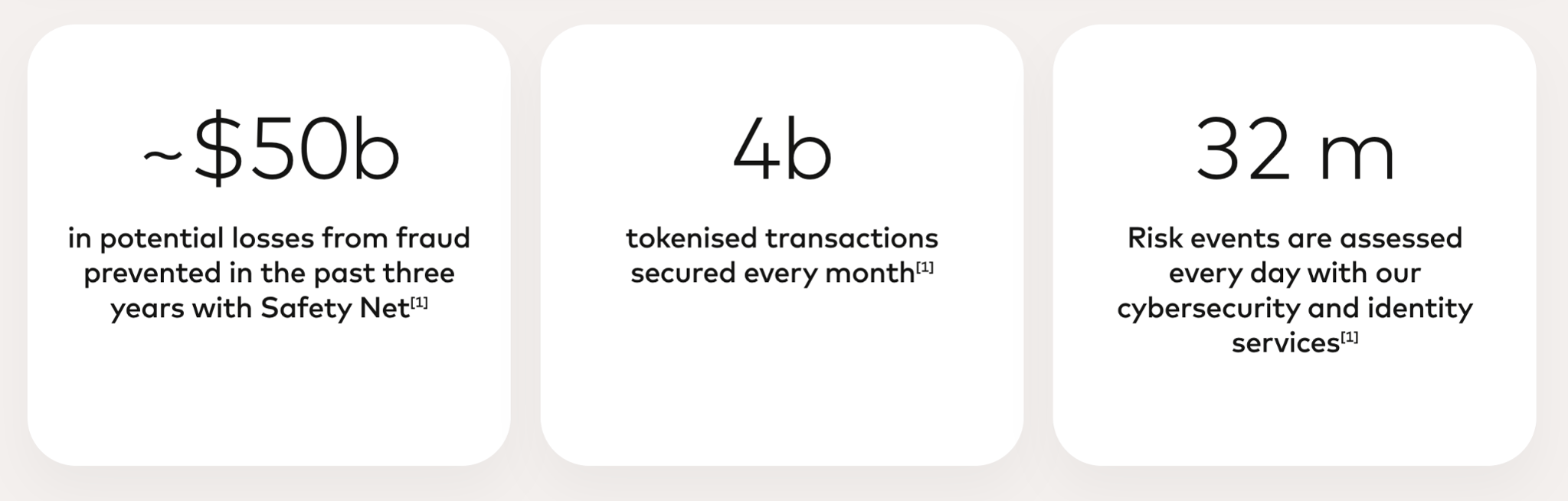
Services such as fraud prevention and identity verification solve ongoing operational problems for banks and merchants. They may create recurring demand even when transaction growth moderates. Investors should watch whether VAS maintains strong organic growth after accounting for acquisitions, since purchased revenue can make the segment look stronger than its underlying momentum.
Free Cash Flow: The Foundation of the Valuation
Earnings can be affected by accounting choices. Free cash flow is the cash left after the business funds its operations and capital spending. It supports buybacks, dividends, acquisitions and debt repayment, which is why it is central to a DCF.
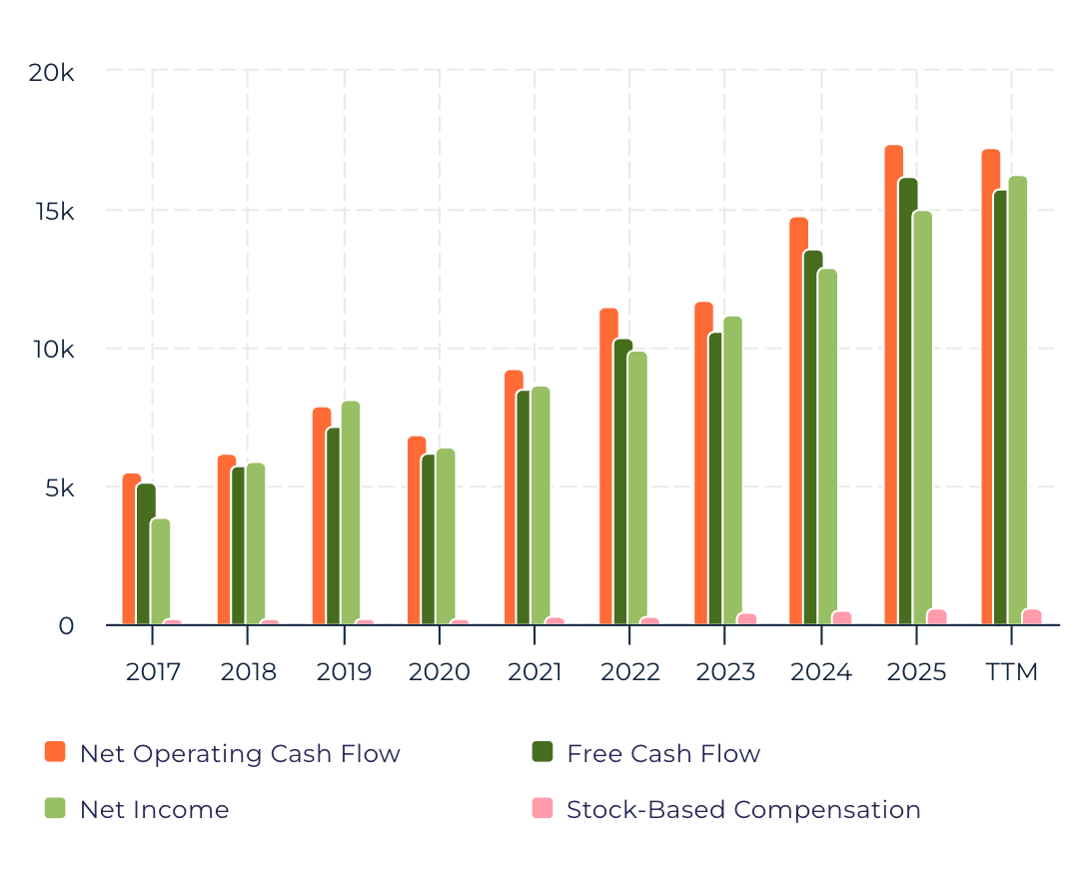
Mastercard (MA) Operating Cash Flow and Free Cash Flow Trend. Powered by StockOracle™.
Mastercard's trailing free cash flow margin is 44.87%, down from 49.29% in fiscal 2025. The decline deserves attention, but the current level remains strong. In simple terms, Mastercard converts almost 45 cents of each revenue dollar into free cash flow.
The next question is why the margin declined. A temporary increase in investment or working capital is less concerning than a lasting rise in operating costs. If cybersecurity and stablecoin initiatives require heavier spending before producing revenue, cash conversion may remain below its previous peak. That would not invalidate the growth strategy, but it should be reflected in the valuation rather than treated as a free source of upside.
Returns on Capital: Strong, With a Buyback Distortion
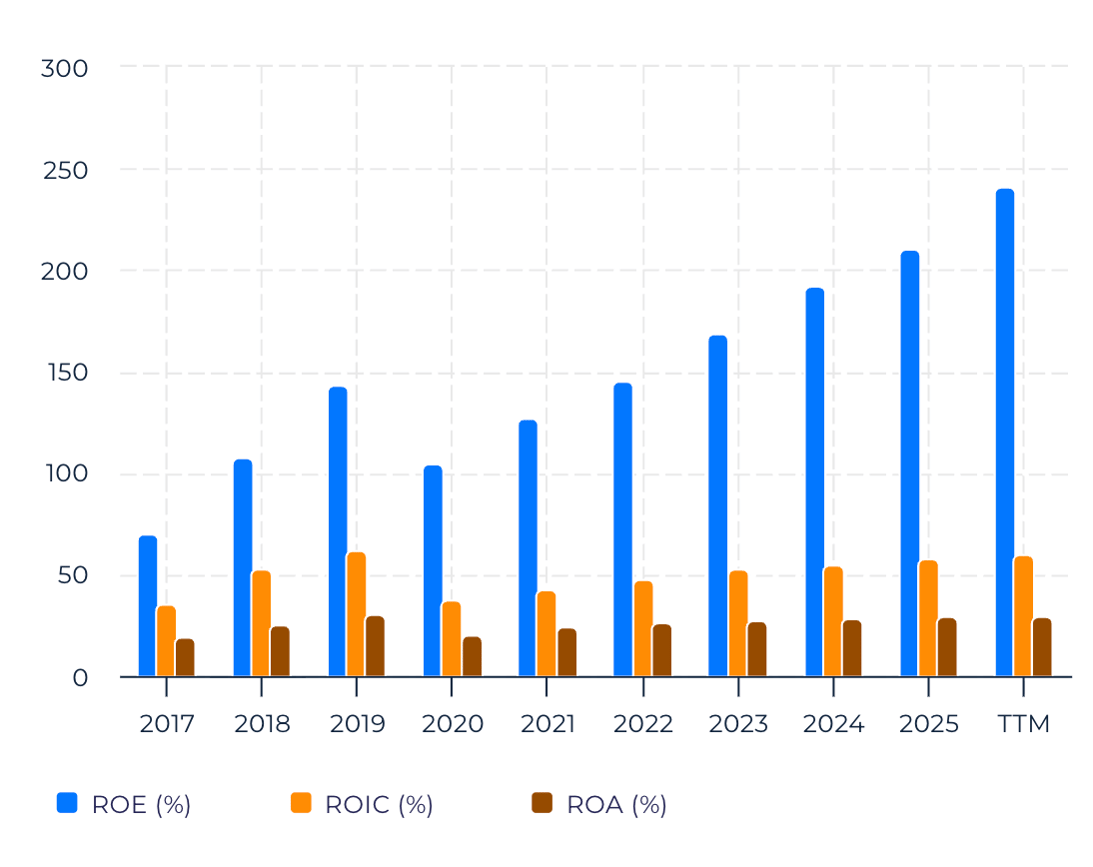
Trailing return on invested capital (ROIC) is 59.53%, above its five-year average of 51.43%. ROIC measures how efficiently a company generates profit from the capital used in the business, so the improvement supports the wide-moat argument.
Return on equity is much higher at 241.49%, but investors should treat that figure carefully. Years of buybacks have reduced Mastercard's equity base, making the ratio rise mechanically. ROIC is the cleaner measure of operating efficiency.
Shareholder Returns: Fewer Shares, Larger Ownership Stakes
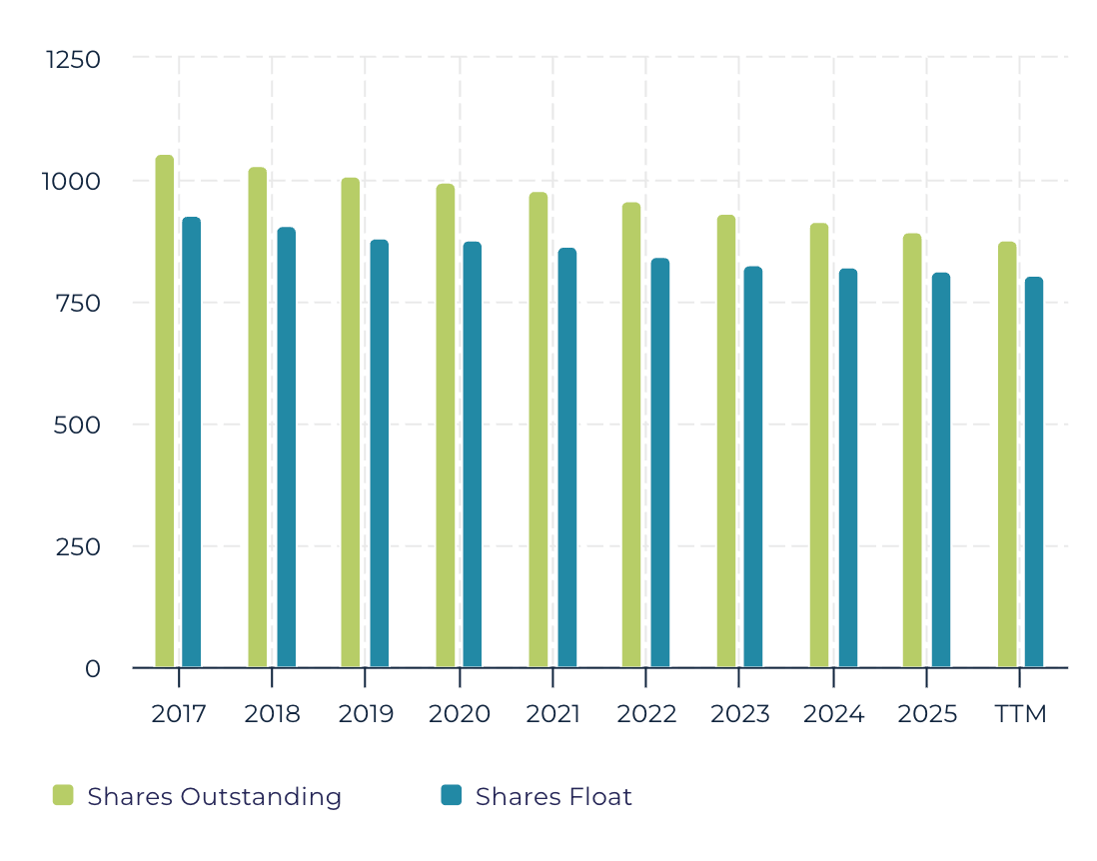
Mastercard's board approved a new $14 billion repurchase program alongside a 14% dividend increase in December 2025. Diluted shares outstanding have fallen from 1.07 billion in 2017 to 883 million on a trailing basis. Each remaining share therefore represents a larger ownership stake in the company, although buybacks create value only when shares are repurchased at sensible prices.
Growth Catalysts
Cross-Border and Value-Added Services Momentum
- Cross-border volume grew 12% year over year on a currency-neutral basis. Travel-related cross-border growth slowed to 6%, partly because of conflict-related disruption in the Middle East.
- VAS revenue reached $3.83 billion in the latest quarter, up 20%, and is approaching 40% of total revenue.
- Management raised full-year 2026 revenue guidance to the high end of its low-double-digit currency-neutral range.
These trends support the valuation in two ways. Cross-border activity remains a profitable core growth driver, while VAS adds a larger and faster-growing revenue stream. The mix shift helps explain why Mastercard could sustain growth above the pace of card transactions alone.
Cross-border travel is especially valuable because international transactions usually carry higher fees than domestic payments. A recovery can therefore have a larger effect on revenue than the same increase in local spending. The risk is that investors mistake a regional rebound for permanent growth. Separating travel normalisation from structural VAS expansion gives a clearer view of the earnings base.
Cybersecurity: From Defense Tool to Growth Business
Mastercard completed its acquisition of Recorded Future at the end of 2024 for a reported $2.65 billion. The deal added a major threat-intelligence platform to Mastercard's existing fraud, identity and security tools.

CEO Michael Miebach has described cybersecurity as Mastercard's fastest-growing business line. His broader argument is that a trusted digital economy needs a security layer, much like a computer operating system does. Mastercard can sell that layer to financial institutions already connected to its network, which lowers the cost of distribution and makes cybersecurity more than a defensive expense.
The investment case does not require cybersecurity to replace the network business. It only needs the segment to deepen customer relationships and lift VAS growth without weakening margins.
The strategic fit is strong because payment networks already handle sensitive data and must prevent fraud in real time. Recorded Future extends that capability beyond individual transactions into broader threat detection. The main execution risk is integration. Mastercard must convert security expertise into products that existing customers will buy, while retaining specialist talent and avoiding unnecessary overlap with its current tools.
Stablecoin Infrastructure: Connecting New and Existing Rails
Mastercard completed its acquisition of BVNK on 3 August 2026 for $1.8 billion. BVNK processes about $30 billion in annualised stablecoin volume and operates across 130 markets. Its platform connects traditional payment systems with multiple blockchains.
Src : https://borderless.xyz/
Mastercard also announced a Crypto Credential pilot with Borderless.xyz. The strategy is not to bet on one token or blockchain. Mastercard wants to provide the compliance, identity and interoperability layer that allows different forms of money to work together.
An analogy is useful: Mastercard is trying to own the bridge and traffic rules, not every vehicle that crosses it. If stablecoins gain adoption, that position could let Mastercard participate without relying only on traditional card rails.
This is a sensible response to disruption, but it is still early. Stablecoin volume does not automatically translate into attractive revenue or margins for Mastercard. Investors should look for evidence that the company can charge for compliance, conversion, settlement or identity services. The strongest outcome would be a platform that earns fees regardless of which stablecoin or blockchain a customer chooses.
Economic Moat: Why Mastercard Still Rates a Wide Moat
StockOracle™ rates Mastercard as a Wide Moat business. Its main advantage is the network effect. More card-issuing banks attract more merchants, while broader merchant acceptance makes the network more useful to banks and consumers. Each side reinforces the other, making the system difficult and expensive to replace.
The competitive threats are different rather than interchangeable. Visa has greater transaction scale. American Express owns a closed-loop network with direct merchant relationships and a premium customer base. PayPal and other digital wallets sit closer to the online checkout experience.
Stablecoins present a longer-term challenge because they could create alternative settlement routes. Mastercard's security and stablecoin investments are designed to keep it relevant even if the underlying payment rail changes. The moat increasingly depends on trust, compliance and connectivity, not just card-switching fees.
That distinction is important. A network effect protects Mastercard only while participants continue to value access to the network. If new rails reduce the need for card-based settlement, acceptance alone becomes less powerful. By embedding security and compliance into newer forms of payment, Mastercard is attempting to transfer its reputation and institutional relationships to the next system. This does not guarantee that the moat will remain as wide, but it gives the company a credible route to adapt.
Mastercard vs. Visa: The Duopoly Scorecard
Mastercard and Visa operate the dominant global card networks, but their similar valuations mask different growth expectations.
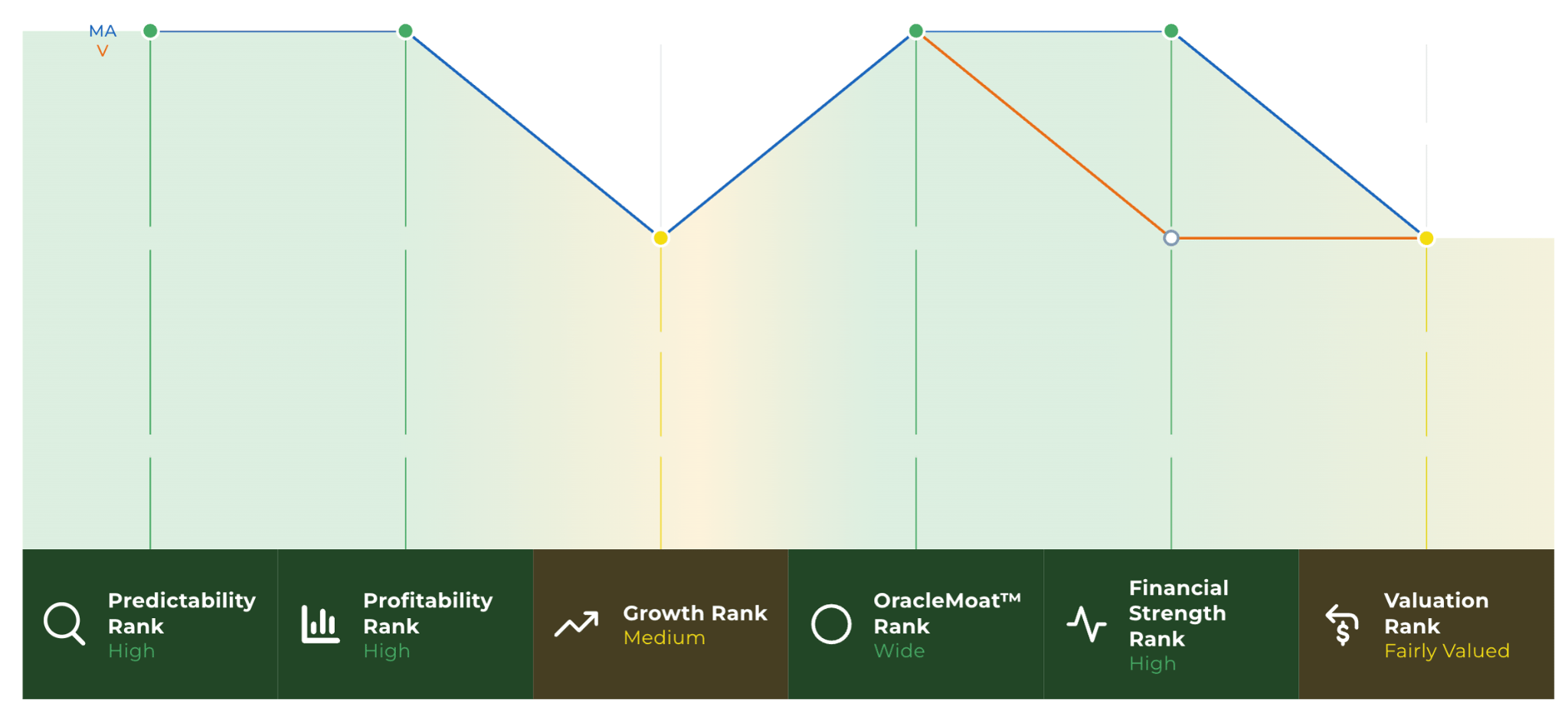
Mastercard (MA) vs. Visa (V): OracleIQ™ Comparison. Powered by StockOracle™. Accurate as of 20 August 2026. (Orange - Visa , Blue - Mastercard)
Both trade near 31 times earnings, yet Mastercard's projected five-year EPS growth rate is 15.65%, compared with 10.81% for Visa. On those estimates, investors are paying a similar earnings multiple for a higher expected growth rate at Mastercard.
Recent quarterly performance is a useful warning. Visa has outgrown Mastercard on a reported basis, so investors should track whether Mastercard's stronger long-term estimate is being confirmed by results. One or two quarters do not establish a trend, but continued underperformance would weaken the DCF case.
The best comparison is not simply which stock has the lower P/E. Investors should ask what growth, balance-sheet risk and capital efficiency are included in each multiple.
Building Your Own DCF: What Would Have to Be True
The $787.31 estimate is not a price target carved in stone. A DCF is a structured set of assumptions, and small changes can have a large effect when compounded over 20 years.
If Years 1 to 5 growth falls from 15.65% toward the pace of the core network, fair value would decline meaningfully. For the base case to hold, two conditions matter most:
- VAS must continue growing materially faster than the core network.
- Cross-border travel growth must recover as regional disruption fades rather than becoming a structural drag.
Investors should also test a higher discount rate because the model's 5.79% rate is relatively supportive of valuation. A higher required return reduces the present value of future cash flows, even if the operating forecast is unchanged.
Run your own assumptions through StockOracle's DCF calculator.
Final Thoughts on Mastercard's Intrinsic Value
- Mastercard remains a highly cash-generative network, with a 44.87% free cash flow margin and 59.53% ROIC.
- VAS is approaching 40% of revenue and growing about twice as fast as the core network, making it the main support for the model's long-term growth assumptions.
- Cybersecurity and stablecoin infrastructure add optionality, but investors should focus on whether they strengthen VAS growth and margins rather than on acquisition headlines alone.
- The $787.31 fair-value estimate depends on sustained growth and a low discount rate. Visa's recent outperformance, slower travel growth and any further decline in cash conversion are the main risks to watch.
The market currently treats Mastercard as a mature network that may be losing its growth edge to Visa. The stronger interpretation is that Mastercard is expanding from payment processing into the security and connectivity infrastructure around digital commerce. The evidence is promising, but the DCF still demands strong execution.
For investors, the practical conclusion is not that $787.31 is guaranteed. It is that the stock may be undervalued if VAS maintains its growth advantage, cross-border travel normalizes and new infrastructure investments earn attractive returns. If those conditions fail, the valuation gap can close through a lower fair value rather than a higher share price.

This analysis is for educational purposes only and is not financial advice or a recommendation to buy, sell or hold any security. The DCF is based on adjustable assumptions, not a guaranteed valuation or standalone investment signal. Past performance is not indicative of future results. Piranha Profits and StockOracle™ are financial education providers, not licensed financial advisers. All figures, especially third-party cybersecurity, crypto and market data, should be independently verified before publication.