Berkshire Hathaway is sitting on a record cash pile of roughly $397 billion and Warren Buffett's successor has been a net seller of stocks, offloading more shares than he's bought quarter after quarter.
A company built by putting cash to work now can't find enough worth buying, so the money keeps piling up in Treasury bills. Which leaves the real question for anyone looking at the stock today: with the market pricing BRK.B almost exactly where StockOracle™ estimates its worth, are you paying a fair price for a fortress or paying full price for a business that's run out of easy places to grow?
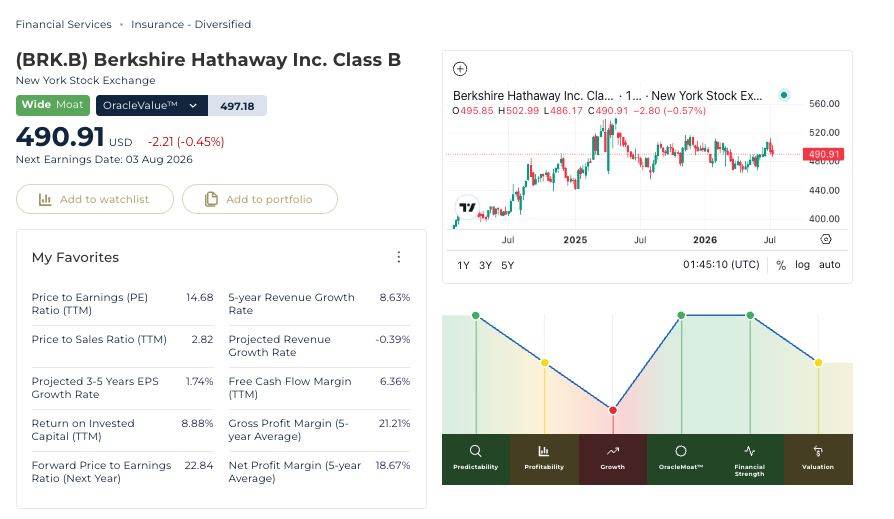
BRK.B Price & OracleValue™ Overview — Powered by StockOracle™
Accurate as of 20 July 2026
What Is Berkshire Hathaway's Intrinsic Value?
Intrinsic value is what a business is actually worth based on the cash it can generate over its lifetime not the price the market happens to assign it on any given day. When the market price sits below that estimate, investors call the gap a margin of safety. When it sits above, the price is leaning on growth that hasn't shown up in the numbers yet.
Berkshire is an unusually hard business to run through that lens, and it's worth understanding why before looking at any number.
Berkshire's Intrinsic Value: The OracleValue™ Estimate
Using its proprietary model, StockOracle™ estimates Berkshire's intrinsic value at $497.18 per share. The market currently has BRK.B priced right up against that figure meaning the model sees the stock as close to fairly valued rather than carrying an obvious discount.
But Berkshire breaks the standard valuation playbook, and that's the part most single-metric screens miss.
Why Berkshire Is a Different Kind of Company
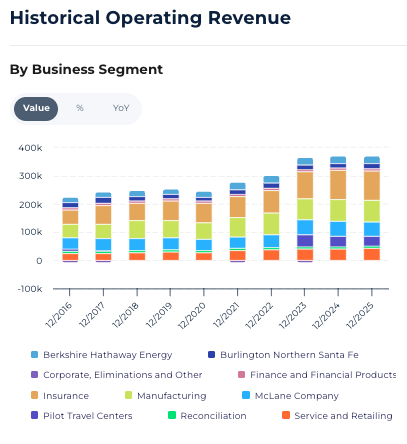
BRK.B Revenue Segment Overview — Powered by StockOracle™
Accurate as of 20 July 2026
Most stocks are one business: a retailer, a software firm, or a bank. Berkshire isn't a business so much as a container for businesses. It wholly owns dozens of companies outright: the GEICO insurer, the BNSF railroad, Berkshire Hathaway Energy, See's Candies, Dairy Queen, and many more.
On top of that, it holds a giant portfolio of public stocks named like Apple, American Express, Coca-Cola, and Chevron much of it funded by “float,” the pool of insurance premiums Berkshire holds before claims are paid.
This structure creates two problems for a conventional valuation.
First, reported earnings swing violently for reasons that have nothing to do with the operating businesses. Accounting rules force Berkshire to run the paper gains and losses on its stock portfolio through net income every quarter. So in a year the market dips, Berkshire can post a headline “loss” even while every underlying company is thriving which is exactly what happened in 2022.
Second, a pure free-cash-flow model understates the whole. Berkshire's headline free-cash-flow margin looks thin (around 6.36% on a trailing basis) partly because capital-heavy businesses like the railroad and the utility swallow cash to reinvest, and partly because the value of the investment portfolio doesn't flow through a cash-flow statement the way a normal company's earnings do.
Keep that in mind as the metrics below unfold.
BRK.A vs BRK.B: Why There Are Two Berkshires
Berkshire trades under two tickers.
BRK.A is the original shares class. Buffett famously never split it, letting the price climb into the hundreds of thousands of dollars per share.
BRK.B was created in 1996 to give smaller investors direct, low-cost access to Berkshire and to head off outside funds that were trying to slice up A shares and sell them on.
Berkshire Hathaway (BRK.B) Financial Performance
Revenue: A Diversified Base That Keeps Compounding
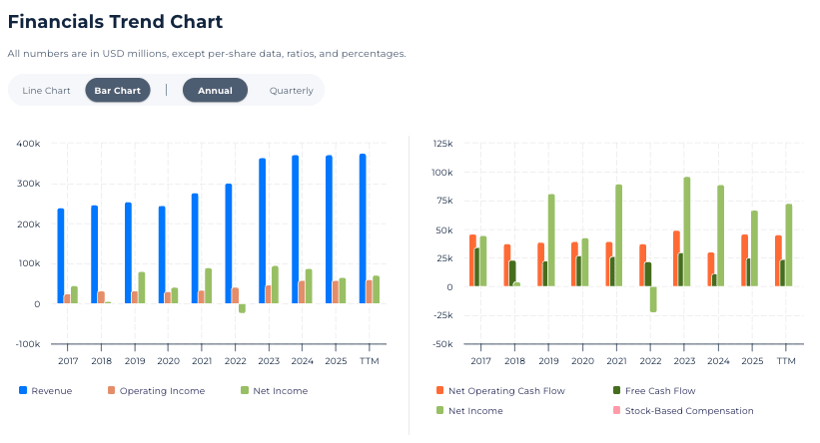
BRK.B Revenue Trend — Powered by StockOracle™
Accurate as of 20 July 2026
Berkshire's revenue has climbed steadily to the high-$300-billion range, with a five-year revenue growth rate of 8.63%. The diversification is the strength here: no single segment carries the whole company, which is what gives the top line its steadiness even when any one business has a soft year.
The net-income bars tell the story of Berkshire's structure. They rose, fell, and in 2022 briefly turned negative not because the businesses stopped working, but because the stock portfolio was marked down on paper that year.
The operating businesses underneath are steadier. In 2025, insurance underwriting had a soft stretch — Q4 underwriting profit fell 54% and investment income slid about 25% year-over-year, dragging full-year operating earnings lower. But by Q1 2026 the picture flipped, with operating earnings up 18% and underwriting profit up 28.5%. That swing is the single best illustration of the bull-and-bear tension in this stock: Berkshire's earnings are lumpy, and the lumpiness is structural, not a warning sign on its own.
Returns and the Balance Sheet
Return on invested capital sits at 8.88% the profit generated per dollar of capital put to work. That's a pretty good figure for a conglomerate carrying large, regulated, capital-intensive assets, though it reflects the reality that infrastructure businesses like BNSF and BHE earn steady rather than spectacular returns.
Berkshire (BRK.B) Growth Catalysts — and the Cash Question
The forward story for Berkshire is less about a single product and more about what it does with its capital:
The record cash pile (~$397 billion), dry powder for a large acquisition, a market dislocation, or expanded buybacks. Its optionality, but idle cash also earns less than businesses do, which is the bears' concern.
Why it matters for valuation: Berkshire's future worth hinges on capital allocation, the discipline to deploy cash into high-return opportunities. That's the skill Buffett is famous for, and the skill new CEO Greg Abel now has to prove.
What OracleIQ™ Says About a Conglomerate
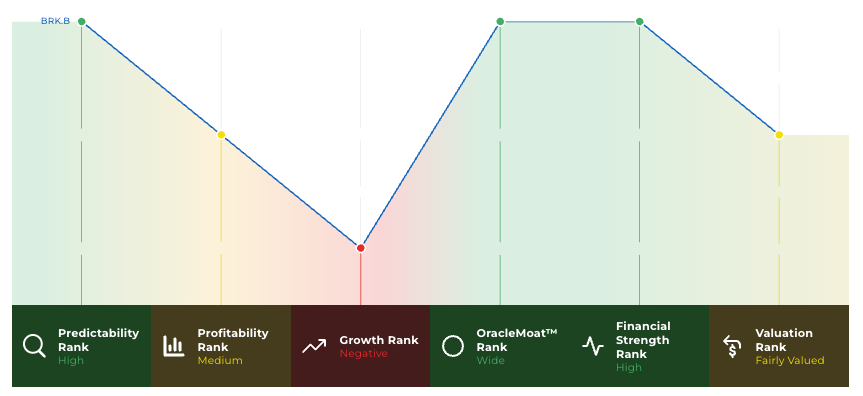
BRK.B OracleIQ™ — Powered by StockOracle™
Accurate as of 20 July 2026
This is where StockOracle™ earns its keep on a name like Berkshire, because the OracleIQ™ profile captures exactly the split personality the structure creates:
Predictability — high (green): the diversified base makes the overall business unusually durable and forecastable
Profitability — medium (yellow): solid but shaped by insurance cycles and capital-heavy segments
Growth — low (red): the projected revenue growth of -0.39% and projected 3–5 year EPS growth of 1.74% land here — the mechanical read of a mature giant, not a sign of decline
OracleMoat™ — high (green): StockOracle™ rates Berkshire a Wide Moat
Financial Strength — high (green): the record cash and insurance float make this the standout score
Valuation — medium (yellow): the model sees the stock as roughly fairly priced, not a clear bargain
The shape is the insight. A business scoring high on Predictability, Moat, and Financial Strength but low on Growth is the silhouette of a fortress, not a growth engine. Investors typically don't buy Berkshire for acceleration; they buy it for durability. Whether that durability is worth today's price is the question the Valuation score leaves deliberately open.
Final Thoughts on Berkshire Hathaway's Intrinsic Value
Stripped to fundamentals, here's what StockOracle™ surfaces on Berkshire:
A Wide Moat built on insurance float, owned infrastructure, and enduring brands
High Financial Strength, anchored by a record ~$397 billion cash reserve and ~$176 billion of float
High Predictability from a genuinely diversified earnings base
A low Growth score that reflects size and maturity, not deterioration
Reported earnings that swing with the stock market, not the underlying businesses
A Valuation the model reads as roughly fair rather than cheap
The market clearly thinks Berkshire is a great company. The debate is whether “fairly valued” is enough, and whether Greg Abel can allocate a $397 billion war chest with the discipline that made the company what it is. If that cash is deployed well and the operating businesses keep compounding, intrinsic value can trend higher over time. Until then, Berkshire carries the mandate of any fortress priced at fair value: keep the discipline, and keep turning capital into more capital.
This analysis is shared for educational purposes and is not intended as financial advice or a recommendation on any investment. OracleValue™ is an estimate and should not be taken as a signal to buy or sell. Any past performance mentioned is historical and is not indicative of future results.