Eli Lilly posted 56% revenue growth in Q1 2026, and the market's response has been strangely muted for a stock. Zepbound and Mounjaro alone brought in $12.8 billion in combined revenue, adding $6.7 billion of growth versus the same quarter last year yet realized prices fell 13% globally as payers push back and competition builds. That tension, blockbuster volume growth against eroding pricing power, is exactly where LLY’s intrinsic value question gets interesting.
What Is Eli Lilly's Intrinsic Value?
Intrinsic value is what a business is actually worth based on the future cash it can generate, not what the market happens to be paying for it today. For a company scaling as fast as Lilly, where volume, pricing, and pipeline risk are all moving at once, that estimate does a lot of work a stock chart can't.
Eli Lilly's Intrinsic Value: The OracleValue™ Estimate
Using its proprietary model, StockOracle™ estimates Eli Lilly's intrinsic value at $1,838.27 per share.
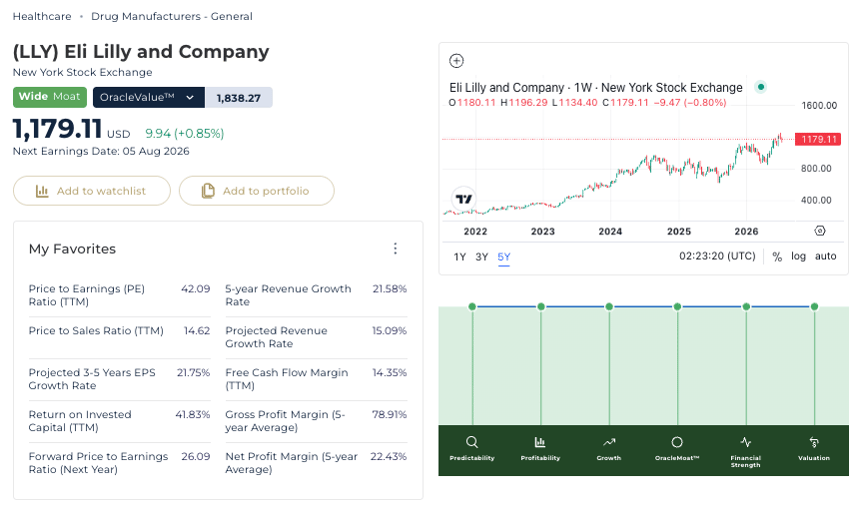
Eli Lilly (LLY) Price & OracleValue™ Overview — Powered by StockOracle™ Accurate as of 20 July 2026
That figure sits alongside a Wide OracleMoat™ rating and a stock trading near 42x trailing earnings and 26x forward earnings, a valuation that assumes Eli Lilly will keep compounding and valuations now make sense provided the growth holds.
Eli Lilly (LLY) Financial Performance
Revenue: A Business Reshaped by One Franchise
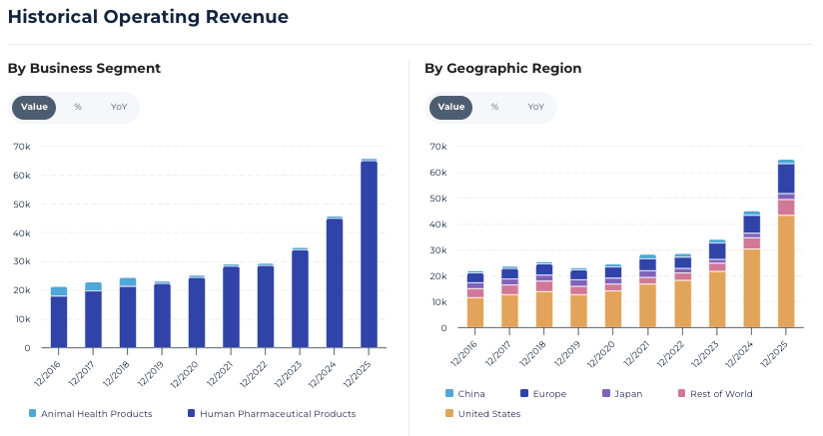
Eli Lilly Historical Operating Revenue by Segment and Region — Powered by StockOracle™ Accurate as of 20 July 2026
Human pharmaceutical revenue has gone from roughly $20 billion in 2016 to around $65 billion in 2025, and the shape of that curve tells its own story: flat for years, then a near-vertical climb once Mounjaro and Zepbound scaled. The United States still drives the majority of sales, but international revenue is growing faster off a smaller base. Mounjaro's addition to China's National Reimbursed Drug List is a big reason why.
5-year revenue growth sits at 21.58%, with projected forward revenue growth of 15.09% a deceleration from the current pace, which is the market pricing in some normalization once the initial GLP-1 ramp matures.
Free Cash Flow: The Line That Anchors the Model
Free cash flow is the cash that actually moves through the business after the bills are paid, and it's the number any DCF model is ultimately betting on.
LLY’s trailing FCF margin sits at 14.35%, meaning just over 14 cents of every revenue dollar converts into real cash after funding R&D, manufacturing buildout, and commercial spend. That's a lower conversion rate than the company's gross margins would suggest, and it's the direct result of a business reinvesting aggressively into capacity and pipeline rather than harvesting cash. The 81.9% gross margin posted in Q1 2026 gives the model plenty of room to work with once that reinvestment cycle matures.
Returns on Capital: Efficiency Despite the Reinvestment
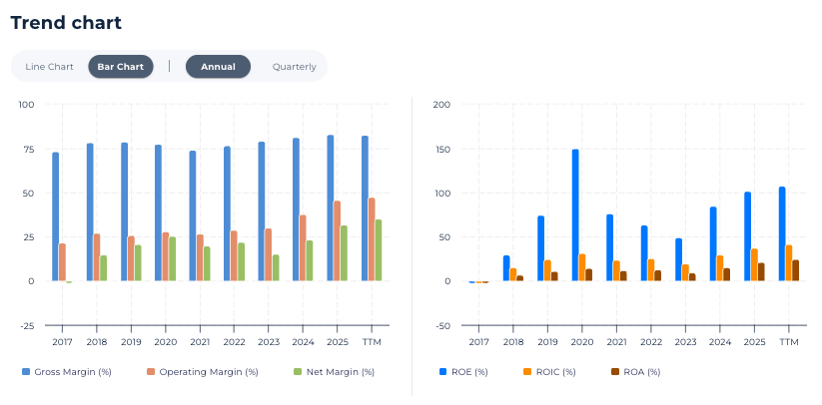
Margins and Returns Trend Chart — Powered by StockOracle™ Accurate as of 20 July 2026
Return on invested capital sits at 41.83% (TTM), and the trend chart shows ROE, ROIC, and ROA all expanding sharply since 2020. That combination, rising returns on capital even as the company plows cash into new manufacturing sites and acquisitions, signals that the core GLP-1 franchise carries exceptional unit economics: incremental revenue is dropping through to profit far faster than the capital being deployed to support it.
Balance Sheet: Debt Funding the Next Phase of Growth
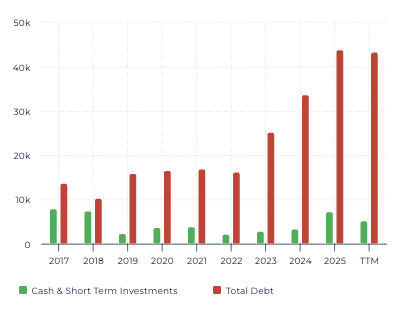
Cash & Short-Term Investments vs. Total Debt — Powered by StockOracle™ Accurate as of 20 July 2026
Total debt has climbed from roughly $14 billion in 2017 to around $43 billion on a trailing basis, while cash and short-term investments have stayed comparatively thin. That widening gap has been reported as a financing choice: Lilly has been funding a string of acquisitions. Verve, Ajax, Orna, Centessa, and Kelonia that bring gene-editing, oncology, and novel-modality capabilities into the pipeline. Whether that debt converts into future FCF depends on those assets eventually producing revenue, which is a multi-year bet.
Eli Lilly (LLY) Growth Catalysts
The GLP-1 Franchise Is Still the Whole Story
- Mounjaro and Zepbound combined for $12.8 billion in Q1 2026 revenue, up from $6.1 billion a year earlier
- Lilly holds over 60% U.S. market share and 53%+ international share of the GLP-1 category
- Zepbound U.S. revenue rose 79% to $4.1 billion, even as realized prices declined
- The FDA approved Foundayo (orforglipron), the first oral GLP-1 for obesity, positioning Lilly to reach patients who won't or can't use an injectable
Why it matters for valuation: this is a franchise still growing in volume even as price gives ground the kind of dynamic that can sustain double-digit revenue growth well past the point most drugs plateau.
Economic Moat: Why StockOracle™ Rates Lilly Wide
A moat only matters if it survives competitive pressure, and Lilly's is being tested in real time by Novo Nordisk and a wave of oral GLP-1 entrants.
Lilly's advantage is the manufacturing scale behind them. The company is building four U.S. mega-sites for API and injectable production, a reshoring investment few competitors can match at the same pace.
Novo Nordisk carries its own embedded advantage as the first mover in the category with Ozempic and Wegovy's brand recognition; smaller entrants working on oral formulations bring pipeline optionality but lack Lilly's manufacturing depth or physician relationships built over decades in diabetes care.
Neither is a direct substitute for Lilly's combined scale and pipeline breadth but both are real competitors Lilly has to out-execute on price and access, not just molecule design.
Final Thoughts on Eli Lilly's Intrinsic Value
The market isn't ignoring Eli Lilly, it's debating how much of the current growth rate is sustainable once pricing normalizes and competition intensifies. StockOracle™ 's model reads the business as still undervalued relative to its cash-generating potential. But that is provided the GLP-1 franchise keeps growing in volume and the pipeline bets start converting into revenue. If both hold, intrinsic value has room to move much higher. If pricing pressure accelerates faster than volume can offset it, that gap closes into the other direction.
This analysis is shared for educational purposes and is not intended as financial advice or a recommendation on any investment. OracleValue™ is an estimate and should not be taken as a signal to buy or sell. Any past performance mentioned is not indicative of future results.