Palantir posted 93% revenue growth, a 155% Rule of 40 score, and a net profit margin north of 49%. Yet the stock still trades at roughly 150 times trailing earnings. Bulls call it the clearest AI monetisation story in software. Bears call it a valuation that has stopped pricing in fundamentals and started pricing in faith.
Read our recent post-earnings PLTR Deep Dive from last month here.
What Does Palantir Actually Do?
Palantir builds software platforms that act as the central operating system for how large organisations integrate data, run analytics, and make operational decisions.
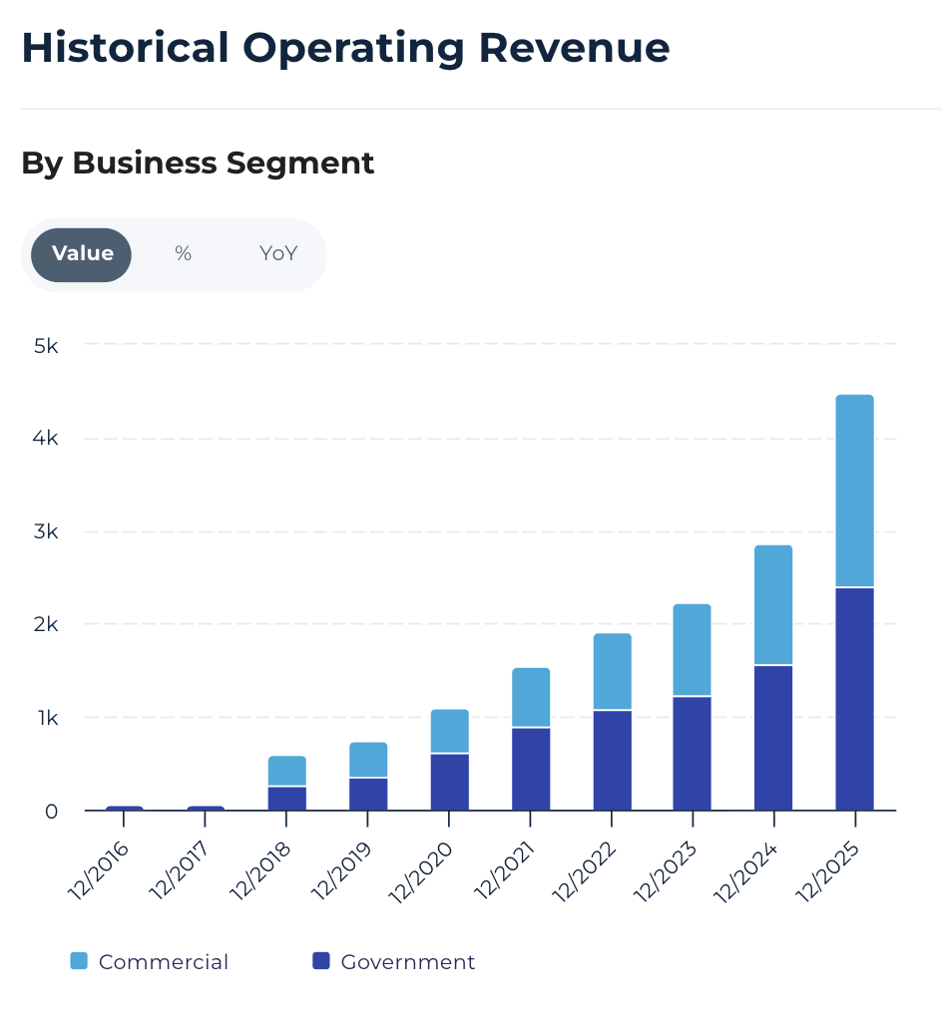
It operates through two segments: Government (defense, intelligence, and public-sector customers) and Commercial (enterprises across healthcare, energy, financial services, and manufacturing).
Its Artificial Intelligence Platform, AIP, lets customers deploy large language models against their own data inside Palantir's infrastructure.
What Is Palantir's Intrinsic Value?
Intrinsic value is what a business is actually worth based on the future cash it can generate, not what the market is pricing it at today. For a company growing revenue at triple-digit rates in some segments, the gap between a mechanical cash-flow model and the market price can become enormous. The assumptions feeding that model matter more than the model itself.
Palantir's Fair Value: When the Growth Assumption Breaks the Model
Run Palantir's numbers through a 20-year DCF model at an 80.53% near-term growth assumption, and the output, $1,280.05 per share, is more than seven times the current $179.94 price. The discounted free cash flow variant reads similarly high, at $1,264.28, and the discounted net income method comes in at $1,136.06.

Palantir (PLTR) Valuation Chart — Model Breakdown — Powered by StockOracle™ · Accurate as of 22 August 2026
Numbers this far from reality say something on their own: A 20-year model is extraordinarily sensitive to its early-year growth assumption. Compounding 80.53% for five years, followed by a Year 6-10 assumption of 57.31%, isn't a modest growth forecast.
More precisely, an 80.53% annual growth rate implies the underlying cash flow base doubling roughly every 14 months. That's growth of about 19 times over five years. The Year 6-10 assumption of 57.31% implies a further 9.6 times growth over the following five years. Multiplied together, analyst and consensus assumes Palantir's cash flow grows on the order of 185 times over the first decade alone.
Run your own growth assumptions of PLTR here on StockOracle.
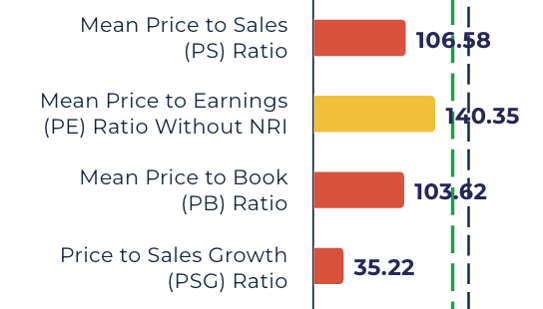
The multiple ratios lenses sit far lower: Mean Price-to-Sales reads $106.58, Mean Price-to-Book $103.62, and Mean Price-to-Earnings $140.35. The Price-to-Earnings-Growth read comes in at $152.20, also below today's share price. These multiples-based figures are still elevated against Palantir's own history. That's a more closer read on what the market is paying for.
Palantir (PLTR) Financial Performance
Revenue: An Acceleration, Not Just a Beat
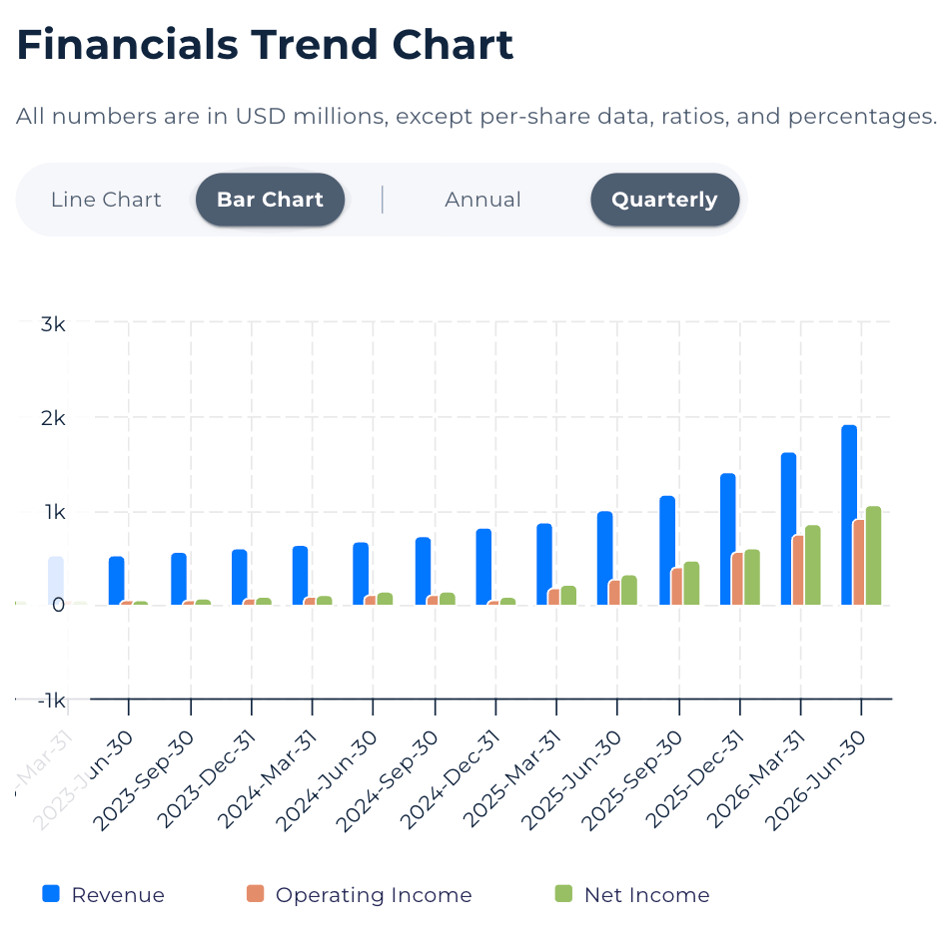
Palantir (PLTR) Revenue, Operating Income and Net Income Trend — Powered by StockOracle™
Palantir's growth is accelerating, not just beating estimates. Second-quarter 2026 revenue reached $1.935 billion, up 93% year-over-year. U.S. commercial revenue grew 149% to $764 million, and U.S. government revenue rose 90% to $809 million. Palantir's second-quarter 2026 results show a GAAP operating margin of 47% and an adjusted operating margin of 62%, showing profitable, not just fast, growth.
Management is also raising expectations. CEO Alex Karp said "demand for AI sovereignty has now been unleashed." Full-year 2026 revenue guidance was raised to $8.150 to $8.158 billion, implying roughly 82% growth. U.S. commercial revenue guidance was raised to at least $3.424 billion, or 134% growth, after the company crushed its prior estimate.
Why Net Income Runs Ahead of Operating Income
Palantir's trailing net profit margin of 49% exceeds its 42.8% operating margin, an unusual gap worth explaining.
Roughly $77 million in interest income on Palantir's $9.4 billion cash pile, plus unrealized gains on marketable securities, added to the gap. The bigger driver is tax. On $1.081 billion of pre-tax income in the second quarter, Palantir's tax provision was only about $15 million, an effective rate near 1.4%. More than $3.5 billion in accumulated deferred tax assets from historical losses are shielding profits from federal tax.
That's a real, current cash benefit, a tax-shield effect layered on top of operating profitability, not exactly clear evidence the business is more profitable than its margin shows.
Free Cash Flow and Returns on Capital
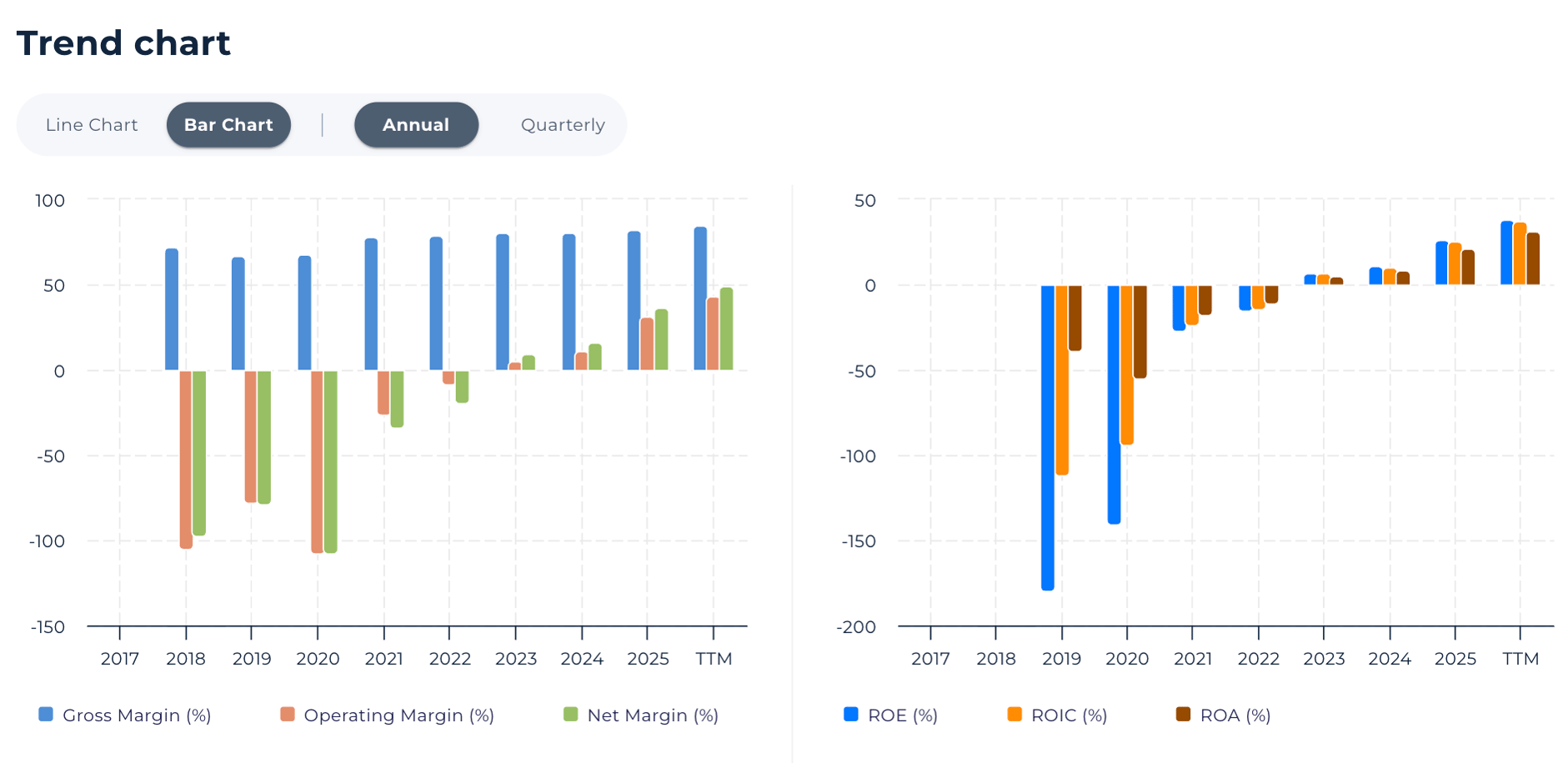
Palantir (PLTR) Margins and Returns Trend — Powered by StockOracle™
Free cash flow reached $3.36 billion on a trailing basis, a margin of 54.55%, extraordinary for a company still growing revenue near triple digits. Return on equity (TTM) reads 38.42% and return on invested capital 37.46%, both a sharp inflection from negative territory a few years ago. That's evidence of a business moving from scaling losses to scaling profit. With zero debt and $9.4 billion in cash and short-term investments, Palantir's balance sheet gives it flexibility to keep investing in AIP without external capital.
Growth Catalysts
Government Contracts and Commercial AIP Adoption, Side by Side
- The U.S. Army Enterprise Agreement, announced in 2025, carries up to a $10 billion ceiling over 10 years, consolidating 75 prior Army contracts into one vehicle.
- Pentagon no-bid contract work reported in August 2026 added up to $244 million, evidence the government pipeline is still widening.
- U.S. commercial revenue growth of 149% year-over-year reflects enterprise AIP adoption across healthcare, energy, and financial services, including deals reported in the hundreds of millions of dollars.
Government and commercial growth are validating each other at once, an unusual dynamic and the real bull case. It's also the momentum a market pricing 80%-plus growth for half a decade needs every quarter, with no room for a disappointing print.
Economic Moat: Why StockOracle™ Rates Palantir a Wide Moat
StockOracle™ rates Palantir a Wide Moat business. The case rests on genuine switching costs. Once a government agency or large enterprise builds workflows on Palantir's data ontology, migrating that knowledge to a competing platform is expensive and slow. That kind of disruption isn't true of most enterprise software.
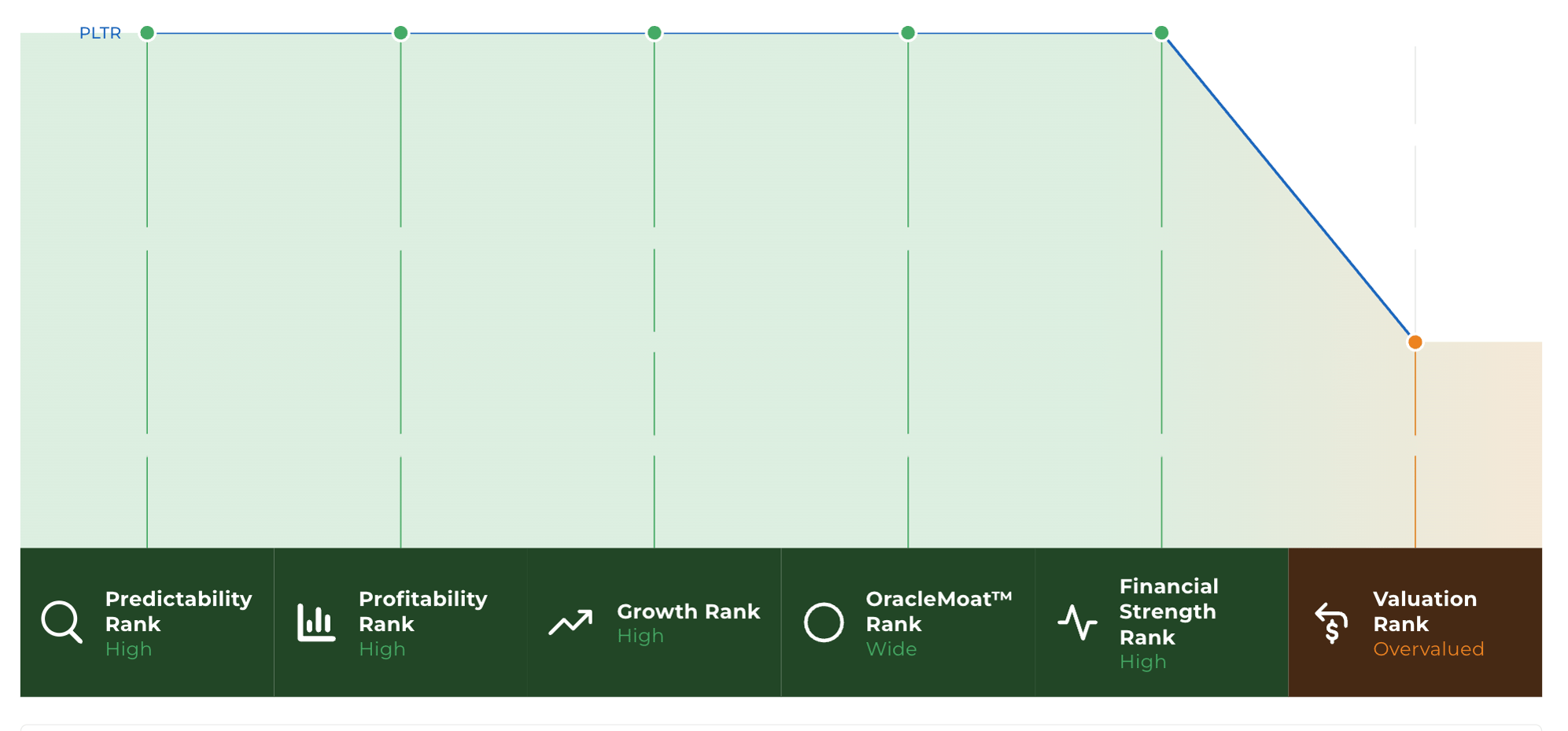
The competitive set carries different strengths, and Palantir must defend against each rather than outspend it.
Microsoft, through Azure and its OpenAI partnership, can bundle AI tooling into an enterprise's existing stack at a scale Palantir can't match.
C3.ai competes for a narrower, more configurable slice of enterprise AI, with a less government-anchored product. Traditional government integrators like
Booz Allen Hamilton carry decades-deep agency relationships that Palantir must displace contract by contract, not win from a standing start.

A More Conservative Look at Palantir's Fair Value
The $1,136 to $1,280 range above leans on 80.53% and 57.31% growth assumptions holding for a full decade, a pace few companies have sustained.
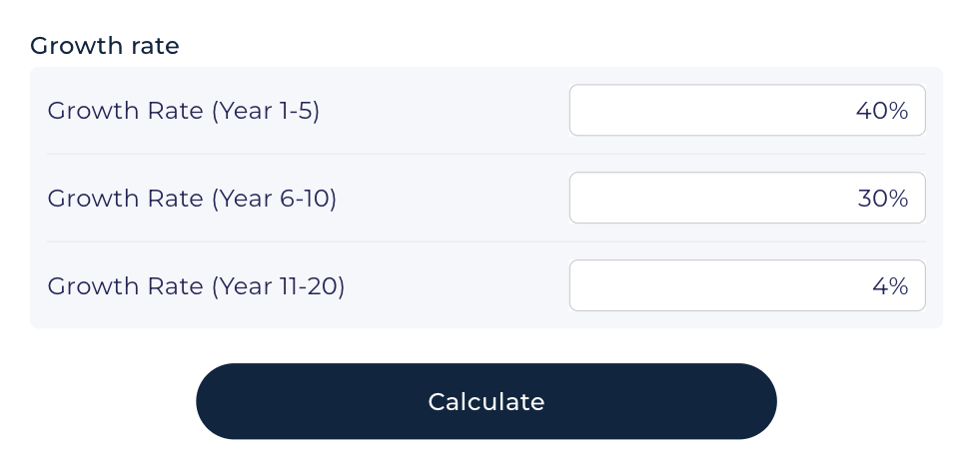
Dial those down toward a still-ambitious 30 to 40% range within StockOracle™ intrinsic value calculator, closer to what large enterprise software companies have managed at their best. The DFCF-20 output then compresses towards current levels.
What has to be true for the current price to be justified by fundamentals, not sentiment? The answer is specific. U.S. commercial revenue needs to keep compounding near its current 149% pace for multiple more years, not just quarters.
Final Thoughts on Palantir's Intrinsic Value
- Second-quarter 2026 revenue grew 93%, with U.S. commercial revenue up 149%, an acceleration off an already-large base.
- The DCF-based models ($1,136 to $1,280) sit so far above the current price that they demonstrate compounding math, not a usable fair-value estimate, once 80%-plus growth is run for a full decade.
- The 49% net margin partly reflects a temporary tax-shield effect from accumulated deferred tax assets, not purely operating performance, though the 47% GAAP operating margin is itself strong.
- Multiple-based methods ($103.42 to $152.20) sit below the current price but remain elevated against Palantir's own trading history, the more honest description of today's valuation.
- A $10 billion U.S. Army enterprise agreement and accelerating commercial AIP adoption are validating both halves of the business at once, the real substance of the bull case.
- The wide-moat rating reflects genuine switching costs once a customer's workflows are built on Palantir's platform, in both government and commercial settings.
Palantir's fundamentals are not the fragile part of this story. The fragile part is a valuation that requires several more years of near-triple-digit growth just to grow into the price. The market has shown it will punish any single quarter that falls short of an extraordinary bar.
This analysis is shared for educational purposes only and is not intended as financial advice or a recommendation to buy, sell, or hold any security. The valuation figures above are model outputs built on stated, adjustable assumptions, not a fixed or guaranteed price target, and should not be treated as a standalone signal. Past performance, including any figures referenced above, is historical and is not indicative of future results.